
Battery Backup Calculator
🔋 Battery Configuration
⚙️ System Configuration
📊 Load Configuration
| Appliance | Power(W) | Qty | Hrs/Day | kWh | Main | × |
|---|
Battery Backup Duration Calculator: How Long It Lasts
Run a 300W load off a 200Ah battery and most people guess it’ll last “about a day.” It won’t. Depth of discharge, inverter losses, and temperature eat into that number fast, and the real answer is usually 6 to 7 hours, not 20.
That gap is why so many people search for a battery backup calculator after buying a battery, not before. They plug in numbers expecting hours of runtime and get half of what they hoped for.
This guide walks through exactly how backup time is calculated, gives you a free interactive tool to run your own numbers, and shows the efficiency losses most calculators skip. Every formula here is based on standard battery engineering used by manufacturers like Victron, Battle Born, and Trojan.
What Is a Battery Backup Calculator?
A battery backup calculator estimates how many hours a battery bank can run a given load. It works by converting amp-hour capacity into usable watt-hours, then dividing by your load in watts. Accurate calculators also subtract losses from depth of discharge, inverter efficiency, and temperature, since those three factors combined can cut real runtime by 40% or more.
Most people search for a home battery backup calculator right after a power outage, usually while sitting in the dark wondering if the battery they bought was big enough. The math itself is simple. The part people miss is that a battery’s rated capacity and its usable capacity are two very different numbers.
A 200Ah lead-acid battery doesn’t give you 200Ah of usable power. Discharge it past 50% regularly and you’ll kill it within a couple of years. A lithium battery of the same size gets you closer to 180Ah of real, safe capacity. That single difference is why a lithium battery backup time calculator and a lead-acid one give such different answers for the same battery size.
Always size your battery backup around your worst-case load, not your average load. A fridge compressor kicking on can spike draw by 200 to 300 watts for a few seconds, and undersized systems trip offline right when you need them most.
How Do You Calculate Battery Backup Time?
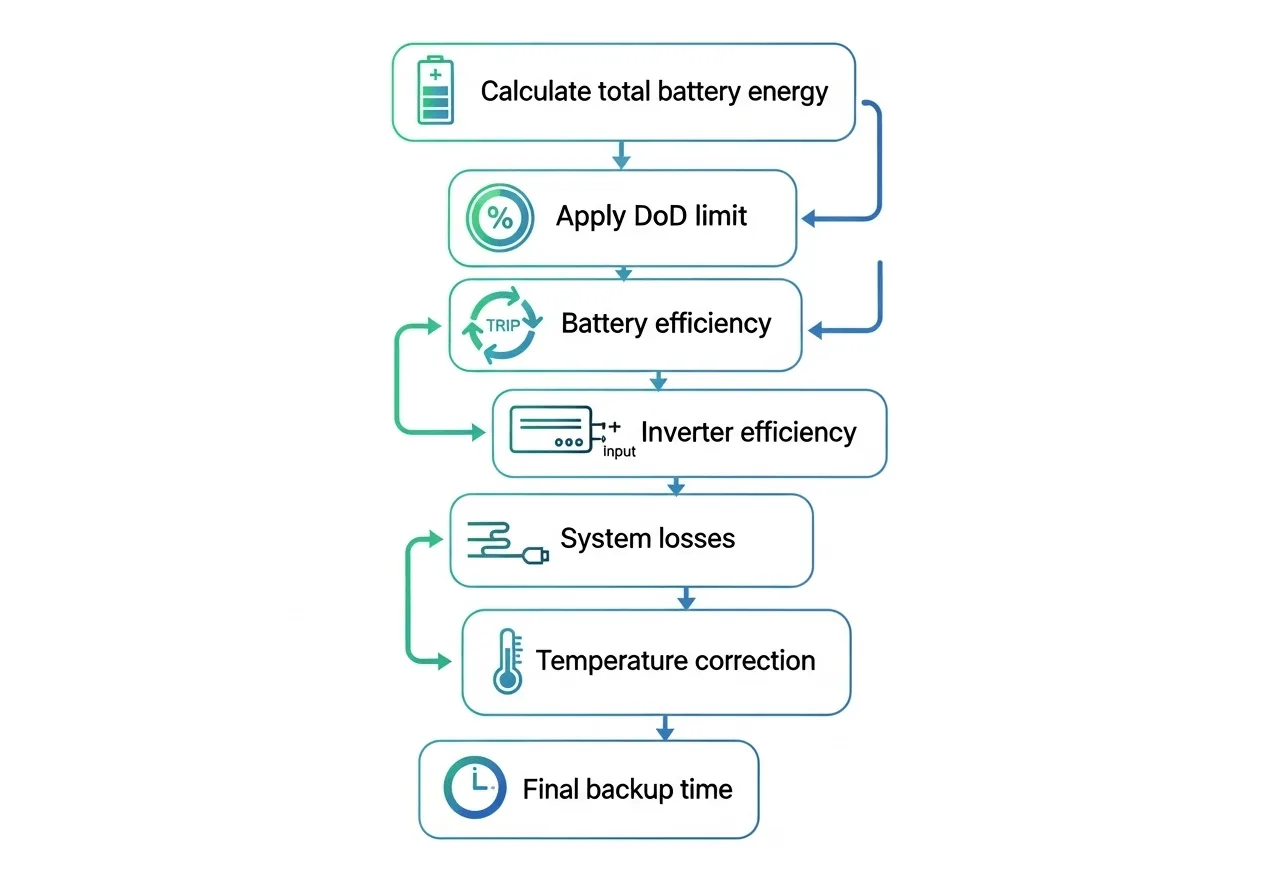
Multiply battery capacity (Ah) by voltage to get watt-hours, then multiply by your depth of discharge and inverter efficiency as decimals. Divide the result by your load in watts. A 200Ah, 12V lithium battery at 90% depth of discharge and 90% inverter efficiency running a 300W load gives roughly 6.5 hours of backup.
Here’s the formula written out in full:
| Step | Calculation | Example (200Ah, 12V lithium) |
|---|---|---|
| 1. Usable capacity | Capacity (Ah) × Depth of Discharge | 200Ah × 0.90 = 180Ah |
| 2. Watt-hours | Usable Ah × Voltage | 180Ah × 12V = 2,160Wh |
| 3. After inverter loss | Watt-hours × Inverter Efficiency | 2,160Wh × 0.90 = 1,944Wh |
| 4. Backup time | Effective Wh ÷ Load (W) | 1,944Wh ÷ 300W = 6.48 hrs |
Skip any one of these steps and the number you get is wrong, usually by a wide margin. This is the exact formula behind the calculator tool on this page, so if you want to test a specific battery and load combination, use it instead of doing the math by hand.
How to Calculate Battery Backup for a Whole Home System
A whole home battery backup calculator works the same way, just with a bigger load number. Add up the running wattage of everything you want covered, HVAC, well pump, fridge, and lighting included, then run it through the same four steps. Whole-home loads typically land between 3,000W and 8,000W, which is why whole-home battery banks are sized in multiple kWh, not single batteries.
What Efficiency Losses Cut Your Backup Time?
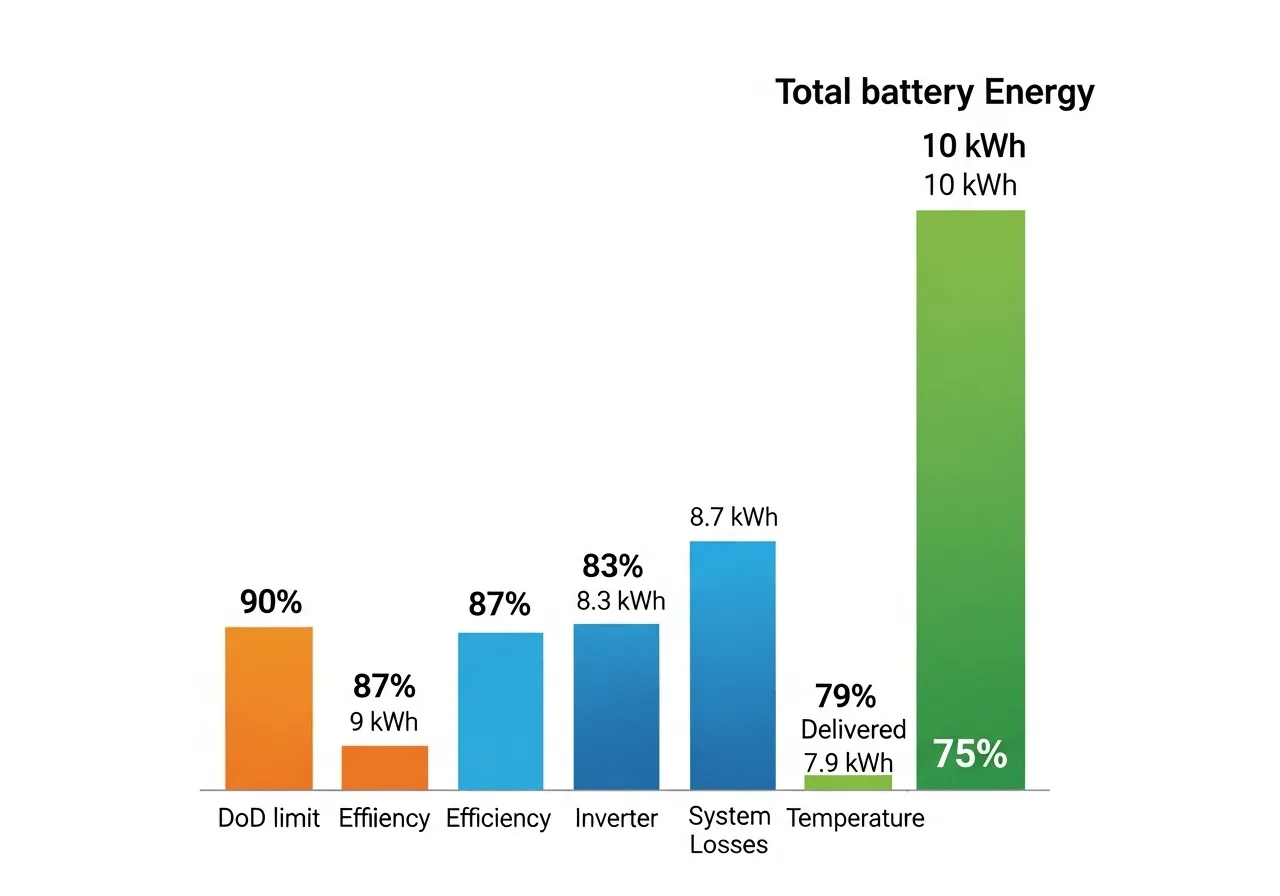
Three losses stack on top of each other: depth of discharge (10% to 50% loss), inverter conversion (5% to 15% loss), and wiring resistance (2% to 5% loss). Combined, these can reduce a battery’s usable runtime by 35% to 55% compared to its rated amp-hour capacity, which is the single biggest reason calculated backup times surprise people.
Manufacturer spec sheets list amp-hours at a specific discharge rate, usually the 20-hour rate, tested in a lab at 25°C with a brand-new cell. Your setup is never that lab. Every real installation stacks losses on top of each other.
| Loss Source | Typical Range | Notes |
|---|---|---|
| Depth of discharge (lead-acid) | 50% used, 50% reserved | Protects battery lifespan; going deeper shortens cycle life fast |
| Depth of discharge (lithium) | 90–100% usable | LiFePO4 handles deep cycling without major degradation |
| Inverter conversion loss | 5–15% | Cheaper modified-sine inverters sit at the higher end |
| Wiring and connection resistance | 2–5% | Increases with thinner gauge cable and longer runs |
| Battery age (after 2–3 years) | 10–20% capacity loss | Applies to all chemistries, lithium degrades slower |
| Cold weather derating | 15–50% | Worse for lead-acid, covered in detail below |
How Does Temperature Affect Battery Backup Duration?
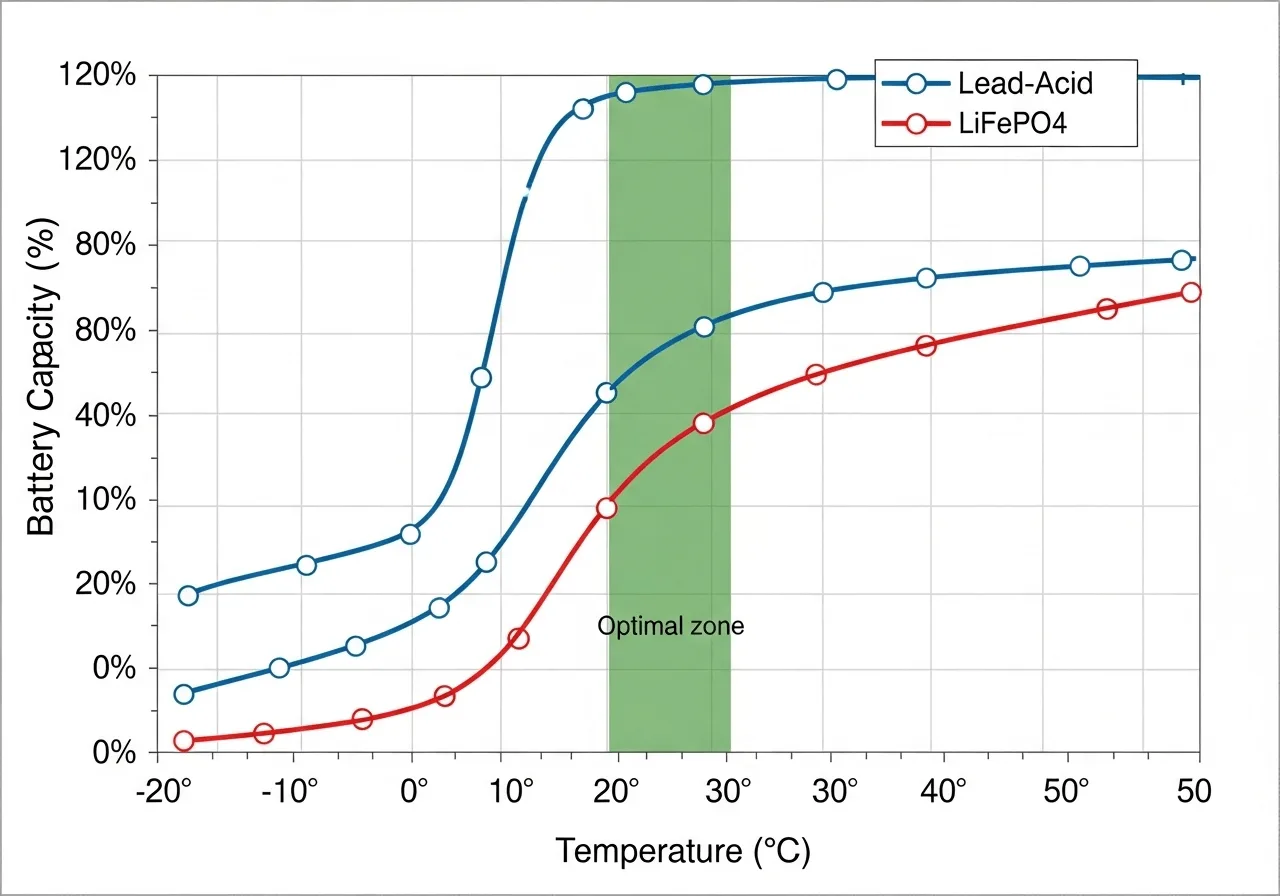
Cold weather reduces the chemical reaction rate inside a battery, cutting usable capacity. At 0°F (-18°C), a flooded lead-acid battery can lose 30% to 50% of its rated capacity, while a quality LiFePO4 battery typically retains 80% or more under the same conditions.
This is the factor most battery backup time calculators skip entirely, and it’s a big one if your battery bank lives in an unheated garage or an outdoor enclosure.
| Temperature | Lead-Acid | AGM | Lithium (LiFePO4) |
|---|---|---|---|
| 25°C / 77°F | 100% | 100% | 100% |
| 10°C / 50°F | 90% | 92% | 97% |
| 0°C / 32°F | 80% | 82% | 92% |
| -10°C / 14°F | 65% | 70% | 85% |
| -18°C / 0°F | 50% | 55% | 80% |
Lithium batteries also can’t be charged below freezing without damage in most cases. If your battery bank sits outside in a cold climate, budget for insulation or a heated enclosure, not just a bigger battery.
How Do You Wire Batteries for Longer Backup Time?
Wire batteries in series to raise voltage while keeping the same amp-hour rating, or in parallel to raise amp-hours while keeping the same voltage. Series-parallel combinations do both, which is how most whole-home and off-grid battery banks reach 10kWh or more.
Four 100Ah, 12V batteries wired in parallel give you 400Ah at 12V. The same four batteries wired in series give you 100Ah at 48V, four times the watt-hours delivered at a quarter of the current, which means thinner cable and less resistance loss.
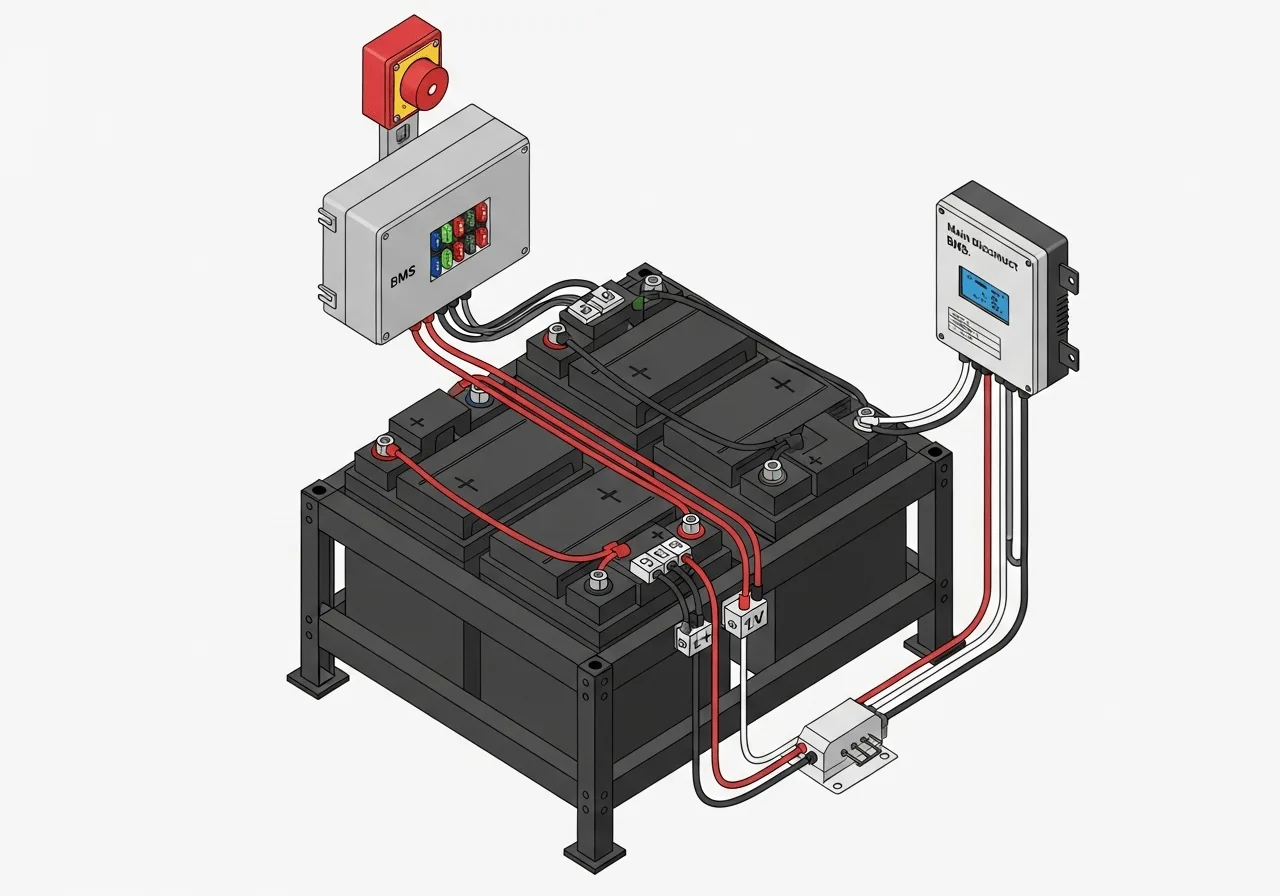
Higher voltage systems (24V or 48V) lose less energy to resistance over the same wire run, which matters more as your load or cable length grows. Most whole-home systems above 3kW settle on 48V for exactly this reason.
How Do You Size Your Inverter for Battery Backup?
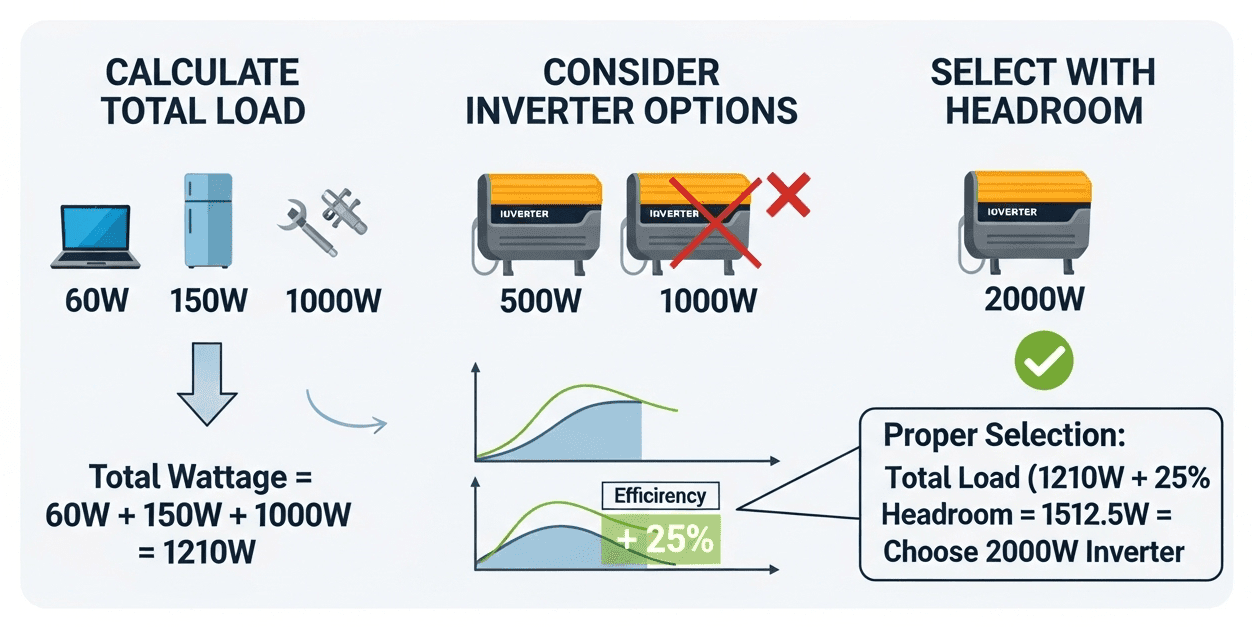
Size your inverter for your highest simultaneous wattage draw, including appliance startup surge, then add 20% headroom. A household running a fridge (150W continuous, 600W surge), lights, and a router needs at least a 1,000W continuous inverter with 2,000W surge capacity.
Undersizing the inverter is the fastest way to make a battery backup calculator’s numbers meaningless. A battery with plenty of capacity left will still shut down if the inverter trips on a surge it can’t handle.
For a deeper walkthrough of sizing an inverter against your specific panel and battery setup, use our hybrid inverter sizing calculator.
Which Circuits Should You Prioritize During an Outage?
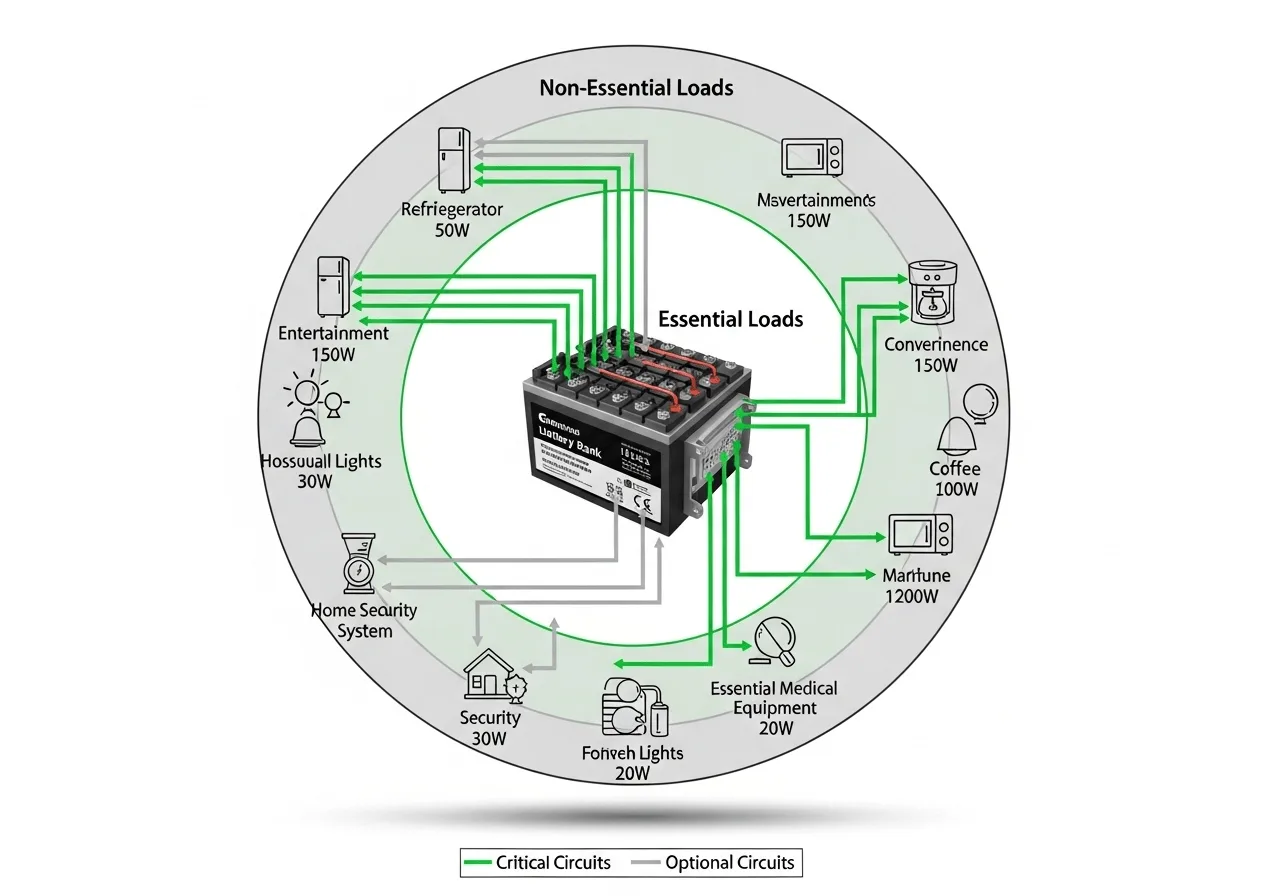
Prioritize the fridge, medical equipment, well pump, and communication devices first. Skip HVAC, electric water heaters, and ovens unless your battery bank is large enough for a whole-home setup, since these draw the most power for the least benefit during a short outage.
Most home battery backup calculator searches come from people who already own a battery and are deciding what to plug into it. Load prioritization is how you stretch a modest battery bank across a multi-day outage instead of running it flat in a few hours.
| Priority | Load | Typical Watts | Notes |
|---|---|---|---|
| Essential | Refrigerator/freezer | 150–400W (surge to 800W) | Compressor cycles, size for surge |
| Essential | Wi-Fi router / modem | 10–20W | Keeps communication alive |
| Essential | Well pump | 750–1,500W | Only if on a private well |
| Essential | Medical equipment (CPAP, oxygen) | 30–90W | Non-negotiable for dependent users |
| Optional | LED lighting | 5–15W per fixture | Low draw, easy to keep on |
| Skip if possible | Central AC / electric heat | 2,000–5,000W | Needs a whole-home sized system |
| Skip if possible | Electric water heater | 3,000–4,500W | Drains most battery banks in under an hour |
Battery Backup Time by Size: 100Ah to 800Ah
At a 300W load and 12V, backup time scales close to linearly with amp-hours once depth of discharge and inverter efficiency are factored in. A 100Ah lithium battery lasts about 3.2 hours, a 400Ah battery lasts about 13 hours, and an 800Ah battery lasts about 26 hours under the same load.
This is the table people usually go looking for after searching “400ah battery backup time” or “800ah battery backup time.” Numbers below use 12V, 90% inverter efficiency, and a 300W continuous load.
| Battery Size | Lithium (90% DoD) | Lead-Acid (50% DoD) | AGM (60% DoD) |
|---|---|---|---|
| 100Ah | 3.2 hrs | 1.8 hrs | 2.2 hrs |
| 200Ah | 6.5 hrs | 3.6 hrs | 4.3 hrs |
| 400Ah | 13.0 hrs | 7.2 hrs | 8.6 hrs |
| 500Ah | 16.2 hrs | 9.0 hrs | 10.8 hrs |
| 800Ah | 26.0 hrs | 14.4 hrs | 17.3 hrs |
For a different load or voltage, use the calculator tool on this page instead of interpolating from this table, since backup time doesn’t scale evenly once you change more than one variable at a time.
Frequently Asked Questions
What is a battery backup calculator?
A battery backup calculator estimates how many hours a battery bank can power your equipment. It multiplies usable capacity by voltage and system efficiency, then divides by your load in watts. Good calculators also adjust for depth of discharge, temperature, and inverter losses, since those factors change the real-world runtime by 30% or more.
How do you calculate battery backup time?
Multiply battery capacity in amp-hours by voltage to get watt-hours, then multiply by depth of discharge and inverter efficiency. Divide that number by your load in watts to get hours of runtime. A 200Ah, 12V lithium battery at 90% depth of discharge and 90% inverter efficiency running a 300W load lasts about 6.5 hours.
How does a home battery backup calculator differ from a whole home battery backup calculator?
A home battery backup calculator usually sizes runtime for a few critical circuits, like a fridge and Wi-Fi router, so load is often 200 to 800 watts. A whole home battery backup calculator adds HVAC, water heaters, and multiple large appliances, pushing the load past 3,000 watts and requiring a much larger battery bank.
How much battery backup do I need for my house?
Add up the watts of the circuits you want to keep running during an outage, then decide how many hours you need to cover. A household running a fridge, router, and a few lights (roughly 400W) for 12 hours needs about 4.8kWh of usable capacity, which is close to a 400Ah battery at 12V with 90% depth of discharge.
Why do lithium battery backup time calculators show longer runtimes than lead-acid ones?
Lithium (LiFePO4) batteries safely discharge to 90% to 100% of their rated capacity, while flooded lead-acid batteries are limited to about 50% to protect their lifespan. That difference alone nearly doubles the usable energy from the same amp-hour rating, which is why a lithium battery backup time calculator returns higher numbers.
How long will a 100Ah, 200Ah, or 400Ah battery backup last?
At 12V with a 300W load and 90% inverter efficiency, a 100Ah lithium battery lasts about 3.2 hours, a 200Ah battery lasts about 6.5 hours, and a 400Ah battery lasts about 13 hours. Lead-acid versions of the same sizes last roughly half as long because of their lower usable depth of discharge.
Does cold weather reduce battery backup calculator results?
Yes. Battery capacity drops as temperature falls, and the effect is worse for lead-acid than lithium. A lead-acid battery can lose 30% to 50% of its rated capacity at 0°F (-18°C), while a quality LiFePO4 battery typically retains 80% or more capacity in the same conditions.
Is a battery backup calculator worth using before buying a battery bank?
Yes. Buying a battery bank without calculating backup time first is one of the most common and expensive mistakes in home energy storage. A calculator shows the true usable hours after accounting for depth of discharge, inverter losses, and temperature, so you buy the right size instead of guessing and running short during an outage.
Get Your Exact Backup Time in Under a Minute
Rated capacity is a lab number. Depth of discharge, inverter losses, and temperature are what actually decide how long your lights stay on. Run your setup through the calculator tool on this page before you buy anything, not after.
Once you know your target backup time, the next question is usually inverter sizing. Check that with our hybrid inverter sizing calculator, or work out full system sizing with the solar sizing calculator if solar is charging the bank.
Sources & Further Reading
Last Updated: | Next Review:
- Battery University. “BU-501: Basics About Discharging.”
- National Renewable Energy Laboratory (NREL). “Residential Battery Storage, Annual Technology Baseline.”
- U.S. Department of Energy. “Solar and Resilience Basics.”
Recommended Tools on Solvebility
Written by Nouman Ahmed
Civil Engineer • Solar Energy Consultant • Software Developer
Nouman is the founder of Solvebility, with practical experience in solar PV system design, engineering calculations, and calculator development since 2011. This tool was built by Nouman and reviewed by the Solvebility engineering team to verify formulas, assumptions, and calculation accuracy before publication — and is updated whenever industry standards change.