

Cable Size Calculator
Inputs
Results
Ampacity Table (Copper, typical insulated conductors)
| Size (mm²) | Ampacity (A) | Nearest AWG |
|---|
- Ambient temp factor (typical): 25°C=1.05, 30°C=1.00, 35°C=0.94, 40°C=0.87, 45°C=0.79, 50°C=0.71.
- Grouping: 1=1.00, 2=0.9, 3=0.8, 4=0.7, 5+=0.65 (editable via manual derate).
- Installation presets adjust recommended ampacity conservatively.
Wrong cable size killed a £340,000 industrial motor last year — in a factory that had been running safely for 22 years. The installer used the breaker rating instead of the actual load current, skipped the temperature derating, and buried 4 mm² cable where 10 mm² belonged. Three weeks later: an arc fault, a fire, and a month of downtime.
A proper cable size calculator would have caught every one of those errors in under 30 seconds.
Whether you’re wiring a home solar system, sizing a 3-phase motor run in a factory, or pulling cable for a submersible pump 150 metres from the panel — this guide walks you through exactly how to use our calculator, what the numbers mean, and the six mistakes professionals see over and over again.
All calculations here are based on IEC 60364, NEC 2023, BS 7671 18th Edition, and AS/NZS 3008. No guesswork.
What Is a Cable Size Calculator?
A cable size calculator determines the minimum wire cross-section (in mm² or AWG) that safely carries your load current without overheating or dropping too much voltage. It applies ampacity tables, derating factors for temperature and installation method, and voltage drop formulas — all at once, in seconds.
Think of it like choosing pipe diameter for water. Too narrow and you get pressure loss, heat buildup, and eventual failure. Too wide and you’ve wasted money on copper you didn’t need. The difference with electrical cable is that “failure” means a fire — not just inconvenience.
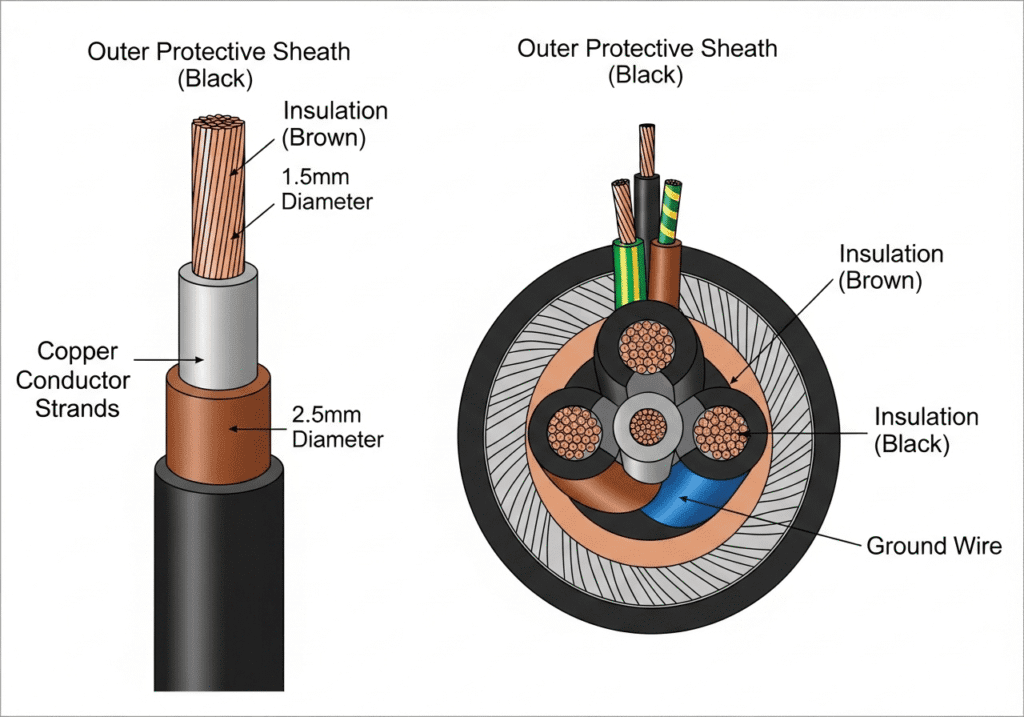
Why Getting Cable Size Right Actually Matters
According to the U.S. Fire Administration, electrical failures account for around 6.3% of all residential fires. Improper wire sizing is one of the biggest contributors — and it’s almost entirely preventable.
Cable undersized by just 25% can hit 90°C under load. At that temperature, PVC insulation starts degrading. By the time you smell something wrong, the damage is already done.
The Two Things a Cable Size Calculator Actually Checks
1. Ampacity (current-carrying capacity): Can this cable handle the load without overheating? Depends on the conductor material, cross-sectional area, how it’s installed, ambient temperature, and how many other cables are bundled with it.
2. Voltage drop: Does enough voltage actually reach the load? Long runs through resistive cable eat voltage. IEC and NEC both limit this — typically 3% for branch circuits, 5% total system.
Both conditions have to pass. A cable that handles the current but drops 8% of your voltage is still the wrong cable.
How Does the Cable Size Calculator Work?
The calculator runs three calculations in sequence: it looks up base ampacity from an IEC/NEC table, multiplies it by derating factors (temperature, grouping, installation method, material), then checks voltage drop against your limit. It picks the smallest cable that passes both tests.
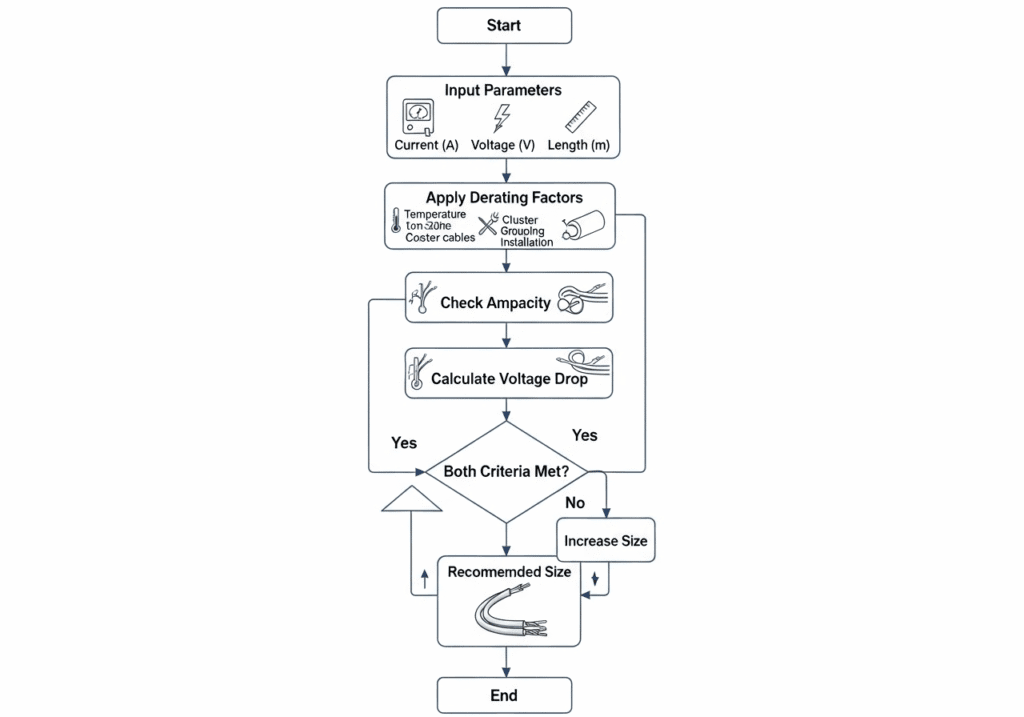
Step 1: Base Ampacity Lookup
Every cable size has a rated ampacity — the maximum current it carries safely under ideal conditions (30°C ambient, single cable in free air). A 10 mm² copper cable, for example, carries 57 A under those ideal conditions.
These values come from decades of lab testing and are published in IEC 60364, NEC Table 310.16, BS 7671 Appendix 4, and AS/NZS 3008.
Step 2: Derating Factors
Real installations are never ideal. So the calculator multiplies the base ampacity by correction factors:
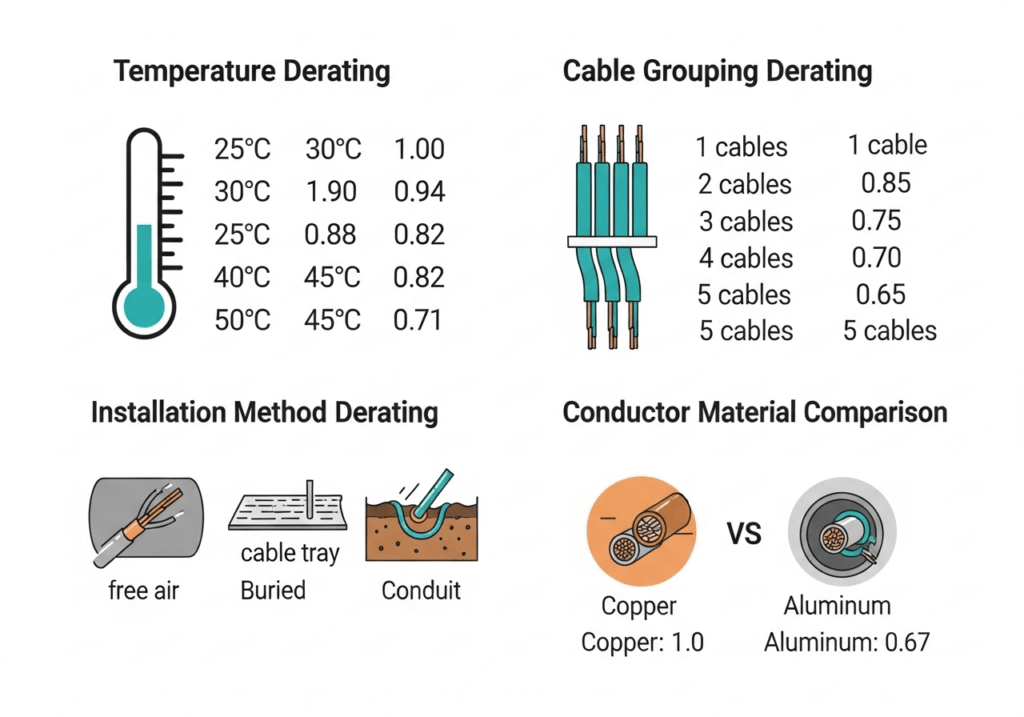
| Ambient Temp (°C) | Derating Factor | Effect on a 57 A cable |
|---|---|---|
| 25°C | 1.05 | 59.9 A (slightly more) |
| 30°C | 1.00 | 57 A (reference) |
| 35°C | 0.94 | 53.6 A |
| 40°C | 0.87 | 49.6 A |
| 45°C | 0.79 | 45.0 A |
| 50°C | 0.71 | 40.5 A ← 29% loss |
Grouping factors kick in when multiple cables share the same tray, conduit, or bundle:
- 1 cable alone: ×1.00
- 2 cables together: ×0.90
- 3 cables together: ×0.80
- 4 cables together: ×0.70
- 5 or more: ×0.65
Put 4 cables in a tray at 50°C and your 57 A cable now handles: 57 × 0.71 × 0.70 = 28.3 A. That’s half the nameplate rating.
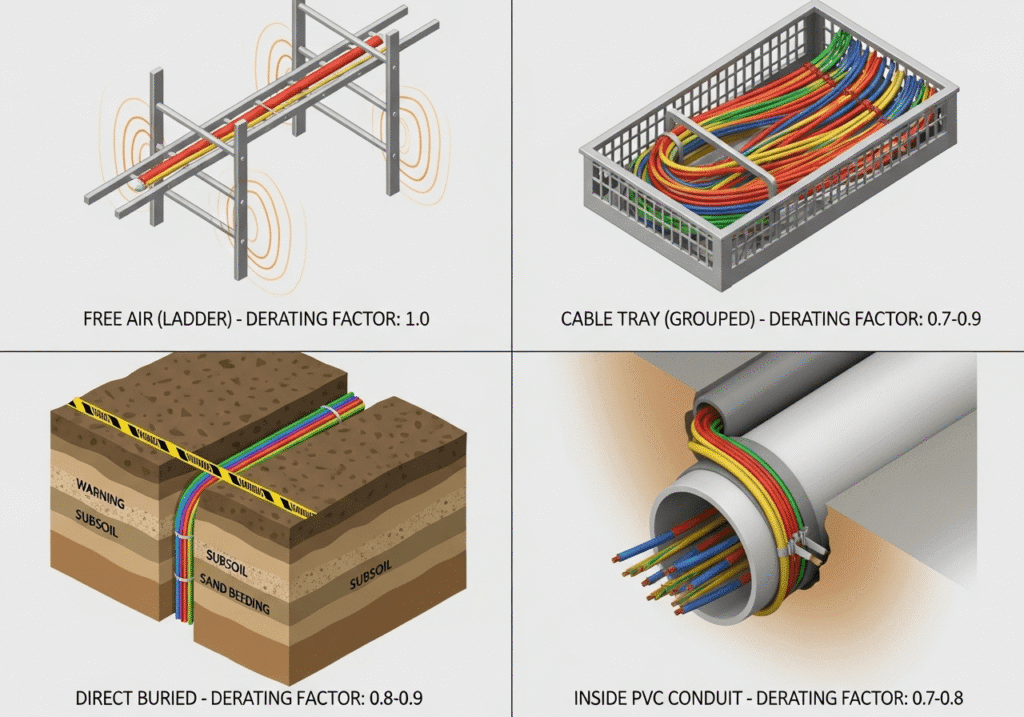
Always use your maximum expected ambient temperature — not average. A cable in a rooftop conduit in Australia can hit 55°C in summer. Size for that, not the 30°C datasheet default.
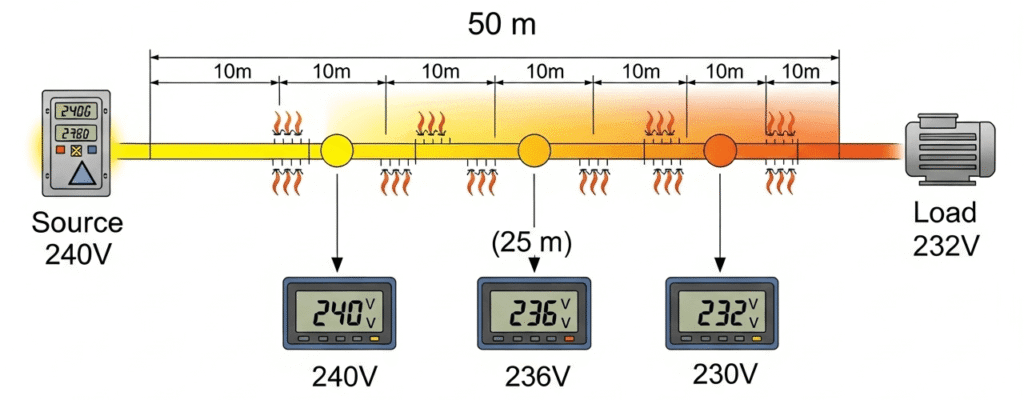
Step 3: Voltage Drop Calculation
Once the calculator confirms the cable handles the current, it checks whether enough voltage reaches your load.
The resistance formula is:
R = ρ × L / A
Where ρ is resistivity (copper: 0.01724 Ω·mm²/m; aluminium: 0.0282 Ω·mm²/m), L is run length in metres, and A is cross-section in mm².
For single-phase:
Voltage drop (V) = 2 × I × R
For 3-phase:
Voltage drop (V) = √3 × I × R × cos(φ)
How to Use the Cable Size Calculator — Step by Step
Enter your load current, system voltage, phase type, cable run length, conductor material, installation method, ambient temperature, number of grouped circuits, and allowable voltage drop. Click Calculate. The tool returns the recommended mm² size, derated ampacity, and voltage drop percentage — with a full candidate table so you can compare trade-offs.
Real Example: 60 A Three-Phase Motor, Factory Setting
Say you’re installing a 60 A motor in a factory: 30 metres from the distribution board, running at 400 V three-phase, power factor 0.8. Cables go in a tray with 2 other circuits. Ambient temperature peaks at 35°C.
- Load Current: 60 A — Use the actual motor nameplate current, not the breaker size. This is the most common mistake on site.
- System Voltage: 400 V — Line-to-line for three-phase. Line-to-neutral for single-phase (e.g. 230 V).
- System Type: Three-phase — Motors, HVAC, industrial loads. Most residential loads are single-phase.
- Length: 30 m (one-way) — Cable route, not straight-line. Include vertical drops, bends, and runs through walls.
- Material: Copper — For runs under 50 m, copper is usually the better call. Aluminium makes sense on long feeders.
- Power Factor: 0.8 — Motors and inductive loads typically run 0.7–0.9. Resistive loads (heaters): 1.0. Mixed commercial loads: 0.85–0.95.
- Installation: Cable tray — Pick the method that matches your actual route. The calculator applies the right factor automatically.
- Ambient Temp: 35°C — Peak summer temperature in the factory, not annual average.
- Grouped Circuits: 3 — Three cables in the same tray triggers a ×0.80 grouping derate.
- Voltage Drop Limit: 3% — Standard for branch circuits per IEC and NEC. Use 2% for sensitive equipment.
Result: 16 mm²
- Base ampacity: 76 A
- Derated ampacity after temp (×0.94) and grouping (×0.80): 57.2 A ✓ (meets 60 A with margin)
- Voltage drop: 2.47% ✓ (under 3% limit)
If you had entered the breaker rating (typically 80 A for a 60 A motor) instead of the actual load current, the calculator would have recommended 25 mm² — costing you 40% more in cable and connectors for no safety benefit.
Three More Real-World Scenarios
| Scenario | Current | Voltage / Phase | Run Length | Conditions | Result | Voltage Drop |
|---|---|---|---|---|---|---|
| Home solar inverter | 21 A | 240 V / 1-ph | 12 m | Conduit, 40°C roof space | 4 mm² Cu | 1.84% ✓ |
| Agricultural submersible pump | 32 A | 400 V / 3-ph | 150 m | Buried, 25°C, aluminium | 70 mm² Al | 4.87% ✓ |
| Residential split AC | 15 A | 230 V / 1-ph | 8 m | PVC conduit, 30°C | 2.5 mm² Cu | 1.02% ✓ |
| Commercial HVAC motor | 45 A | 415 V / 3-ph | 60 m | Cable tray, 40°C, 4 circuits | 16 mm² Cu | 2.91% ✓ |
3-Phase Cable Size Calculator: When to Use It and Why It Saves Money
Three-phase power distributes current across three conductors instead of one, which means the current per conductor is 1/√3 (about 57.7%) of what single-phase would require for the same load. That directly translates to smaller cable, lower voltage drop, and significantly cheaper installation — especially on loads above 7 kW.
The Numbers That Make the Case
Take a 10 kW load at 0.9 power factor. Here’s what happens when you run it single-phase vs three-phase:
| Parameter | Single-Phase (230 V) | Three-Phase (400 V) | Saving |
|---|---|---|---|
| Current | 48.3 A | 16.0 A per phase | −67% |
| Minimum cable size | 10 mm² | 2.5 mm² | −75% |
| Cable cost (30 m run, Cu) | ~£85 | ~£22 | −74% |
| Power loss (0.05 Ω) | 116.6 W | 38.4 W | −67% |
| Annual energy waste (24/7) | 1,021 kWh | 336 kWh | ~£58/yr |
That’s not a rounding error. You cut your conductor cost by three-quarters and your ongoing power loss by two-thirds — just by choosing the right system type before picking up the cable.
Common Three-Phase Voltages by Region
- 208 V — USA commercial (line-to-line)
- 400 V — EU standard (most of Europe, Middle East, Asia)
- 415 V — UK, Australia, New Zealand, parts of Africa
- 480 V — USA industrial
When Three-Phase Makes Sense
- Motors above 2.2 kW — single-phase motors above this size draw huge starting currents and run less efficiently
- Continuous loads above 7 kW — the cable and energy savings pay back the three-phase supply cost within 2–4 years
- Large commercial HVAC — anything above 7.5 tonnes cooling capacity needs three-phase
- Multiple high-power machines — balanced across phases, voltage drops are lower and stay lower
The three-phase cable size calculator uses √3 × I × R × cos(φ) for voltage drop. The √3 factor (1.732) and the cos(φ) term are the two things most people forget when doing three-phase calcs by hand — which is exactly why a calculator exists.
Standard Ampacity Table: Copper & Aluminium
Base ampacity ratings are for a single conductor in free air at 30°C. Real-world ampacity is 40–50% lower once you apply derating factors for temperature, grouping, and installation method. Always start with the table, then multiply by your derating factors — never use base values directly for design.
| Size (mm²) | Copper Ampacity (A) | Aluminium Ampacity (A) | Nearest AWG | Typical Application |
|---|---|---|---|---|
| 1.5 | 17 | — | AWG 15 | Lighting circuits, controls |
| 2.5 | 24 | — | AWG 13 | Power outlets, residential circuits |
| 4 | 32 | — | AWG 11 | Heavy appliances, small equipment |
| 6 | 41 | — | AWG 9 | Air conditioners, water heaters |
| 10 | 57 | 44 | AWG 7 | Electric cookers, large appliances |
| 16 | 76 | 59 | AWG 5 | Sub-panels, distribution boards |
| 25 | 101 | 78 | AWG 3 | Main feeders, large motors |
| 35 | 125 | 96 | AWG 2 | Industrial loads, heavy machinery |
| 50 | 154 | 118 | AWG 1/0 | Heavy plant, production equipment |
| 70 | 197 | 152 | AWG 2/0 | Large motors, industrial feeders |
| 95 | 234 | 180 | AWG 3/0 | Distribution systems |
| 120 | 264 | 203 | AWG 4/0 | Service entrance, main distribution |
| 150 | 303 | 233 | 250 kcmil | Commercial mains |
| 185 | 344 | 265 | 350 kcmil | Industrial feeders, substations |
| 240 | 420 | 323 | 500 kcmil | Large industrial installations |
These are BASE values under ideal conditions. Real-world ampacity after derating can be 40–50% lower. Always apply the derating factors before making any design decision. For final installations, verify against local standards (NEC, IEC 60364, BS 7671, AS/NZS 3008) and the cable manufacturer’s datasheet.
Voltage Drop — The Hidden Energy Thief
Voltage drop is the voltage lost as current flows through the cable’s resistance. A 5% drop on a 100 A, 400 V three-phase circuit wastes around 2,000 W continuously — about £1,750 per year at £0.10/kWh running 24/7. Most standards limit branch circuits to 3% and total system to 5%.
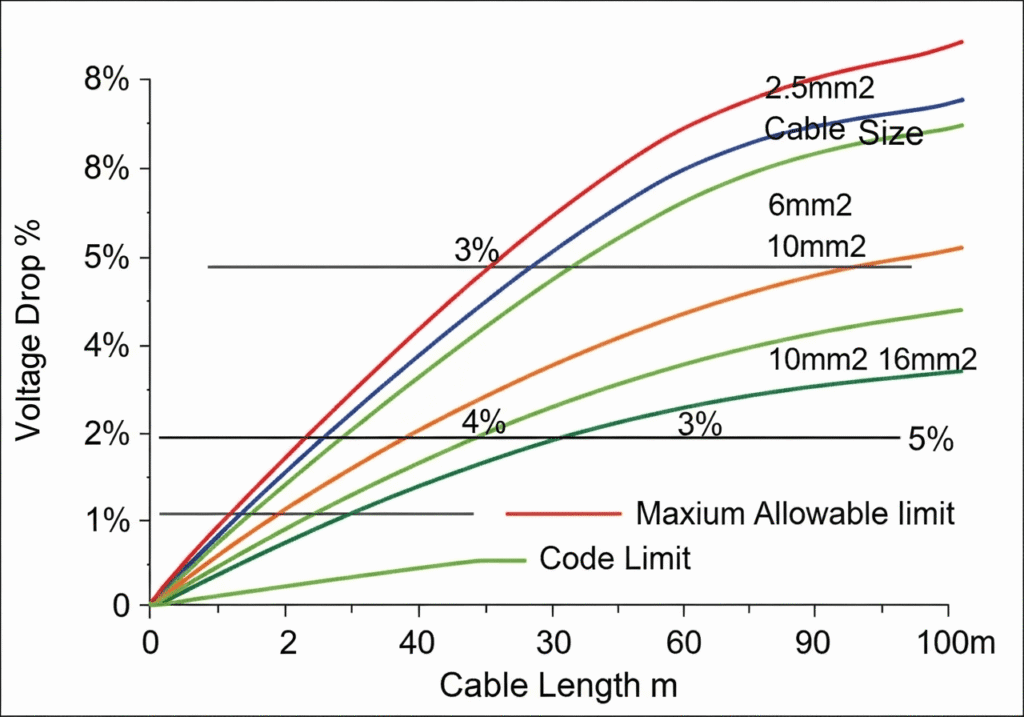
What Excessive Voltage Drop Actually Does to Equipment
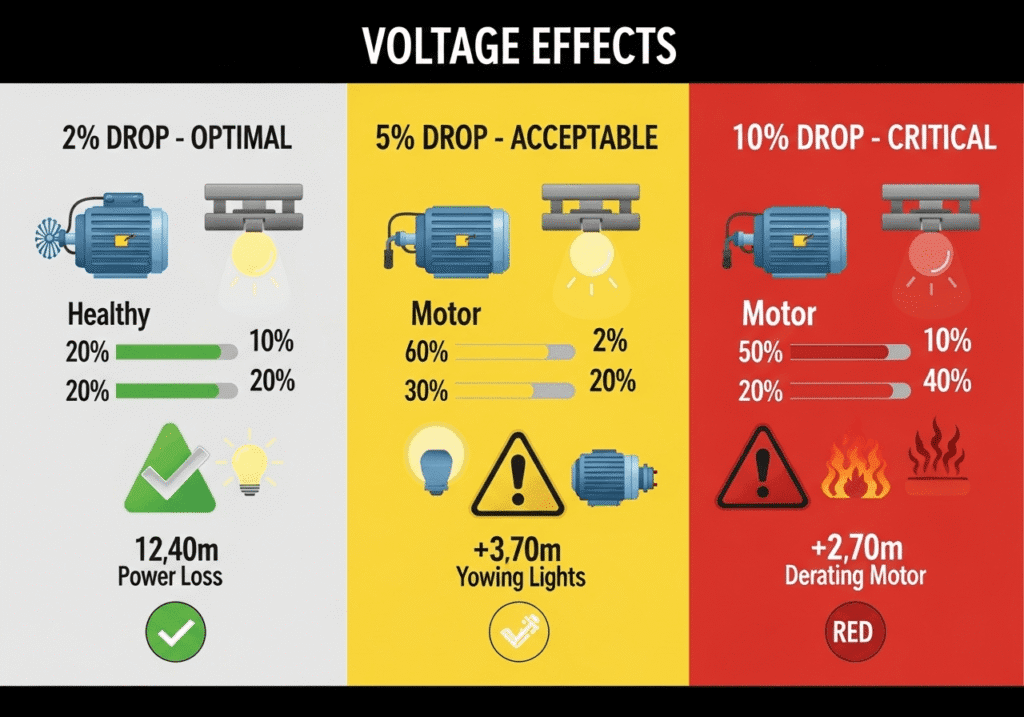
| Equipment Type | Effect of 5% Drop | Effect of 10% Drop |
|---|---|---|
| Three-phase motor | 9.75% torque reduction, 10.5% current increase | 19% torque reduction, 21% current increase, overheating |
| LED lighting | Slight dimming, colour shift | Visible flicker, reduced fixture life |
| VFD / inverter drive | Slight efficiency loss | Possible undervoltage trip, nuisance faults |
| Computer / UPS | Minimal (UPS compensates) | Possible brownout shutdown |
| Heating element | 9.75% less heat output | 19% less heat output |
Voltage Drop Limits by Application
- 2% or less: Medical equipment, data centres, precision CNC machinery, communication systems
- 3%: Standard branch circuits — NEC and IEC recommendation for most loads
- 5%: Total system limit (including distribution and branch circuits combined)
- Up to 7%: Some utility systems allow this on long rural distribution runs — not recommended for end-use equipment
How to Fix a Voltage Drop Problem
- Go up one cable size — usually the cheapest fix on short runs
- Run parallel cables — for very high currents (above 400 A), two smaller cables in parallel are often cheaper than one massive conductor
- Reduce run length — move your sub-board or panel closer to the load if the installation allows
- Increase distribution voltage — use a step-down transformer at the load end; common on long rural feeders
- Switch to aluminium on long runs — larger cross-section but lower resistance per dollar on feeders above 50 metres
Copper vs Aluminium Cable — Full Comparison
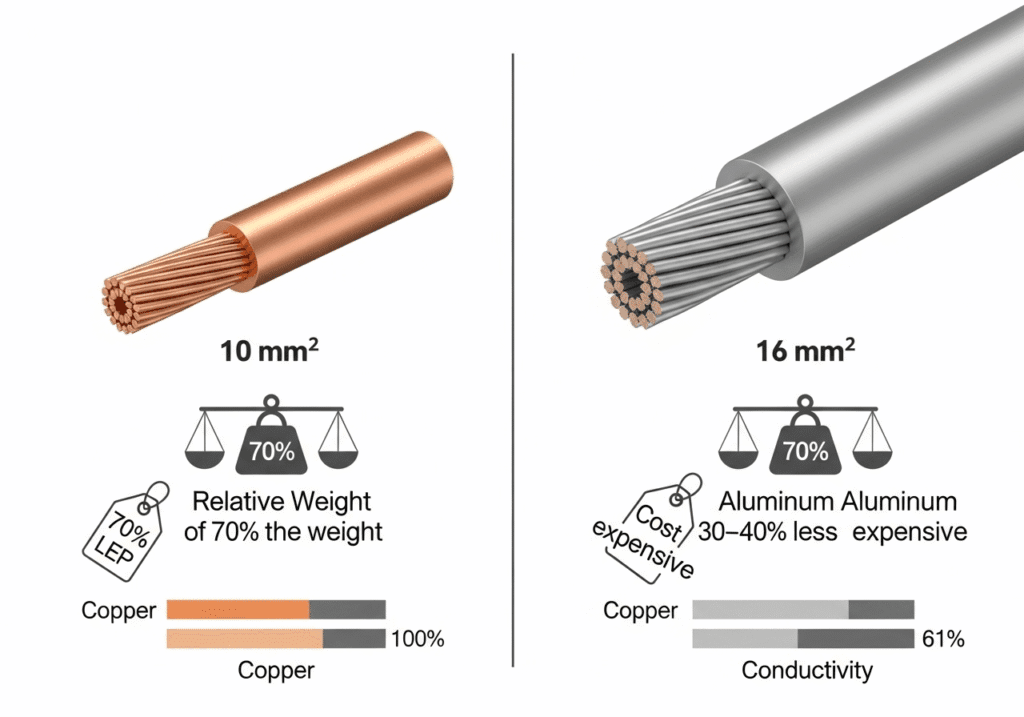
Copper carries more current per mm², bends easily, and is universally accepted by electrical codes. Aluminium is 70% lighter and 30–40% cheaper per metre, but you need a 50% larger cross-section for the same ampacity. Use copper for runs under 50 m and most residential work; aluminium on long feeders, overhead lines, and large conductors above 35 mm².
| Factor | Copper (Cu) | Aluminium (Al) |
|---|---|---|
| Conductivity | 100% (reference) | 61% of copper |
| Required cable size for same ampacity | Baseline | ~50% larger cross-section |
| Weight per metre | Heavier (8.96 g/cm³) | 70% lighter (2.70 g/cm³) |
| Material cost | Higher (~£8–10/kg) | 30–40% cheaper |
| Flexibility | More flexible, easier to bend | Stiffer, larger bend radius |
| Oxidation | Minimal concern | Forms oxide layer — needs anti-oxidant compound at connections |
| Termination requirements | Standard terminals | Must use AL-rated lugs, specific torque |
| Code compliance | Universally accepted, all sizes | Often restricted below 10 mm² for branch circuits |
| Service life | 50+ years | 40+ years (with correct installation) |
| Best use case | Short–medium runs, high reliability, residential, frequent connections | Long runs (>50 m), overhead lines, large feeders, cost-sensitive projects |
If you’re switching from copper to aluminium, always use anti-oxidant paste at every termination, torque lugs to the manufacturer’s spec, and never mix AL and Cu terminations in the same lug. Galvanic corrosion between the two metals is a real failure mode — and it happens slowly enough that you won’t catch it until there’s a problem.
6 Cable Sizing Mistakes That Cause Fires (and How to Avoid Them)
The six most dangerous cable sizing mistakes are: using breaker rating instead of load current, ignoring ambient temperature, forgetting cable grouping effects, mixing up one-way and total circuit length, confusing AWG with mm², and not sizing for future load growth. Every one of these is a real incident, and every one is preventable with a calculator and the right inputs.
Mistake 1: Using Breaker Rating Instead of Load Current
Breakers are sized at 125% of continuous load for safety margin. Your 40 A breaker doesn’t mean you have a 40 A load. A 32 A motor on a 40 A breaker still needs to be sized for 32 A — not 40 A.
Using breaker size pushes you toward unnecessarily large (and expensive) cable. Using a number that’s too high doesn’t kill people, but it wastes money. The dangerous version is the reverse — using a lower number than the actual load. Always read the equipment nameplate.
Mistake 2: Ignoring Ambient Temperature
Cables installed in a 50°C attic or roof space lose 29% of their ampacity compared to the datasheet rating at 30°C. A 4 mm² cable rated at 32 A at 30°C only carries 22.7 A in a 50°C environment. Size for the worst case, always.
Mistake 3: Forgetting Grouping Effects
James, an electrician in Manchester, installed 5 cables in a tray and sized each one for 100% of its rated current. Three months later, they were all running at 65% capacity — but the thermal buildup in the tray had already started degrading the insulation on the cables in the centre.
Four cables together have only 70% of their individual rated capacity. Five or more: 65%. The heat is cumulative and there’s no way around it except upsizing the conductor or improving cable spacing.
Mistake 4: One-Way Length vs. Total Circuit Length
Voltage drop depends on the total length current travels — to the load and back. For single-phase, effective length is 2× the one-way run. The cable size calculator accounts for this automatically when you enter one-way distance. Don’t enter the total conductor length — you’ll get a result that’s too conservative.
Mistake 5: Mixing AWG and mm²
AWG and mm² don’t convert with a simple multiplier. AWG 10 is approximately 5.26 mm², but AWG numbers decrease as conductor size increases (AWG 4 is larger than AWG 10). Keep your project in one system from start to finish and use the conversion column in the ampacity table above.
Mistake 6: Not Sizing for Future Growth
Pulling new cable through a conduit that’s already full costs five to ten times what it would have cost to upsize the original conductor. If there’s any realistic chance of load growth within 10 years, add 25–50% to your current requirement and size the conductor accordingly. The marginal cost of 25 mm² vs 16 mm² over a 30-metre run is usually under £40. The cost of a cable replacement job is rarely under £400.
International Standards: NEC, IEC, BS 7671, AS/NZS
The four major standards that govern cable sizing are NEC (USA/Canada), IEC 60364 (international), BS 7671 18th Edition (UK and many Commonwealth countries), and AS/NZS 3008 (Australia and New Zealand). They all use the same physics, but have different ampacity tables, derating factors, and installation-method classifications. Our cable size calculator is calibrated to IEC/NEC reference data, so always verify against your local standard before finalising a design.
| Standard | Region | Ampacity Section | Voltage Drop | Notes |
|---|---|---|---|---|
| NEC 2023 | USA, Canada | Article 310, Table 310.16 | 3% branch, 5% total | Uses AWG sizing; THHN, XHHW cable types common |
| IEC 60364 | International (most of world) | Section 523 | Section 525 (4% LV) | Most widely adopted; used in EU, Asia, Middle East, Africa |
| BS 7671 18th Ed. | UK, Ireland, many Commonwealth | Appendix 4 | Appendix 12 (3% max) | IEC-based with UK-specific requirements; mandatory for UK installations |
| AS/NZS 3008 | Australia, New Zealand | Tables 3–8 | Clause 4.3 (5% max) | Includes comprehensive tables for tropical and hot-climate conditions |
Pre-Installation Compliance Checklist
- ✓ Verify which standard applies to your jurisdiction
- ✓ Confirm local code requires a licensed electrician for this work
- ✓ Check cable temperature rating matches the environment
- ✓ Verify voltage drop meets your local code limit
- ✓ Confirm overcurrent protection is correctly sized (typically 125% of continuous load)
- ✓ Check cable type is approved for the installation method (direct burial, tray, conduit)
- ✓ Document all calculations — many jurisdictions require this for inspection
- ✓ For loads above 7 kW, consider future growth in conductor sizing
Need More Electrical Calculators?
Check out our full suite of free engineering tools — VFD sizing, single vs 3-phase comparisons, hybrid inverter sizing, and more.
Browse All Calculators →Frequently Asked Questions
A cable size calculator is an engineering tool that determines the minimum conductor cross-section (in mm² or AWG) needed to safely carry a specific electrical load. It calculates ampacity after applying derating factors (temperature, grouping, installation method, material) and checks voltage drop against your allowable limit — returning the smallest cable size that passes both tests.
Select “Three-phase” in the system type field and enter your line-to-line voltage (e.g. 400 V for EU, 415 V for UK/Australia, 480 V for US industrial). The calculator uses the three-phase voltage drop formula: √3 × I × R × cos(φ). Because current per conductor is lower in three-phase systems, the required cable size is typically 50–75% smaller than the equivalent single-phase installation. You can also use our dedicated single vs 3-phase comparison calculator to see the cost difference in detail.
Standard limits are 3% for branch circuits (NEC recommendation; IEC 60364 and BS 7671 both recommend 3–4% for LV final circuits) and 5% for the total system including distribution. For sensitive loads — data centres, medical equipment, CNC machinery — limit to 2% or less. AS/NZS 3008 for Australia/NZ allows up to 5% total. Always check your local standard, as enforcement varies by jurisdiction.
Use aluminium when cable runs exceed 50 metres, conductors are 35 mm² or larger, or weight reduction matters (overhead lines, long vertical runs). Aluminium is 30–40% cheaper per metre and 70% lighter than copper, but you need a 50% larger cross-section for the same ampacity. Always use anti-oxidant compound and AL-rated terminations. Most codes prohibit aluminium for branch circuits smaller than 10 mm².
Higher ambient temperatures reduce a cable’s ability to shed heat, which reduces its safe current capacity. At 50°C versus the standard 30°C reference, a copper cable’s ampacity drops by 29% (derating factor of 0.71). Always enter the maximum expected temperature at the installation location — not the annual average. Cables in roof spaces, near heating equipment, or in hot climates frequently need to be upsized by one or two sizes because of temperature alone.
Yes. For the AC side (inverter to main panel), enter the inverter output current, system voltage, and phase type as usual. For DC runs (panels to inverter), use single-phase and set power factor to 1.0 since DC has no reactive component. Keep DC voltage drop under 1–2% to maximise power harvest. For complete solar system sizing, our solar sizing calculator and hybrid inverter sizing calculator handle the full system design.
For a 32 A single-phase supply at 230 V in a standard UK/EU installation (in conduit, 30°C ambient), 6 mm² copper cable is typically correct. But the right answer depends on your specific conditions — run length, ambient temperature, installation method, and grouping. A 10-metre run in free air at 25°C could use 4 mm². A 20-metre run in a warm loft with 3 other cables could require 10 mm². Use the cable size calculator with your actual parameters to get the right answer for your installation.
The calculator uses IEC 60364-based reference data which aligns closely with BS 7671 18th Edition. For UK installations, always verify the output against BS 7671 Appendix 4 tables and Appendix 12 voltage drop limits. The calculator is suitable for preliminary sizing and educational purposes. Final designs for UK regulated work must comply with BS 7671 in full and should be signed off by a qualified electrician registered with NICEIC, NAPIT, or an equivalent competent person scheme.
The Bottom Line on Cable Sizing
Cable sizing isn’t complicated — but it has to be right. The cable size calculator takes every variable (load current, run length, material, installation method, ambient temperature, grouping) and runs the maths in seconds. What used to take an engineer 20 minutes with tables and a calculator now takes 30 seconds.
The two rules that matter most: always derate for real conditions, and always check voltage drop as well as ampacity. A cable that handles the current but loses 8% of your voltage is still the wrong cable.
Run your numbers above, cross-check against your local standard (NEC, IEC, BS 7671, or AS/NZS 3008), and if there’s any doubt — especially for high-current or safety-critical work — have a licensed electrical engineer review the design.
The calculator is free. Use it before you pull the cable, not after.
References & Standards
- National Fire Protection Association. NFPA 70: National Electrical Code 2023. Article 310 — Conductors for General Wiring. nfpa.org
- International Electrotechnical Commission. IEC 60364-5-52:2009 — Electrical installations of buildings: Selection and erection of electrical equipment — Wiring systems. Geneva: IEC.
- British Standards Institution. BS 7671:2018+A4:2026 — Requirements for Electrical Installations (IET Wiring Regulations, 18th Edition, Amendment 4 — “Orange Book”). London: BSI/IET. electrical.theiet.org
- Standards Australia / Standards New Zealand. AS/NZS 3008.1.1:2017 — Electrical installations: Selection of cables for alternating voltages up to and including 0.6/1 kV — Typical Australian installation conditions.
- U.S. Fire Administration. Electrical Fires (Topical Fire Report Series, Vol. 8, Issue 8). FEMA, 2012. usfa.fema.gov