

3 Phase Power Calculator: kW, kVA & Current Formulas
Enter line voltage, line current, and power factor. Get real power, apparent power, and current back instantly, with the formulas shown so you can check the math yourself.
Inputs

A contractor I talked to last year sized a transformer using phase voltage instead of line voltage. The math looked fine on paper. The transformer tripped under load three weeks after commissioning. A 3 phase power calculator won’t stop every mistake like that, but it removes the one that trips up more engineers than any other: doing the √3 math by hand under deadline pressure.
This guide walks through what a 3 phase power calculator actually computes, the formulas running underneath it, and the five things people get wrong most often. By the end, you’ll know exactly which numbers to plug in and why the results matter for sizing cable, breakers, and transformers.
Whether you searched for a three phase power calculator, a 3-phase kVA calculator, or just the raw formula, you’ll find all three here, worked out with real numbers instead of just the equation.
What Is a 3-Phase Power Calculator?
A 3-phase power calculator converts line voltage, line current, and power factor into real power (kW) and apparent power (kVA) for balanced three-phase systems. It replaces manual √3 math with an instant, error-checked result you can use for sizing cable, breakers, and transformers.
Three-phase power is how almost every factory floor, data center, and commercial building gets its electricity. Instead of one alternating current, you get three, each offset by 120 degrees. That staggering is what makes three-phase motors run smoother and deliver more power per pound of copper than single-phase equipment.
The calculator gives you two numbers, and they answer two different questions:
- Real power (P), in kilowatts. This is the power actually doing work: turning a shaft, producing heat, lighting a room. It’s what shows up on your electricity bill.
- Apparent power (S), in kilovolt-amperes. This is the total power flowing through the wires, including the reactive portion that doesn’t do useful work but still has to be supplied. It’s what you use to size cable and transformers.
If you only look at kW, you’ll undersize your equipment. If you only look at kVA, you’ll overpay for capacity you don’t need. You need both, and that’s the whole point of running the calculation properly instead of eyeballing it.
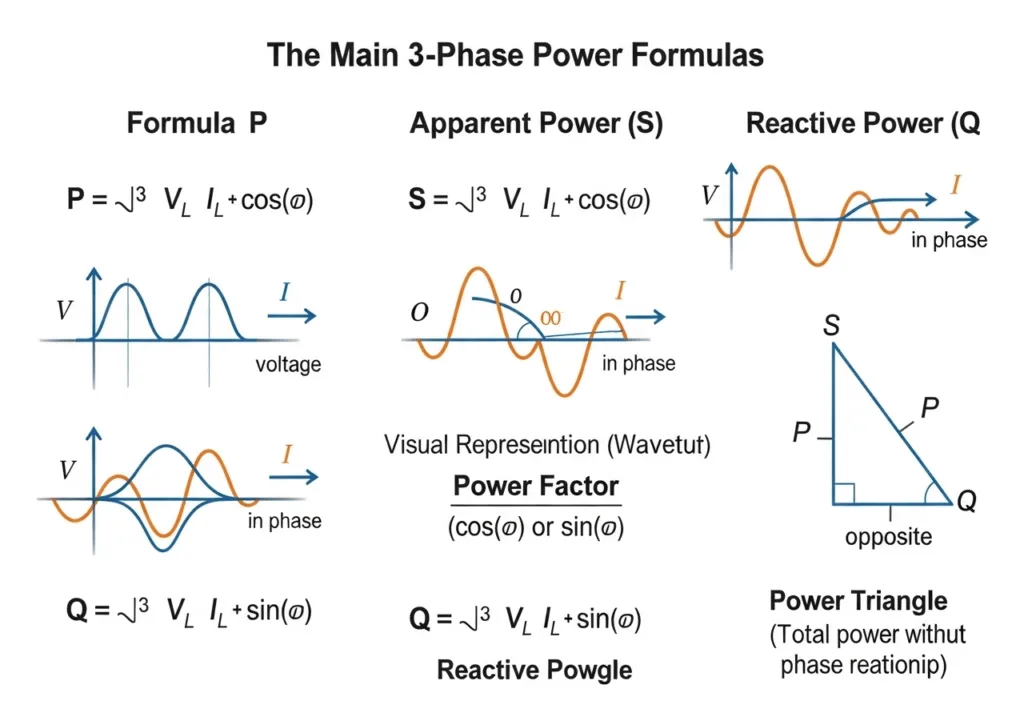
What Are the Formulas for 3-Phase Power?
S (kVA) = √3 × V × I ÷ 1000 for apparent power. P (kW) = √3 × V × I × PF ÷ 1000 for real power, where V is line voltage, I is line current, and PF is power factor. The only difference between the two formulas is the power factor multiplier.
√3 equals 1.732, and it shows up because you’re measuring three currents that are out of phase with each other, not adding three identical values together.
Here’s a worked example. A motor draws 50A at 400V with a power factor of 0.8:
| Step | Formula | Result |
|---|---|---|
| Apparent power (S) | 1.732 × 400 × 50 ÷ 1000 | 34.64 kVA |
| Real power (P) | 1.732 × 400 × 50 × 0.8 ÷ 1000 | 27.71 kW |
| Difference | S − P | 6.93 kVAR (reactive) |
You need 34.64 kVA of capacity in your cables and transformer, but only 27.71 kW is doing productive work. That gap is reactive power, and it’s the reason power factor correction exists in the first place.
What Is the Formula for 3-Phase Current?
I (A) = (kVA × 1000) ÷ (√3 × V) when you know apparent power, or I (A) = (kW × 1000) ÷ (√3 × V × PF) when you know real power. Both give the same current for a balanced load, since kVA and kW × PF describe the same apparent power.
This is the reverse of the calculation above: instead of finding power from voltage and current, you’re finding current from power and voltage. It’s the formula you need when a nameplate gives you a kW or kVA rating and you have to size the conductor or breaker.
Same 400V system, this time rated at 30 kVA:
| Step | Formula | Result |
|---|---|---|
| Line current (I) | 30 × 1000 ÷ (1.732 × 400) | 43.3 A |
A quick note on a related mix-up: kW and kWh aren’t the same thing. kW is power, the rate energy is used right now. kWh is energy, kW multiplied by the hours it ran. A 27 kW load running for 4 hours consumes 108 kWh, not 27 kWh.
Why Does Power Factor Matter So Much?
Power factor tells you how much of your apparent power actually converts to useful work. A PF of 0.8 means 80% of the power drawn is productive; the rest is reactive power that still costs you in cable sizing, transformer capacity, and often a utility penalty on your bill.
Power factor runs from 0 to 1.0. Industrial motors typically sit around 0.7 to 0.85. Resistive heaters run close to 1.0. Older fluorescent fixtures without correction can drop as low as 0.5.
| Power Factor | Rating | Typical Loads | Action Needed |
|---|---|---|---|
| 0.95 – 1.0 | Excellent | Resistive heaters, incandescent lighting | None |
| 0.85 – 0.94 | Good | Modern motors, LED systems | Monitor |
| 0.70 – 0.84 | Fair | Older motors, mixed loads | Consider correction |
| 0.50 – 0.69 | Poor | Fluorescent lighting, welders | Correction required |
| Below 0.50 | Critical | Arc furnaces, poorly matched systems | Correct immediately |
Most utilities start charging penalty fees once your power factor drops below 0.85. Capacitor banks fix this by supplying reactive power locally instead of pulling it from the grid, and they typically pay for themselves within a year or two through lower bills.
How Do You Use a 3-Phase Power Calculator?
Gather line voltage, line current, and power factor from your equipment nameplate or measurements, select the correct units, enter the values, and read off kW and kVA. Most calculators flag suspicious inputs, like a power factor outside 0.1–1.0, before you trust the result.
- Gather your data. Line voltage from the panel or nameplate, line current from a clamp meter, and power factor from equipment specs or a power analyzer.
- Set your units. Voltage can be entered in V or kV; current in A or mA. Match whatever your measurement tool actually displays.
- Enter the values. The calculator checks that voltage and current are positive and that PF falls between 0.1 and 1.0.
- Read the results. Green means the calculation is valid. Yellow flags an unusually low PF worth double-checking. Red means something’s wrong with an input.
- Apply the numbers. Use kVA for cable and transformer sizing, kW for energy cost and equipment output.

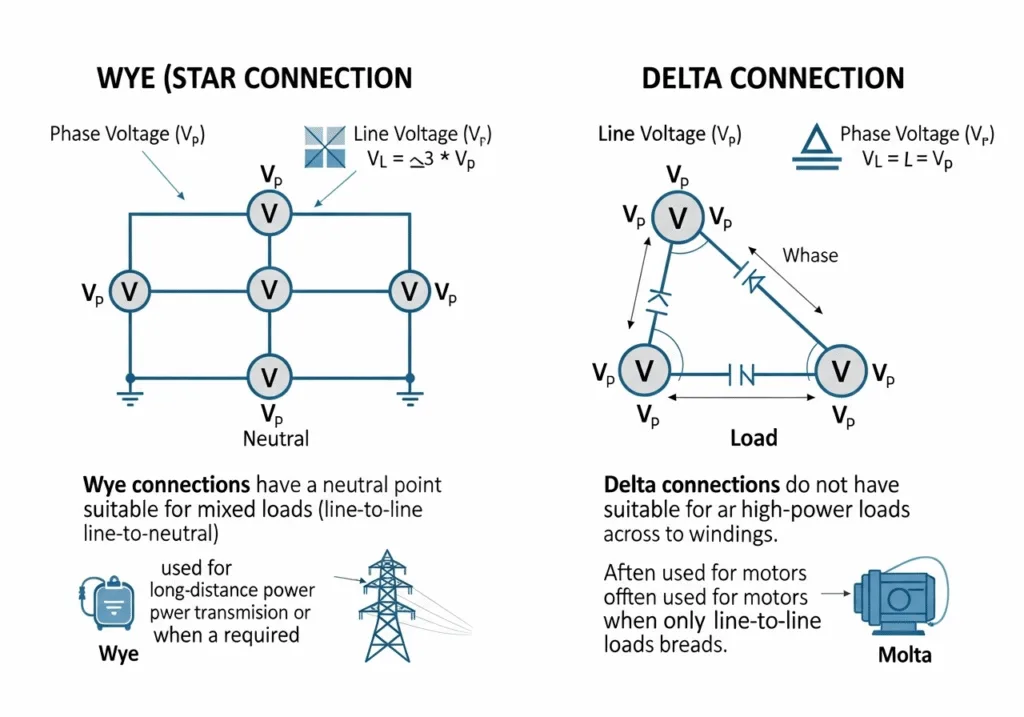
Wye vs. Delta: Which Connection Are You Measuring?
In a delta connection, line voltage equals phase voltage. In a wye (star) connection, line voltage is √3 times phase voltage. Standard 3-phase power formulas always use line voltage and line current, regardless of configuration.
This is the mix-up that got the contractor I mentioned earlier. He read phase voltage off a wye-connected panel and plugged it straight into a line-voltage formula. The transformer was sized for roughly 58% of what it actually needed to carry.
| Configuration | Line Voltage | Common Use |
|---|---|---|
| Delta | Equal to phase voltage | Industrial motor loads, older distribution |
| Wye (Star) | √3 × phase voltage | Utility distribution, systems needing a neutral |
What Mistakes Throw Off 3-Phase Power Calculations?
The four most common errors are confusing phase voltage with line voltage, mixing up kV/V or mA/A units, guessing at power factor instead of measuring it, and skipping the safety margin for startup currents. Any one of these can throw results off by 10% or more.
- Phase vs. line voltage. Always use line voltage in the standard formula. Check your connection type first.
- Unit mismatches. Entering kV where the field expects V multiplies your result by 1,000. Same problem with mA vs. A.
- Assumed power factor. A motor’s rated PF and its actual operating PF under partial load can differ by 0.2 or more. Measure it when you can.
- No safety margin. Add 15–25% beyond your calculated value for equipment sizing, to cover startup inrush and future load growth.
Where Does This Actually Get Used?
Manufacturing plants running 15–20 motors off a single 415V line need accurate kVA totals to avoid overloading the transformer during peak shifts.
Data centers size backup generators off these same numbers, often cross-checked against a dedicated generator sizing calculator. Get it wrong and you find out during an outage, which is the worst possible time.
Agricultural operations running 3-phase submersible pumps use it to size cable runs that can stretch hundreds of feet from the panel to the field.
Construction sites size temporary power distribution for welders, mixers, and tower cranes, where load calculations directly affect what gets inspected and approved.
Once you have your kVA figure, run it through our cable size calculator to size conductors correctly. For motor loads specifically, the VFD sizing calculator takes your kW result a step further. And if you’re still deciding between single-phase and three-phase for a new installation, our single vs. 3-phase comparison calculator breaks down the real cost difference.
Frequently Asked Questions
What’s the difference between kW and kVA?
kW measures real power, the portion actually doing work, like running a motor or producing heat. kVA measures apparent power, the total flowing through the system including reactive power. You pay your utility for kW, but you size cable and transformers for kVA.
How does a 3-phase power calculator work?
It applies S = √3 × V × I ÷ 1000 for apparent power and P = √3 × V × I × PF ÷ 1000 for real power, using your entered line voltage, line current, and power factor. The √3 constant accounts for the 120-degree offset between the three phases.
Why should I use a calculator instead of doing the math by hand?
A calculator validates your inputs automatically, flagging an out-of-range power factor or a suspiciously high voltage before you act on a bad number. Manual math under deadline pressure is exactly where unit and voltage mix-ups happen.
When do I need kVA instead of kW?
Use kVA any time you’re sizing cable, breakers, or transformers, since that equipment has to carry the full apparent power, not just the productive portion. Use kW for energy cost calculations and comparing actual equipment output.
What’s the formula for 3-phase current?
I (A) = (kVA × 1000) ÷ (√3 × V), or I (A) = (kW × 1000) ÷ (√3 × V × PF) if you’re starting from real power. Both formulas return the same current for a balanced three-phase load.
Can I use a 3-phase calculator for single-phase systems?
No. Three-phase formulas include the √3 multiplier, which doesn’t apply to single-phase circuits. For single-phase, use P = V × I × PF and S = V × I without the √3 factor.
3-phase power calculator vs. manual calculation: which is more accurate?
Both use the same formula, so accuracy comes down to input quality either way. The calculator’s advantage is catching unit errors and out-of-range values instantly, which is where most manual calculations actually go wrong.
What power factor range should I expect on a healthy system?
Industrial standards target 0.85 to 0.95 for efficient operation. Utilities commonly penalize values below 0.85, while anything below 0.1 or above 1.0 signals a measurement error rather than a real reading.
Is this 3-phase power calculator worth using for professional work?
Yes, provided your inputs are measured accurately. The formulas are standard and match IEEE 1459-2010 definitions, so results within 0.1% precision depend entirely on the quality of the voltage, current, and PF you enter.
Run your numbers in 30 seconds
Get power factor right, use line voltage and line current consistently, and double-check your units. Those three habits prevent nearly every calculation error engineers run into with three-phase systems.
Open the 3-Phase Power CalculatorSources & Further Reading
Last updated: July 2, 2026 · Next review: January 2, 2027
- IEEE. “IEEE Std 1459-2010 — Power Measurement Definitions.” standards.ieee.org
- NFPA. “NEC Article 220: Load Calculations.” nfpa.org
- IEC. “IEC 60038: Standard Voltages.” webstore.iec.ch
- Siemens. “Power Factor Correction Resources.” siemens.com