

Brick and Block Masonry Calculator: Get Your Material Order Right
You’re standing at the builders’ merchant with a wall in your head and no real number to give the guy behind the counter. Sound familiar?
A brick and block masonry calculator solves that problem in about 90 seconds. Punch in your wall size, pick your unit type, and it tells you exactly how many bricks or blocks, how much cement, and how much sand your wall actually needs.
Most sites over-order by 15% “just to be safe” and then eat the storage costs, or under-order and pay for a rush delivery that costs more than the materials. Neither is smart. This guide walks through how the calculator on this page works, why the numbers matter more than people think, and where estimates usually go wrong.

What Is a Brick and Block Masonry Calculator?
A brick and block masonry calculator is a tool that turns your wall dimensions into a material list: units needed, mortar volume, cement bags, and sand quantity. Enter your wall size, unit type, and mortar joint thickness, and it does the arithmetic instantly instead of you working it out on the back of a delivery note.
Think of it as the quantity surveyor you don’t have to pay by the hour. It takes the same inputs a mason would eyeball on-site, wall length, height, opening sizes, brick or block dimensions, and mortar joint thickness, and runs them through the standard masonry formulas.
What comes out the other end answers the four questions every project manager asks before placing an order:
- How many bricks or blocks does this wall need?
- How much mortar has to be mixed?
- How many bags of cement should I buy?
- How much sand goes with it?
A good calculator, like the one above, also handles regional brick sizes (South Asia, Europe, USA, Australia), switches between clay brick, solid block, hollow block, and AAC/CLC block, and converts between metric and imperial without you touching a calculator app on your phone.
Why Accurate Estimation Actually Matters
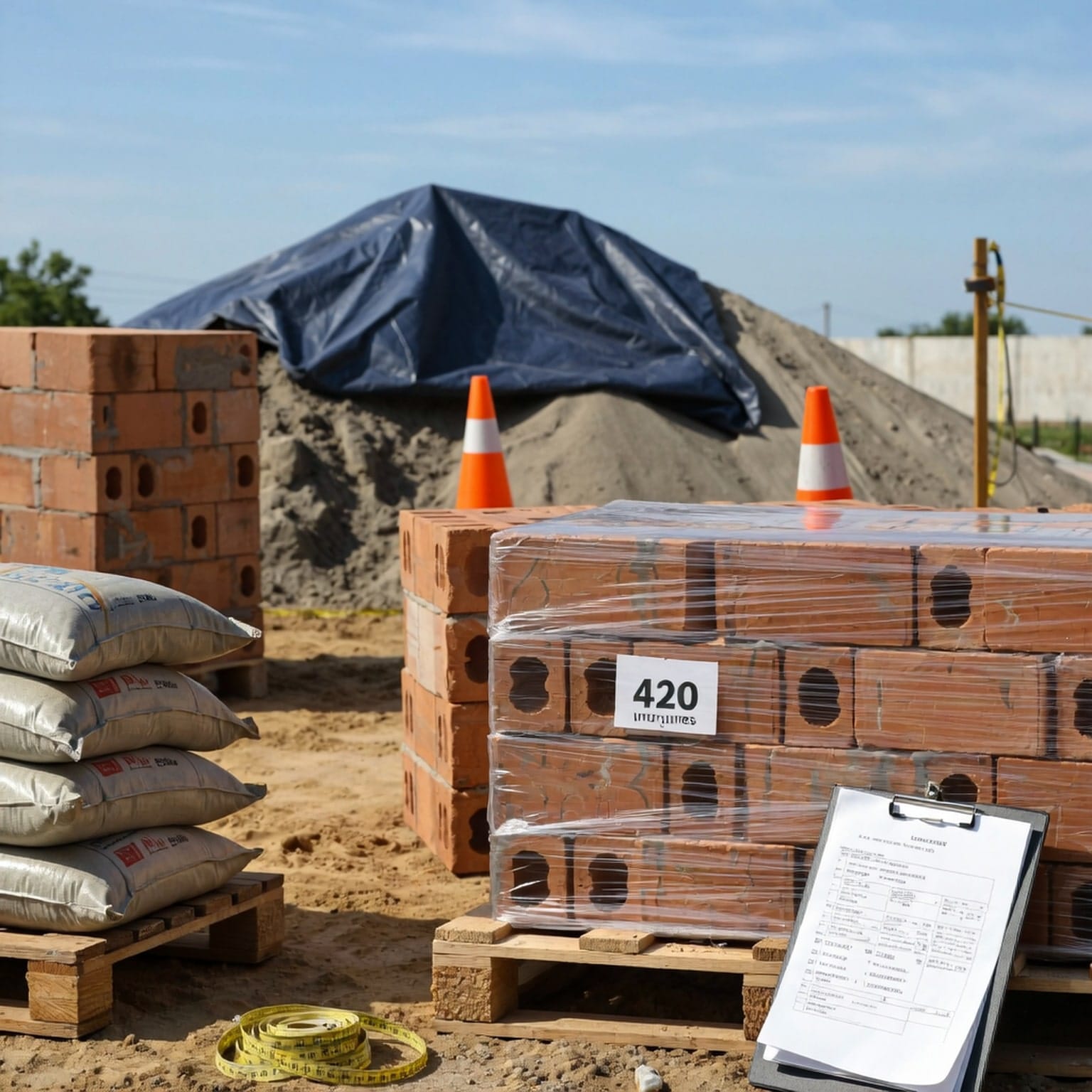
Getting material quantities wrong costs money twice: once on emergency re-orders when you under-buy, and again on wasted stock and storage when you over-buy. A 10% shortfall on a mid-size wall can add hundreds of dollars in rush fees and days of downtime for the mason crew.
I’ve watched a two-day job stretch to five because someone eyeballed the brick count and came up 200 short. The supplier had them, but not until Thursday. Three masons stood around a half-built wall for two days waiting on a truck.
That’s the real cost of a bad guess. It’s rarely the materials themselves, it’s the labor sitting idle and the schedule falling apart behind it.
What Under-Ordering Costs You
A rush order usually carries a delivery surcharge, and if the shortfall pulls from a different production batch, you’ll see color and dimension mismatches in the finished wall. That’s a callback waiting to happen.
What Over-Ordering Costs You
Extra pallets sitting on-site for months tie up cash and space. Bricks left exposed to weather can also degrade before you get to use them, especially clay units that pick up moisture and salts.
The Quality Angle Nobody Talks About
When you order the right quantity up front, every unit comes from the same batch. That matters more than most people think: color drift between batches is one of the most common complaints on finished brick facades.
There’s also a sustainability angle. Masonry waste is a meaningful chunk of construction landfill. Ordering accurately, instead of the traditional “add 15% and hope,” cuts down on what gets thrown away.
Clay Bricks vs Concrete Blocks: Which One Fits Your Wall?
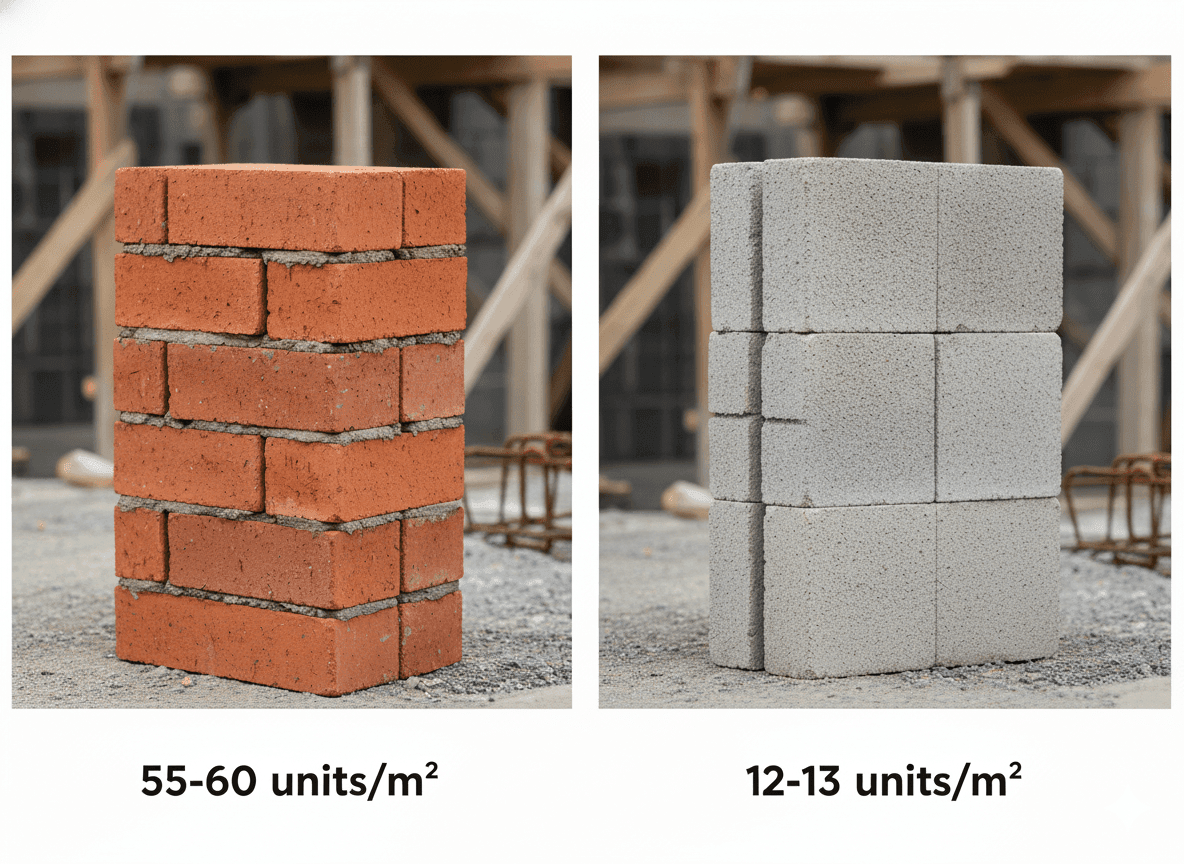
Clay bricks suit decorative facades, curved walls, and load-bearing residential work but need 55 to 60 units per square meter and more skilled labor. Concrete blocks cover the same wall in 12 to 13 units per square meter, going up 3 to 4 times faster, which makes them the default for commercial and high-rise construction.
Bricks are the traditional choice for a reason. A standard South Asian clay brick runs around 190mm x 90mm x 90mm, small enough to handle curves, corners, and decorative patterns that concrete block simply can’t do.
The tradeoff is labor. More units means more time laying them, and clay brick masonry demands a skilled hand to keep joints consistent.
Blocks flip that equation. A standard hollow block at 390mm x 190mm x 190mm covers the same wall area with roughly a fifth of the units. Three types dominate the market:
- Solid blocks: dense and strong, built for load-bearing walls.
- Hollow blocks: lighter, with air cavities that add insulation and cut cement use.
- AAC/CLC blocks: ultra-lightweight, best thermal performance, lowest mortar consumption of the four.
| Unit Type | Mortar Fraction | Unit Weight | Best For |
|---|---|---|---|
| Clay Brick | ~28% | 18-20 kg | Facades, residential, decorative |
| Solid Concrete Block | ~18% | 25-30 kg | Load-bearing, commercial |
| Hollow Concrete Block | ~12% | 10-15 kg | Partitions, non-structural |
| AAC/CLC Block | ~8% | 6-10 kg | Insulation, lightweight builds |
Your masonry calculator needs to know which one you’re using, because mortar fraction alone changes cement consumption by more than 3x between AAC block and clay brick.
How the Calculator Works, Step by Step
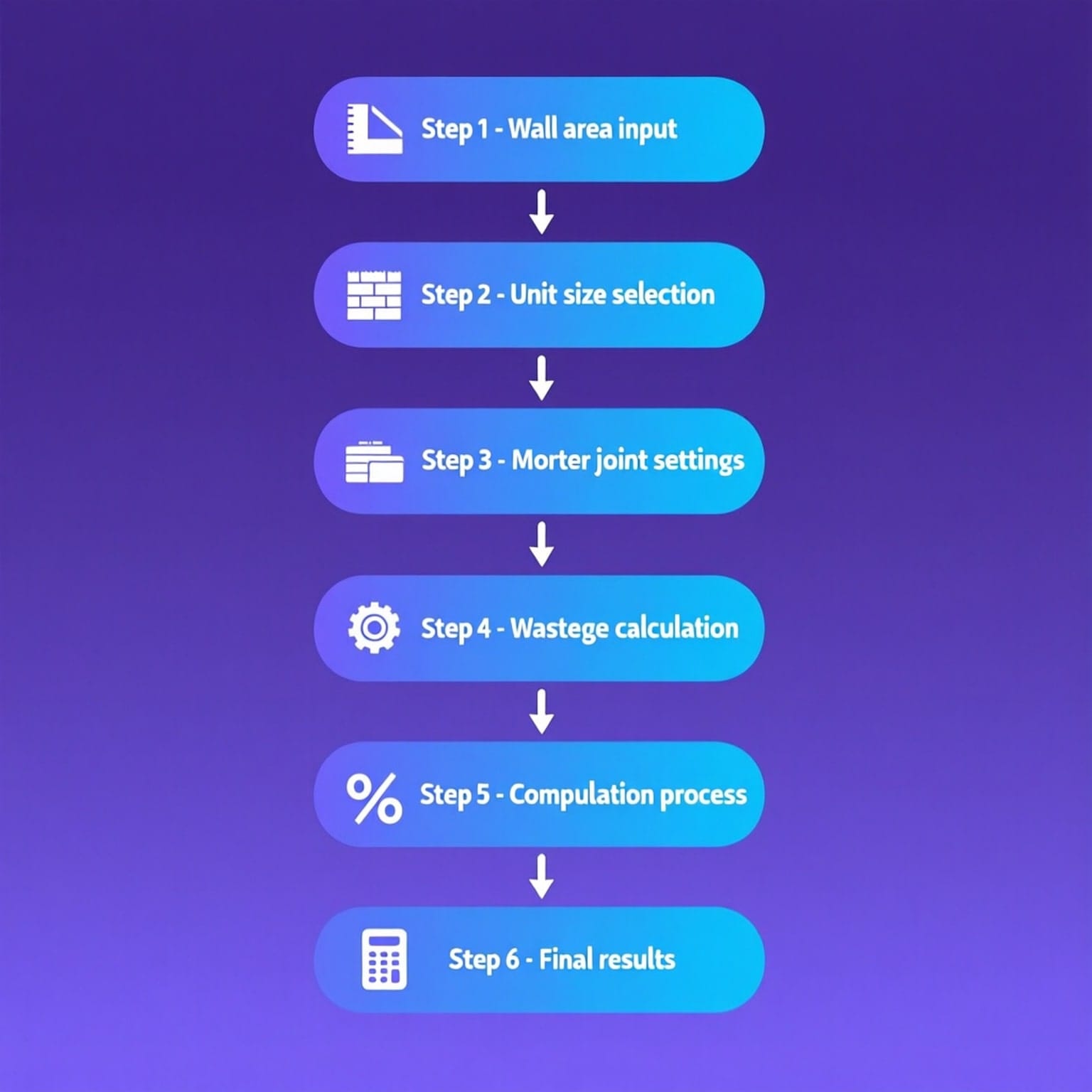
The calculator subtracts openings from your gross wall area, divides the result by the unit’s footprint (including the mortar joint), adds your wastage percentage, then converts the mortar volume into cement bags and sand based on your chosen mix ratio. Six steps, all instant.
Step 1: Net Wall Area
Gross wall area minus door, window, and vent openings. A 10m² wall with a 2m² door leaves 8m² of actual masonry to build.
Step 2: Units Required
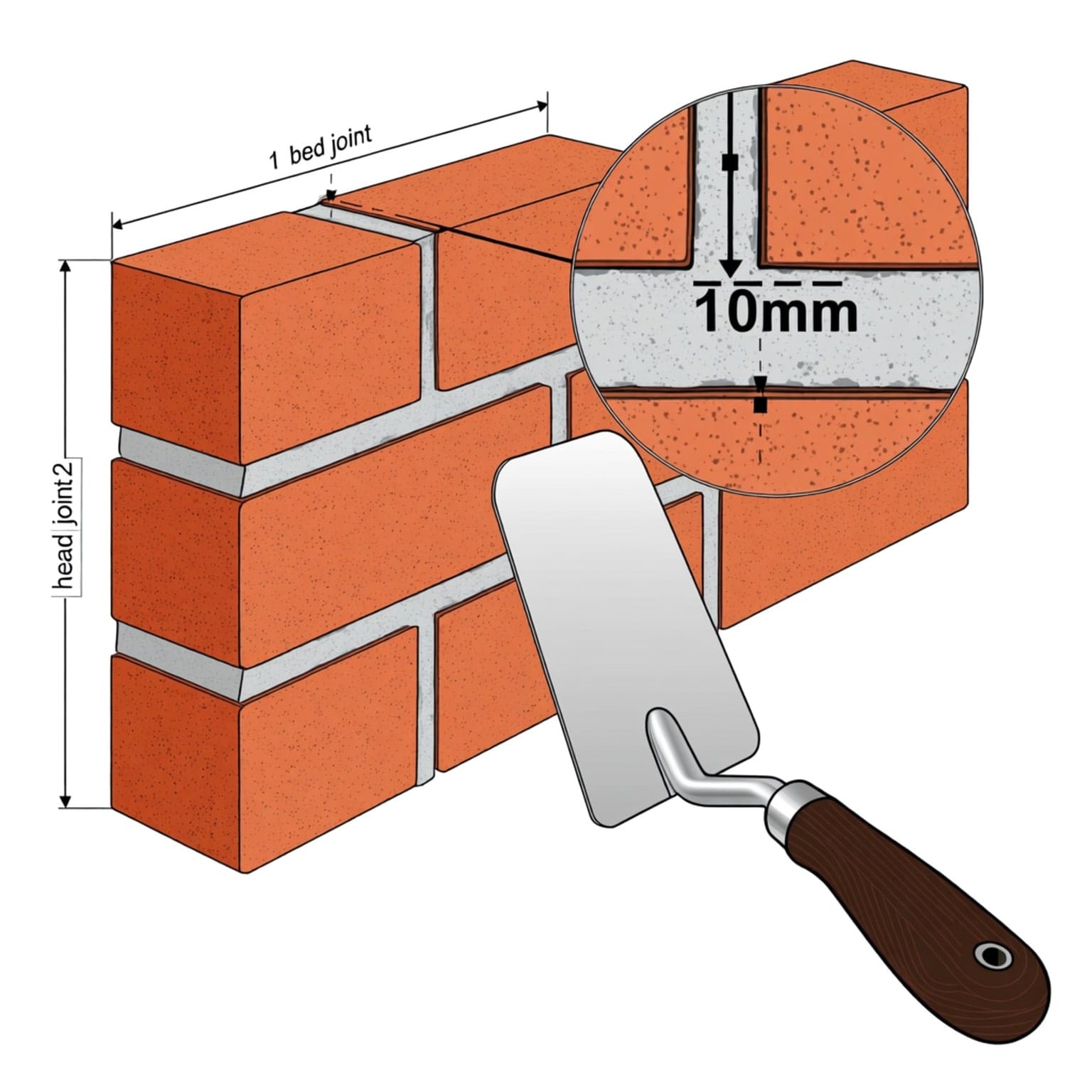
The calculator adds the mortar joint to both the unit’s length and height, multiplies them, and divides that into 1 to get units per square meter.
For a 190mm x 90mm brick with a 10mm joint: (0.19+0.01) x (0.09+0.01) = 0.02m². That’s 50 units per square meter.
Step 3: Add Wastage
Breakage, cutting, and rejected units all eat into your count. A 3-5% wastage buffer covers straightforward walls.
Step 4: Mortar Volume
Wall volume (net area x wall thickness) multiplied by the mortar fraction for your unit type.
Step 5: Cement and Sand
The mix ratio splits mortar volume between cement and sand, with a 1.33 bulking factor for mixing and compaction loss.
Run a 1:6 mix on 0.5m³ of mortar: cement volume comes out to roughly 0.095m³, which converts to about 3 bags at 50kg each.
Step 6: Full Breakdown
Everything lands in one summary: total units, cement bags, sand volume, mortar volume, and (on the calculator above) a 2D preview of how the units lay out across your wall.
Brick and Block Sizes by Region
A brick isn’t a brick everywhere. Standard dimensions shift by region, and using the wrong preset throws your whole estimate off by 8-10 units per square meter.
| Region | Standard Size (L×H×W) | Units per m² | Common Mix Ratio |
|---|---|---|---|
| South Asia | 190 × 90 × 90 mm | 55-60 | 1:6 |
| Europe | 215 × 65 × 102.5 mm | 50-52 | 1:5 |
| United States | 194 × 57 × 92 mm | 60-65 | 1:4 |
| Australia | 230 × 76 × 110 mm | 48-50 | 1:6 |
| Concrete Block (universal) | 390 × 190 × 190 mm | 12-13 | 1:5 |
Maria, a contractor in Toronto, told me she once ran a US brick preset on a European-spec renovation. The order came up short by almost 300 units on a mid-size extension. Ten minutes of double-checking the regional setting would have caught it.
If your supplier’s units differ even slightly from the regional default, measure a sample and enter custom dimensions. The calculator’s accuracy only holds if the inputs match reality.
Estimation Mistakes That Cost You Money
The most expensive masonry estimation mistakes are ignoring mortar joint thickness, forgetting to subtract door and window openings, and applying too little wastage on complex layouts. Each one alone can throw a material order off by 5-25%.
- Skipping the mortar joint. A 10mm joint reduces usable unit area by 5-7%. Leave it out and your count runs high.
- Forgetting wall thickness. A single-width wall (110mm) uses far less mortar than a double-width one (230mm). Confirm which you’re building before you run the numbers.
- Under-buffering wastage. 3% works for a plain rectangular wall. Curved sections, multiple corners, or an inexperienced crew push that closer to 8%.
- Mixing unit systems. Entering brick length in inches while your area is in square meters is a fast way to get a nonsense result.
- Ignoring gross-vs-net area. Skipping the opening subtraction inflates a typical residential order by 15-25%.
- Trusting catalog dimensions blindly. Manufacturer specs sometimes drift from what actually ships. Measure a sample unit when the order is large.
- No buffer for corners and returns. Cut bricks at junctions add up. Give complex layouts an extra 2-3%.
| Project Type | Wastage % | Risk Level |
|---|---|---|
| Straightforward walls | 3-5% | Low |
| Complex layouts, corners, curves | 5-8% | Medium |
| Decorative or patterned work | 8-12% | High |
| Remote or hard-to-access sites | 8-10% | High |
| Low-quality or inconsistent units | 10-15% | Very High |
Choosing the Right Mortar Mix Ratio
The mix ratio you pick changes strength, cost, and workability all at once. Going cheaper than the job calls for isn’t a savings, it’s a liability with a delay.
| Mix (C:S) | Strength | Best Use | Relative Cost |
|---|---|---|---|
| 1:3 | 7-10 MPa | Load-bearing, structural walls | High |
| 1:4 | 5-7 MPa | Exterior walls, foundations | Moderate-High |
| 1:5 | 3-5 MPa | Internal walls, general residential | Moderate |
| 1:6 | 2-3 MPa | Non-load-bearing, garden walls | Low |
| 1:8 | <2 MPa | Temporary work, plaster base | Very Low |
A 1:6 mix on a wall that needed 1:4 might save $50 on cement today. It can cost thousands in repairs later if the wall underperforms. Pick the ratio based on what the wall has to do, not just what’s cheapest at the counter.
Ready to Run Your Numbers?
Scroll back up and use the brick and block masonry calculator above to get your exact unit, cement, and sand quantities in under a minute.
Back to the CalculatorFrequently Asked Questions
Standard brick size depends on region: South Asia uses roughly 190×90×90mm, Europe uses 215×65×102.5mm, and the US uses a 194×57×92mm modular brick. A good calculator lets you pick a regional preset or enter your supplier’s exact dimensions.
Divide 1 by the combined footprint of the brick plus its mortar joint. A 190mm brick with a 10mm joint works out to roughly 50 units per square meter. Larger regional bricks or thicker joints lower that number.
1:6 works fine for non-structural walls like garden boundaries. Load-bearing walls generally need 1:5 or 1:4 for the extra strength. Check local building code before finalizing your mix.
3-5% covers a plain, straight wall with an experienced crew. Curved walls, multiple corners, or decorative patterns push that to 8-12%. Remote sites with limited access usually add a bit more on top.
Yes, as long as it adjusts mortar fraction and coverage per unit type. Blocks use a lower mortar fraction than bricks because of their larger size and, for hollow types, internal cavities.
Hollow blocks use around 12% mortar fraction versus 18% for solid blocks, cutting cement use by roughly a third. Coverage per square meter stays similar for both, but solid blocks weigh nearly double, which affects labor pace.
Calculators assume ideal, uniform conditions. Real sites have uneven surfaces, breakage, and skill variation. Add a small 2-3% buffer on top of your calculated figure to cover the gap.
Always. Skipping this step is one of the most common estimation errors and can inflate a residential material order by 15-25%. Enter net wall area, not gross, for an accurate count.
Getting Your Order Right the First Time
Accurate material estimation isn’t a nice-to-have. It’s what keeps a build on schedule and on budget, and it’s the difference between a mason crew laying bricks and a mason crew standing around waiting for a delivery truck.
Use the brick and block masonry calculator above with real dimensions, the correct regional preset, and a wastage number that matches your layout’s complexity. Skip the old habit of adding a flat 15% “just in case.” It wastes money in the other direction.
Measure twice, run the calculator once, and order with confidence.
References
- British Standards Institution (BSI) — BS EN 771-1:2011+A1:2015, Specification for Masonry Units.
- American Concrete Institute (ACI) — ACI 530-13, Building Code Requirements for Masonry Structures.
- Bureau of Indian Standards (BIS) — IS 1077:1992, Common Burnt Clay Building Bricks Specification.
- ASTM International — ASTM C90, Standard Specification for Loadbearing Concrete Masonry Units.
- National Concrete Masonry Association (NCMA) — TEK Manual, Concrete Masonry Design and Construction Reference.
Written by Nouman Ahmed
Civil Engineer • Solar Energy Consultant • Software Developer
Nouman is the founder of Solvebility, with practical experience in solar PV system design, engineering calculations, and calculator development since 2011. This tool was built by Nouman and reviewed by the Solvebility engineering team to verify formulas, assumptions, and calculation accuracy before publication — and is updated whenever industry standards change.