
Last Updated: July 17, 2026 | Next Review: January 2027
PV Array String Configuration Calculator
Live calculations, validation warnings, and exportable BOM (CSV).
Module & Site Inputs
Results & Validation
Validation Warnings
Quick BOM
| Item | Value |
|---|---|
| Modules per string | -- |
| Number of strings | -- |
| Total modules | -- |
PV Array String Configuration Calculator: How to Size Solar Strings Without Guesswork
A PV array string configuration calculator tells you how many modules to wire in series before you buy an inverter, order conduit, or send a design to permitting. Get that number wrong and you’re looking at a tripped inverter, a failed inspection, or inverter over-voltage faults, failed inspections, and costly system redesigns.
This guide walks through the voltage math behind string sizing, shows you how to run it with our free calculator, and covers the mistakes that trip up even experienced installers.
What Is PV Array String Configuration?
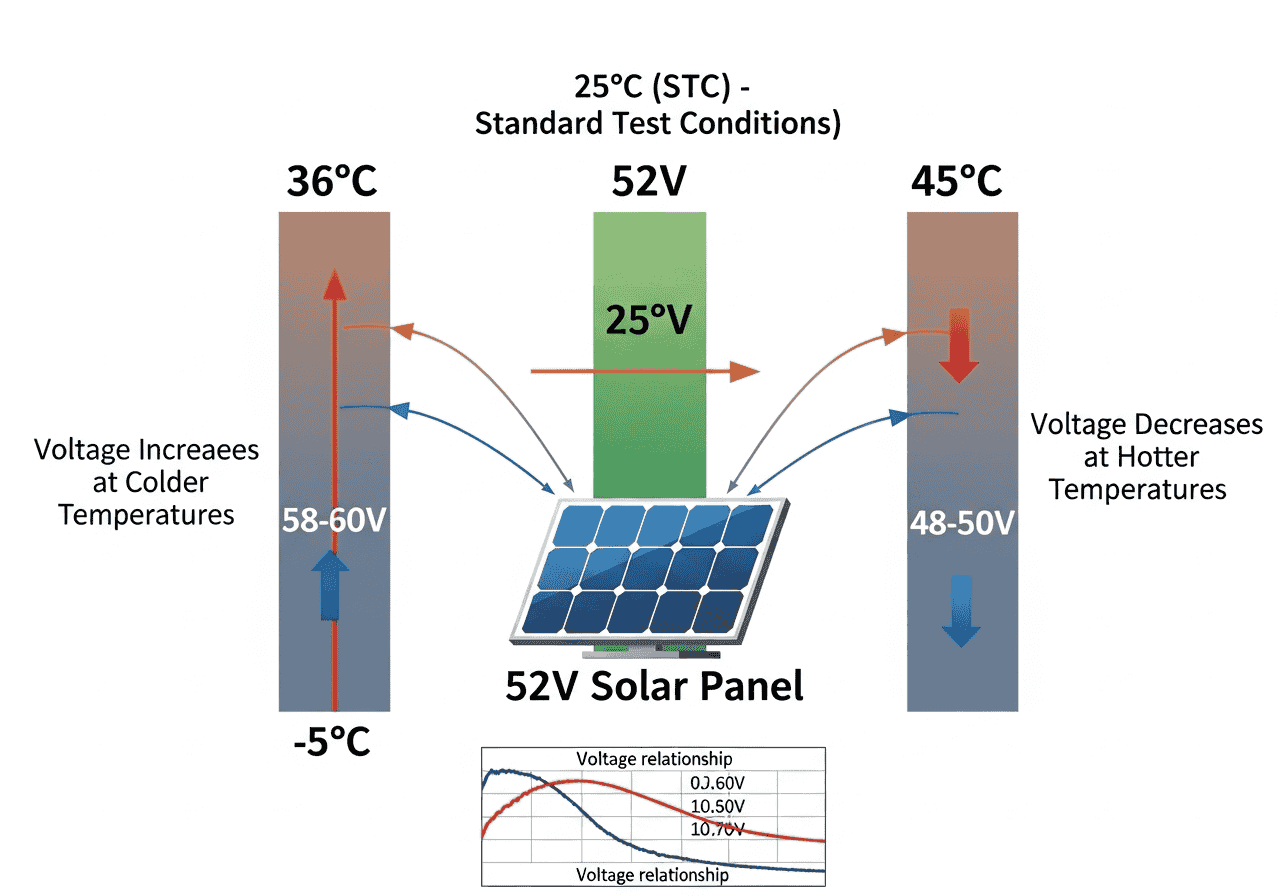
Wire modules in series and their voltages stack. Ten 40V modules in series give you a 400V string. That part is simple arithmetic. The complication is that a module’s voltage isn’t fixed. It moves with temperature, and it moves more than most people expect.
Get the string count wrong on the high side and you can push voltage past your inverter’s absolute maximum on a cold morning, which is the kind of mistake that kills DC input circuits. Get it wrong on the low side and your string voltage falls below the inverter’s MPPT window on hot afternoons, and you lose production every single day the sun is out.
Why Does String Voltage Change With Temperature?
Every module datasheet lists Voc and Vmp measured at Standard Test Conditions (STC): 25°C cell temperature, 1000 W/m² irradiance. Real installations rarely sit at 25°C. On a clear winter morning before sunrise, cell temperature can track close to ambient air temperature, and ambient can easily sit well below freezing.
The correction formula every calculator, including ours, runs behind the scenes is:
Voc_cold = Voc × (1 + (tempCoeff / 100) × (T_cold − 25))
Say a module is rated 38.3V Voc with a -0.30%/°C temperature coefficient, and your coldest expected site temperature is -5°C. Plug it in:
38.3 × (1 + (-0.30/100) × (-5 – 25)) = 38.3 × 1.09 = 41.75V
That’s a 9% jump over nameplate. Multiply by a 24-module string and the difference between using the STC number and the cold-corrected number is 82.8V, more than enough to push a marginal design over a 1000V inverter limit.
How Do You Use the PV Array String Configuration Calculator?
Here’s the workflow, start to finish.
Step 1: Pull module data from the datasheet
You need Voc, Vmp, and the Voc temperature coefficient (almost always negative, typically -0.25% to -0.35%/°C for crystalline silicon). Use the datasheet number, not the number on a spec sheet summary or a sales flyer. Those two documents disagree more often than they should.
Step 2: Set your coldest site temperature
Use the minimum design temperature recommended by your local electrical code, meteorological data, or project specification. Many designers also include an additional safety margin for unusually cold conditions, particularly in regions with large seasonal temperature swings.
Step 3: Enter your inverter’s voltage window
You’ll need two numbers here, not one. The MPPT minimum is the lowest voltage where the inverter can still track maximum power. The absolute maximum DC input is the hard ceiling you can never cross, cold morning or not.
Step 4: Read the validation results
The calculator checks your string count against both limits at once. It shows the cold-corrected Voc, the recommended module count, and any warnings before you commit to a design.
Step 5: Export and document
The CSV export gives you a clean bill of materials for permit packages, client proposals, and the install crew. Inspectors want to see documented assumptions, not a number pulled from memory.
Typical PV Module Voc and Vmp Values by Panel Class
Datasheet values still vary by manufacturer, but here’s what you’ll typically see across common module classes, useful as a sanity check before you run your own numbers.
| Module class | Voc range | Vmp range | Typical temp. coefficient (Voc) | Common use |
|---|---|---|---|---|
| 350-400W residential | 39-41V | 33-35V | -0.27 to -0.30%/°C | Rooftop residential |
| 400-450W residential/light commercial | 41-45V | 34-38V | -0.26 to -0.29%/°C | Rooftop, small commercial |
| 500-550W commercial/utility | 45-50V | 38-42V | -0.25 to -0.28%/°C | Ground mount, C&I |
| N-type TOPCon/HJT premium | 40-46V | 34-39V | -0.24 to -0.27%/°C | High-efficiency installs |
Always confirm against the specific manufacturer datasheet. These are typical ranges, not substitutes for real numbers.
Common String Sizing Mistakes (And How to Avoid Them)
Skipping the temperature correction
Using nameplate Voc without adjusting for cold weather is the single most common error. A string that looks safe at STC can land 8-13% higher on a January morning. Run the correction every time, even when the climate feels mild.
Confusing MPPT range with absolute maximum
An inverter rated for 1000V DC input might have an MPPT window of only 200-850V. A string that stays under the hard limit but sits outside the MPPT band still loses production, even though nothing gets damaged.
Applying inconsistent safety margins
Random safety factors that change from project to project look unprofessional to inspectors and make it harder to defend a design later. Document your temperature assumption and margin on every job, and keep them consistent.
Ignoring module mismatch
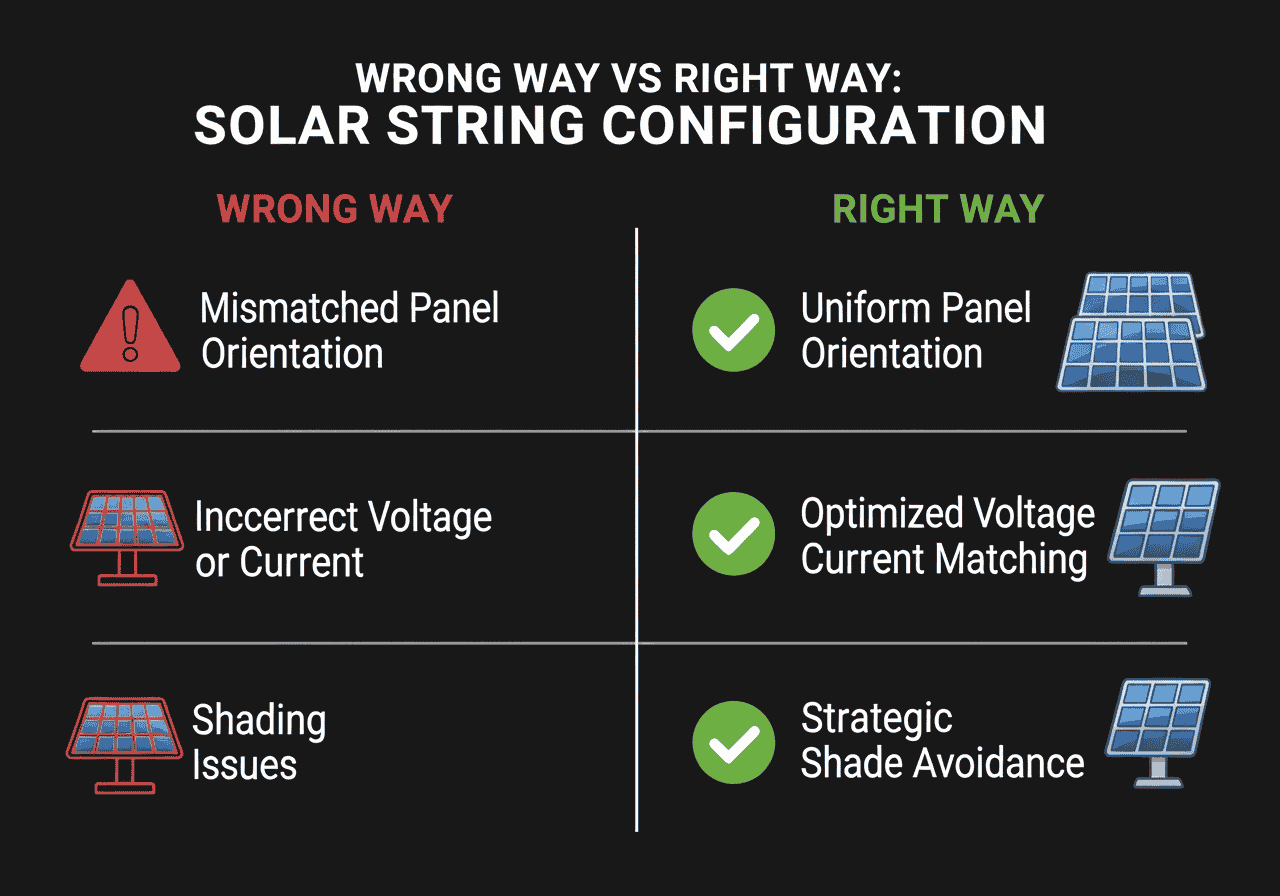
Manufacturing tolerance, soiling, and partial shading mean modules in a string rarely perform identically. The weakest module in the string caps the whole string’s output. Tighter power tolerances (±3% or better) and, in shaded conditions, power optimizers, cut down on this loss.
String Sizing Across Three Climates
The same module and inverter combination can call for a different string count depending on where the system sits. Here’s how the math plays out across three climate profiles, using a module rated 40V Voc, -0.29%/°C, and an inverter with a 1000V max input.
| Climate profile | Design cold temp. | Voc at cold temp. | Max modules/string (under 1000V) |
|---|---|---|---|
| Mild (coastal California) | 0°C | 42.9V | 23 |
| Cold (Upper Midwest) | -25°C | 45.8V | 21 |
| Extreme cold, high altitude (Rockies) | -32°C | 46.6V | 21 |
Notice the swing is only 2 modules between the mildest and harshest sites in this example, but that difference is exactly the gap between a design that clears inspection and one that gets flagged.
Advanced Tips for Professional String Design
Plan for extreme weather conditions. Historical weather records are useful, but unusually cold events can still occur. Selecting an appropriate minimum design temperature and applying a reasonable engineering safety margin helps ensure the PV array remains within the inverter’s voltage limits.
Leave headroom for future inverters. Modules last 25-30 years; inverters typically get replaced once or twice in that span. Avoid designing to the very edge of your current inverter’s voltage window so a future swap has room to work with.
Test multiple scenarios before locking a design. Run best-case, worst-case, and a 10-year degradation scenario through the calculator. A string that’s fine today can drift as components age.
FAQ: PV Array String Configuration Calculator
What happens if I exceed my inverter’s maximum voltage?
You risk permanent damage to the inverter’s DC input circuits, voided warranties, and in the worst cases, arc-flash hazards. Modern inverters have protection circuits, but they aren’t a substitute for correct sizing.
How many modules should be in a string?
It depends on your module’s Voc and temperature coefficient, your coldest site temperature, and your inverter’s MPPT and max voltage range. There’s no fixed number. Run your specific inputs through the calculator rather than relying on a rule of thumb.
Does hot weather ever cause a string sizing problem?
Yes, but in the opposite direction. High heat lowers module voltage, and a string sized too short can drop below your inverter’s MPPT minimum on the hottest afternoons, cutting production even though nothing is damaged.
Can I mix different module models in one string?
Generally no. Mismatched voltage and current characteristics between different modules reduce the whole string’s output. If two modules share identical electrical specs but different physical dimensions, confirm compatibility with the manufacturer before mixing.
How often should I recalculate string configuration?
For an existing system, only when you’re adding modules or replacing the inverter. For every new design, always run current module specs and site conditions, since panel specifications change often as technology improves.
What’s the difference between a string and an array?
A string is a set of modules wired in series, where voltage adds and current stays the same. An array is typically multiple strings wired in parallel, where current adds and voltage stays at the string level.
Is a string configuration calculator a substitute for an engineer’s review?
No. It’s a preliminary design tool that catches the most common voltage errors early. Always verify final designs against manufacturer datasheets and local electrical code, including NEC 690.7 requirements for maximum PV system voltage.
How do I calculate the maximum number of solar panels in a string?
Divide the inverter’s maximum DC input voltage by the module’s cold-corrected open-circuit voltage (Voc), then round the result down to the nearest whole number. Always verify the final design against the inverter manufacturer’s specifications and applicable electrical codes.
Key Takeaways
- Cold weather raises module voltage, sometimes by 10% or more over nameplate rating.
- Always check two limits, not one: the inverter’s absolute maximum and its MPPT window.
- Use the actual datasheet temperature coefficient for your specific module, not an industry average.
- Document your design temperature and safety margin on every project.
- Run the numbers again whenever module specs, inverter models, or site conditions change.
- Always verify final string sizing using the latest module and inverter manufacturer datasheets before installation.
A properly sized string is a small calculation that prevents a large repair bill. Run your module and inverter specs through the PV array string configuration calculator before you finalize a design, and pair it with the solar roof area estimator if you haven’t confirmed how many modules physically fit on site yet.
If you’re designing a full off-grid or hybrid system, check string voltage first, then size the inverter itself with the hybrid inverter sizing calculator and confirm daily energy needs with the solar watt-hour calculator. For sites with tricky roof angles, the PV panel tilt optimizer is worth running before you lock the layout.
Ready to size your strings?
Run your module and inverter specs through the free PV array string configuration calculator and get an instant, code-aware recommendation.
Open the CalculatorBrowse the rest of the energy calculators library, or head back to the Solvebility homepage to find tools for civil engineering, farming, and education projects.
Sources:U.S. Department of Energy – Solar Photovoltaic System Design Basics·IAEI Magazine – PV Math (NEC 690.7)·PV Education – Fundamentals of Solar Cell Operation·PV Education – Effect of Temperature
About This Guide
This guide was prepared by the Solvebility editorial team using manufacturer datasheets, U.S. Department of Energy resources, NEC guidance, and established photovoltaic engineering practices. Every calculation should be verified against the latest module and inverter documentation before installation.
Disclaimer: This guide and calculator provide preliminary design assistance. Always verify against manufacturer datasheets and consult local electrical code and a licensed professional before finalizing an installation.