
Fertilizer Dose Calculator
Compute kg/ha of fertilizers to meet N, P₂O₅, K₂O targets — accounts for purity, efficiency, overlap and cost.
Inputs
Fertilizer Mapping Table
| Fertilizer | N% | P₂O₅% | K₂O% | Cost per 50kg | Actions |
|---|
Fertilizer Dose Calculator – Smart NPK Requirement Tool for Crop Nutrition Planning
Calculate precise fertilizer requirements (N, P₂O₅, K₂O) for crops. Smart NPK calculator with Urea, DAP, MOP dosing, cost analysis & split application schedules

Introduction
Here's the thing—most farmers waste money on fertilizers. Not because they don't care, but because they're guessing.
You know what? Traditional fertilizer application methods often lead to either nutrient deficiency (stunted growth, poor yields) or over-fertilization (wasted money, environmental damage). A wheat farmer in Punjab might apply 3 bags of Urea "because that's what everyone does," without knowing if his soil actually needs that much nitrogen.
The problem is real: According to agricultural research, improper fertilizer use can reduce crop yields by 20-40% while increasing costs by 30% or more. That's literally throwing money into the soil—and not getting anything back.
What if you could calculate exactly how much Urea, DAP, and MOP your crops need? What if you knew the precise kg/ha for Nitrogen (N), Phosphorus (P₂O₅), and Potassium (K₂O) based on your target yield?
That's where a Fertilizer Dose Calculator comes in. This smart tool transforms guesswork into science, helping you compute accurate fertilizer requirements while accounting for nutrient purity, soil efficiency, and even budget constraints.
In this guide, you'll discover how to use this powerful calculator, understand the science behind NPK dosing, and master the formulas that'll save you thousands while boosting your harvest.
What is a Fertilizer Dose Calculator?
A Fertilizer Dose Calculator is an intelligent digital tool that computes the exact quantity of fertilizers needed to meet your crop's nutrient requirements. Think of it as a GPS for your field—instead of wandering around guessing directions, you get precise coordinates.
Why Traditional Methods Fail
Traditional fertilizer application relies on:
- Generalized recommendations (ignoring soil variability)
- Experience-based estimates (subjective and inconsistent)
- Fixed ratios (not customized to crop needs)
- Single-nutrient focus (ignoring nutrient interactions)
The modern Fertilizer Dose Calculator solves these problems by considering multiple factors simultaneously—something impossible to do manually.
Key Features That Make It Essential
Multi-nutrient balancing: Unlike simple calculators, advanced tools account for the fact that fertilizers like DAP provide both Nitrogen AND Phosphorus. This overlap requires sophisticated linear algebra to solve correctly.
Cost optimization: The calculator doesn't just tell you what nutrients you need—it suggests the most economical fertilizer combinations to achieve your targets.
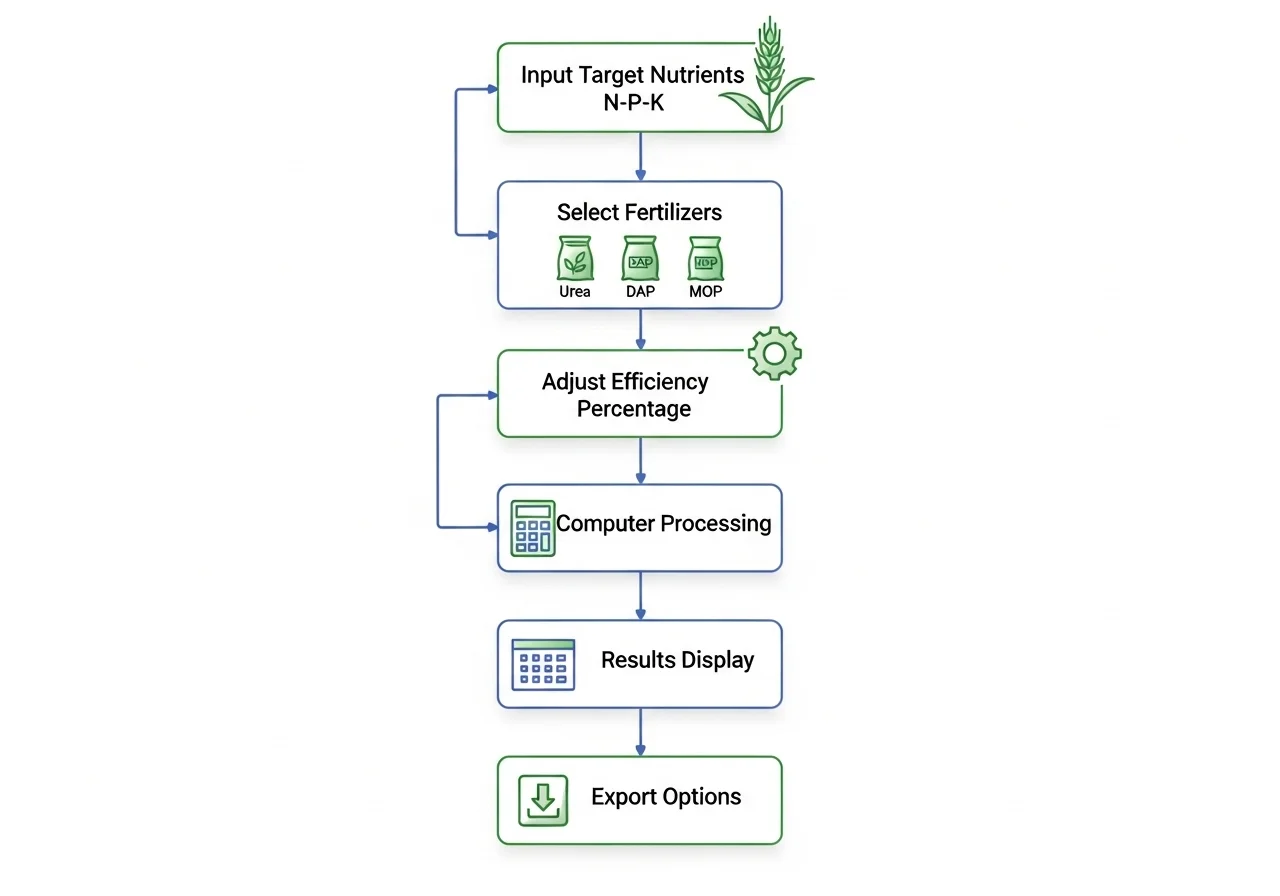
Efficiency adjustments: Real-world conditions mean not all applied nutrients reach your crops. The calculator adjusts for nutrient use efficiency (typically 70-85% depending on soil conditions and application method).
Split application scheduling: Growing crops need different nutrients at different stages. The tool helps you divide your total fertilizer dose into optimal timing schedules.
Understanding NPK: The Foundation of Crop Nutrition
Before diving into calculations, let's understand what you're actually calculating.
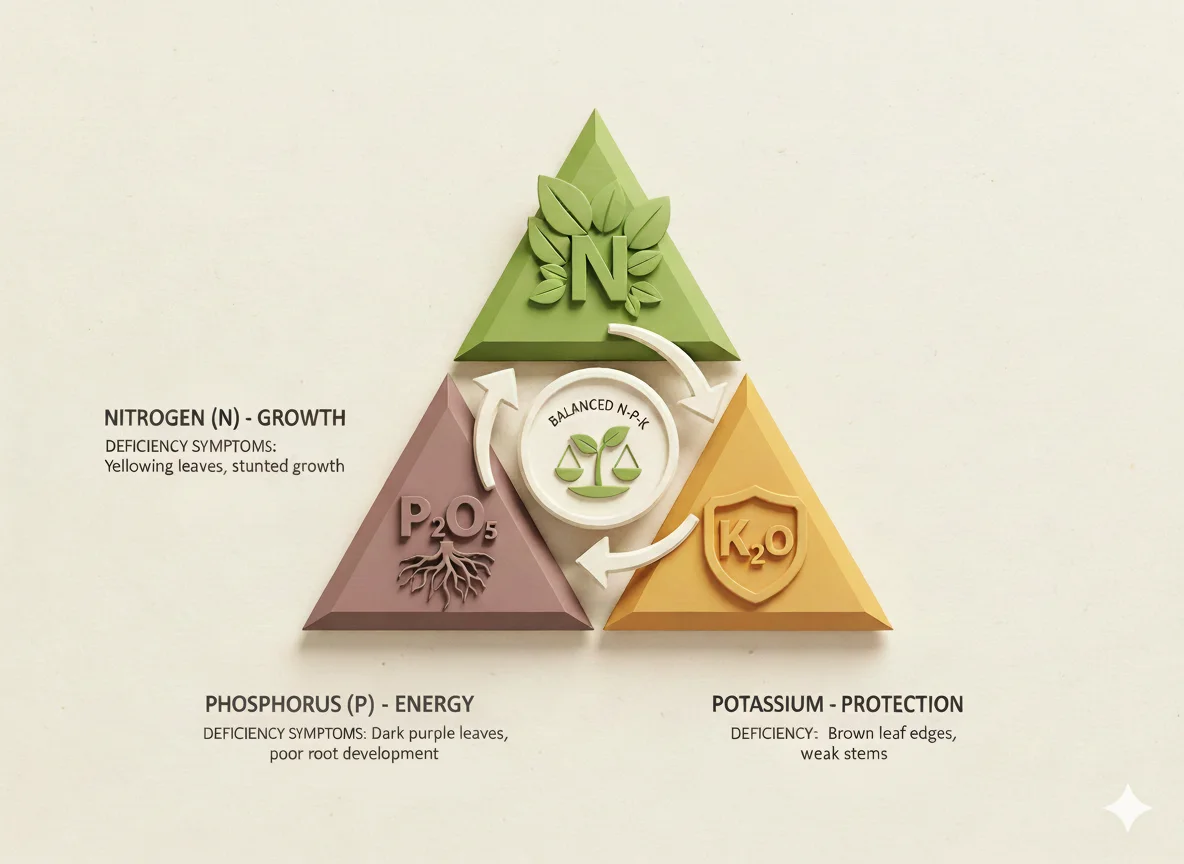
The NPK Triangle
Nitrogen (N): The growth engine. Nitrogen drives vegetative development, leaf formation, and protein synthesis. A corn plant needs significant N during its early growth stages—deficiency causes pale yellow leaves and stunted growth.
Phosphorus (P₂O₅): The energy currency. Phosphorus powers root development, flowering, and seed formation. It's critical during early growth and reproductive phases. Without adequate P, your wheat might grow tall but produce hollow grains.
Potassium (K₂O): The health guardian. Potassium regulates water uptake, disease resistance, and stress tolerance. It doesn't show dramatic visible effects like N, but its absence makes crops vulnerable to drought, frost, and diseases.
Why the Numbers Matter
When you see "46-0-0" on a Urea bag, it means 46% Nitrogen, 0% Phosphorus, 0% Potassium. For DAP (18-46-0), you're getting both N and P. This is where calculations get tricky—and why calculators are essential.
Regional Crop Requirements
Different crops and regions have vastly different nutrient needs. A rice paddy in Punjab might need 120-60-60 (N-P₂O₅-K₂O kg/ha), while cotton in Sindh requires 150-80-80. Wheat typically demands 120-90-60, and maize goes for 140-70-70.
These aren't random numbers—they're based on decades of agronomic research, soil testing, and yield response studies.
Regional Crop NPK Requirements
Recommended nutrient rates (kg/ha) by crop and region
| Crop | Region | N (kg/ha) | P₂O₅ (kg/ha) | K₂O (kg/ha) | Target Yield |
|---|---|---|---|---|---|
| Corn (Maize) | Iowa, USA | 180 | 80 | 90 | 10.5 ton/ha |
| Soybeans | Illinois, USA | 0 | 45 | 90 | 3.5 ton/ha |
| Winter Wheat | Kansas, USA | 110 | 50 | 40 | 4.0 ton/ha |
| Cotton | Texas, USA | 135 | 65 | 70 | 2.8 ton/ha |
| Canola (Rapeseed) | Saskatchewan, Canada | 120 | 55 | 45 | 2.8 ton/ha |
| Spring Wheat | Manitoba, Canada | 100 | 40 | 30 | 3.5 ton/ha |
| Barley | Alberta, Canada | 90 | 35 | 30 | 4.0 ton/ha |
| Wheat | Western Australia | 85 | 40 | 35 | 3.2 ton/ha |
| Canola | Victoria, Australia | 110 | 50 | 40 | 2.5 ton/ha |
| Barley | South Australia | 75 | 30 | 25 | 3.5 ton/ha |
| Winter Wheat | France | 160 | 70 | 60 | 7.5 ton/ha |
| Corn | Germany | 170 | 75 | 85 | 9.5 ton/ha |
| Sugar Beet | Netherlands | 140 | 60 | 180 | 70 ton/ha |
| Rapeseed | United Kingdom | 200 | 70 | 80 | 3.8 ton/ha |
| Sunflower | Spain | 100 | 60 | 70 | 2.5 ton/ha |
How the Fertilizer Dose Calculator Works: The Science Behind the Tool
Let's pull back the curtain and see the mathematical engine powering accurate fertilizer recommendations.
The Basic Formula
The foundation is deceptively simple:
Fertilizer Dose (kg/ha) = (Nutrient Requirement ÷ Nutrient %) × 100
Example: You need 120 kg/ha of Nitrogen, and you're using Urea (46% N).
Calculation: (120 ÷ 46) × 100 = 260.87 kg/ha of Urea
Simple enough, right? But here's where reality complicates things.
Accounting for Nutrient Use Efficiency
Not all applied nutrients reach your crops. Some leach away, some get fixed by soil, some volatilize. Agronomic research shows:
- Nitrogen efficiency: 70-85% (depends on application method)
- Phosphorus efficiency: 60-75% (depends on soil pH)
- Potassium efficiency: 80-90% (relatively stable)
The calculator adjusts your requirement upward to compensate. If you need 120 kg N and efficiency is 80%, the actual requirement becomes:
Adjusted N = 120 ÷ 0.80 = 150 kg/ha
The Multi-Fertilizer Challenge
Here's where manual calculation becomes nearly impossible. If you're using DAP (provides both N and P), Urea (only N), and MOP (only K), you need to solve a system of equations:
Let's say:
- x = kg/ha of Urea (46% N)
- y = kg/ha of DAP (18% N, 46% P₂O₅)
- z = kg/ha of MOP (60% K₂O)
Your requirements are 120 kg N, 60 kg P₂O₅, 60 kg K₂O.
The equations become:
- (0.46 × x) + (0.18 × y) = 120 (Nitrogen balance)
- (0.46 × y) = 60 (Phosphorus balance)
- (0.60 × z) = 60 (Potassium balance)
Solving this manually? Tedious and error-prone. The calculator uses Gaussian elimination with pivoting—a linear algebra technique that solves these multi-variable systems in milliseconds while accounting for efficiency and purity adjustments.
Purity Corrections
Commercial fertilizers aren't always pure. A bag labeled "Urea" might be 98% pure due to moisture or impurities. The calculator multiplies nutrient percentages by purity factors (typically 95-100%) to ensure accuracy.
Non-Negativity Constraints
Sometimes the mathematical solution suggests negative quantities (impossible in real life). The calculator enforces non-negativity by clipping negative values to zero and recalculating the achieved nutrient levels. This ensures practical, implementable recommendations.
Step-by-Step Guide: Using the Fertilizer Dose Calculator
Let's walk through a real-world scenario. You're growing wheat in Punjab and need precise fertilizer recommendations.
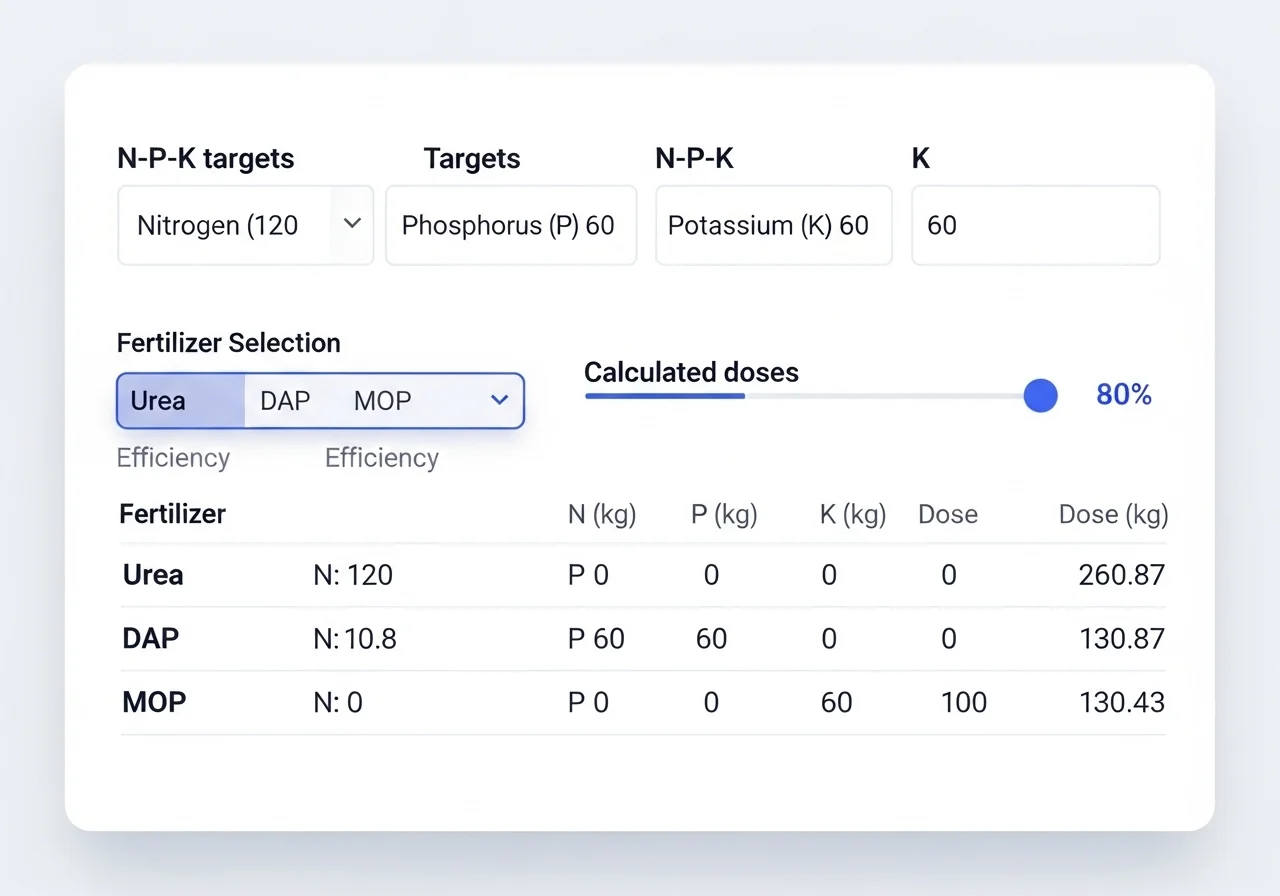
Step 1: Determine Your Nutrient Targets
Start by knowing what your crop needs. For wheat expecting 4-5 ton/ha yield:
- Nitrogen: 120 kg/ha
- P₂O₅: 60 kg/ha
- K₂O: 60 kg/ha
These targets come from soil testing and yield goals. If you've done soil analysis, subtract existing soil nutrients from crop requirements.
Step 2: Select Your Available Fertilizers
Click "Add common fertilizers" to load typical options:
- Urea (46-0-0) — Cost: PKR 2,800/50kg
- DAP (18-46-0) — Cost: PKR 3,600/50kg
- MOP (0-0-60) — Cost: PKR 3,200/50kg
Alternatively, use "Add custom fertilizer" if you have specialty products like NPK complexes or organic fertilizers.
Step 3: Adjust Efficiency Parameters
Set Nutrient Use Efficiency to 80% (a realistic assumption for well-managed fields with proper application timing and method).
Set Purity to 100% if using standard commercial fertilizers. Reduce to 95-98% if you suspect quality issues.
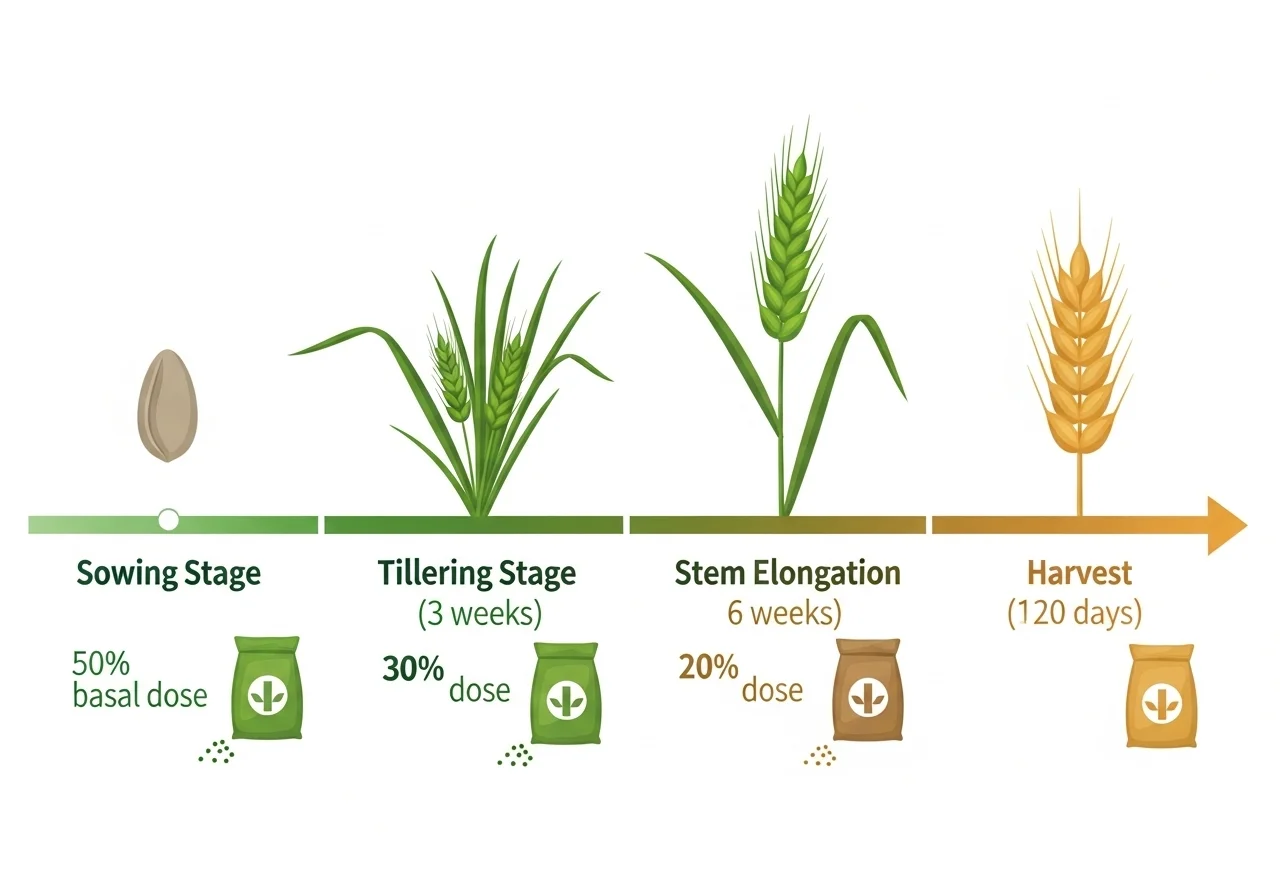
Step 4: Configure Split Application
Enter your split schedule. For wheat: "50,30,20" means:
- 50% at sowing (basal dose)
- 30% at first irrigation (tillering stage)
- 20% at second irrigation (stem elongation)
This split application improves efficiency and matches crop uptake patterns.
Split Fertilizer Application Schedule
Optimal timing and distribution for wheat crop (Total: 426 kg/ha)
| Split | Timing | Growth Stage | Share % | Quantity (kg/ha) | Purpose |
|---|---|---|---|---|---|
| Split 1 | At Sowing (Day 0) | Germination | 50% | 213 kg/ha | Basal dose for root establishment and early growth. Apply all P and K, partial N. |
| Split 2 | 3 Weeks (21 Days) | Tillering Stage | 30% | 128 kg/ha | Boost tillering and vegetative growth. Apply primarily N for leaf development. |
| Split 3 | 6 Weeks (42 Days) | Stem Elongation | 20% | 85 kg/ha | Support stem elongation and pre-flowering. Final N application for grain filling. |
Application Tips:
- Irrigation timing: Apply fertilizer before irrigation for better soil incorporation
- Weather consideration: Avoid application before heavy rain to minimize leaching losses
- Uniformity: Use calibrated spreaders for even distribution across the field
- Efficiency boost: Split application improves nutrient use efficiency by 15-25%
Step 5: Click "Compute Doses"
The calculator instantly solves the multi-variable system and displays:
Results table showing:
- Urea: 195.65 kg/ha (cost: PKR 10,956)
- DAP: 130.43 kg/ha (cost: PKR 9,391)
- MOP: 100.00 kg/ha (cost: PKR 6,400)
Total fertilizer needed: 426.08 kg/haTotal cost: PKR 26,747/ha
Achieved nutrients: N 119.8 kg/ha, P₂O₅ 59.9 kg/ha, K₂O 60.0 kg/ha (nearly perfect!)
Step 6: Review Split Schedule
The calculator breaks down your total dose:
- Split 1 (50%): 213 kg/ha — apply at sowing
- Split 2 (30%): 128 kg/ha — apply at 3 weeks
- Split 3 (20%): 85 kg/ha — apply at 6 weeks
This timing ensures nutrients are available when crops need them most.
Step 7: Optimize for Cost
Click "Suggest combos" to run the optimization algorithm. The calculator evaluates all possible 1-fertilizer, 2-fertilizer, and 3-fertilizer combinations, ranking them by nutrient accuracy and total cost.
It might suggest using SSP (Single Super Phosphate) instead of DAP if it's cheaper in your region, or recommend Ammonium Sulfate for acidic soils needing sulfur.
Understanding Fertilizer Types: A Comprehensive Guide
Different fertilizers serve different purposes. Here's what you need to know about common options.
Nitrogen Fertilizers
Urea (46-0-0): The most concentrated N source. Fast-acting but prone to volatilization losses if not incorporated. Best for:
- Broadcast application before rainfall
- Side-dressing during crop growth
- Fertigation systems
Ammonium Sulfate (21-0-0): Lower N concentration but provides sulfur. Ideal for:
- Alkaline soils (slightly acidifying)
- Crops needing sulfur (oilseeds, legumes)
- Coastal areas with sulfur deficiency
Calcium Ammonium Nitrate (CAN, 26-0-0): Balanced fast and slow-release N. Premium option for:
- High-value crops
- Controlled-release needs
- Reducing leaching in sandy soils
Phosphorus Fertilizers
DAP (18-46-0): Most popular. High P content with bonus N. Caution: can increase soil pH.
Single Super Phosphate (SSP, 0-16-0): Lower P but provides calcium and sulfur. Better for alkaline soils.
Triple Super Phosphate (TSP, 0-46-0): Pure P without N. Use when N levels are already adequate.
Potassium Fertilizers
Muriate of Potash (MOP, 0-0-60): Cheapest K source. Contains chloride—avoid for chloride-sensitive crops (tobacco, potatoes, grapes).
Sulfate of Potash (SOP, 0-0-50): Premium option. No chloride, plus sulfur. Perfect for:
- Fruit crops
- Tobacco
- High-value vegetables
- Chloride-sensitive environments
Advanced Features: Maximizing Calculator Potential
Once you've mastered basic calculations, these advanced techniques unlock even more value.
Regional Preset Loading
Different countries have different fertilizer availability and prices. The calculator includes preset configurations for:
- Pakistan: Urea, DAP, MOP with local PKR pricing
- India: Urea, NPK complexes, SSP with INR rates
- USA/Europe: Anhydrous ammonia, liquid fertilizers, organic options
- Australia: Controlled-release products, specialty blends
Click "Load region presets" and modify prices to match your local market.
Fertilizer Mapping Table Management
The mapping table is your fertilizer database. Best practices:
Keep it updated: Fertilizer prices fluctuate seasonally. Update costs monthly during growing season.
Add custom blends: Many regions have locally mixed NPK complexes (like 12-24-12). Add them with their exact analysis.
Track alternative products: Have multiple suppliers? Add different brands of the same fertilizer type to compare costs.
Document organic options: Compost (1-1-1), FYM (0.5-0.3-0.5), biochar-enhanced fertilizers—these can be factored in too.
Fertilizer Mapping Table - NPK Composition & Costs (USD)
| Fertilizer Name | N % | P₂O₅ % | K₂O % | Cost per 50kg | Best Use |
|---|---|---|---|---|---|
| Urea | 46% | 0% | 0% | $10.00 | Pure nitrogen source, all crops |
| DAP (Di-Ammonium Phosphate) | 18% | 46% | 0% | $12.85 | Phosphorus + nitrogen, basal application |
| MOP (Muriate of Potash) | 0% | 0% | 60% | $11.40 | Potassium source, most crops |
| SSP (Single Super Phosphate) | 0% | 16% | 0% | $6.45 | Budget phosphorus, alkaline soils |
| Ammonium Sulphate | 21% | 0% | 0% | $9.30 | Nitrogen + sulfur, oilseeds |
| SOP (Sulfate of Potash) | 0% | 0% | 50% | $16.10 | Premium K, fruits & vegetables |
| TSP (Triple Super Phosphate) | 0% | 46% | 0% | $12.15 | Pure phosphorus when N adequate |
| CAN (Calcium Ammonium Nitrate) | 26% | 0% | 0% | $11.05 | Controlled N release, high-value crops |
Export and Record Keeping
Professional farm management requires documentation. The calculator offers:
Mapping CSV export: Download your complete fertilizer database. Import it into Excel for further analysis or sharing with agronomists.
Results CSV export: Create season records. Track fertilizer usage patterns year-over-year to identify cost-saving opportunities.
Integration potential: Export files can be imported into farm management software for comprehensive crop budget planning.
Multi-Scenario Planning
Run different scenarios to make informed decisions:
Price sensitivity analysis: What if DAP price increases 20%? Recompute and see if alternative P sources become economical.
Yield target adjustment: Compare fertilizer costs for 4 ton/ha vs 5 ton/ha wheat yields. Determine if higher inputs justify expected revenue gains.
Efficiency optimization: Model the cost-benefit of precision application methods (fertigation, variable rate) that improve nutrient use efficiency from 75% to 90%.
Common Fertilizer Calculation Mistakes (And How to Avoid Them)
Even experienced farmers and agronomists make these errors. Here's how to sidestep them.
Mistake 1: Ignoring Nutrient Overlap
The error: Calculating DAP based only on P requirement, then adding full Urea dose for N—resulting in 18% excess Nitrogen from DAP.
The fix: Always use multi-nutrient calculators that solve simultaneous equations. The calculator automatically subtracts N provided by DAP from your Urea requirement.
Mistake 2: Forgetting Efficiency Factors
The error: Applying exactly 120 kg N/ha when soil tests recommend 120 kg—but achieving only 90 kg effective N due to 75% efficiency.
The fix: Set realistic efficiency values (70-85% for N, 60-75% for P, 80-90% for K). The calculator adjusts upward automatically.
Mistake 3: Wrong Conversion Units
The error: Mixing acres and hectares, or using elemental P instead of P₂O₅ (they differ by a factor of 2.29).
The fix: Standardize on kg/ha for all calculations. If your soil test reports elemental P, multiply by 2.29 to convert to P₂O₅ before entering.
Mistake 4: Skipping Split Applications
The error: Applying 260 kg Urea in one dose at sowing—leading to massive volatilization losses and groundwater contamination.
The fix: Use the split scheduler. For most field crops, 2-3 splits improve efficiency by 15-25% compared to single application.
Mistake 5: Not Validating Results
The error: Blindly trusting calculator output without checking if achieved nutrients match targets.
The fix: Always review the "Achieved nutrients" section. If there's >5% deviation from targets, check your fertilizer compositions and efficiency settings.
Real-World Application: Case Studies
Let's see how farmers worldwide use the calculator to solve practical problems.
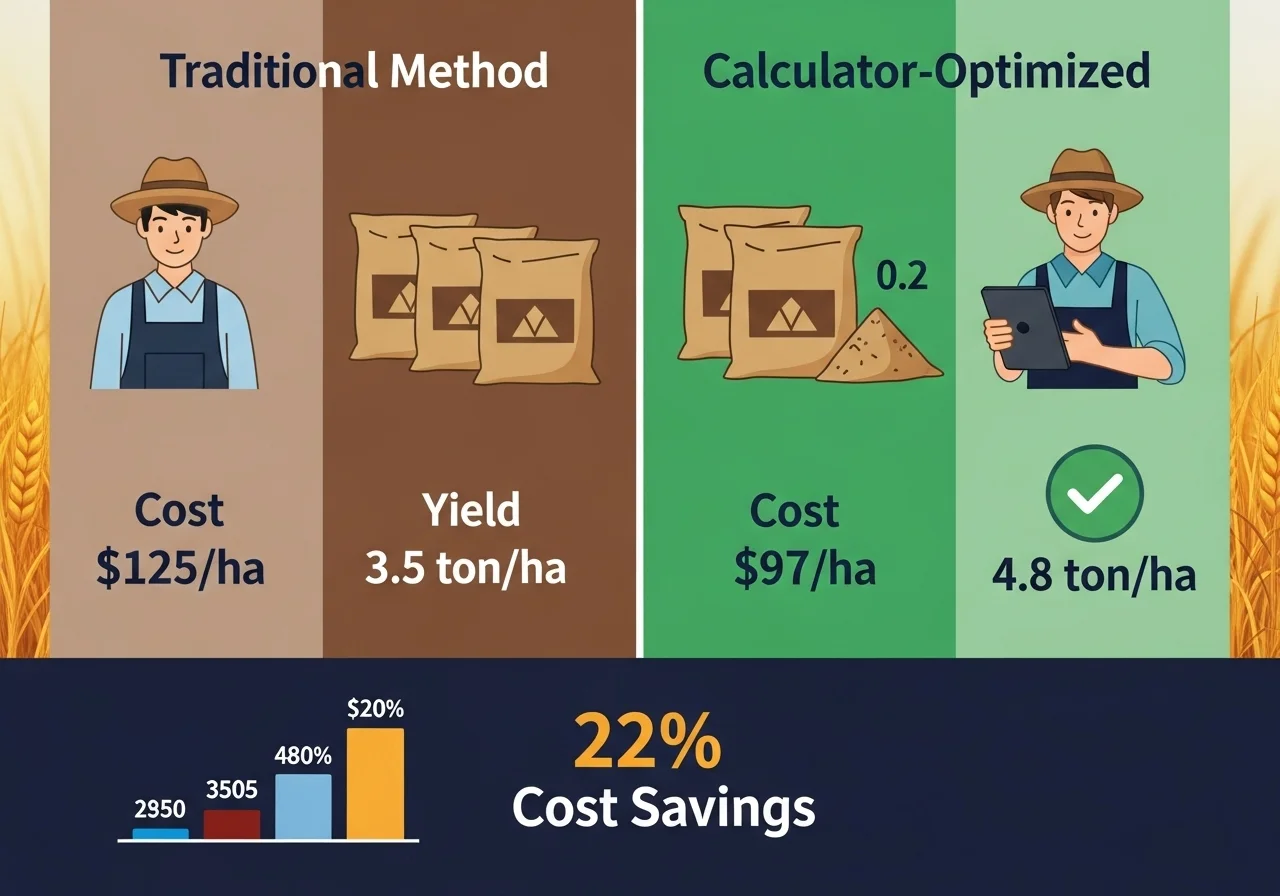
Case Study 1: Punjab Wheat Farmer Saves 22% on Fertilizer Costs
Situation: Farmer Rashid from Faisalabad was spending PKR 35,000/ha on fertilizers using traditional estimates: 4 Urea bags, 3 DAP bags, 2 MOP bags.
Calculator approach: Soil test showed actual needs: N 100 kg/ha (not 120), P₂O₅ 70 kg/ha, K₂O 50 kg/ha. His soil had residual K.
Results:
- Urea: 163 kg/ha (3.3 bags instead of 4)
- DAP: 152 kg/ha (3 bags—same)
- MOP: 83 kg/ha (1.7 bags instead of 2)
Savings: PKR 7,700/ha (22% reduction)Yield impact: No yield loss—actually increased 0.3 ton/ha due to better nutrient balance
Case Study 2: Indian Rice Farmer Optimizes for Waterlogged Conditions
Situation: Subramanian's paddy fields in Kerala suffered from low nitrogen efficiency (55%) due to submergence and denitrification.
Calculator approach: Set efficiency to 55% for N, 70% for P, 85% for K. Used slow-release Urea alternatives.
Results: Calculator recommended 50% more Urea than standard recommendations but split into 4 applications. Cost increased 18% but yield jumped 1.2 ton/ha—a net profit increase of 320%.
Case Study 3: Australian Broadacre Farmer Uses Precision Mapping
Situation: 500-hectare wheat farm with variable soil fertility. GPS soil sampling revealed three distinct zones with different nutrient needs.
Calculator approach: Ran three separate calculations:
- Zone A (high fertility): 80-40-30 kg/ha
- Zone B (medium): 120-60-60 kg/ha
- Zone C (poor): 160-90-90 kg/ha
Results: Variable rate application using exported CSV data. Saved 15% on fertilizer vs uniform application while increasing whole-farm yield 8%.
Fertilizer Economics: Maximizing ROI
Understanding the financial aspects helps you make smarter fertilizer decisions.
Cost-Benefit Analysis Framework
For every dollar spent on fertilizer, calculate expected return:
ROI Formula:ROI = [(Yield Increase × Price per Unit) - Fertilizer Cost] ÷ Fertilizer Cost × 100
Example: Wheat farmer invests PKR 26,750/ha in optimized fertilizer. Yield increases from 3.5 to 4.8 ton/ha (1.3 ton increase). Wheat price: PKR 3,500/ton.
Revenue increase = 1.3 × 3,500 = PKR 45,500 Net profit = 45,500 - 26,750 = PKR 18,750 ROI = (18,750 ÷ 26,750) × 100 = 70%
That's a fantastic return—but it only works if you're applying the right nutrients at the right rates.
Price Fluctuation Strategies
Fertilizer prices vary seasonally. Smart timing can save significant money:
Buy during low season: In Pakistan, Urea prices typically drop April-June (off-season). Farmers who purchase then save 10-15% compared to October peak prices.
Bulk purchasing cooperatives: Farmers pooling orders often get 5-8% discounts from distributors.
Government subsidy programs: Many regions offer seasonal subsidies. In India, the Nutrient-Based Subsidy ensures stable prices. Track these programs using the calculator's cost scenarios.
Nutrient Response Economics
Not all nutrients provide equal returns:
Nitrogen: Typically highest ROI (150-300%) because it directly impacts yield. However, diminishing returns kick in above optimal rates.
Phosphorus: Moderate ROI (100-200%) but critical for yield stability. P deficiency causes more severe long-term soil fertility decline.
Potassium: Often lowest immediate ROI (50-150%) but essential for stress tolerance and quality. Potash application is an insurance policy—you might not see dramatic yield gains, but you avoid catastrophic losses during drought or disease pressure.
Integration with Soil Testing: The Complete Nutrition Picture
The Fertilizer Dose Calculator becomes truly powerful when combined with soil analysis.
Reading Soil Test Reports
Soil tests typically report:
- Available N: Often measured as NO₃-N (nitrate) or Nh5-N (ammonium)
- Available P: Measured by extraction methods (Olsen, Bray, Mehlich)
- Exchangeable K: Usually reported as ppm or meq/100g
Critical: Soil tests measure what's AVAILABLE, not total nutrient content. Your fertilizer recommendation = Crop requirement - Available soil nutrients.
Converting Soil Test Values
Soil labs report in different units. Common conversions:
Nitrogen: If soil test shows 25 ppm NO₃-N in top 6 inches:
- 25 ppm × 2 (conversion factor) = 50 kg/ha available N
- If crop needs 120 kg/ha, fertilizer should supply 70 kg/ha
Phosphorus: Labs often report Olsen P or Bray P in ppm:
- Low: <10 ppm (apply 100% of crop requirement)
- Medium: 10-20 ppm (apply 75% of requirement)
- High: >20 ppm (apply 50% of requirement)
Potassium: Reported as exchangeable K in ppm:
- Similar interpretation as P (low/medium/high thresholds)
Customizing Calculator Inputs
After soil testing:
- Determine crop removal rates (N-P-K kg/ha per ton of yield)
- Subtract available soil nutrients
- Enter adjusted targets in the calculator
- Account for efficiency based on soil properties (sandy soils = lower efficiency)
Organic and Integrated Nutrient Management
Modern farming isn't just about chemical fertilizers. The calculator handles organic inputs too.
Incorporating Organic Amendments
Farmyard Manure (FYM): Typical analysis 0.5-0.3-0.5 (N-P₂O₅-K₂O). If you apply 10 ton/ha FYM:
- N supplied: 10,000 kg × 0.005 = 50 kg/ha
- P₂O₅ supplied: 30 kg/ha
- K₂O supplied: 50 kg/ha
Calculator approach: Subtract these from your targets before computing chemical fertilizer needs.
Compost: Usually 1-1-1 analysis but slower release. Account for 50% efficiency in year one.
Green manures: Leguminous crops like dhaincha or sesbania fix 40-80 kg N/ha. Incorporate before computing supplemental fertilizer needs.
Biochar and Enhanced Efficiency Fertilizers
Biochar-enhanced fertilizers: Improve nutrient retention. Increase efficiency parameter from 80% to 90% in calculator.
Slow-release coated urea: Reduces N losses. Can reduce total N requirement by 15-20% vs conventional urea.
Nitrification inhibitors: DCD or DMPP-coated products improve N efficiency by 20-30% in high-rainfall areas.
Balanced Approach Strategy
Optimal nutrient management combines:
- 50% nutrients from organic sources (long-term soil health)
- 50% from chemical fertilizers (immediate availability)
Example for wheat:
- Apply 5 ton/ha FYM at land preparation (provides 25 kg N)
- Use calculator to compute chemical fertilizer for remaining 95 kg N
- Result: Better soil structure + precise nutrient supply
Troubleshooting: Common Calculator Issues and Solutions
Even the best tools occasionally present challenges. Here's how to resolve them.
Issue 1: "Matrix Singular" Error
What it means: The calculator can't solve your fertilizer combination—usually because fertilizers are too similar.
Example: Using three fertilizers that all provide similar N:P ratios (like NPK 20-20-0, NPK 24-24-0, and NPK 18-18-0) creates redundancy.
Solution: Remove one fertilizer or add a distinctly different option (pure K source, or pure N source).
Issue 2: Negative Quantities Suggested
What it means: The mathematical solution suggests removing nutrients (impossible).
Cause: Your fertilizer combination can't meet targets. For example, using only DAP (18-46-0) to meet high N requirement would oversupply P massively.
Solution: Add more fertilizer types. For balanced NPK, you need at least three distinct sources.
Issue 3: Achieved Nutrients Deviate >10% from Targets
What it means: The calculator found a solution but couldn't perfectly match your targets.
Causes:
- Limited fertilizer options
- Efficiency settings too aggressive
- Conflicting constraints (trying to minimize cost while meeting precise targets)
Solution:
- Add more fertilizer types
- Adjust efficiency to realistic levels
- Accept small deviations (±5% is acceptable agronomically)
Issue 4: Extremely High Costs
What it means: The recommended doses seem unreasonably expensive.
Check:
- Are your target requirements realistic? (150 kg N/ha is typical; 500 kg is excessive)
- Are prices entered correctly? (per 50kg, not per kg)
- Is efficiency set too low? (50% efficiency means doubling fertilizer—check if realistic)
Solution: Validate targets with agronomic guides. Most field crops need 80-150 kg N, 40-80 kg P₂O₅, 40-80 kg K₂O per hectare.
Future of Fertilizer Management: Where Technology is Heading
The Fertilizer Dose Calculator represents current best practices, but technology continues evolving.
Precision Agriculture Integration
Next-generation tools will connect directly with:
- GPS soil sampling data: Automatically create variable rate maps for different field zones
- Yield monitors: Use previous season data to refine nutrient removal estimates
- Weather forecasting: Adjust N recommendations based on predicted rainfall (high rainfall = higher losses)
AI-Powered Recommendations
Machine learning models analyzing millions of field trials will:
- Predict optimal fertilizer timing based on crop growth stage imaging
- Identify hidden nutrient deficiencies from drone photography before visible symptoms
- Optimize fertilizer combinations considering secondary nutrients (S, Ca, Mg, micronutrients)
Sensor-Based Real-Time Adjustment
Emerging technologies include:
- Leaf sensors: Measuring real-time N status to guide side-dressing applications
- Soil moisture integration: Adjusting doses based on water availability (dry soils = lower efficiency)
- IoT fertilizer dispensers: Automated application based on calculator recommendations
Blockchain for Supply Chain Transparency
Future versions may integrate:
- Verified fertilizer composition from blockchain-tracked supply chains
- Authentic product guarantees (reducing the purity discount problem)
- Smart contracts triggering automatic reorders when field sensors detect deficiencies
Frequently Asked Questions (FAQs)
How do I calculate fertilizer requirement from NPK recommendation?
Use the basic formula: Fertilizer Dose = (Nutrient Requirement ÷ Nutrient %) × 100.
For example, if you need 120 kg nitrogen and use Urea with 46% N,
calculate: (120 ÷ 46) × 100 = 260.87 kg/ha of Urea.
For complex multi-fertilizer scenarios where DAP provides both N and P,
use a fertilizer dose calculator that automatically solves simultaneous equations.
What is the best fertilizer combination for wheat crops?
The optimal mix typically includes Urea for nitrogen, DAP for phosphorus plus some nitrogen,
and MOP for potassium.
A standard wheat recommendation is about 260 kg/ha Urea, 130 kg/ha DAP, and 100 kg/ha MOP,
but actual amounts depend on soil tests and yield targets. Using a fertilizer calculator helps maintain nutrient balance and prevent wastage.
Can I use this calculator for organic fertilizers?
Yes. Enter organic fertilizer analysis values in the custom section.
Example: farmyard manure (FYM) usually contains 0.5% N, 0.3% P₂O₅, and 0.5% K₂O.
The calculator will compute required amounts automatically.
Remember: organic nutrient release is slower, so set efficiency to 50–60% instead of 100%.
Why do fertilizer recommendations vary by region?
Regional variation arises from differences in soil type, rainfall, temperature, and crop varieties.
Sandy soils in coastal zones lose nitrogen through leaching (requiring split doses),
while alkaline soils in arid regions may need sulfur-containing fertilizers.
The calculator’s regional presets account for local soil and fertilizer availability.
How often should I update fertilizer prices in the calculator?
Update prices every season or after major market changes. Fertilizer rates can fluctuate by 10–20% seasonally,
usually lowest in off-season periods.
Monthly updates during active cropping help ensure accurate costing.
Export your price table as a CSV backup before major revisions.
What is nutrient use efficiency and how does it affect calculations?
Nutrient use efficiency (NUE) = percent of applied fertilizer absorbed by crops.
Typical NUE values: 70–85% for N, 60–75% for P, 80–90% for K.
Low efficiency = higher fertilizer need to reach target uptake. Efficiency depends on soil, timing, irrigation, and crop variety.
Can the calculator optimize for minimum cost?
Yes. Use the “Suggest Combos” button — it runs cost optimization by testing possible fertilizer combinations (up to three). The algorithm ranks results by nutrient accuracy and total cost, suggesting the most economical blend within tolerance limits.
How do I interpret split application schedules?
Split application divides fertilizer into growth-stage-based doses.
Example: a 50-30-20 split for wheat = 50% at sowing, 30% at tillering (3–4 weeks), 20% at stem elongation (6–7 weeks).
This approach can improve nutrient use efficiency by 15–25% versus single full-dose applications.
Conclusion
You've just discovered the blueprint for precision fertilizer management—a skill that separates profitable farming from guesswork.
The Fertilizer Dose Calculator isn't just a tool; it's your partner in making data-driven decisions that boost yields, cut costs, and protect soil health. By mastering the NPK calculation formulas, understanding nutrient interactions, and leveraging advanced features like cost optimization and split scheduling, you're positioning yourself ahead of 90% of farmers still relying on traditional estimates.
Remember the key takeaways:
- Always base calculations on soil test results and realistic yield targets
- Account for nutrient use efficiency and fertilizer purity in every calculation
- Use multi-nutrient solvers for complex fertilizer combinations
- Split applications improve efficiency by 15-25% over single doses
- Update fertilizer prices seasonally to optimize purchasing decisions
- Validate calculator results by checking achieved vs target nutrients
The difference between a good harvest and a great one often comes down to precise nutrient management. The calculator removes uncertainty, giving you confidence that every kilogram of fertilizer is working toward your yield goals.
Ready to transform your fertilizer strategy? Start by running your first calculation today. Gather your soil test results, determine your target yields, and let the calculator show you exactly what your crops need. Share this tool with fellow farmers—better nutrition decisions benefit entire farming communities.
Take action now: Bookmark this calculator, export your first fertilizer mapping CSV, and commit to data-driven nutrient management this season. Your crops—and your bank account—will thank you.
References & Data Sources — Fertilizer / Nutrient Management
Food and Agriculture Organization (FAO)
International Plant Nutrition Institute (IPNI)
Agricultural Extension Services — Regional recommendations
- Pakistan — NFDC / Fertilizer Review 2023-24 (PDF) [Found]
- Punjab AARI — Soil & Water Testing Laboratory (Bhakkar) [Found]
- India — Adoption of recommended fertiliser doses (PDF) [Found]
- USA — NRCS Fertilizer Recommendations Guide (EC750 PDF) [Found]
- Australia — Department of Agriculture (policy / soils documents) [Found]
Soil Science Society of America (SSSA)
International Fertilizer Development Center (IFDC)
- IFDC — Homepage [Found]
- IFDC — 2024 Annual Report (PDF) [Found]
- IFDC Hub — Fertilizer Reports [Found]