
PV Module Degradation Impact Simulator
Summary & Charts
Standard Comparison
Year-by-Year Table
| Year | Module Eff (%) | PR | Annual Prod (kWh) | Lost vs 0% (kWh) | Annual Loss (currency) | Cumulative Loss (currency) |
|---|
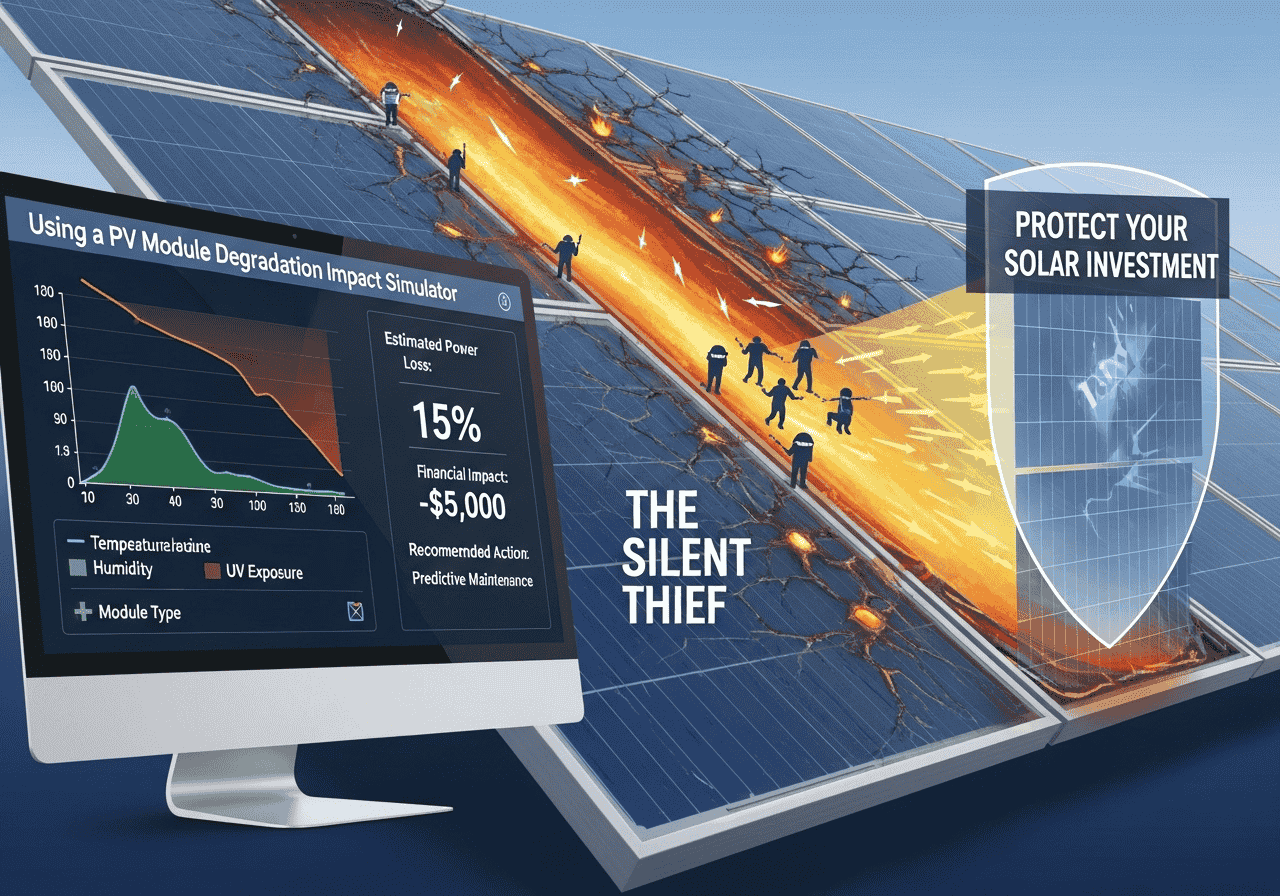
The Silent Thief: Using a PV Module Degradation Impact Simulator to Protect Your Solar Investment
Discover how PV module degradation silently reduces solar output and learn to protect your investment using a smart impact simulator tool.
You’ve invested a significant amount of money in a solar power system, right? You’re counting on that clean energy to slash your bills and boost your home’s value for decades. But here’s the thing that keeps solar experts up at night: PV module degradation. It's the silent, sneaky thief that slowly saps your solar panels' power, year after year.
If you don't account for this gradual power loss, you could find your system underperforming your expectations, leading to fewer savings and a longer payback time. Nobody wants that!
That’s why we need a way to see the future—or at least, simulate it. Introducing the PV Module Degradation Impact Simulator (or simply, a reliable performance calculator). This isn't just a fancy tool; it’s your financial fortress against the inevitable decline in power output.
Ready to understand how much power you’ll really have in 10, 20, or even 25 years? Let's dive in!
What Exactly is PV Module Degradation? (And Why You Should Care)
Think of your solar panels like a brand-new car. It rolls off the lot at 100% capacity, but the performance inevitably decreases over time. For solar panels, this loss in efficiency is called degradation.
It’s completely normal and unavoidable. Most manufacturers offer a performance warranty, usually guaranteeing 90% of the original output after 10 years and 80% after 25 years. This implies an average annual degradation rate of around 0.5% to 0.7%.
The Big Problem: Not All Panels—Or Environments—Are Equal!
Here’s the rub: that average rate might not apply to your specific system! Factors like your local climate, the quality of the modules, and even the installation can drastically change the actual degradation rate.
- Hot Climates: High temperatures accelerate certain chemical degradation mechanisms.
- Lower Quality Panels: May have higher initial loss (LID/LETID) or faster annual decay.
- Humidity/Coastal Regions: Can lead to corrosion and Potential-Induced Degradation (PID) faster.
Agree & Amplify: You agreed that you want maximum returns. But if your panels are degrading at 1.5% instead of 0.5% per year, your power output after 20 years will be dramatically lower than expected. This difference could cost you thousands in lost energy and wasted investment. This is why accurately simulating the impact is crucial.
How a PV Degradation Impact Simulator (or Calculator) Works
A PV Degradation Impact Simulator is essentially a sophisticated financial and performance calculator. It takes the physical realities of your solar system's aging and translates them into tangible output predictions, helping you make smart decisions.
The Key Inputs for Your Simulator
To provide an accurate forecast, a good simulator needs precise data points. This is the Expertise component of our analysis.
| Input Parameter | What It Represents | Why It Matters for Simulation |
|---|---|---|
| System Size (kWp) | The initial, nameplate capacity of your system. | Your starting point for energy production. |
| Initial Degradation Loss (LID/LETID) | The power loss in the first year (often 1-3%). | Determines the true power output after commissioning. |
| Annual Degradation Rate | The percentage loss per year (typically 0.5% - 0.7%). | The core factor for long-term calculation. |
| System Life Span | The number of years you want to model (e.g., 25 years). | Sets the projection horizon for your financial model. |
| Specific Climate Factors | High temperature, humidity, extreme UV, etc. | Adjusts the standard annual rate to a more realistic value for your location. |
The Core Calculation (A Simple Proof)
The simulator uses a simple compounding formula, similar to compound interest, but in reverse (decay):
Pt=P0×(1−Rannual)t
Where:
- P_t = Power output at time t
- P_0 = Initial power output (after initial degradation)
- R_annual = Annual degradation rate (e.g., 0.005 for 0.5%)
- t = Time in years
This basic formula, when combined with site-specific loss factors, allows the simulator to Prove the exact performance and financial impact over time.
Comparing Degradation: Why the Rate Matters
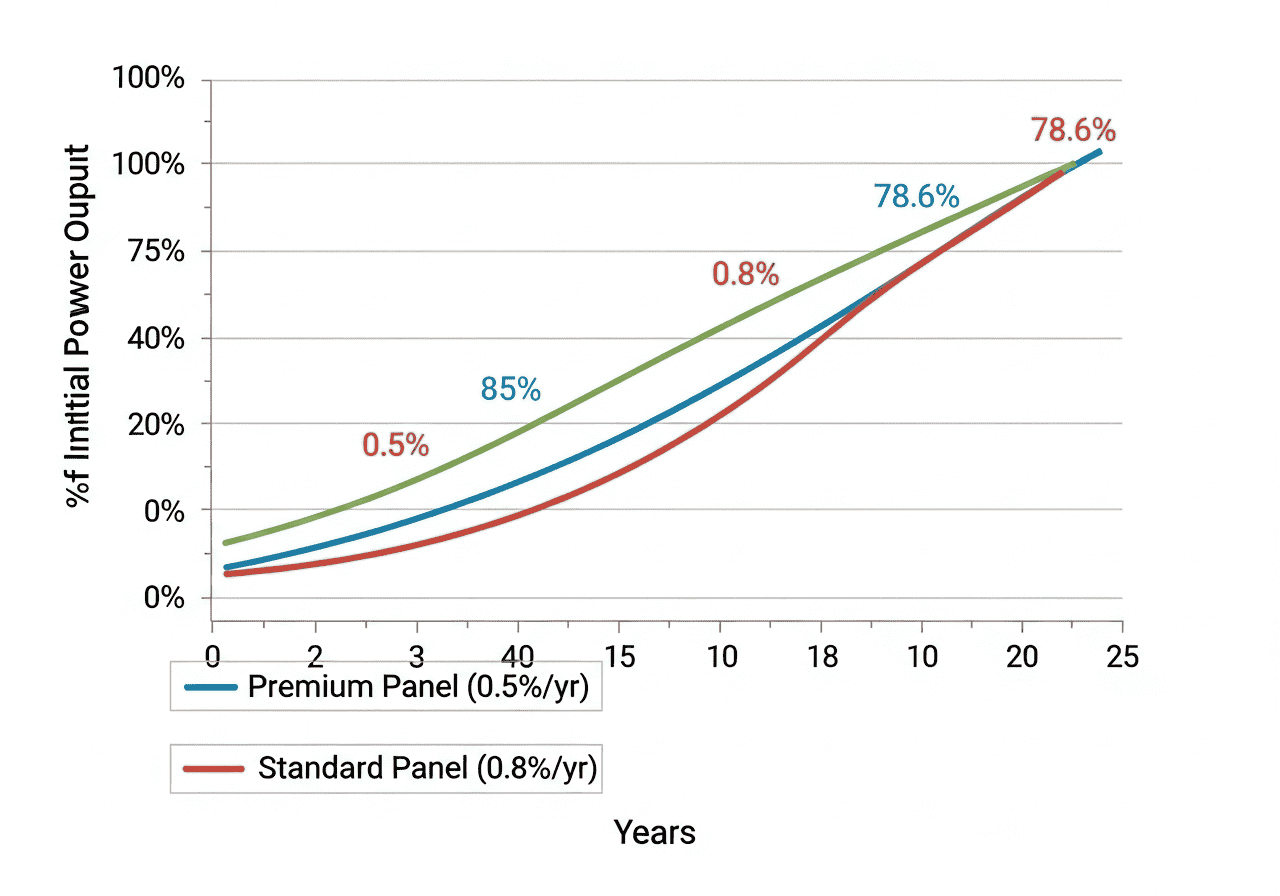
You know what? Even a seemingly small difference in the degradation rate can create a massive chasm in performance over 25 years. This is where the visualization of the simulator's output really drives home the point.
Let’s compare two scenarios for a typical 10 kW system over its 25-year warranty period, assuming an initial output of 15,000 kWh/year.
PV Degradation Impact Comparison
| Metric | Scenario A (Premium Panel: 0.5% Annual Degradation) | Scenario B (Standard Panel: 0.8% Annual Degradation) |
|---|---|---|
| Initial Annual Loss (LID) | 1.0% | 2.0% |
| Annual Degradation Rate | 0.5% (Year 2+) | 0.8% (Year 2+) |
| Output at Year 10 | 93.8% of original power | 91.2% of original power |
| Output at Year 25 | 85.0% of original power | 78.6% of original power |
| Total Lifetime Energy Difference (Approximate) | ≈ 350,000 kWh | ≈ 330,000 kWh |
| Loss over 25 Years (Compared to Year 1) | ≈ 15.0% loss | ≈ 21.4% loss |
ou can clearly see that the seemingly minor difference of 0.3% annually translates to a huge gap in lifetime energy production. This is the Desire—you want the premium outcome!
Practical Ways to Mitigate Degradation
A PV degradation simulation helps you identify critical performance issues before they escalate. By pinpointing weak areas early, you can take targeted action to slow panel decline, extend system lifespan, and maximize your return on investment.
Backed by real-world experience and trusted engineering methods, these simulations give solar professionals the data they need to make smarter, more reliable maintenance decisions.
1. Choose the Right Technology
Not all PV cells are made equal. Newer technologies offer better degradation guarantees:
- N-Type Cells (TOPCon/HJT): These newer cell types are naturally less susceptible to the initial power loss mechanisms like Light-Induced Degradation (LID) and Light and Elevated Temperature-Induced Degradation (LeTID). Look for warranties that promise a degradation rate of just 0.35% per year after the first year.
2. Protect Against Environmental Stressors
High voltage combined with humidity and temperature can cause Potential-Induced Degradation (PID). This is a massive power killer.
- Solution: Ensure your installer uses inverters with anti-PID technology or a proper system grounding scheme to mitigate this voltage stress, especially in humid or tropical environments.
3. Regular System Health Checks
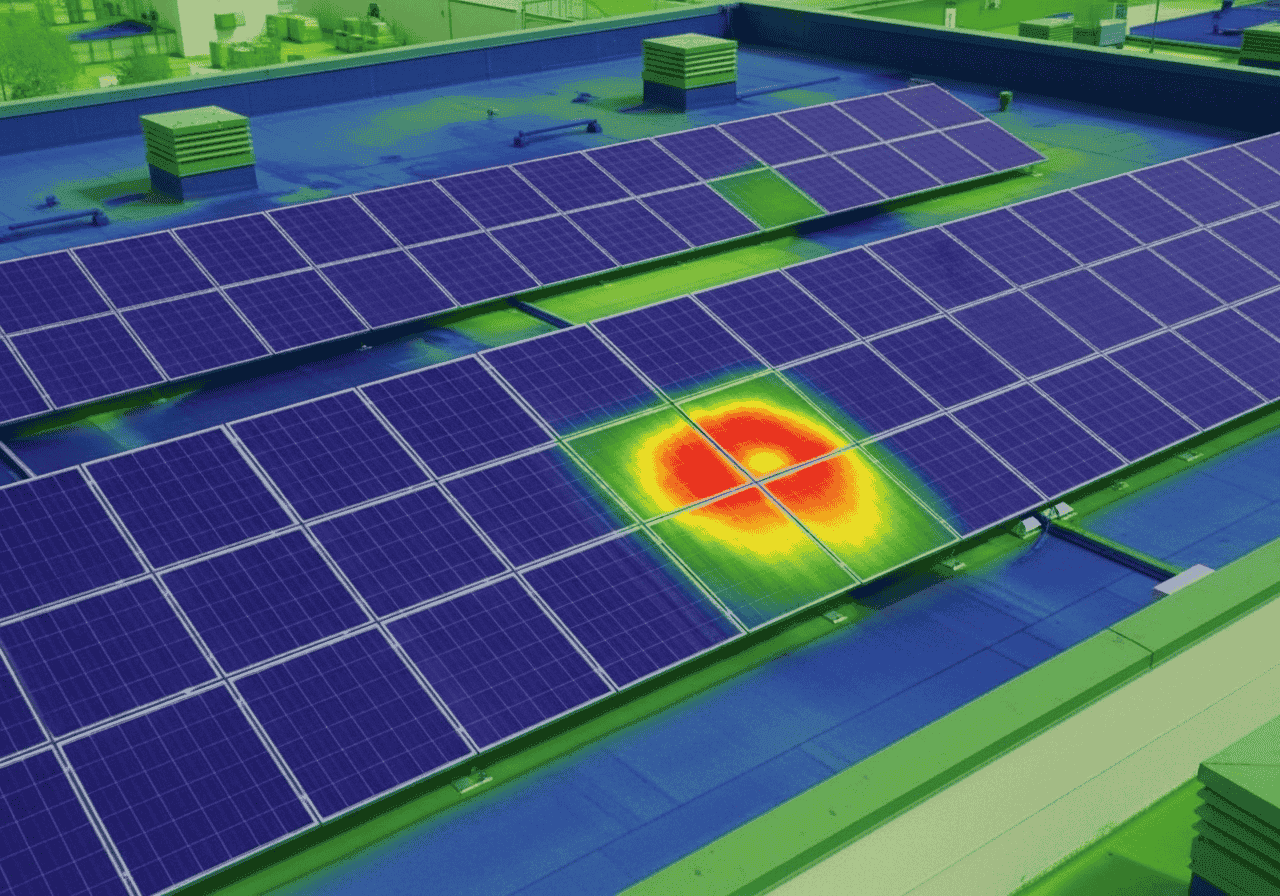
Degradation can be caused by micro-defects that worsen over time, like hotspots or microcracks.
- Solution: Conduct an annual visual inspection and a professional thermographic inspection (using an infrared camera) every 3-5 years. The thermal image can reveal failing cells before they cause significant power loss.
Frequently Asked Questions (FAQs)
Q1: What is a good annual degradation rate for a new solar panel?
Q2: How does temperature affect my PV module degradation calculator results?
Q3: Do solar panel warranties cover degradation loss?
Q4: What is the difference between LID and LeTID?
Q5: Can I calculate the financial loss from degradation?
Conclusion: Take Control with a Calculator
The truth is, your solar panels will degrade. But by using a reliable PV Module Degradation Impact Simulator—or a powerful performance calculator—you move from simply hoping for the best to proactively managing your investment.
Understanding your specific degradation rate, choosing the right N-type technology, and putting mitigation strategies in place ensures your system delivers the maximum return for decades to come.
Don't let the silent thief steal your solar savings. Use the data, make smart choices, and keep the power flowing!
Ready to calculate your solar future? Share this article with a friend who is thinking about going solar, and let us know what degradation rate your solar installer guaranteed you in the comments below!
Read the FAQs for Quick Answers! | Find the Best Low-Degradation Panels Now
Authoritative Reference: For the latest degradation data and fleet performance analysis, see the NREL's PV Fleet Performance Data Initiative.