
Wall Plaster Quantity Calculator
Estimate plaster volume, cement bags, sand volume and optional cost. Values are approximate — adjust wastage for site conditions.
Input
Wall Plaster Quantity Calculator: How to Estimate Cement & Sand for Perfect Wall Finishing
Calculate exact plaster volume, cement bags & sand needed for walls. Free calculator with cost estimation. Get accurate results in seconds with our easy-to-use tool.
Introduction
Ever started a plastering project only to run out of cement halfway through? Or worse—over-ordered materials and watched your budget disappear into unused bags stacked in the corner?
Here's the thing: 95% of homeowners and contractors miscalculate plaster quantities, leading to project delays, budget overruns, and unnecessary waste. Whether you're renovating a single room or constructing an entire building, getting your material estimates wrong can cost you thousands.
But what if you could calculate exactly how much cement, sand, and plaster you need—down to the last bag—in under 2 minutes?
That's where the Wall Plaster Quantity Calculator comes in. This powerful tool eliminates guesswork, saves money, and ensures your project runs smoothly from start to finish. In this comprehensive guide, you'll discover how to use this calculator effectively, understand the science behind plaster calculations, and master material estimation like a professional contractor.
Ready to transform how you plan plastering projects? Let's dive in.
What is a Wall Plaster Quantity Calculator?
A Wall Plaster Quantity Calculator is a digital tool designed to estimate the exact amount of plastering materials needed for your construction or renovation project. Think of it as your personal construction assistant that does complex mathematical calculations instantly.
Why Traditional Estimation Methods Fail
You know what? The old-school method of "eyeballing" quantities or using rough thumb rules rarely works in real-world scenarios. Here's why:
- Human error in calculations: Manual math mistakes can cost 15-30% extra materials
- Inconsistent mix ratios: Different projects need different cement-to-sand proportions
- Wastage miscalculation: Site conditions vary—a 5% wastage assumption might be way off
- Unit conversion confusion: Mixing feet with meters? Recipe for disaster
The Modern Solution
Advanced plaster calculators solve these problems by:
✓ Converting multiple units automatically (square feet, square meters, yards)
✓ Accounting for variable plaster thickness (from 10mm to 25mm)
✓ Calculating precise cement bag requirements
✓ Estimating sand volume with wastage factors
✓ Providing instant cost projections
Surprising fact: Professional contractors using digital calculators reduce material waste by an average of 23%, saving $800-$2,400 per medium-sized project.
How Does the Wall Plaster Quantity Calculator Work?
Understanding the calculator's logic helps you make better decisions. Let's break down the mathematical magic happening behind the scenes.
Core Calculation Formula
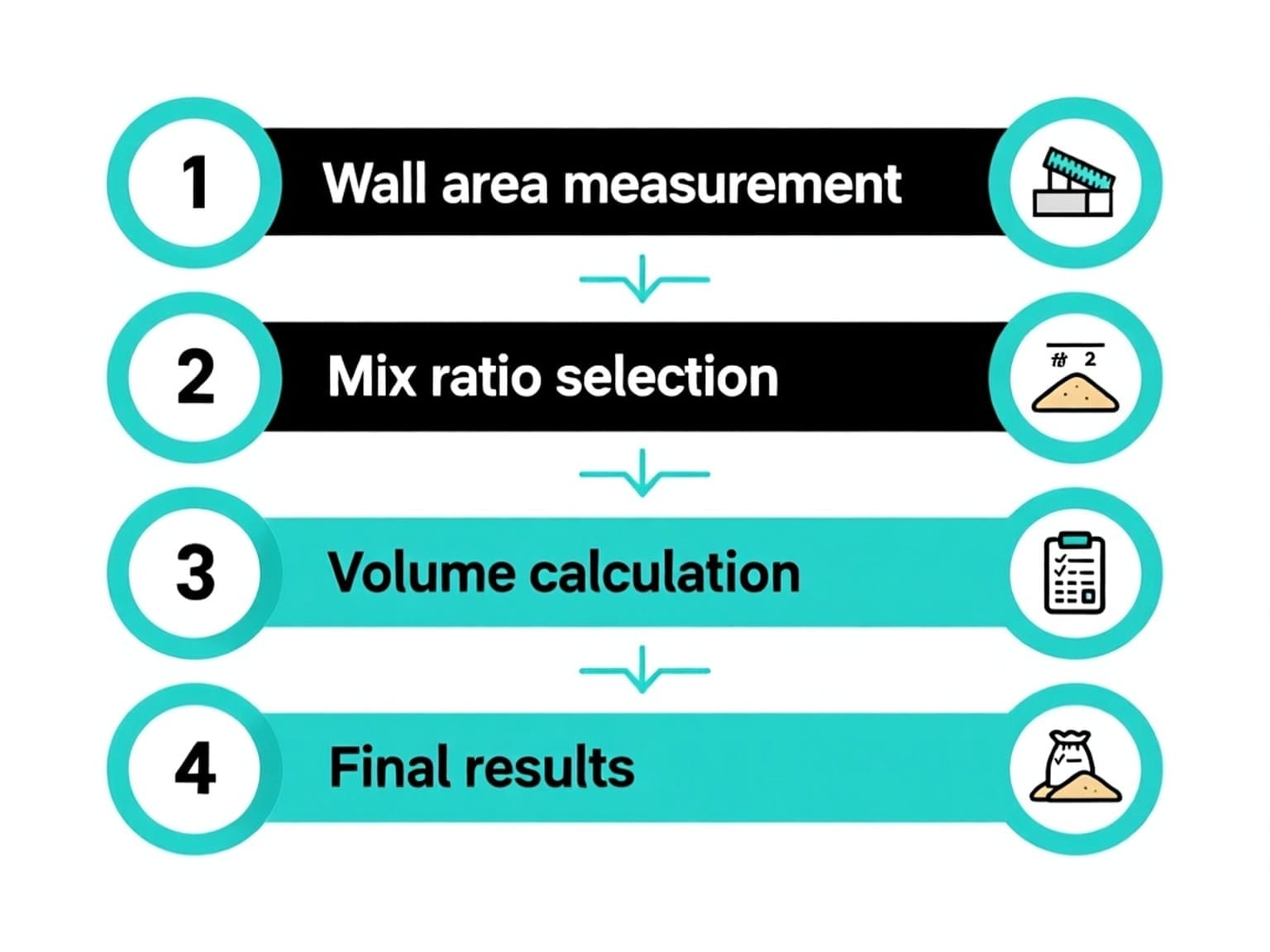
The fundamental formula for plaster volume calculation is:
Plaster Volume = Wall Area × Plaster Thickness
But that's just the beginning. Here's the complete process:
Step 1: Volume Calculati
Total Plaster Volume (m³) = Wall Surface Area (m²) × Thickness (meters)Example:
- Wall area: 100 m²
- Thickness: 12 mm (0.012 meters)
- Volume = 100 × 0.012 = 1.2 m³
Step 2: Mix Ratio Distribution
Plaster consists of cement and sand mixed in specific ratios (commonly 1:4, 1:5, or 1:6).
For a 1:4 mix ratio:
- Total parts = 1 (cement) + 4 (sand) = 5 parts
- Cement fraction = 1/5 = 0.20 (20%)
- Sand fraction = 4/5 = 0.80 (80%)
Cement Volume = Total Volume × (1 ÷ [1 + Sand Ratio])
Sand Volume = Total Volume × (Sand Ratio ÷ [1 + Sand Ratio])
Step 3: Converting Cement Volume to Bags
Cement bags are sold by weight (typically 50 kg), but we need volume. The calculator uses standard cement bulk density:
Cement Density = 1440 kg/m³
Therefore:
- One 50 kg bag = 50 ÷ 1440 = 0.0347 m³
- Number of bags = Cement Volume ÷ 0.0347
Step 4: Wastage Factor
Real-world construction involves spillage, uneven surfaces, and material loss. The calculator adds a wastage percentage (typically 5-10%):
Final Quantity = Base Quantity × (1 + Wastage %)
Complete Calculation Example
Let's calculate plaster requirements for a room:
Given:
- Wall area: 85 m²
- Thickness: 15 mm
- Mix ratio: 1:5 (cement:sand)
- Wastage: 7.5%
- Cement bag size: 50 kg
Calculations:
1 - Plaster Volume: 85 × 0.015 = 1.275 m³
2 - Cement Volume(before wastage):
- 1.275 × (1 ÷ 6) = 0.2125 m³
3 - Sand Volume(before wastage):
- 1.275 × (5 ÷ 6) = 1.0625 m³
4 - With 7.5% Wastage:
- Cement: 0.2125 × 1.075 = 0.2284 m³
- Sand: 1.0625 × 1.075 = 1.1422 m³
5 - Cement Bags Required:
- 0.2284 ÷ 0.0347 = 6.58 bags (round up to 7 bags)
6 - Final Sand Volume: 1.14 m³
Step-by-Step Guide: Using the Wall Plaster Calculator
Let's walk through the practical process of using the calculator effectively.
Input Parameters Explained
1. Wall Surface Area
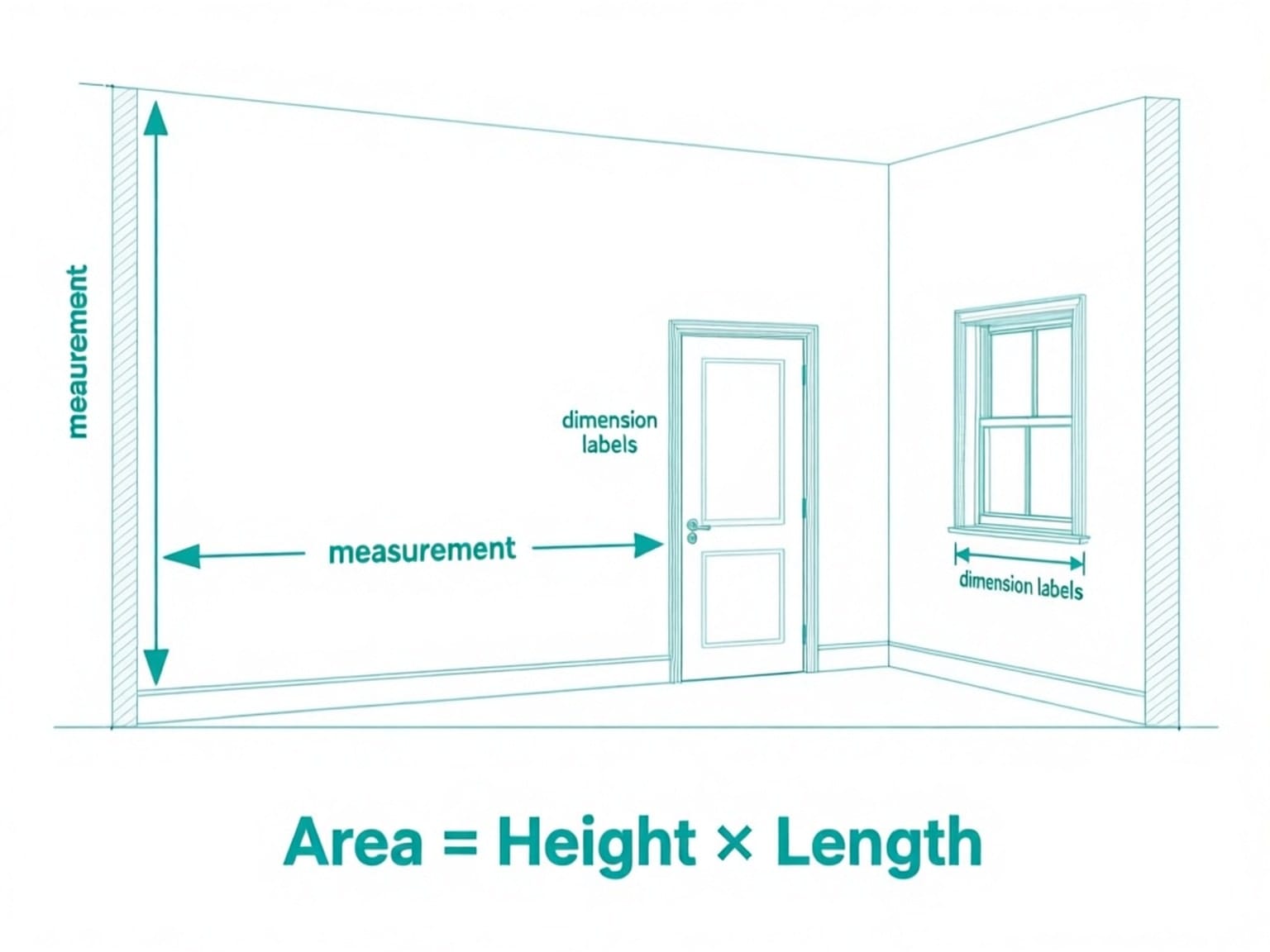
This is the total area you'll be plastering. Calculate it by:
Area = Height × Length (for each wall)
Pro tips:
- Measure in consistent units (all feet or all meters)
- For multiple walls, calculate each separately and add them up
- Decide whether to subtract door/window openings (recommended for accuracy)
Example: A room with four walls (10 ft height, 12 ft and 15 ft widths):
- Wall 1 & 2: 10 × 12 = 120 ft² each
- Wall 3 & 4: 10 × 15 = 150 ft² each
- Total: (120 + 120 + 150 + 150) = 540 ft²
Subtract openings:
- Door: 7 × 3 = 21 ft²
- Windows (2): 4 × 3 = 12 ft² each
- Net area: 540 - 21 - 24 = 495 ft²
Let's walk through the practical process of using the calculator effectively.
Input Parameters Explained
1. Wall Surface Area
This is the total area you'll be plastering. Calculate it by:
Area = Height × Length (for each wall)
Pro tips:
- Measure in consistent units (all feet or all meters)
- For multiple walls, calculate each separately and add them up
- Decide whether to subtract door/window openings (recommended for accuracy)
Example: A room with four walls (10 ft height, 12 ft and 15 ft widths):
- Wall 1 & 2: 10 × 12 = 120 ft² each
- Wall 3 & 4: 10 × 15 = 150 ft² each
- Total: (120 + 120 + 150 + 150) = 540 ft²
Subtract openings:
- Door: 7 × 3 = 21 ft²
- Windows (2): 4 × 3 = 12 ft² each
- Net area: 540 - 21 - 24 = 495 ft²
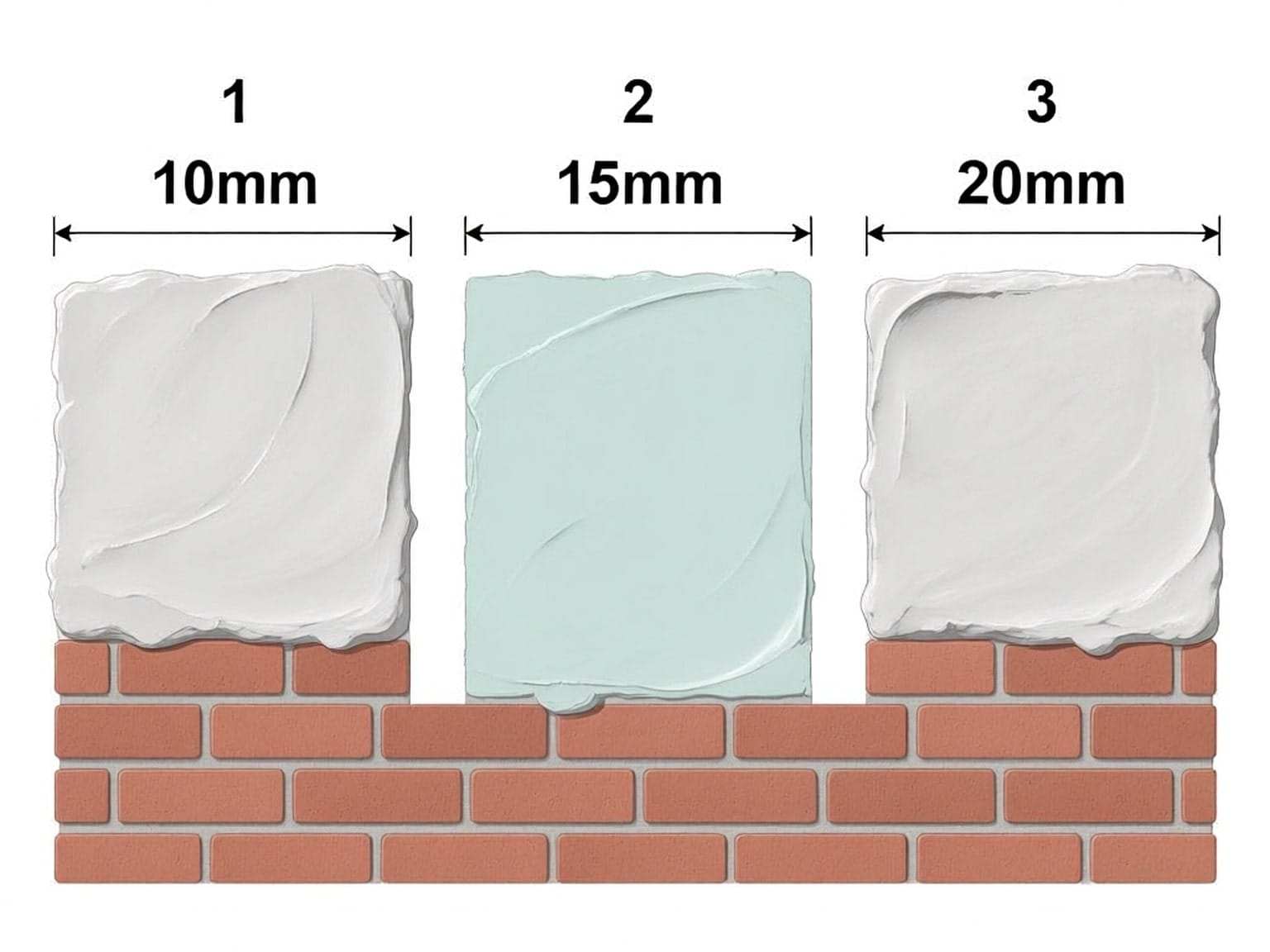
2. Plaster Thickness Selection
Different applications require different thickness:
- Single coat internal walls: 10-12 mm
- External walls: 15-20 mm
- Rough surfaces requiring leveling: 20-25 mm
- Ceiling plaster: 8-10 mm
Warning: Going thicker than 20mm in a single coat increases cracking risk. Consider two-coat application for uneven walls.
3. Mix Ratio Selection
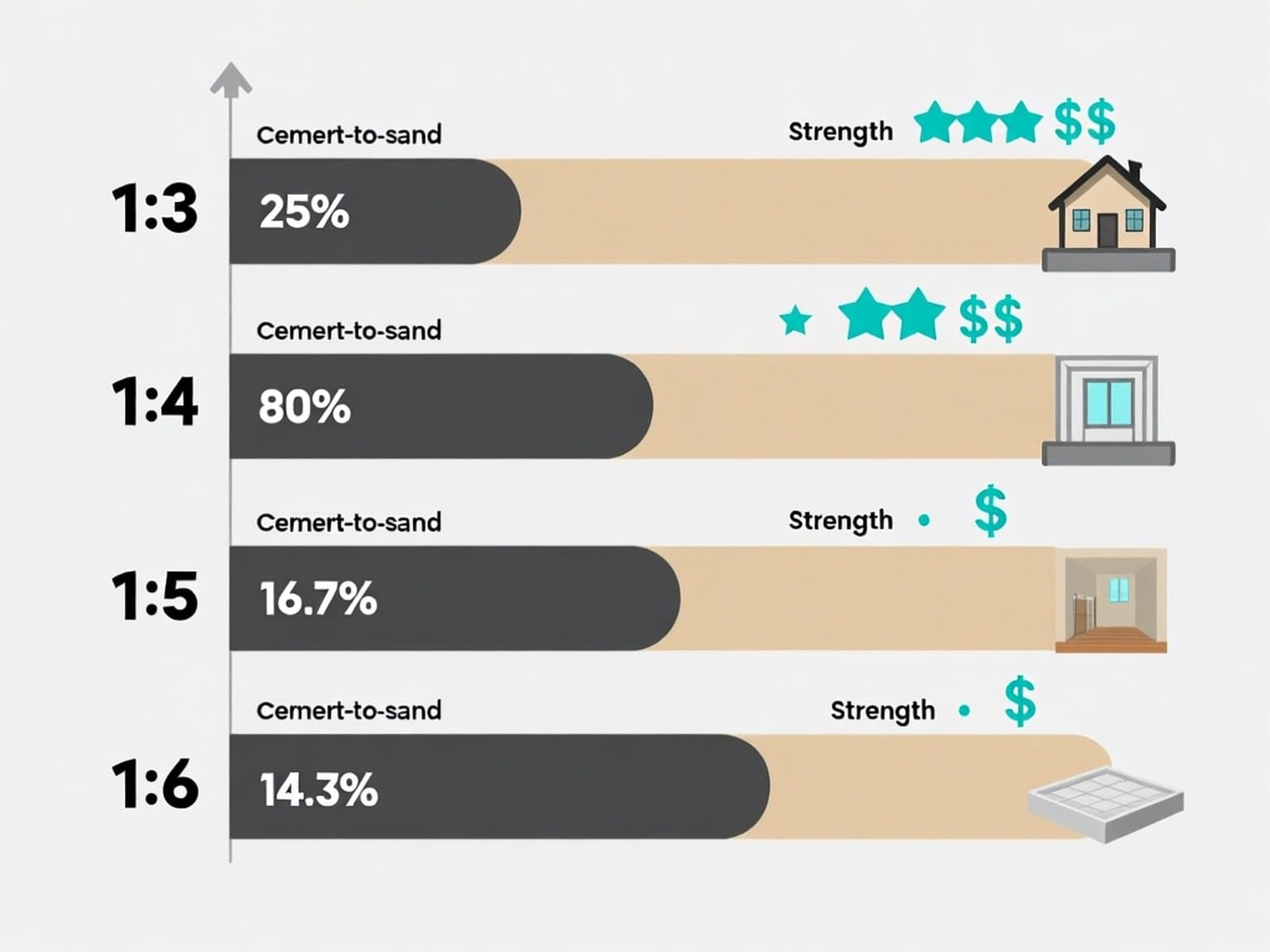
The cement-to-sand ratio determines plaster strength and cost:
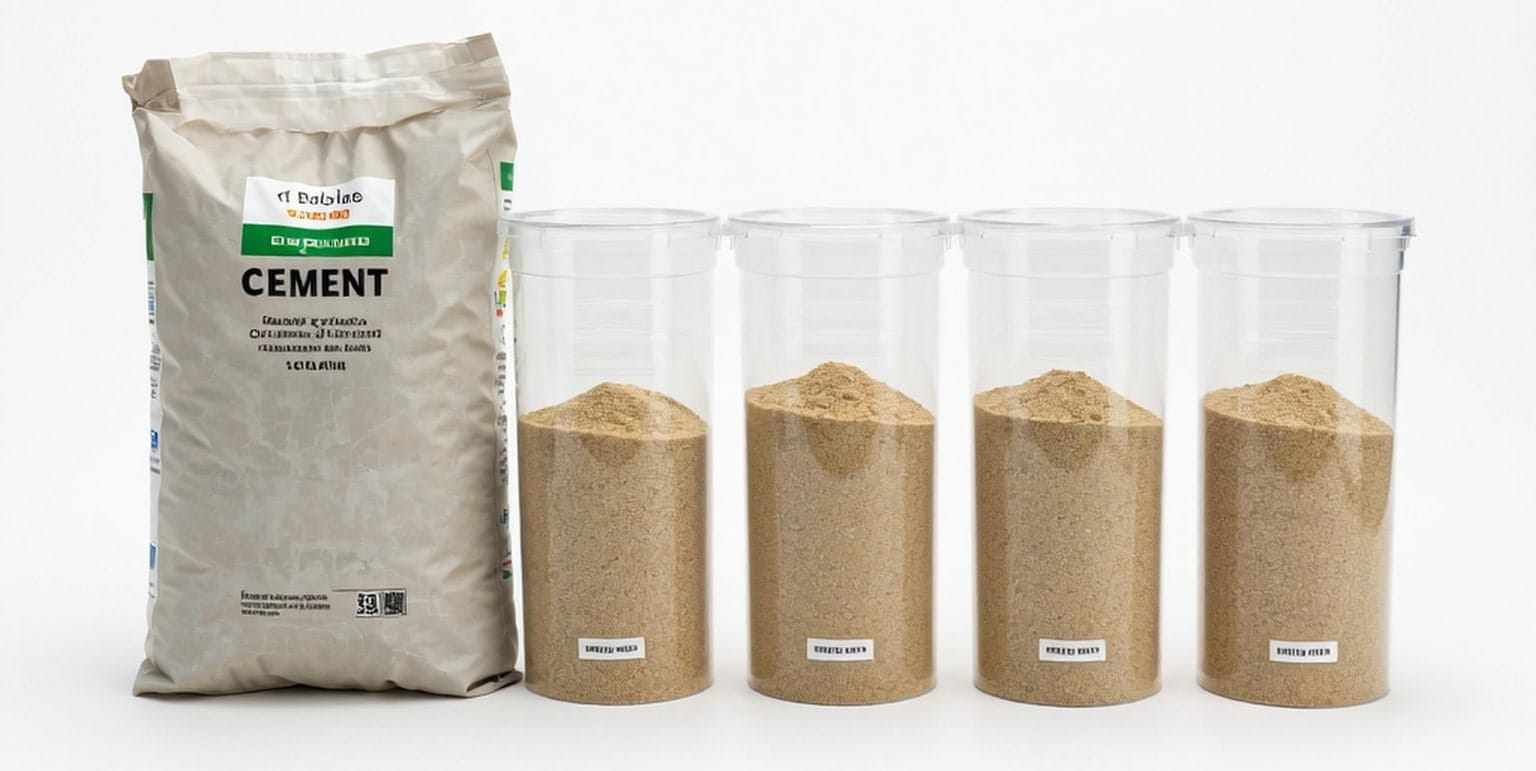
Most common choice: 1:5 offers the best balance of strength, workability, and economy for residential projects.
4. Wastage Percentage
This accounts for:
- Material spillage and mixing losses (2-3%)
- Surface irregularities (2-4%)
- Application technique inefficiency (1-2%)
- Storage and handling waste (1-2%)
Recommended wastage factors:
- Experienced professionals with good site management: 5-7%
- Average contractors: 7.5-10%
- DIY projects or poor site conditions: 10-15%
Higher wastage isn't always bad—it's insurance against running out mid-project.
5. Optional Cost Estimation
Enter your local cement bag price to get instant budget projection. Don't forget to add:
- Sand cost (typically 30-40% of total material cost)
- Transportation
- Labor charges
- Other materials (water, admixtures)

Understanding Your Calculator Results
Once you hit "Calculate," you'll see several outputs. Here's what each means and how to use it:
1. Total Plaster Volume
This is the cubic volume of wet plaster mix needed. It helps you:
- Understand project scale
- Plan mixing batches
- Schedule delivery logistics
2. Cement Bags Required
Always round up to the nearest whole bag. You can't buy 6.58 bags—you'll need 7.
Smart ordering tip: Order one extra bag per 10 required as buffer stock. For 7 bags, order 8.
3. Sand Volume
Presented in cubic meters, cubic feet, or cubic yards depending on your input unit.
Practical conversion for ordering:
- 1 m³ ≈ 1.4-1.5 tons of dry sand
- 1 m³ ≈ 35.3 cubic feet
- Typical truck load: 4-6 m³
4. Estimated Material Cost
This is your baseline budget for cement only. Multiply by 1.8-2.0 to estimate total material costs including sand and incidentals.
5. Detailed Breakdown
Review this carefully to verify:
- Input values are correct
- Mix ratio matches your specification
- Wastage factor is appropriate
- Unit conversions are accurate
Common Mistakes to Avoid
Even with a calculator, you can make errors. Here's what to watch out for:
Mistake #1: Incorrect Area Measurement
Problem: Measuring only floor area instead of wall surface area
Impact: 30-50% material shortage
Solution: Always measure wall height × length, not floor dimensions
Mistake #2: Ignoring Surface Condition
Problem: Using the same thickness for smooth and rough walls
Impact: Uneven finish or excessive material use
Solution: Inspect walls first; add 2-3mm for rough surfaces
Mistake #3: Unit Mixing
Problem: Entering area in feet but thickness in millimeters without conversion
Impact: Catastrophically wrong calculations
Solution: Double-check all units match before calculating
Mistake #4: Wrong Mix Ratio
Problem: Using 1:6 ratio for external walls needing 1:4
Impact: Weak plaster, early deterioration
Solution: Match ratio to application (see table in previous section)
Mistake #5: Underestimating Wastage
Problem: Using 0-3% wastage for large projects
Impact: Multiple emergency material runs, project delays
Solution: Be realistic—use 7.5-10% for most projects
Advanced Calculator Features
Modern plaster calculators offer powerful additional capabilities:
Multiple Wall Calculation
Calculate each wall separately and see combined totals. Perfect for:
- Rooms with varying plaster thickness
- Different mix ratios per wall (internal vs. external)
- Phased construction projects
Custom Mix Ratios
Need a 1:5.5 or 1:4.5 ratio? Custom input allows precision matching to:
- Specific engineering requirements
- Local building codes
- Architect specifications
Unit Flexibility
Seamlessly switch between:
- Area: m², ft², yd²
- Thickness: mm, cm, inches
- Volume: m³, ft³, yd³
No mental math required—the calculator handles everything.
Cost Tracking
Enter prices for:
- Cement per bag
- Sand per cubic meter/ton
- Labor per square meter
Get complete project cost breakdown instantly.
Save & Print Reports
Generate professional calculation reports including:
- Input parameters
- Detailed calculations
- Material quantities
- Cost estimates
- Date and project reference
Perfect for client presentations or site records.
Plaster Mix Ratio Guide: Choosing the Right Blend
Understanding mix ratios is crucial for quality results. Here's your comprehensive guide:
Ratio Selection by Application
1:3 Mix (Rich Mix)
Composition: 1 part cement, 3 parts sand
Best for:
- External plastering exposed to weather
- Damp-prone areas (bathrooms, basements)
- Areas requiring high durability
- First coat on rough masonry
Characteristics:
- High strength and water resistance
- More expensive
- Faster setting time
- Can be harder to work with
1:4 Mix (Standard External)
Composition: 1 part cement, 4 parts sand
Best for:
- Standard external walls
- Internal walls in commercial buildings
- High-traffic residential areas
- Renovation work over old plaster
Characteristics:
- Good balance of strength and workability
- Moderate cost
- Suitable for most conditions
- Professional standard for quality work
1:5 Mix (Balanced Mix)
Composition: 1 part cement, 5 parts sand
Best for:
- Internal walls in residential buildings
- Protected external areas (covered porches)
- Second coat plastering
- Ceiling finish coat
Characteristics:
- Economical yet effective
- Easier to apply smoothly
- Good workability period
- Most popular choice for homes
1:6 Mix (Lean Mix)
Composition: 1 part cement, 6 parts sand
Best for:
- Interior ceilings
- Non-structural finishing
- Budget-conscious projects
- Areas with minimal stress
Characteristics:
- Most economical
- Easiest to spread
- Lower strength (adequate for intended use)
- Longer working time
Climate Considerations
Hot & Dry Climates (Middle East, parts of Australia):
- Use 1:4 or richer mixes
- Add slightly more cement for heat resistance
- Consider adding retarders to slow drying
Humid & Rainy Climates (Coastal areas, tropical regions):
- Use 1:3 or 1:4 for external walls
- Ensure good waterproofing
- Allow proper curing time (7-14 days)
Cold Climates (Northern US, Canada, Europe):
- Richer mixes (1:3 or 1:4) for frost resistance
- Avoid plastering when temperature drops below 5°C
- Use anti-freeze admixtures if necessary
Material Quality: What You Need to Know
The calculator gives you quantities, but material quality determines your results.
Cement Selection
Types of Cement
Ordinary Portland Cement (OPC):
- Most common for plastering
- Available in 33, 43, and 53 grades
- Grade 43 is ideal for most residential work
Portland Pozzolana Cement (PPC):
- Better workability
- Improved water resistance
- Slightly lower early strength
- Excellent for plastering
White Cement:
- For decorative finishes
- Much more expensive
- Limited structural use
- Beautiful final appearance
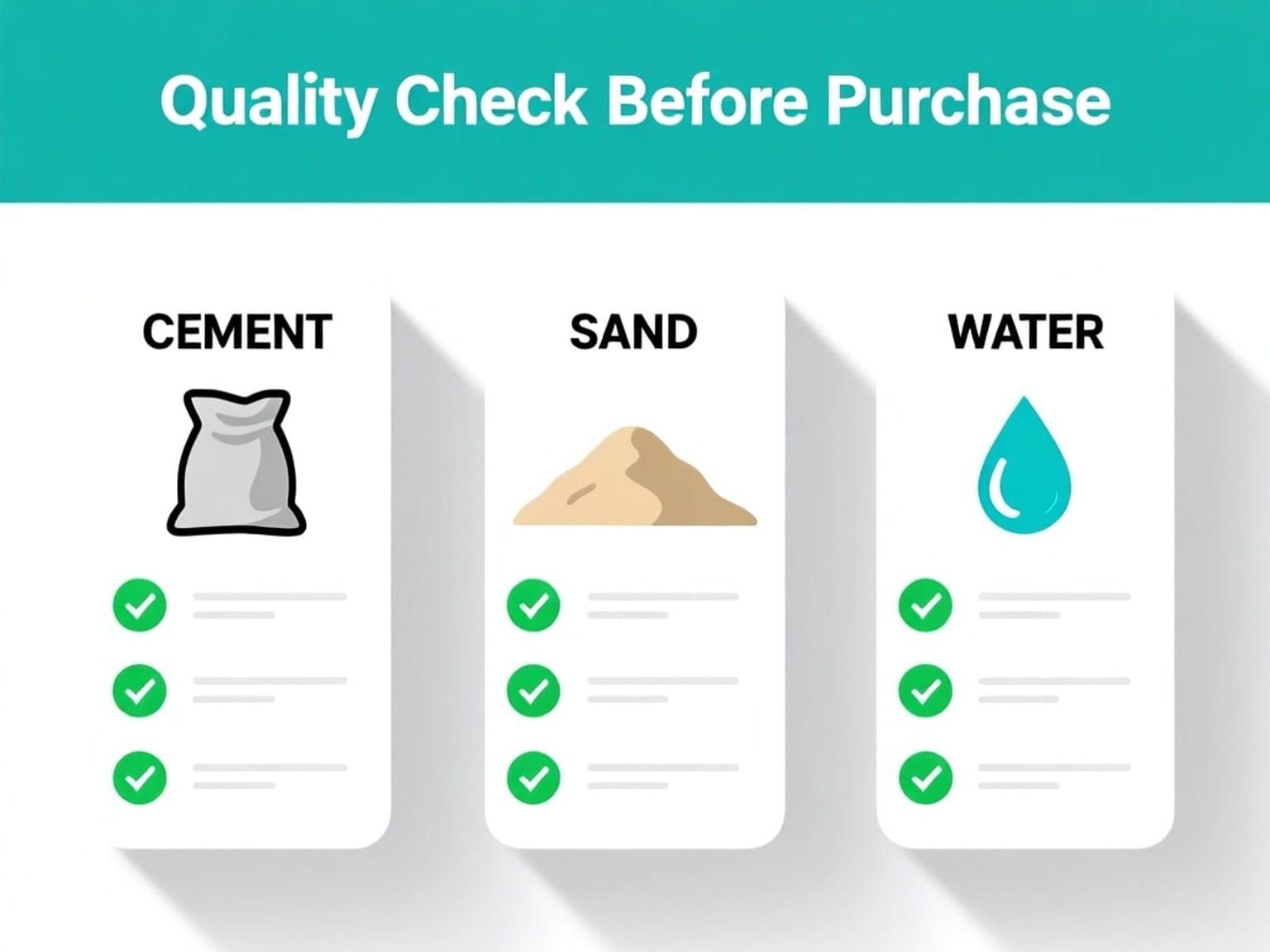
Quality Checks for Cement
Before purchasing, verify:
- Manufacturing date (use within 90 days)
- Bags should be firm, not lumpy
- No moisture damage
- ISI/ASTM certification mark
- Properly sealed packaging
Storage tip: Keep bags 150mm above ground on wooden pallets, covered with tarpaulin.
Sand Selection
Sand Types
River Sand:
- Best quality for plastering
- Well-rounded grains
- Good bonding properties
- Naturally clean
Manufactured Sand (M-Sand):
- Crushed stone dust
- Angular particles (better bonding)
- Consistent quality
- Environmentally friendly
Pit Sand:
- Coarser grain structure
- Suitable for rough coats
- Needs thorough screening
- Usually more affordable
Quality Criteria
Good plaster sand should be:
- Grain size: Pass through 1.2mm sieve, retain on 0.15mm
- Clean: Free from clay, silt, organic matter
- Moisture content: Slightly damp (5-7%) is ideal
- Color: Light yellow/brown (avoid very dark sand)
Simple field test: Rub sand between palms—it shouldn't leave dirty residue or too much dust.
Water Quality
Often overlooked but critical:
- Use clean, potable water
- Avoid seawater (causes efflorescence)
- No industrial waste contamination
- pH between 6-8 is ideal
Rule of thumb: If you wouldn't drink it, don't use it for plastering.
Cost Estimation and Budgeting
Understanding material costs helps you plan budgets and negotiate better rates.
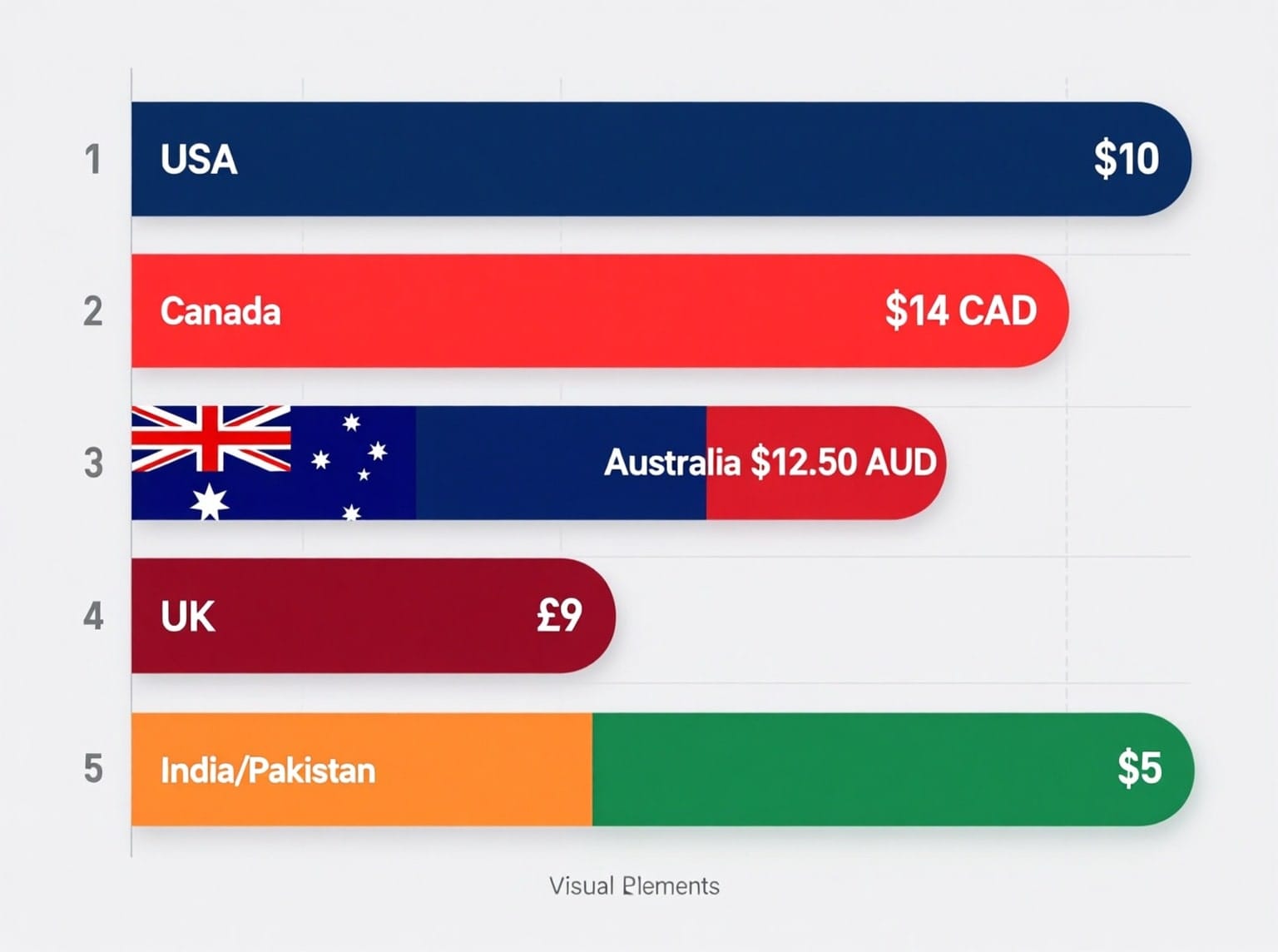
Material Cost Breakdown (2025 Average Prices)
Note: Prices vary by region. These are approximate ranges for reference.
Cement Cost
*Prices are approximate 2025 averages and vary by location, brand, and bulk ordering. Updated: January 2025
Sand Costs
| Unit | Typical Price Range | Notes |
|---|---|---|
| Per m³ (loose) | $30-$60 | River sand premium |
| Per ton | $25-$50 | Bulk discounts available |
| Per truckload (4-6 m³) | $150-$300 | Including delivery |
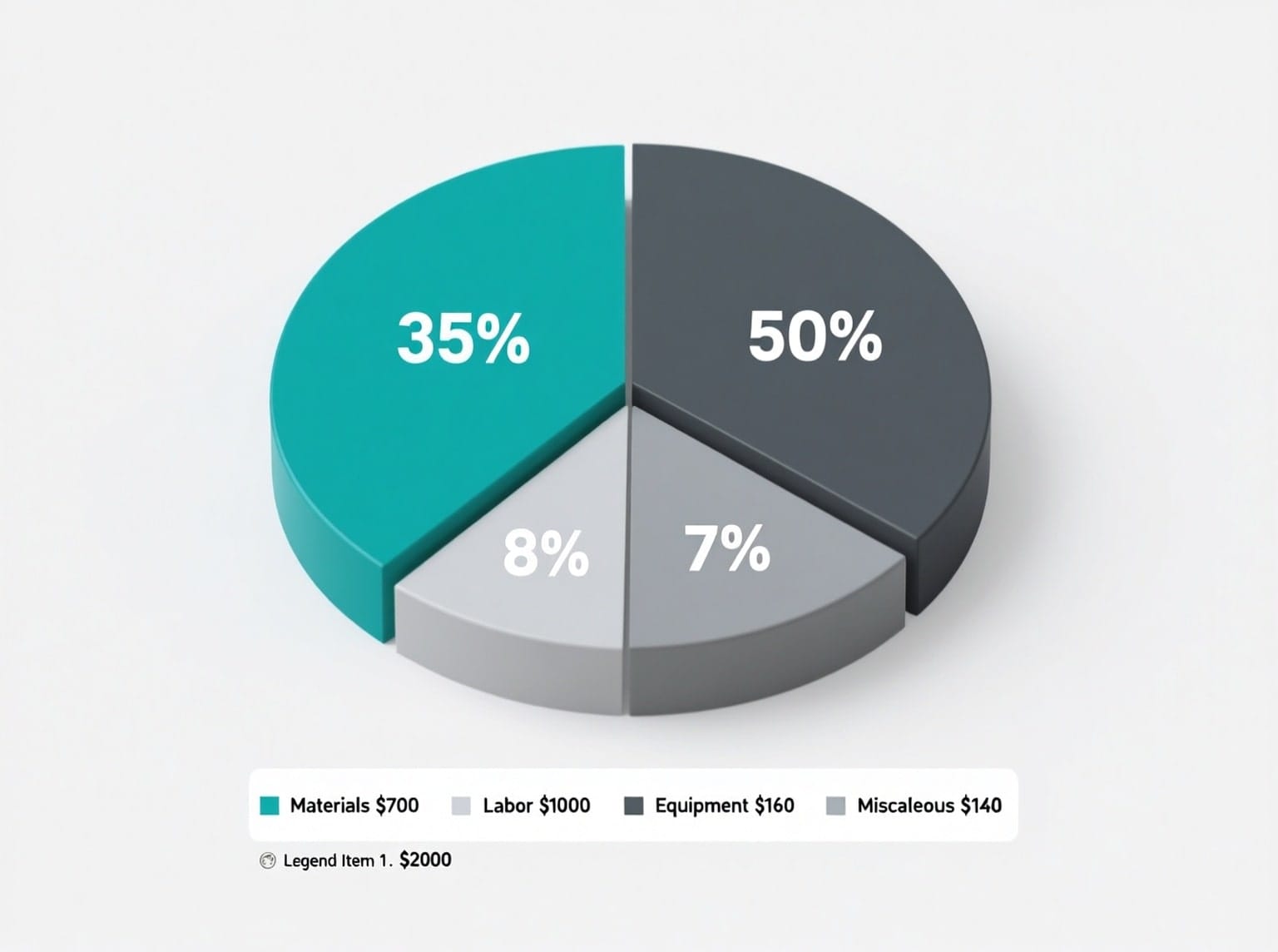
Total Project Cost Calculation
For a typical 500 ft² plastering project:
Material Costs:
- Cement (12 bags × $10): $120
- Sand (2 m³ × $40): $80
- Water, admixtures: $10
- Subtotal: $210
Labor Costs (varies greatly):
- Professional contractors: $2.50-$5.00 per ft²
- For 500 ft²: $1,250-$2,500
Additional Costs:
- Surface preparation: $100-$200
- Equipment rental: $50-$100
- Wastage contingency (10%): $21
- Total Project Range: $1,631-$3,081
Money-Saving Tips
- Bulk purchasing: Buy cement in bulk (10+ bags) for 5-10% discount
- Seasonal timing: Material prices often dip in winter months
- Direct from distributor: Skip retail markup, save 15-20%
- Accurate calculation: Using this calculator prevents over-ordering
- Quality balance: Don't buy cheapest—mid-range brands offer best value
Pro insight: Spending 10% more on quality materials often reduces labor costs by 20% due to easier application and better coverage.
DIY vs. Professional Plastering: Making the Right Choice
Should you tackle plastering yourself or hire professionals? Here's an honest assessment.
DIY Plastering
Pros:
- Save 60-70% on labor costs
- Learn valuable skills
- Complete control over project timing
- Satisfaction of self-completion
Cons:
- Steep learning curve
- Time-intensive (3-4x slower than pros)
- Risk of poor finish quality
- Need to rent or buy specialized tools
Best for:
- Small projects (single room)
- Non-visible areas (garages, utility rooms)
- Budget-constrained renovations
- Individuals with some construction experience
Professional Plastering
Pros:
- Expert quality finish
- Fast completion (500 ft² in 1-2 days)
- Warranty on workmanship
- No tool investment needed
- Proper surface preparation
Cons:
- Higher upfront cost
- Need to schedule and coordinate
- Less personal control
- Finding reliable contractors can be challenging
Best for:
- Entire home plastering
- Visible, high-traffic areas
- Complex surfaces (high ceilings, curved walls)
- Time-sensitive projects
Hybrid Approach
Many smart homeowners choose this middle path:
DIY handles:
- Surface preparation (cleaning, filling holes)
- Material calculation and procurement (using this calculator!)
- Helper tasks during application
- Final touch-ups and minor corrections
Professional handles:
- Main plaster application
- Achieving smooth, level surfaces
- Troubleshooting problematic areas
- Quality assurance
This approach saves 30-40% on labor while ensuring professional results.
Troubleshooting Common Plaster Problems
Even with perfect calculations, application issues can arise. Here's how to diagnose and fix them:
Problem 1: Cracking After Application
Symptoms: Fine hairline cracks or larger structural cracks
Causes:
- Too rapid drying (hot weather, direct sunlight)
- Excessive water in mix
- Insufficient curing
- Plaster applied too thick in single coat
- Poor bonding with substrate
Solutions:
- Keep plastered surface damp for 7-10 days
- Use 1:4 or richer mix for thick applications
- Apply in multiple coats if thickness exceeds 18mm
- Dampen wall before plastering
- Add bonding agent for smooth concrete surfaces
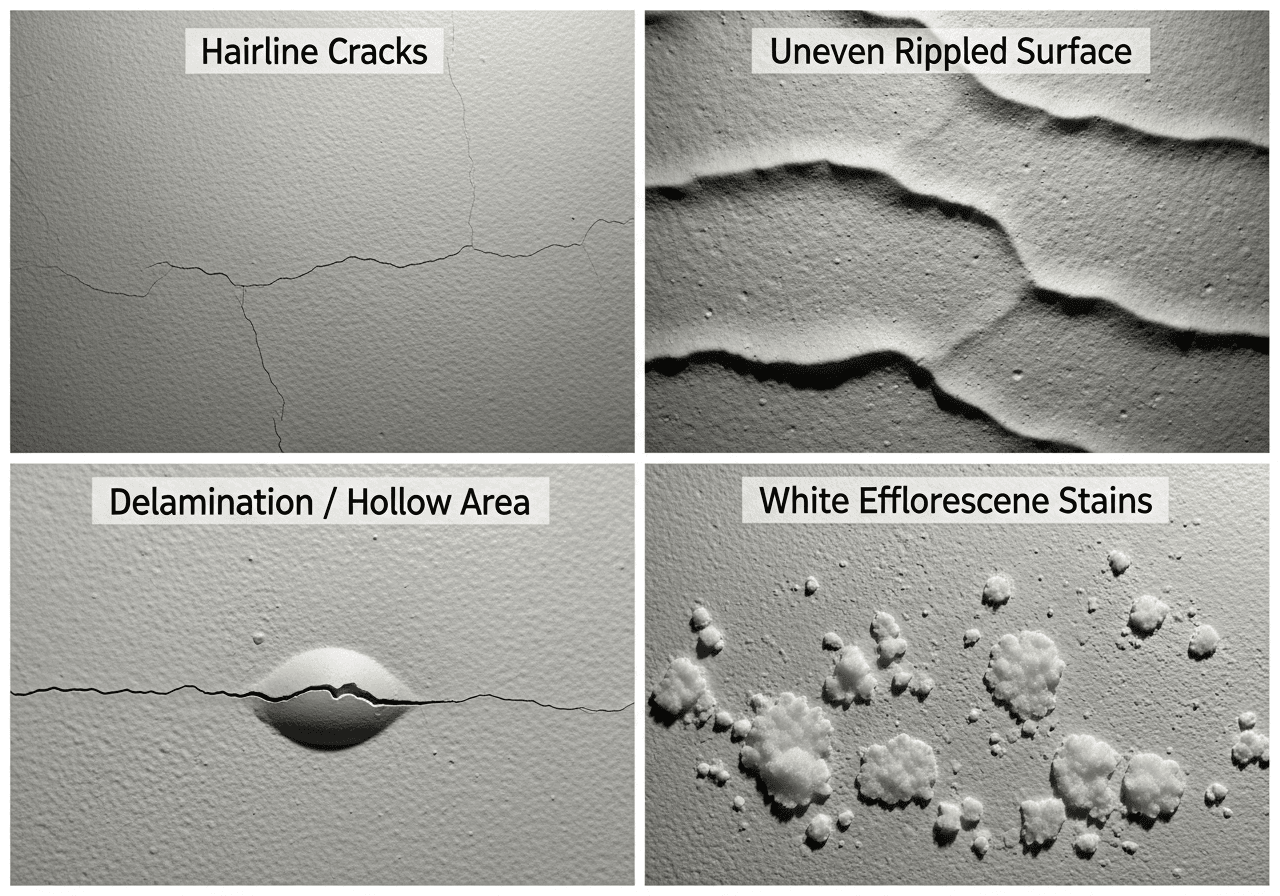
Problem 2: Uneven Finish or Ripples
Symptoms: Wavy surface, visible trowel marks
Causes:
- Inconsistent plaster thickness
- Wrong trowel technique
- Mix consistency varying between batches
- Insufficient smoothing passes
Solutions:
- Use level guides (dot and dab method)
- Maintain consistent mix water proportion
- Final smoothing when plaster is semi-set (thumb impression test)
- Multiple light passes better than single heavy pass
Problem 3: Delamination (Plaster Falling Off)
Symptoms: Plaster separating from wall, hollow sound when tapped
Causes:
- Wall surface not cleaned properly
- Wall too dry during application
- Poor quality cement or sand
- Applying new plaster over painted surface
- Insufficient mechanical key
Solutions:
- Clean wall thoroughly, remove loose materials
- Dampen wall 2-3 hours before plastering
- Use bonding agent on smooth surfaces
- Create mechanical key with wire brush
- Never plaster over glossy paint without proper preparation
Problem 4: Efflorescence (White Powder/Stains)
Symptoms: White crystalline deposits on surface
Causes:
- Excessive moisture in wall
- Soluble salts in cement, sand, or wall
- Water penetration from outside
- Inadequate curing practices
Solutions:
- Fix water leakage before plastering
- Use low-alkali cement
- Test and wash sand if high salt content
- Ensure proper external waterproofing
- Allow wall to dry completely before painting
Problem 5: Soft or Powdery Surface
Symptoms: Surface rubs off easily, lacks strength
Causes:
- Too much sand in mix (wrong ratio)
- Expired or poor-quality cement
- Excessive water added
- Plaster disturbed during setting
- Insufficient curing
Solutions:
- Verify mix ratio is correct using calculator
- Check cement manufacturing date
- Remove weak plaster and reapply
- Protect surface during curing period
- Consider cement-sand ratio increase to 1:4
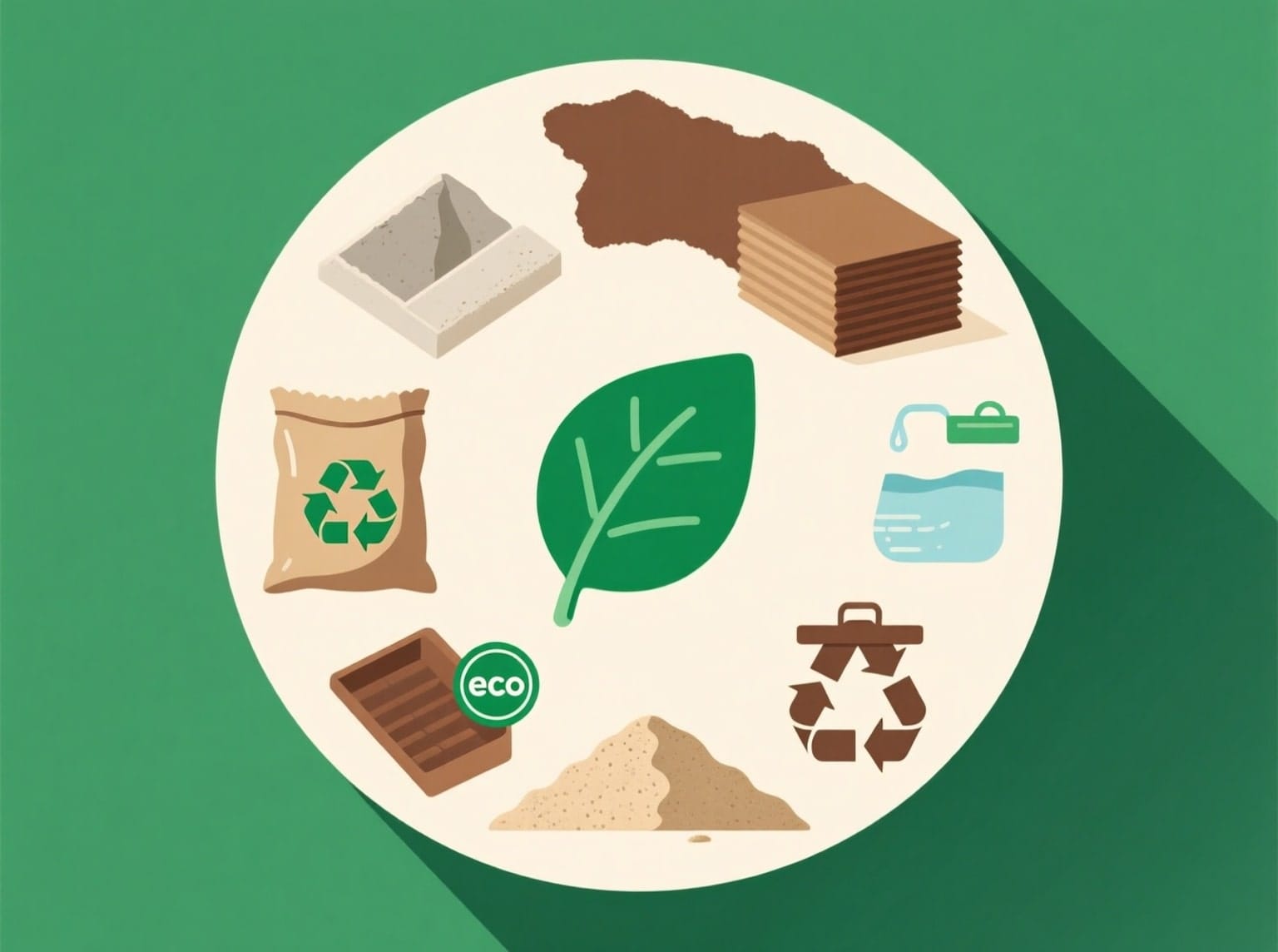
Environmental Considerations and Sustainable Plastering
Modern construction emphasizes sustainability. Here's how to make your plastering project eco-friendlier:
Sustainable Material Choices
Cement Alternatives:
- Fly ash: Reduces cement usage by 20-30%
- Ground granulated blast-furnace slag (GGBS): Industrial byproduct replacement
- Natural pozzolans: Volcanic ash, calcined clay
Eco-friendly Sand:
- Manufactured sand (M-Sand) from quarry waste
- Recycled aggregate from construction demolition
- Local sand sources (reduces transportation emissions)
Waste Reduction Strategies
Using the Wall Plaster Quantity Calculator is itself an environmental action:
Material waste reduction:
- Accurate calculations prevent 15-25% material over-ordering
- Less waste means reduced landfill burden
- Fewer cement bags = lower carbon footprint
Best practices:
- Order materials in phases for large projects
- Store materials properly to prevent spoilage
- Use leftover plaster mix immediately (can't be stored)
- Donate excess bags to community projects
Energy-Efficient Application
Smart scheduling:
- Plaster during moderate temperatures (15-25°C)
- Reduces need for climate control during curing
- Natural ventilation instead of fans
Water conservation:
- Use precisely measured water quantities
- Collect and reuse washing water for curing
- Install drip irrigation for large wall curing
Carbon footprint comparison: A typical 1000 ft² plastering project using accurate calculations produces approximately 200 kg less CO₂ compared to traditional "estimate and order extra" approach.
Regional Variations and Building Codes
Plastering practices vary globally. Here's what you need to know for different regions:
United States
Code requirements:
- ASTM C926: Standard Specification for Application of Portland Cement-Based Plaster
- Thickness: Typically 3/8" to 5/8" (9-16mm) for interior, up to 7/8" (22mm) for exterior
- Mix ratios: Usually specified in project documentation
Regional notes:
- Southwest states: Focus on crack resistance due to thermal expansion
- Southeast coastal: Enhanced water resistance, mold prevention
- Northern states: Freeze-thaw resistance critical
Canada
Standards:
- CSA A23.1/A23.2: Concrete materials and methods
- R-value considerations for thermal efficiency
- Vapor barrier requirements
Cold climate specifics:
- Anti-freeze admixtures for winter work
- Extended curing protection
- Minimum application temperature: 5°C
Australia
Standards:
- AS 3700: Masonry structures
- AS 1170: Structural design actions (for external render)
Climate considerations:
- Bushfire-prone areas: Non-combustible materials
- Coastal regions: Salt-resistant mixes
- Tropical north: Mold and moisture resistance
United Kingdom
Standards:
- BS 5492: Code of practice for internal plastering
- BS EN 13914: Design, preparation and application of external rendering
Typical specifications:
- Internal walls: 11mm two-coat work
- Ceilings: 8mm finish
- External render: 15-20mm multi-coat
India and Pakistan
Standards:
- IS 1661: Method of sampling and analysis of cement plaster
- IS 2542: Sand for plaster
Common practices:
- Predominantly 1:4 and 1:5 mixes
- Manual application (machine plastering emerging)
- Extensive use of natural curing (water sprinkling)
Always verify: Check local building codes and regulations before starting your project. The calculator provides material quantities, but application must meet regional standards.
Frequently Asked Questions
Q How accurate is the Wall Plaster Quantity Calculator?
The calculator provides 95-98% accuracy when you input correct measurements and appropriate parameters. Real-world accuracy depends on factors like surface irregularity, application technique, and actual wastage. Always round up final quantities and add a 5-10% buffer for complex projects or first-time applications to ensure you have sufficient materials.
Q What's the ideal plaster thickness for internal walls?
For standard internal residential walls, 12mm thickness offers the best balance of strength, smoothness, and economy. Use 10mm for smooth, pre-leveled surfaces and 15-18mm for slightly uneven walls. Ceiling plaster should be thinner, typically 8-10mm, to reduce weight and minimize cracking risk.
Q Can I use the calculator for lime plaster or gypsum plaster?
The calculator is optimized for cement-sand plaster using standard cement bulk density of 1440 kg/m³. For lime plaster, gypsum plaster, or clay-based plasters, the density and mix ratios differ significantly. You can use it for volume calculation, but cement bag conversion won't be accurate for alternative plaster types.
Q How do I calculate plaster for walls with many windows and doors?
Measure the gross wall area first (total wall dimensions), then calculate each opening area separately. Subtract openings from the total for accuracy. For numerous small openings, you might choose to include them in the calculation as a built-in wastage buffer to simplify the process without significant material excess.
Q What wastage percentage should I use for my project?
Use 5-7% for experienced contractors with good site management, 7.5-10% for average projects with typical site conditions, and 10-15% for DIY projects, complex surfaces, or poor site organization. Higher wastage accounts for mixing losses, uneven surfaces, spillage, and application inefficiency, preventing costly project delays from material shortages.
Q Is it better to order all materials at once or in phases?
For small to medium projects (under 1000 ft²), order everything at once to benefit from bulk discounts and ensure consistent material batches. For large projects, phase ordering in 2-3 shipments prevents cement aging beyond 90 days and reduces on-site storage challenges. Use the calculator to divide total requirements by project phases effectively.
Q Can I reduce cement quantity to save costs?
You can use a leaner mix ratio (like 1:6 instead of 1:4) for non-critical areas like interior ceilings, but don't compromise on external walls or moisture-prone areas. Using weak mixes in wrong applications leads to early deterioration, costing far more in repairs than initial material savings. The calculator helps you optimize ratios appropriately, not compromise quality.
Q How long does plastered surface take to cure completely?
Initial setting occurs in 24-48 hours when the surface can be touched carefully. Practical strength develops in 7 days, sufficient for painting preparation. Complete curing takes 28 days to achieve full chemical strength. During the first 7-10 days, keep the surface damp by sprinkling water 2-3 times daily to prevent cracking and ensure proper curing.
Conclusion: Master Your Plastering Projects with Confidence
You've now unlocked the complete guide to accurate plaster material estimation. Here's what you've discovered:
The Wall Plaster Quantity Calculator transforms a complex, error-prone process into a simple, accurate, and fast operation. By understanding wall area calculation, choosing appropriate plaster thickness, selecting the right cement-to-sand ratio, and accounting for realistic wastage, you can estimate materials with professional-level precision.
Key takeaways:
- Accurate calculations prevent 15-25% material waste and save hundreds to thousands of dollars
- Mix ratio selection (1:3 to 1:6) directly impacts strength, durability, and cost
- The 7.5% wastage factor is your safety net against project delays
- Quality materials matter as much as quantity—don't compromise on cement and sand standards
- Regional codes and climate conditions influence mix design and application methods
Whether you're a homeowner planning a DIY renovation, a contractor managing multiple projects, or a construction professional seeking efficiency, this calculator becomes your indispensable tool. It eliminates guesswork, reduces waste, saves money, and ensures you have exactly the right amount of materials when you need them.
Ready to calculate your project requirements? Input your measurements, select your parameters, and get instant, accurate material quantities. Transform your next plastering project from a stressful guessing game into a planned, profitable, and perfectly executed success.
Calculate now and build better → Start using the Wall Plaster Quantity Calculator today and experience the confidence that comes with precision planning.
References:
- ASTM C926-20: Standard Specification for Application of Portland Cement-Based Plaster — ASTM International (ASTM C926 page)
- BS 5492:1990 - Code of practice for internal plastering — BSI Knowledge (product page)
- IS 1661:1972 - Method of Sampling and Analysis for Cement Plaster — Bureau of Indian Standards (free PDF copy)
- CSA A23.1/A23.2:19 - Concrete materials and methods of concrete construction — CSA Group (product page)
- AS 3700:2018 - Masonry structures — Standards Australia (standard details)
- Portland Cement Association — "Plaster and Stucco Technical Manual" (PCA product/publication page)
- National Lime Association — Technical notes / publications on lime-based plaster systems (publications list)
- U.S. Green Building Council — LEED Reference Guide for Building Design and Construction (LEED BD+C reference guide page)
- 2021 International Building Code (IBC) — International Code Council (ICC digital codes)
- CIRIA — "Early-age thermal crack control in concrete" (CIRIA C660 guidance page)