

GPA and CGPA Calculator
Multi-region • Auto-save • Export ready — Calculate accurately using global grading standards
International Smart GPA & CGPA Calculator: Complete Guide to Academic Success
Whether you’re tracking your semester GPA, computing your cumulative CGPA for graduate school applications, or converting grades across international systems — this guide covers everything you need to know. Use the calculator above and read on to understand exactly how GPA and CGPA calculations work worldwide.
You know what keeps students up at night? It’s not just exams. It’s not knowing whether you’ll graduate with honors or barely scrape through — and having no reliable way to check.
Most students don’t find out their CGPA is off until the damage is already done. A student studying in Canada thought she was on track for a scholarship. Final semester comes, CGPA’s lower than she thought. Turns out she’d been using the wrong grading scale the whole time. One mistake, one missed opportunity.
Whether you’re applying to grad school, chasing a merit scholarship, or just tracking where you stand mid-semester, you need accurate numbers. The calculator above handles all of that. This guide explains how GPA and CGPA actually work, what differs across 9+ grading systems, and how to avoid the mistakes that quietly kill cumulative averages.

Students across grading systems — one calculator that handles them all.
GPA vs. CGPA — what’s actually different
GPA is a semester-level number. It tells you how you performed in one specific term — useful for tracking momentum, not for grad school applications.
CGPA is cumulative. Every course you’ve ever taken, weighted by credit hours, rolled into a single number. That’s what appears on your official transcript. That’s what employers and admissions offices look at.
Here’s what catches students off guard: a single bad semester leaves a mark for years. But knowing the math means you can target improvement strategically — focus on the high-credit, high-weight courses where an extra grade point does the most work.
Why most GPA calculators get it wrong for international students
The typical online GPA tool assumes you’re on a 4.0 American scale. If you’re not, the numbers are completely wrong. These systems each use something different:
CBCS system under UGC guidelines. O (Outstanding) = 10.
HD, Distinction, Credit, Pass. HD reserved for top ~15% of students.
First Class, 2:1, 2:2, Third. Converting to GPA trips up most applicants.
A+ = 4.33, giving top performers a measurable numerical edge.
HEC framework with slightly different grade boundaries than the US system.
Grade A is top 10% of students, not a fixed percentage score.
Mapped to percentage ranges. 90–100% = A = 4.0.
The global reference point, but far from universal. Most competitive grad programs want 3.0+.
The calculator above supports all of these — plus a Custom mode for any system not on the list.
How the calculator actually works
Select your region and the calculator loads that country’s exact grade scale. Enter a course name, grade, and credit hours — your GPA updates instantly, no “calculate” button. Add semesters as you go. Rename them anything you want.
The Target GPA Predictor is the part most students don’t know about. Enter your goal CGPA, and it tells you exactly how many more credits at top grades you’d need to reach it. Vague ambition becomes a concrete number.
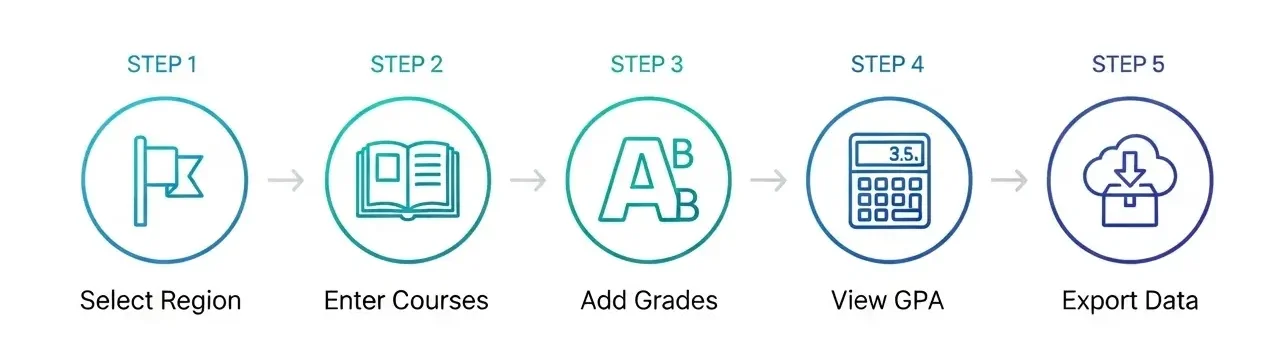
Five steps from opening the calculator to having your full CGPA on screen.
The formula
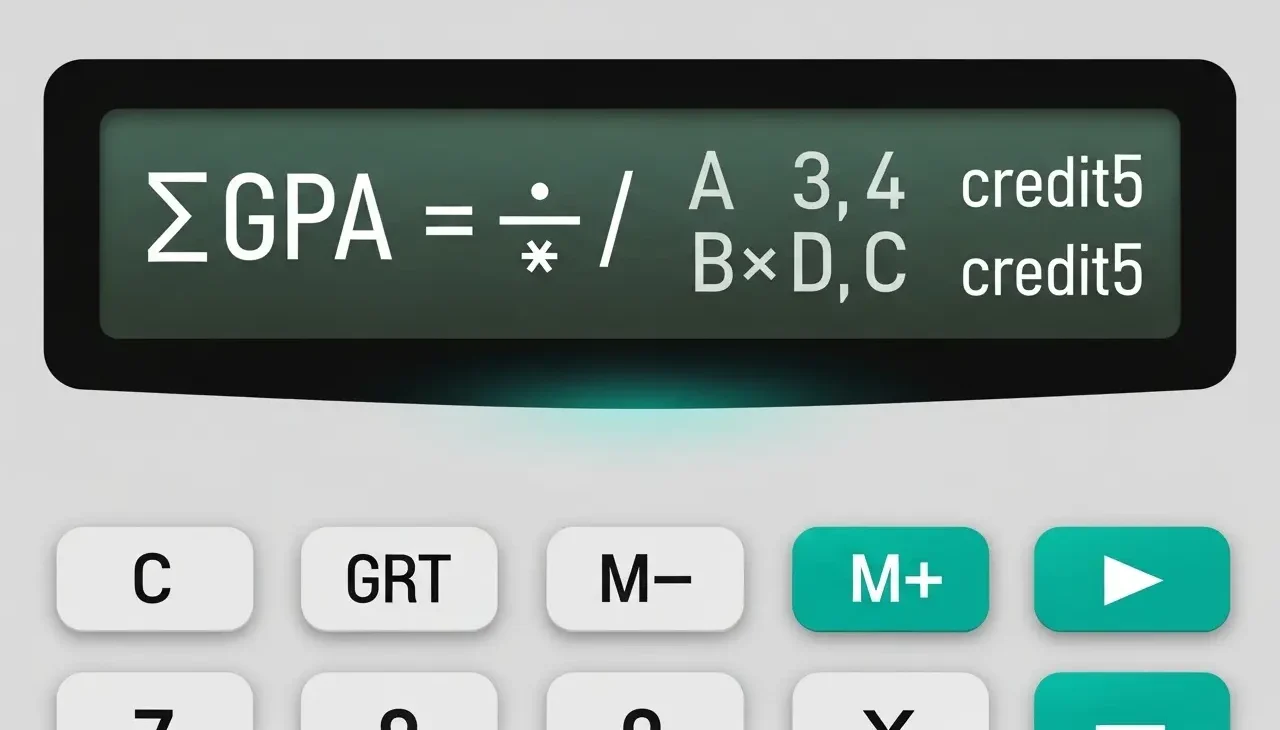
Every GPA, everywhere, uses the same credit-weighted calculation:
CGPA works the same way — it just pulls from every semester at once, not just one.
How to use it — 5 steps, under 5 minutes
- Select your region. The calculator loads the correct grade scale for your country instantly.
- Check the grade scale. Click “Grade Scale” to see how your letter grades or percentages map to GPA points. Worth doing once before you enter anything.
- Enter your courses. Course name, grade, credit hours. The grade field suggests valid values for your region as you type.
- Watch the number update. GPA and CGPA recalculate live. Performance badges — Excellent, Good, At Risk — appear automatically.
- Add more semesters. Click “Add Semester” and keep building. Name them whatever you want: “Fall 2024”, “Semester 3”, “Year 2 Term 1”.
Advanced features worth knowing
The Target GPA Predictor turns a goal (“I want 3.8”) into a specific credit plan. Export to CSV for spreadsheets or JSON for backup. The Print option generates a clean page for scholarship applications. All data saves locally in your browser — close the tab, come back a week later, it’s still there.
International grading systems in detail
USA — 4.0 scale
A = 4.0. B = 3.0. C = 2.0. D = 1.0. F = 0.0. Most competitive graduate programs want 3.0+ for admission, 3.5+ for merit scholarships. A 3.8 gets noticed.
Canada — 4.33 scale
A+ = 4.33, not 4.0. That extra third of a point is real — it separates elite performers from the pack on applications. University of Toronto, UBC, and McGill all use this scale, though some Canadian schools still run on 4.0 or a 9-point system.
UK — Honours classification
British universities don’t give GPAs. They give degree classes. First Class (70%+) is the 4.0 equivalent and is required for most UK PhD programs. Upper Second / 2:1 (60–69%) maps roughly to 3.3 and is the floor for most Masters programs.
India — 10.0 CGPA scale (CBCS)
Under the UGC’s Choice Based Credit System, grades run 0–10. To convert to a US 4.0 for applications: multiply your CGPA by 4, then divide by 10. WES accepts this formula. So does most of the American university system.
Australia — 7.0 scale (HD system)
HD (High Distinction, 85–100%) = 7.0. D (Distinction, 75–84%) = 6.0. C (Credit, 65–74%) = 5.0. P (Pass, 50–64%) = 4.0. HD is reserved for roughly the top 15% of students at most institutions.
Pakistan — 4.0 scale (HEC framework)
LUMS, NUST, IBA, COMSATS — all follow HEC grading policy. The scale is 4.0, with grade boundaries that differ slightly from the US system. A CGPA of 3.0+ is the general floor for merit-based scholarships and graduate admission.
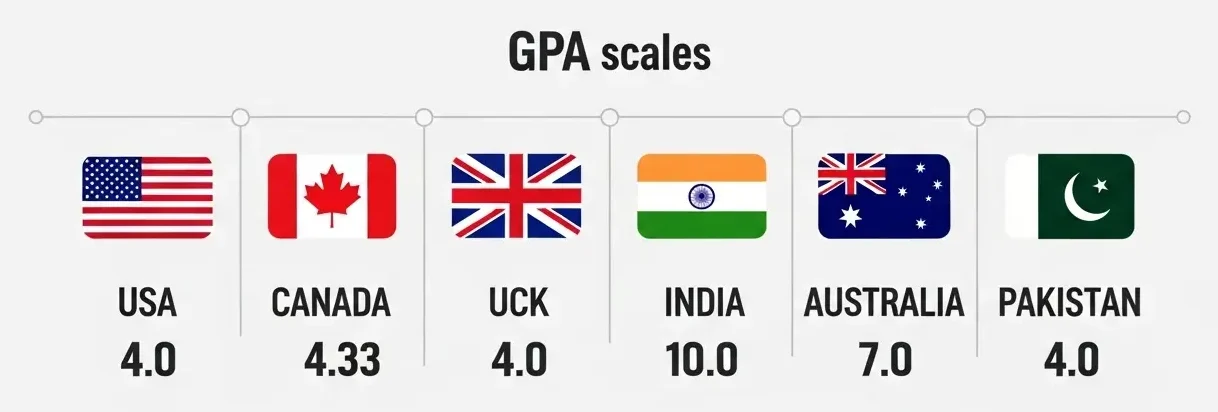
Six major systems, six different maximums, one calculator that converts between them.
International GPA systems at a glance
| Feature | USA (4.0) | Canada (4.33) | UK | India (10.0) | Australia (7.0) | Pakistan (4.0) |
|---|---|---|---|---|---|---|
| Maximum scale | 4.0 | 4.33 | 4.0 equiv. | 10.0 | 7.0 | 4.0 |
| Top grade | A / A+ | A+ (4.33) | First (70%+) | O (Outstanding) | HD (85%+) | A+ |
| Passing grade | D (1.0) | D (1.0) | Third (40%) | D (4.0) | P (50%) | D (1.0) |
| Honours range | 3.5–4.0 | 3.7–4.33 | 2:1 and above | 7.5–10.0 | 5.0–7.0 | 3.5–4.0 |
| Grad school floor | 3.0+ | 3.0+ | 2:1+ | 7.0+ | 5.0+ | 3.0+ |
| Governing body | Institution | CICIC | QAA | UGC / CBCS | AQF | HEC |
Percentage-to-GPA conversion reference
| Percentage | Letter grade | USA 4.0 | India 10.0 | Australia 7.0 | UK classification |
|---|---|---|---|---|---|
| 90–100% | A+ | 4.0 | 10 | 7.0 | First Class |
| 85–89% | A | 4.0 | 9 | 7.0 | First Class |
| 80–84% | A– | 3.7 | 8 | 6.0 | First Class |
| 75–79% | B+ | 3.3 | 7 | 6.0 | Upper Second (2:1) |
| 70–74% | B | 3.0 | 6 | 5.0 | Upper Second (2:1) |
| 65–69% | B– | 2.7 | 5 | 5.0 | Upper Second (2:1) |
| 60–64% | C+ | 2.3 | 4 | 4.0 | Lower Second (2:2) |
| 50–59% | C | 2.0 | 3 | 4.0 | Lower Second (2:2) |
| Below 50% | F | 0 | 0 | 0 | Fail |
4 mistakes that quietly kill your CGPA
Treating a 2-credit elective the same as a 4-credit core course. They’re not equal — not even close.
Running a 10.0-scale Indian CGPA or a 7.0-scale Australian GPA through a standard US 4.0 calculator.
Excluding F grades or withdrawn courses to make the number look cleaner.
Assuming 80% = 8.0 GPA or 3.8 GPA. It doesn’t work that way in any system.
How to actually improve your CGPA
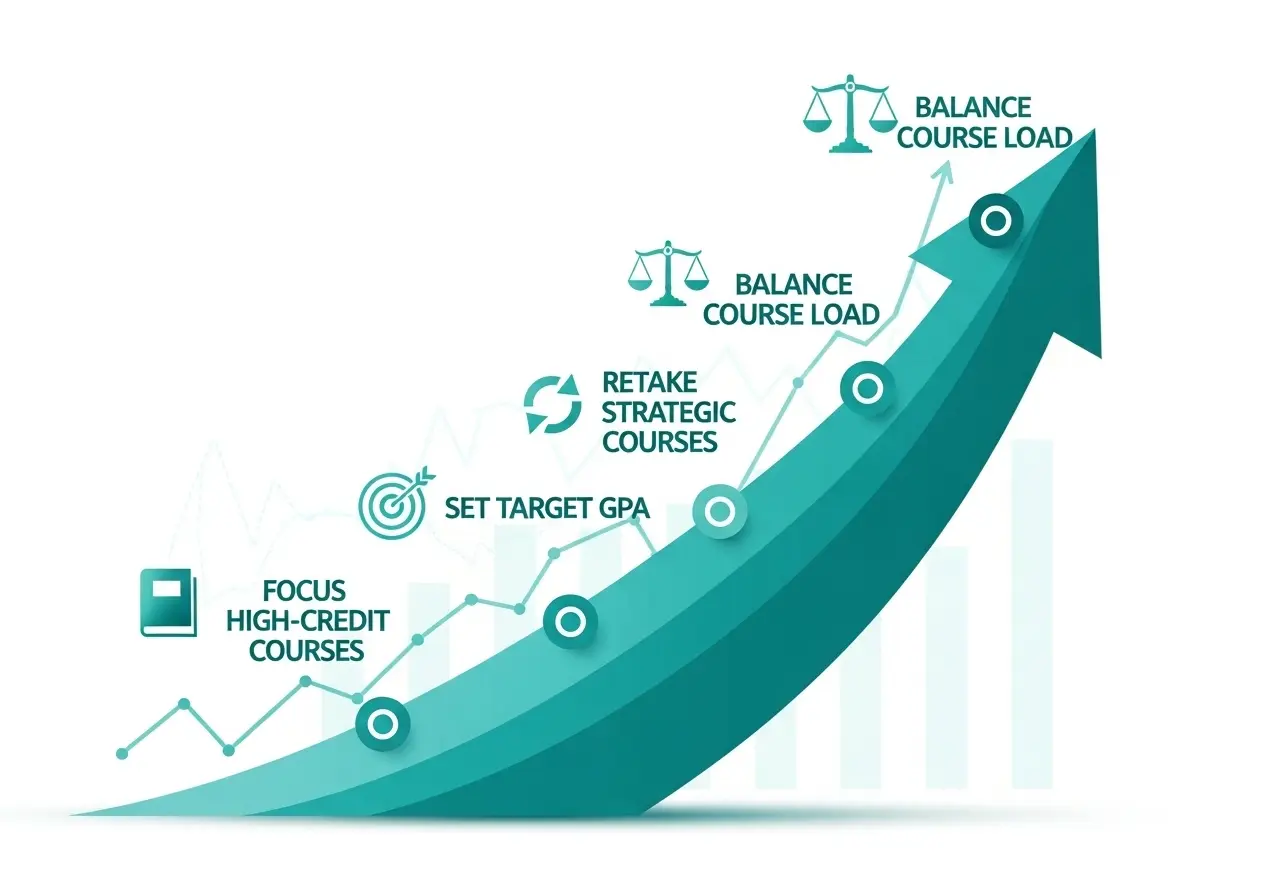
Go after high-credit courses first
Improving from B to A in a 4-credit course moves your GPA more than improving two 1-credit courses combined. The math is simple — most students just haven’t run it. Use the Target GPA Predictor to model scenarios before your semester registration closes.
Use the predictor before the semester starts
Enter your goal CGPA. The predictor tells you exactly how many credits at top grades you need to reach it. That’s a plan. “I want better grades” is not.
Retake strategically — if your university allows it
Many institutions allow grade replacement. A C in a 4-credit core course is a candidate for retaking. Check your institution’s policy first — not every school handles grade replacement the same way.
Simulate your semester before you register
Add your upcoming courses to the calculator before the semester starts. Mix a difficult high-credit course with more manageable electives. See what the semester GPA looks like before you’re locked in.

Frequently asked questions
GPA covers one semester, while CGPA is cumulative across all completed terms. Your CGPA goes on your final transcript and is what graduate programs and employers review. Read our complete guide on Semester GPA vs. Cumulative GPA for a detailed breakdown.
Yes. Select the grading system that matches your school and enter grades exactly as they appear on your report card. It works particularly well for high school students applying to international universities, since you can see how your grades translate across different systems.
The calculator uses standardized conversion tables accepted by most universities worldwide. For scholarship or official admission applications, verify with your specific institution — each may have slight variations, especially for borderline grades. WES (World Education Services) publishes its own conversion methodologies if you need an external reference.
Yes. Once the page loads, it runs entirely in your browser. Your grades save locally — close the tab, come back days later, everything’s still there. One caveat: clearing your browser data clears your saved grades. Export regularly if you’re approaching application deadlines.
Yes. Select “Custom” from the region dropdown and define your own grade-to-point mappings. This matches any school’s specific weighted GPA policy, including AP, IB, or honors course weighting.
Select “Custom” from the region dropdown. You can define your own grade letters and corresponding GPA point values to match any institution’s exact system — anywhere in the world.
If you clicked “Clear All Data,” recovery isn’t possible unless you previously exported to CSV or JSON. The calculator autosaves as you work, but a manual clear is permanent. Export before any major application deadline.
Pakistan (HEC formula): Percentage = (CGPA ÷ 4.0) × 100. India (common institutional formula): Percentage = CGPA × 9.5 for a 10-point scale. For other systems, divide your CGPA by the scale maximum and multiply by 100. Always check if your specific employer or institution has its own formula — some do.
Reference sources
Grading standards, conversion methodologies, and academic benchmarks used in this calculator come from these authoritative bodies: