

Wall plaster quantity and cost calculator
then enter rates to see costs.
Ever mixed a batch of plaster, run out halfway up the wall, and had to send someone back to the yard for one more bag? Or ordered too much and watched three unopened bags turn into concrete blocks in the corner over winter?
You’re not alone. Most first-time renovators and even a fair few contractors get plaster quantities wrong, because the “eyeball it” method skips a step almost nobody remembers: dry volume expansion. Wet plaster shrinks as it sets, so the raw area-times-thickness number is always short. Miss that, and your estimate can be off by 25% or more before you’ve even opened a cement bag.
This guide walks through exactly how the Wall Plaster Quantity Calculator above works, the formula behind it, and how to read the cement bags, sand volume, and cost numbers it gives you. Every formula here follows standard civil engineering practice, cross-checked against IS 1661, ASTM C926, and BS 5492.
How Many Bags of Plaster Per Board?
For a standard 2400 × 1200 mm plasterboard (2.88 m²) skimmed at about 2 mm, allow roughly 0.33 of a 25 kg bag of finish plaster per board. In simple terms, one 25 kg bag covers about 3 standard boards. Actual coverage varies by plaster product, thickness and application method, so check the manufacturer’s coverage rate before ordering.
If you’re asking how many bags of plaster per board, this is a different calculation from cement-and-sand wall plastering. Plasterboard is normally skimmed with a gypsum-based finish plaster, so the useful figure is the product’s coverage per square metre rather than the cement-bag formula used for masonry walls.
Plasterboard Bags Calculator: Quick Reference
| Plasterboards | Approx. Bags | Planning Allowance |
|---|---|---|
| 1 board | 0.33 bag | 1 bag purchased |
| 3 boards | 0.99 bag | 1 bag |
| 6 boards | 1.98 bags | 2 bags |
| 9 boards | 2.97 bags | 3 bags |
| 12 boards | 3.96 bags | 4 bags |
Formula: Bags needed = number of boards × 0.33. Round the result up to a whole bag when purchasing. For example, 10 standard boards × 0.33 = 3.3 bags, so plan to buy 4 bags before allowing for any additional product-specific wastage.
The 0.33-bag figure is a planning estimate, not a universal coverage rate. Different finish plasters have different published coverage rates, and a thicker skim or uneven substrate can increase consumption. Use the product data sheet for the final order quantity.
What Is a Wall Plaster Quantity Calculator?
A wall plaster quantity calculator is a digital tool that converts wall area, plaster thickness, and your cement:sand ratio into exact material quantities: cement bags, sand volume, and an optional cost estimate. It applies the 1.35 dry volume factor automatically, which most manual “thumb rule” calculations skip entirely.
Think of it as a quantity surveyor that never gets tired. You type in three or four numbers. It runs the same formula an estimator would use on paper, just without the arithmetic slips that creep in after the fifth wall.
Manual estimation fails for a handful of predictable reasons:
- Skipped dry volume factor: wet plaster compresses once water fills the gaps between dry particles. Skip the 1.35 multiplier and you’ll under-order by roughly a quarter.
- Wrong mix ratio math: a 1:5 mix and a 1:4 mix split cement and sand differently. Confuse the fractions and both numbers come out wrong.
- Flat wastage guesses: a rough block wall eats more plaster than a smooth concrete one. A single 5% assumption doesn’t hold across site conditions.
- Unit mixing: area in square feet, thickness in millimeters, no conversion step. This is the single most common cause of a wildly wrong result.
A calculator handles all four automatically, which is why contractors who switch from manual math to a digital tool tend to cut material waste noticeably on their next few jobs.
How to Calculate Plaster Quantity for a Wall
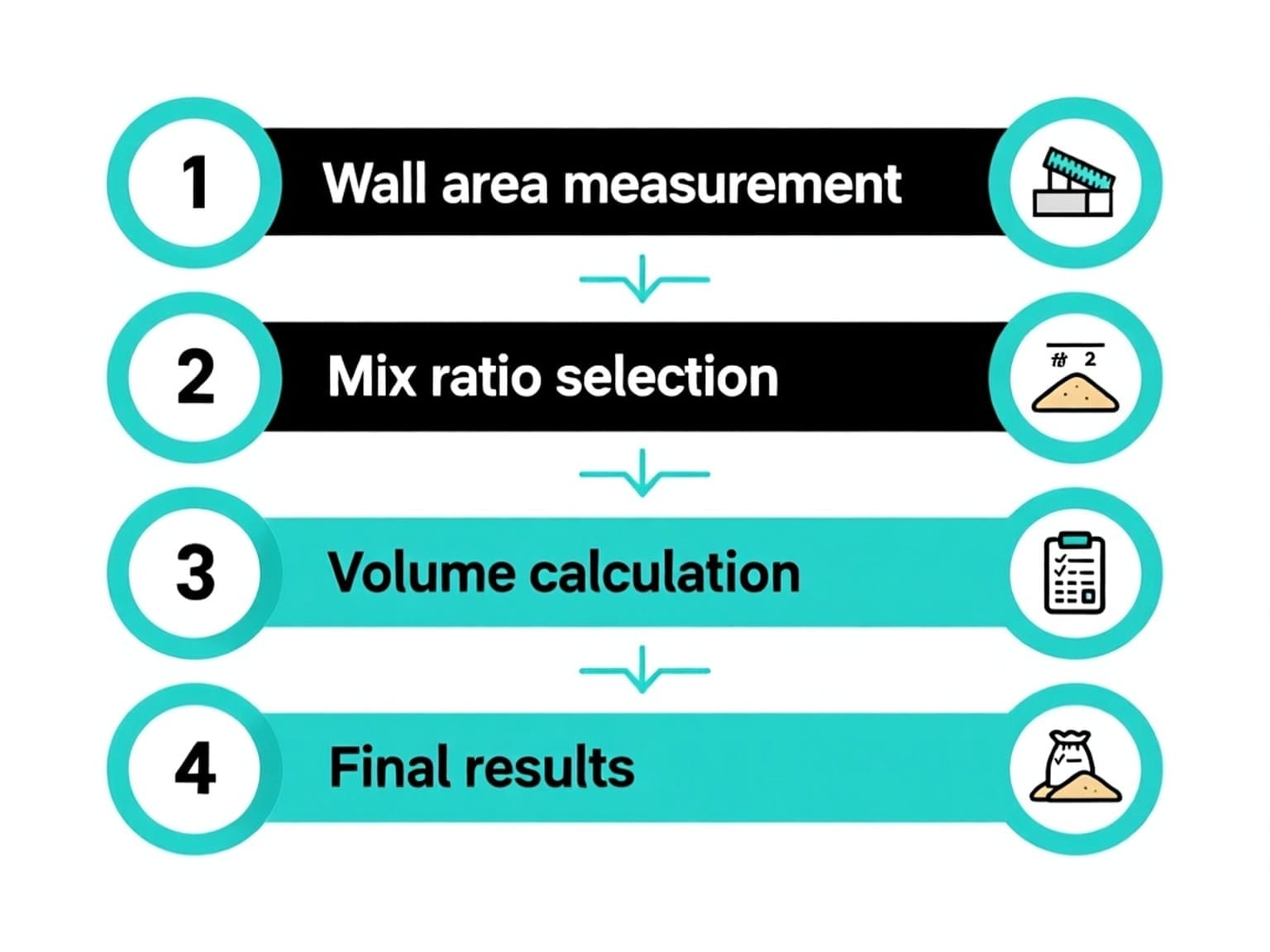
Multiply wall area by plaster thickness to get wet volume, then multiply by 1.35 for dry volume. Split that number by your mix ratio to get separate cement and sand volumes, then add your wastage percentage. Convert cement volume to bags using a 1440 kg/m³ bulk density.
Here’s the process broken into four steps, the same ones the calculator runs behind the scenes.
Step 1: Wet Volume
Wet Volume (m³) = Wall Area (m²) × Plaster Thickness (m)
A 100 m² wall at 12 mm thickness gives 100 × 0.012 = 1.2 m³. That’s the volume once the plaster is on the wall, mixed and wet.
Step 2: Dry Volume
Dry cement and sand have air gaps between the particles. Water fills those gaps during mixing, so the dry material you buy takes up more space than the wet plaster on the wall. Multiply by 1.35 to account for it:
Dry Volume = Wet Volume × 1.35
1.2 × 1.35 = 1.62 m³. Skip this step and you’ll come up roughly 26% short on materials, which is the single biggest error in hand-calculated plaster estimates.
Step 3: Split by Mix Ratio
For a 1:5 mix, total parts = 1 + 5 = 6. Cement takes 1/6 of the dry volume, sand takes 5/6.
- Cement volume = 1.62 × (1/6) = 0.27 m³
- Sand volume = 1.62 × (5/6) = 1.35 m³
Step 4: Add Wastage and Convert to Bags
At 7.5% wastage: cement = 0.27 × 1.075 = 0.29 m³. A 50 kg cement bag occupies 50 ÷ 1440 = 0.0347 m³, so bags needed = 0.29 ÷ 0.0347 ≈ 8.4, rounded up to 9 bags.
Complete Worked Example
Given: Wall area 85 m², thickness 15 mm, mix ratio 1:5, wastage 7.5%, bag size 50 kg.
- Wet volume: 85 × 0.015 = 1.275 m³
- Dry volume: 1.275 × 1.35 = 1.72 m³
- Cement volume: 1.72 × (1/6) = 0.287 m³
- Sand volume: 1.72 × (5/6) = 1.433 m³
- With 7.5% wastage — cement: 0.287 × 1.075 = 0.309 m³; sand: 1.433 × 1.075 = 1.541 m³
- Cement bags: 0.309 ÷ 0.0347 = 8.9 bags, round up to 9
- Final sand volume: 1.54 m³ (about 54.4 cft)
Always round cement bags up, never down. You can’t buy 8.9 bags, and running one bag short mid-mix means an emergency supply run with wet plaster already curing on the trowel.
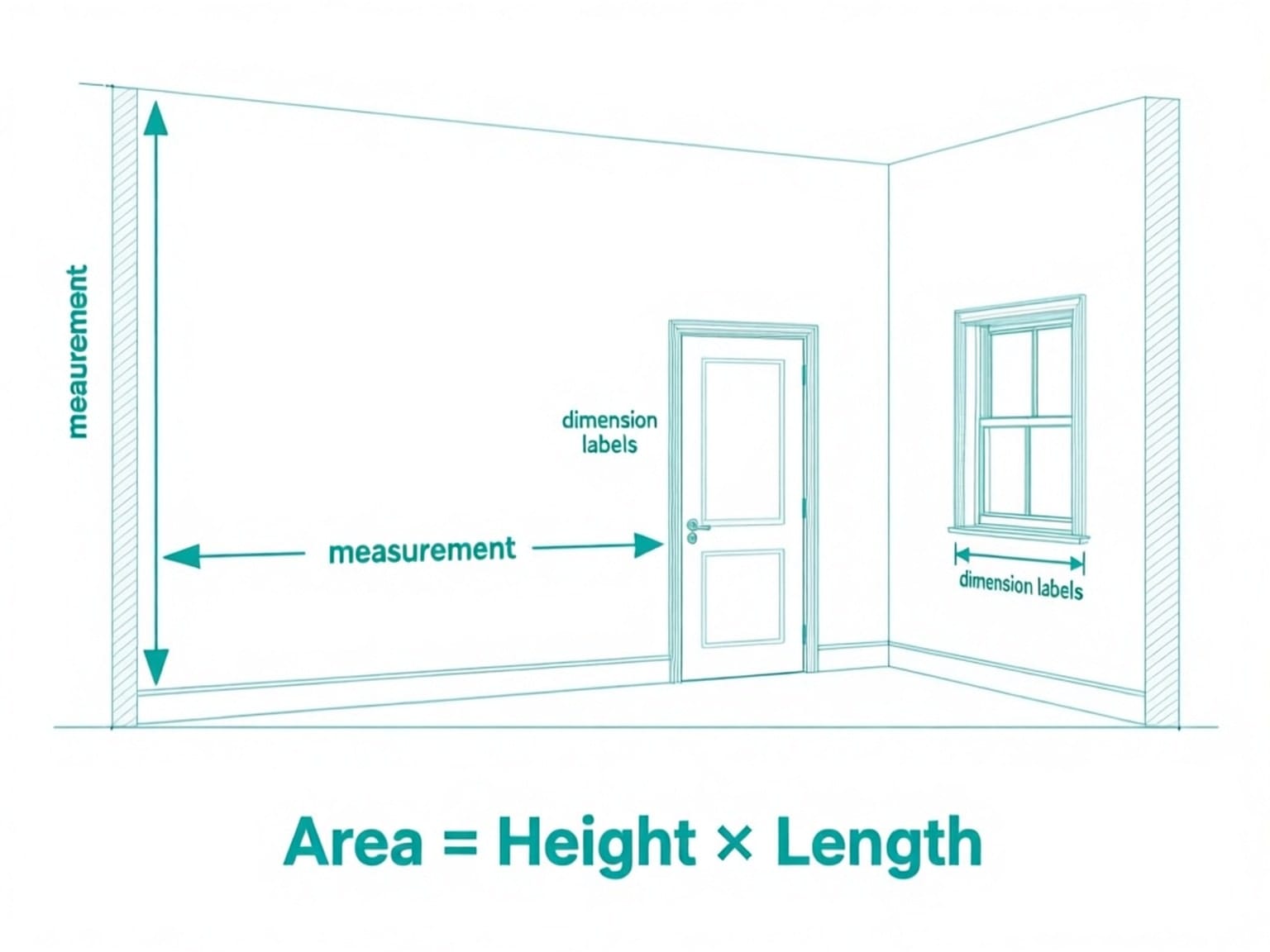
Measuring the area correctly matters just as much as the formula. Use height × length for each wall, add them up, then subtract door and window openings if you want a tighter number. A room with four walls (10 ft height, 12 ft and 15 ft widths) gives (120 + 120 + 150 + 150) = 540 ft² gross. Subtract a 21 ft² door and two 12 ft² windows and you’re at 495 ft² net.
If you’re pouring a slab or footing before you get to the walls, the Concrete Mix Design Calculator runs the same kind of material breakdown for structural concrete, and the Plot Area and Perimeter Calculator is handy if you need room dimensions before you’ve even started measuring individual walls.
How Many Cement Bags Do You Need for Plastering?
For a standard 12 mm coat with a 1:5 mix and 7.5% wastage, expect roughly 0.9 to 1.1 cement bags (50 kg) per 10 m² of wall. A 100 m² room typically needs 9 to 11 bags, depending on thickness and mix ratio.
This is one of the most searched questions around plastering, and the honest answer is: it depends on thickness and ratio, not just area. A thin 10 mm skim coat on a smooth wall needs noticeably less cement than a 20 mm external render in a 1:3 rich mix.
| Mix Ratio | Cement Bags | Sand Volume (m³) | Typical Use |
|---|---|---|---|
| 1:3 | ~14 bags | ~1.16 m³ | External walls, damp areas |
| 1:4 | ~11 bags | ~1.24 m³ | Standard external, renovation |
| 1:5 | ~9 bags | ~1.29 m³ | Internal residential walls |
| 1:6 | ~8 bags | ~1.33 m³ | Ceilings, finish coats |
If you’re skimming plasterboard rather than plastering a masonry wall, the number you actually want is bags of finish plaster per board, not cement bags per m². The FAQ below gives you that figure directly, because running this calculator’s cement bag output against a plasterboard skim coat will give you the wrong number.
Plaster Mix Ratio Guide: 1:3 to 1:6
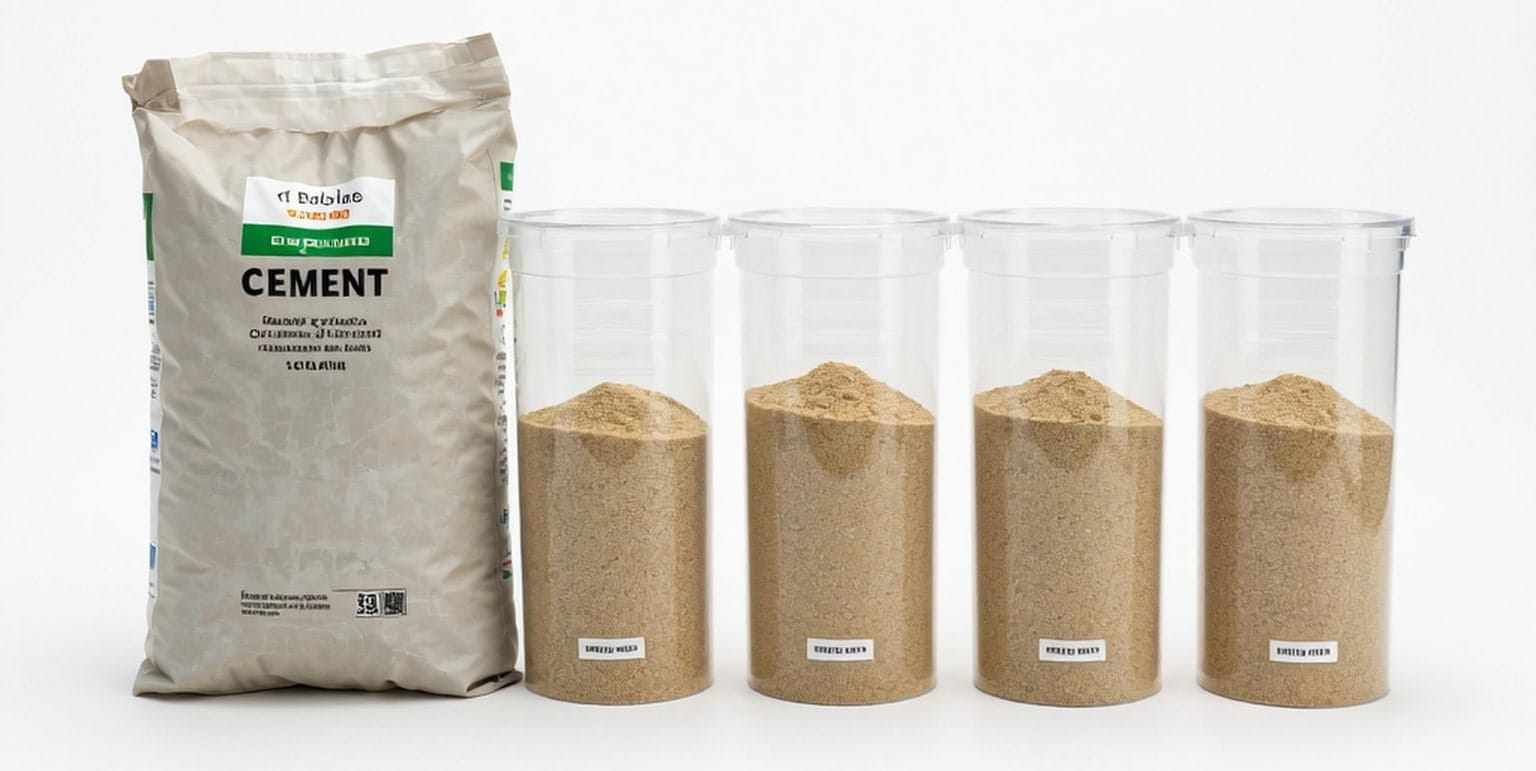
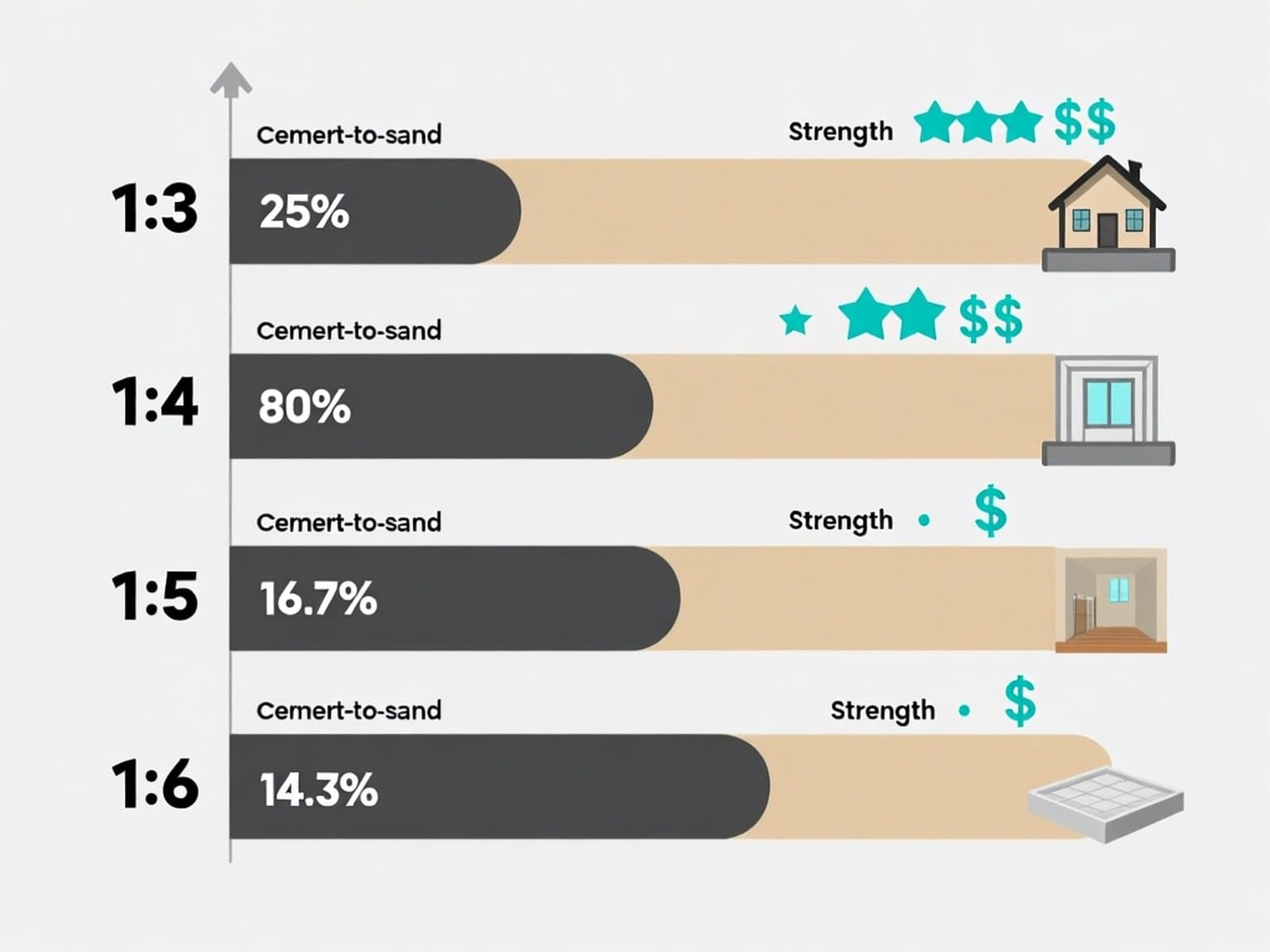
Use 1:3 or 1:4 for external walls and damp-prone areas where strength and water resistance matter most. Use 1:5 for standard internal residential walls. Use 1:6 for ceilings and non-structural finish coats where economy matters more than strength.
| Mix Ratio | Composition | Best Application | Relative Cost |
|---|---|---|---|
| 1:3 (Rich Mix) | 1 part cement, 3 parts sand | External walls, damp areas, first coat on rough masonry | $$$ |
| 1:4 (Standard) | 1 part cement, 4 parts sand | Standard external walls, high-traffic renovation | $$ |
| 1:5 (Balanced) | 1 part cement, 5 parts sand | Internal residential walls, second coat | $ |
| 1:6 (Lean Mix) | 1 part cement, 6 parts sand | Ceilings, non-structural finishing | $ |
Climate plays into this too. Hot, dry regions do better with a 1:4 or richer mix since heat accelerates drying and thin lean mixes crack more readily. Humid, coastal, or heavy-rain regions need 1:3 or 1:4 on external faces for water resistance. Cold climates want the richer mixes as well, since frost resistance depends on cement content, and you shouldn’t plaster below 5°C regardless of ratio.
For load-bearing masonry beneath the plaster, cross-check quantities with the Brick and Block Masonry Calculator so cement usage across the whole wall assembly stays consistent.
What Wastage Factor Should You Use for Plastering?
Use 5-7% wastage for experienced contractors with tight site management, 7.5-10% for average site conditions, and 10-15% for DIY projects or rough, uneven surfaces. Higher wastage isn’t wasteful spending, it’s insurance against a mid-project material run.
Wastage covers four things that never show up in a clean formula: spillage during mixing (2-3%), surface irregularities that eat extra material (2-4%), inefficiency from application technique (1-2%), and handling losses in storage (1-2%). Add them up and 7.5% lands as a sensible mid-point for most jobs.

Order one extra bag per ten required as buffer stock. For 9 bags, order 10. It’s a small overspend against the cost and delay of a mid-job supply run.
Plaster Cost Estimator: How Much Does Wall Plastering Cost?
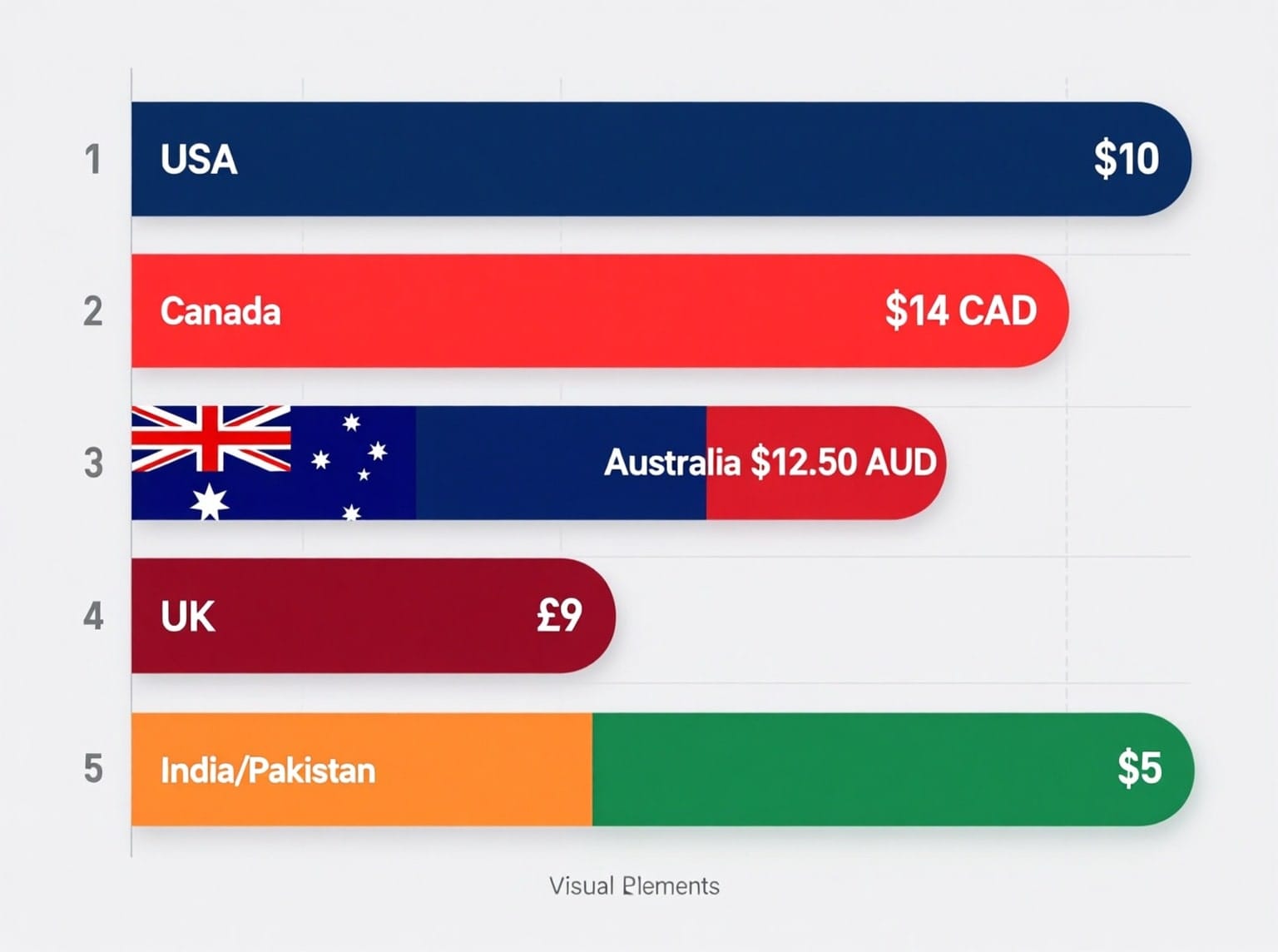
Material costs for a typical 500 ft² plastering job run roughly $200-$300 for cement and sand combined. Add labor, and total project costs for professional installation land between $1,600 and $3,100 depending on region and surface prep needed.
| Region | Cement (50kg bag) | Sand (per m³) | Labor (per ft²) |
|---|---|---|---|
| United States | $8 – $12 | $40 – $60 | $3.50 – $5.00 |
| Canada | CAD $12 – $16 | CAD $50 – $70 | CAD $4.00 – $6.00 |
| Australia | AUD $10 – $15 | AUD $45 – $65 | AUD $4.50 – $7.00 |
| United Kingdom | £7 – £11 | £35 – £50 | £3.00 – £5.50 |
| India / Pakistan | ₹350-450 / PKR 1,100-1,400 | ₹1,200-1,800 / PKR 4,000-6,000 | ₹15-25 / PKR 50-80 |
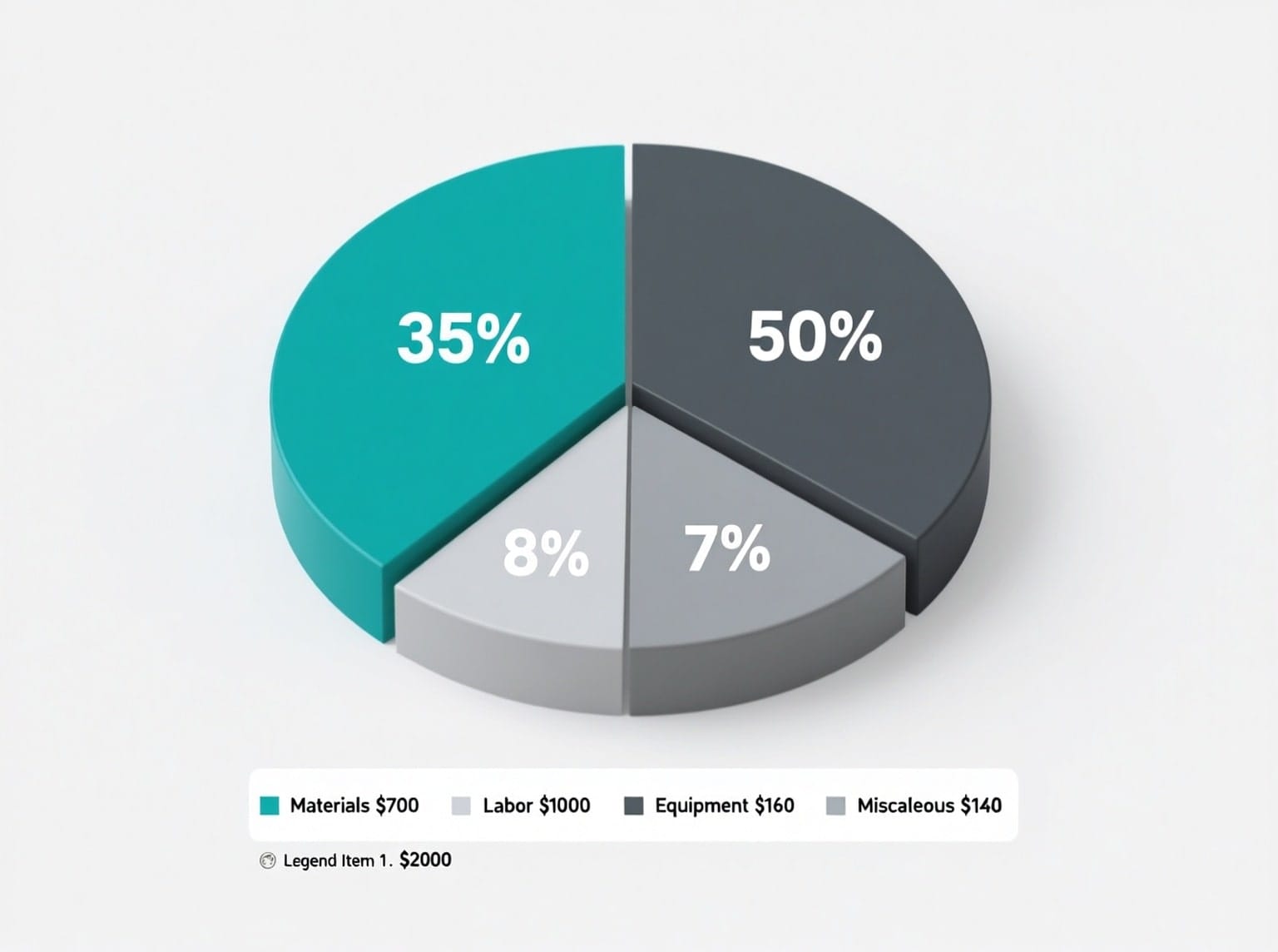
For a typical 500 ft² job: 12 bags of cement at $10 each runs $120, 2 m³ of sand at $40 adds $80, and water plus admixtures add another $10, putting materials around $210. Labor at $2.50-$5.00 per ft² adds $1,250-$2,500 on top. Add surface prep, equipment rental, and a 10% wastage contingency, and the full project lands between roughly $1,630 and $3,080.
Curing Time and IS 1661 Standards for Cement Plaster
Initial setting happens within 24-48 hours. Practical strength for painting develops in about 7 days, which is the minimum curing period referenced under IS 1661. Full chemical strength takes closer to 28 days. Keep the surface damp for the first 7-10 days by sprinkling water two to three times daily.
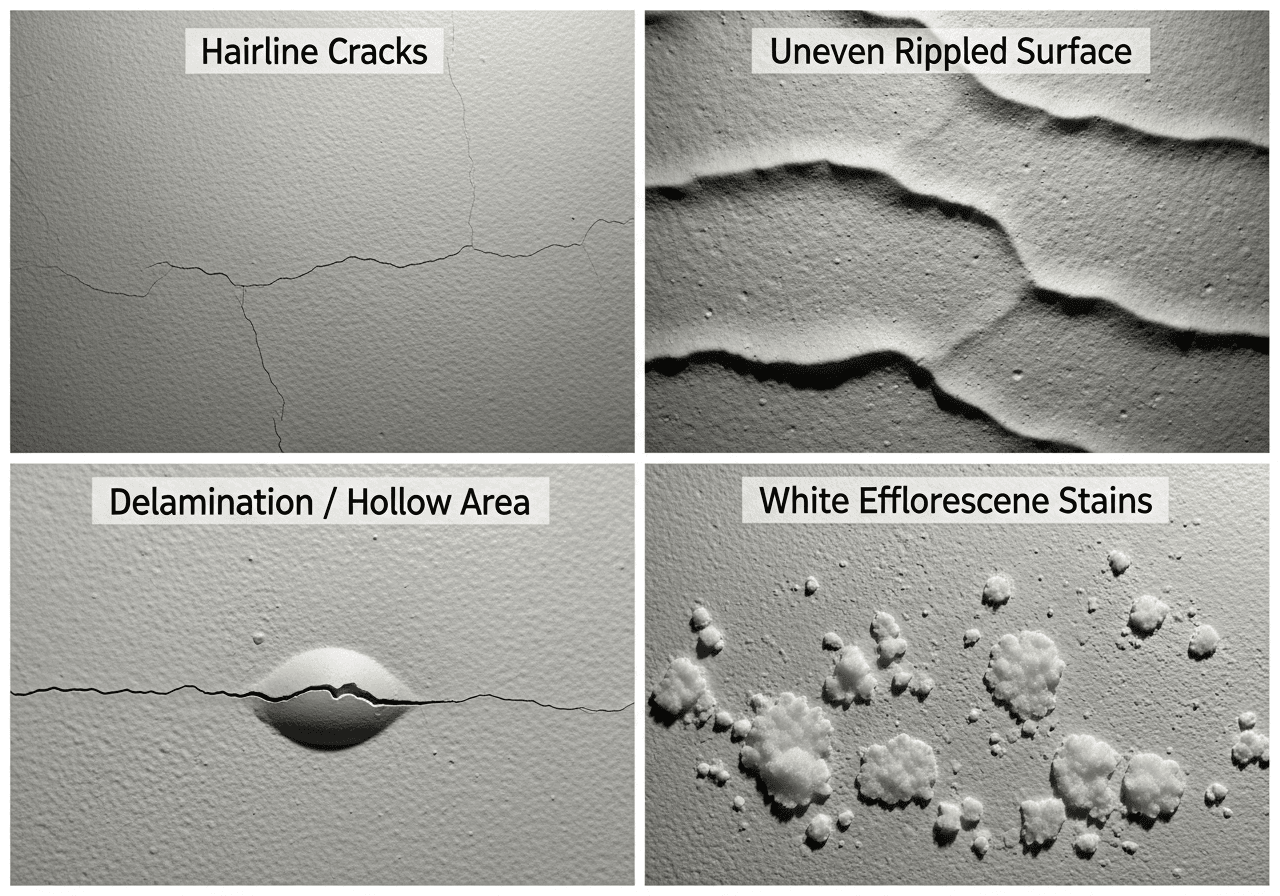
A lot of searches land on whether 7 days of curing is actually enough under IS 1661. It’s the widely used practical minimum, not the finish line. Seven days gets you surface strength sufficient for painting prep in most residential settings, but the plaster keeps gaining strength up to 28 days as the cement fully hydrates. Skimp on the damp-curing window and you’re trading a faster handover for a higher chance of shrinkage cracking later.
Regional codes back this up with slightly different specifics: ASTM C926 in the US governs Portland cement-based plaster application and thickness (typically 9-16 mm interior, up to 22 mm exterior), BS 5492 covers UK internal plastering practice, and CSA A23.1/A23.2 handles Canadian concrete materials and methods where frost resistance is the bigger concern than curing speed.
Common Plastering Estimate Mistakes to Avoid
| Mistake | Impact | Fix |
|---|---|---|
| Measuring floor area instead of wall area | 30-50% material shortage | Always use height × length per wall |
| Same thickness on rough and smooth walls | Uneven finish or excess material | Add 2-3mm for rough surfaces |
| Mixing units (feet with millimeters) | Wildly wrong result | Convert everything to one system first |
| Wrong ratio for the application | Weak plaster, early failure | Match ratio to exposure (see mix ratio table) |
| Zero to 3% wastage on large jobs | Multiple supply runs, delays | Use 7.5-10% for most projects |
Material quality matters as much as the arithmetic. Grade 43 Ordinary Portland Cement suits most residential work, and it should be used within 90 days of manufacture. River sand or manufactured sand (M-sand) both work for plastering as long as the sand is free of clay and silt and passes a 1.2mm sieve. If you’d rather cut cement content deliberately for non-critical areas, fly ash or GGBS can replace 20-30% of cement volume without giving up much strength.
Excavating or leveling ground before you even get to wall work? The Excavation and Earthwork Volume Calculator handles the site-prep numbers, and the full Civil Engineering Calculators library covers everything else from footings to concrete mix design.
Frequently Asked Questions
A wall plaster quantity calculator is a digital tool that converts wall area, thickness, and mix ratio into exact cement bag and sand volume requirements. It applies the 1.35 dry volume factor and your chosen wastage percentage automatically, removing the manual math most estimators get wrong.
Multiply wall area by thickness for wet volume, multiply by 1.35 for dry volume, split by your mix ratio to get cement and sand volumes, then add wastage. Convert cement volume to bags using a 1440 kg/m³ density. A 100 m² wall at 12mm with a 1:5 mix needs roughly 9 bags of cement.
Manual estimates commonly skip the dry volume factor, which alone causes a 26% underestimate. A calculator applies it automatically, along with correct mix ratio splitting and unit conversion, cutting the two or three errors that add up to a badly wrong material order.
Use 1:3 or 1:4 for external walls, damp-prone rooms, and first coats on rough masonry, where strength and water resistance matter most. Use 1:6 only for ceilings or non-structural interior finish coats. Using a lean 1:6 mix on an exposed exterior wall leads to early deterioration.
Material cost alone runs roughly $0.40-$0.60 per ft² in the US. Add professional labor at $2.50-$5.00 per ft², and total installed cost for a 500 ft² job typically lands between $1,600 and $3,100 depending on region, surface prep, and mix ratio.
As a planning estimate, one 25kg bag of finish plaster covers about 3 standard 2400 x 1200mm plasterboards when skimmed at approximately 2mm. Coverage depends on the product, application thickness and substrate, so check the manufacturer’s coverage information before ordering.
For skimming a standard 2400 x 1200mm plasterboard (2.88 m²) at 2mm finish thickness, budget roughly one-third of a 25kg bag of finish plaster per board, so a single bag covers about 3 boards. This is a separate gypsum-based finish coat, not cement-sand wall plaster, so it uses coverage per board rather than the cement-density formula this calculator runs. For a full room, multiply your board count by 0.33 bags and round up.
Seven days gets you practical surface strength sufficient for painting prep and is the commonly cited minimum. Full chemical curing continues to about 28 days. Keep the surface damp for the first 7-10 days by sprinkling water two to three times daily to limit shrinkage cracking.
At 12mm thickness with a standard 1:5 mix and 7.5% wastage, expect around 9 cement bags (50kg) per 100 m². A richer 1:3 mix pushes that to roughly 14 bags, while a leaner 1:6 mix drops it to about 8 bags. Thickness above 12mm scales the number up proportionally.
Get Your Exact Numbers in Under a Minute
The formula is straightforward once you’ve seen it worked through, but running it by hand for every wall in a house gets tedious fast, and one mistyped decimal throws the whole order off. Enter your wall area, thickness, and mix ratio into the calculator above and you’ll get cement bags, sand volume, and a cost estimate without touching a calculator app or a notepad.
Whether you’re a homeowner planning a weekend DIY job, a contractor juggling five sites this week, or an estimator putting a bid together, accurate quantities up front save you the two things that hurt most: wasted budget and a stalled job waiting on one more bag of cement.
Ready to run your own numbers?
Use the Wall Plaster Quantity Calculator ↑Sources & Further Reading
Last Updated: | Next Review:
- ASTM International. “ASTM C926-20: Standard Specification for Application of Portland Cement-Based Plaster.”
- BSI Group. “BS 5492:1990 — Code of Practice for Internal Plastering.”
- Bureau of Indian Standards. “IS 1661:1972 — Method of Sampling and Analysis for Cement Plaster.”
- CSA Group. “CSA A23.1/A23.2:19 — Concrete Materials and Methods of Concrete Construction.”