

Formula & Example
Required_Ah = (Load_W × Backup_hours) / (System_Voltage × Efficiency_decimal × DOD_decimal)
Number_of_batteries = ceil(Required_Ah / Single_Battery_Ah)
Series = round(System_Voltage / Single_Battery_Nominal_Voltage) (min 1)
Parallel strings = ceil(Number_of_batteries / Series)
Battery Sizing Calculator: How to Get Your Backup Capacity Right the First Time
A winter storm knocked out the grid on Dave’s street in Austin, Texas, right in the middle of dinner. His backup system, sized on a rough guess six months earlier, died in under two hours. He’d used a battery sizing calculator to pick a battery once, then skipped the depth of discharge field because he didn’t understand what it meant.
That one skipped field is the difference between a battery bank that runs all night and one that quits before the fridge does. Most people size backup power by multiplying watts by hours and calling it done, then wonder why the real runtime never matches the number on the box.
This guide walks you through the exact math behind a proper battery sizing calculator, what each input actually controls, and how to pick between LiFePO4, lead-acid, and AGM without falling for marketing numbers. You’ll also get worked examples for solar backup, UPS systems, and off-grid setups.
The formula and DOD ranges below come from Battery University’s cycle-life data and the same NEC Article 706 references US installers use when they sign off on a permit.
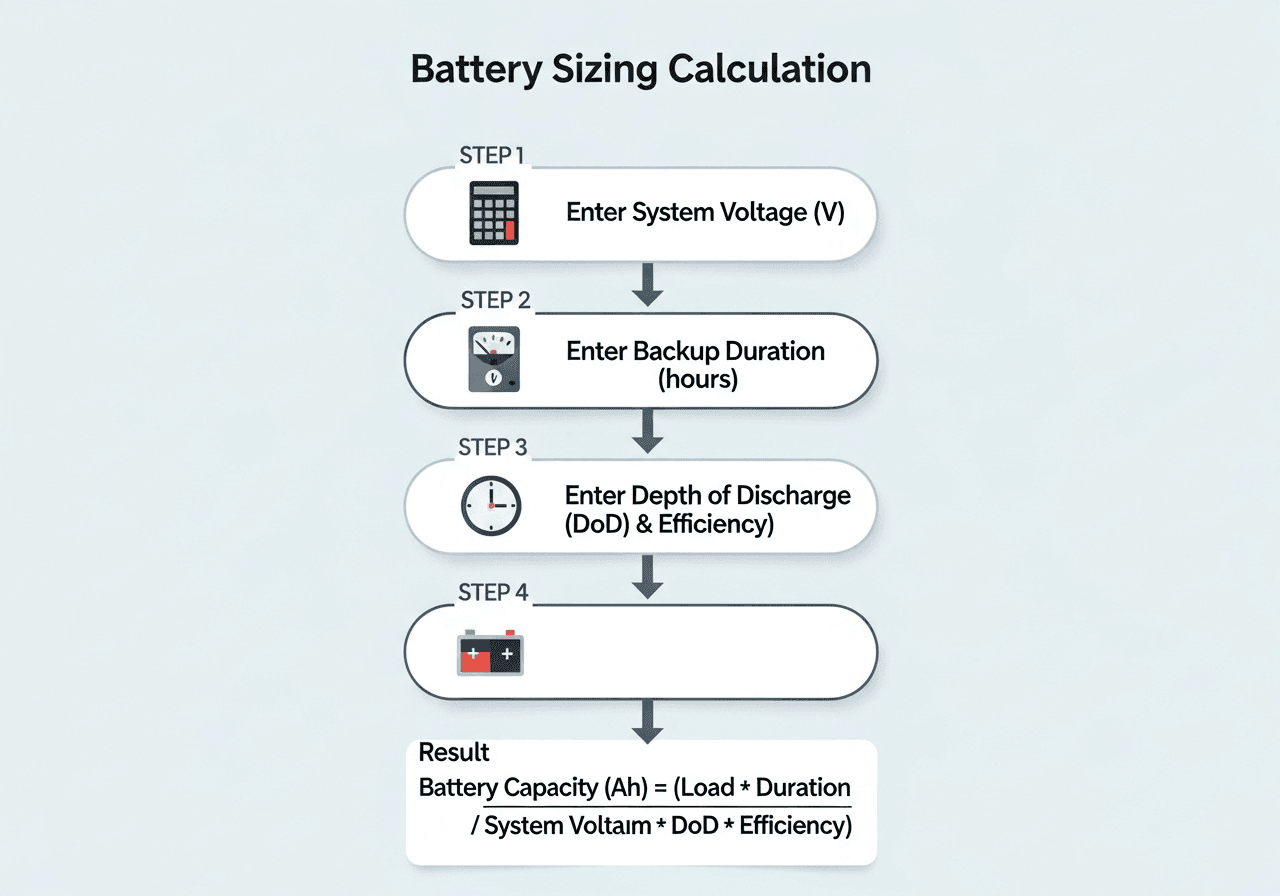
How Does a Battery Sizing Calculator Actually Work?
A battery sizing calculator converts your load, backup hours, system voltage, depth of discharge, and efficiency into a single amp-hour figure using Ah = (Watts × Hours) ÷ (Volts × Efficiency × DOD). It then rounds that number up against the capacity of one battery to tell you how many you need and how to wire them.
Think of it like filling a bathtub that leaks. Watts times hours tells you how much water you want in the tub. Voltage, efficiency, and DOD tell you how leaky the tub actually is, and how much you’re allowed to drain before you damage the plumbing.
Skip DOD and efficiency, and you’re sizing for a tub that never leaks. That’s not how real batteries behave.
Here’s the formula written out in full:
- Required Ah = (Load in Watts × Backup Hours) ÷ (System Voltage × Efficiency decimal × DOD decimal)
- Adjusted Ah = Required Ah × (1 + Safety Margin %)
- Number of batteries = Adjusted Ah ÷ Single Battery Ah, rounded up
- Series count = System Voltage ÷ Single Battery Voltage
- Parallel strings = Number of batteries ÷ Series count, rounded up
Run a real number through it. Sarah in Phoenix needs 650W for 5 hours on a 24V LiFePO4 setup, 92% efficiency, 85% DOD:
Required Ah = (650 × 5) ÷ (24 × 0.92 × 0.85) = 3,250 ÷ 18.77 = 173.2 Ah. Add a 15% safety margin and she lands at 199.2 Ah, which two 100 Ah LiFePO4 batteries in series cover with room to spare.
Always calculate in Ah first, then convert to kWh to compare across voltages. kWh = (Voltage × Ah) ÷ 1,000. It’s the only unit that lets you compare a 12V bank fairly against a 48V one.
What Inputs Does a Battery Sizing Calculator Need?
You need five numbers before you touch a calculator: total load in watts, required backup hours, system voltage, your battery’s depth of discharge rating, and round-trip efficiency. Get the load and DOD wrong and every other number downstream is wrong too.
Load: measure it, don’t guess it
Nameplate wattage on an appliance is almost always higher than what it actually pulls. A fridge rated at 200W might average 90W once the compressor cycles. Plug your loads into a cheap watt meter for a day before you commit to a number.
Backup hours: match it to the actual outage pattern
Four to six hours covers a typical evening outage. Twelve hours covers overnight. If you’re in a region with regular storm-driven or wildfire-related PSPS outages, size for a full 12 to 24 hour window instead of a generic “backup” number.
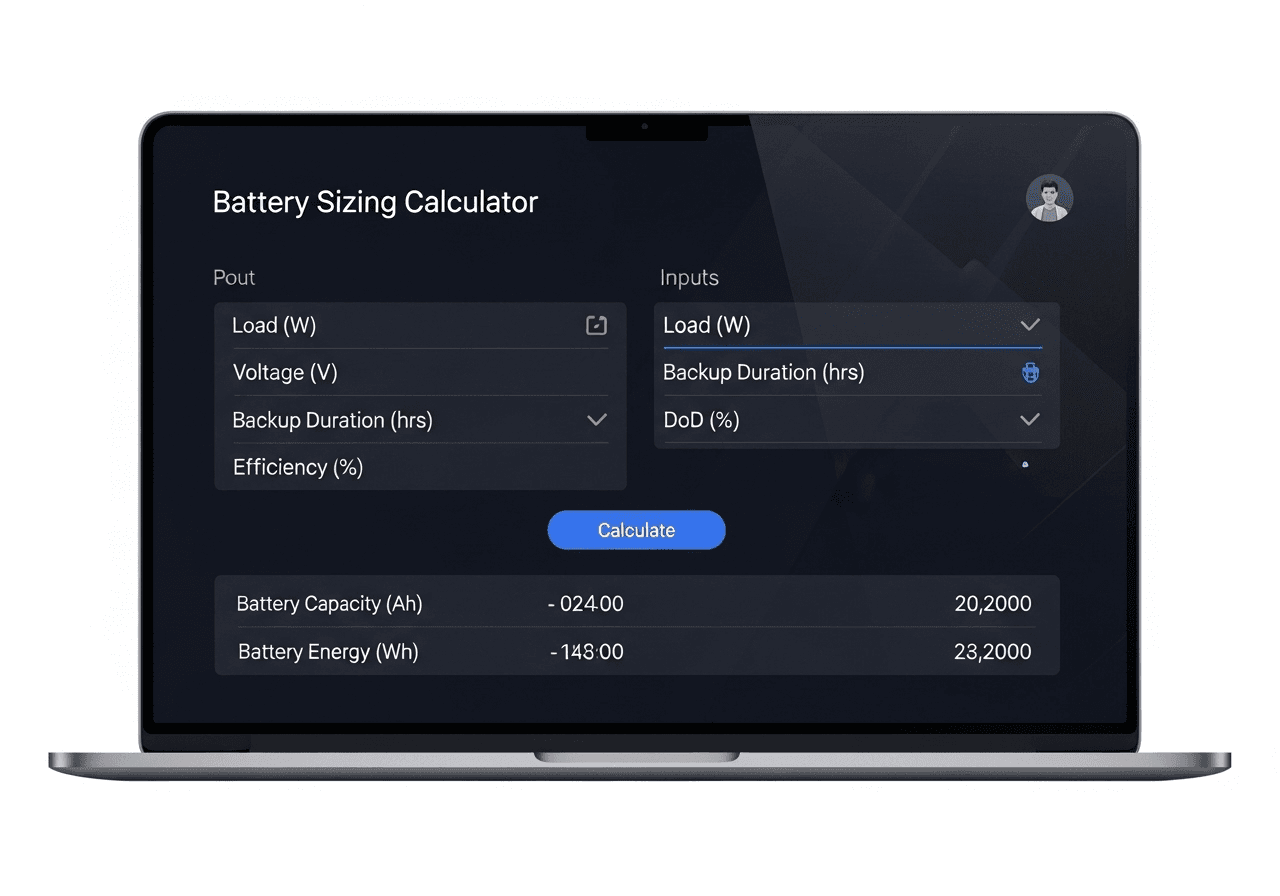
System voltage: bigger loads need bigger voltage
A rough rule that holds up in practice: 12V for loads under 1,000W, 24V for 1,000 to 2,500W, 48V for 2,500W to 10kW, and 110V or higher above that. Higher voltage means lower current for the same power, which means thinner, cheaper cable.
Depth of discharge: the number most people skip
DOD is how much of a battery’s rated capacity you can actually use without wrecking its lifespan. Lithium chemistries tolerate 80 to 90%. Lead-acid tops out around 50 to 60% if you want it to last more than a couple of years.
Efficiency: the losses you don’t see
Inverter conversion, wiring, and the battery’s own charge/discharge cycle all eat energy. Budget 85 to 90% for lead-acid systems and 92 to 96% for lithium.
Which Battery Chemistry Should You Choose: LiFePO4, Lead-Acid, or AGM?
LiFePO4 is the right default for most solar and backup builds because it delivers 4,000+ cycles at 80 to 90% DOD, which beats lead-acid’s 500 to 1,000 cycles at half the usable capacity. Choose lead-acid or AGM only when upfront cost matters more than a 10-plus year lifespan.
The sticker price tells you almost nothing about what a battery actually costs you. Cycle life and usable DOD together decide the real number, cost per cycle.
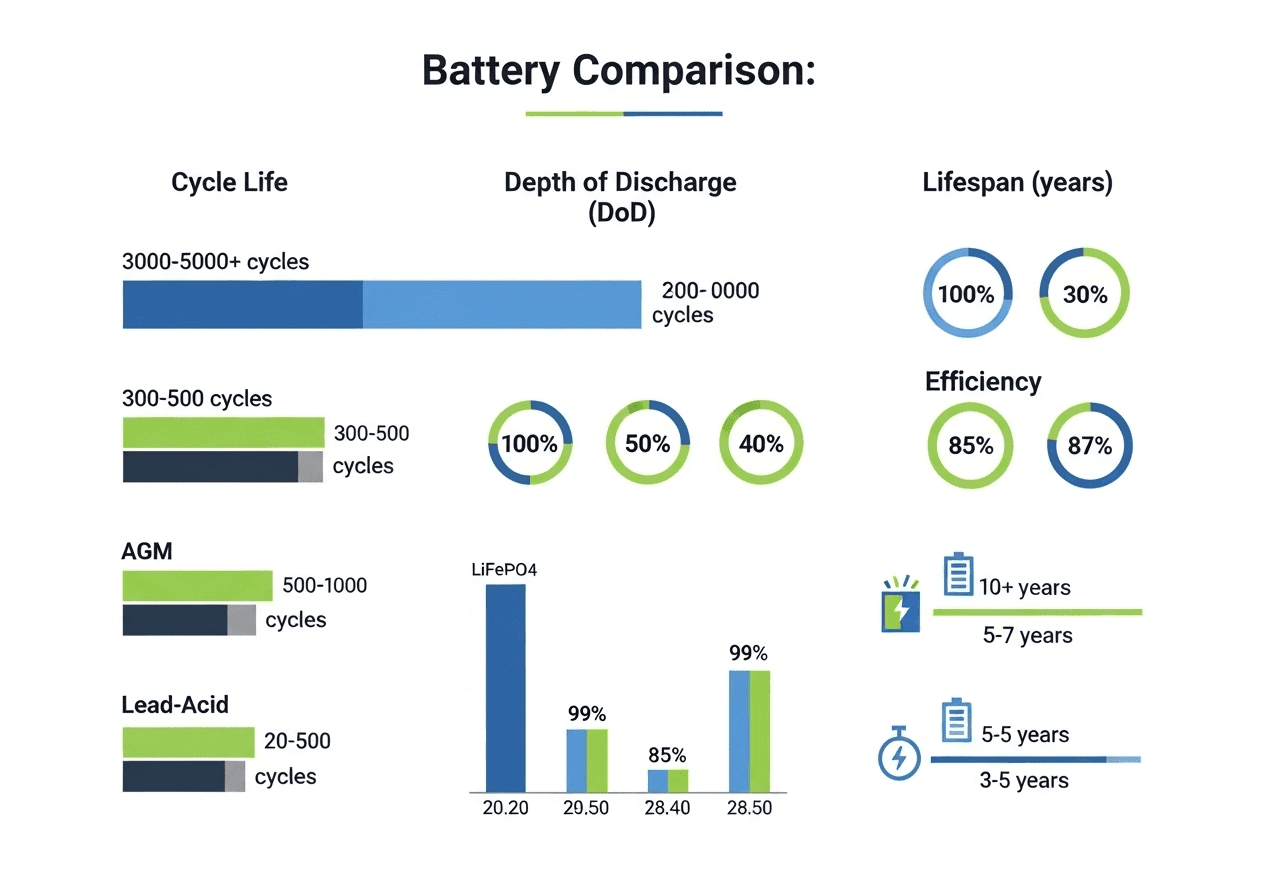
| Chemistry | Recommended DOD | Cycle Life | Round-Trip Efficiency | Est. Cost per kWh |
|---|---|---|---|---|
| LiFePO4 (LFP) | 80–90% | 4,000–6,000 | 92–95% | $400–$700 |
| Lithium NMC | 70–85% | 2,000–3,000 | 90–92% | $450–$750 |
| AGM Lead-Acid | 50–70% | 600–1,000 | 85–88% | $180–$280 |
| Flooded Lead-Acid | 50–60% | 500–800 | 80–88% | $150–$220 |
| Sodium-Ion | 80–85% | 3,000–4,000 | 90–93% | $180–$320 |
Run the numbers on a 10 kWh usable bank over 10 years and the gap gets hard to ignore. Flooded lead-acid needs roughly 5 replacement sets in that window once you factor in DOD and cycle life, while a correctly sized LiFePO4 bank often makes it the full decade without a single swap.
Never mix battery chemistries or ages in the same bank. Batteries balance to the weakest cell, so one old lead-acid unit next to three new ones drags the whole bank’s performance down.
How Do Solar Panels, Batteries, and Inverters Work Together?
Solar panels generate DC power, the battery stores whatever isn’t used immediately, and the inverter converts stored DC back to AC for your appliances. A battery sizing calculator sits at the center of that chain because it tells you how much of that stored energy you can actually count on when the sun’s down.
A battery bank sized only for load and hours, without thinking about where the energy comes from, tends to run flat during a run of cloudy days. That’s why off-grid and hybrid systems usually size backup around 1 to 3 days of autonomy, not a single evening.
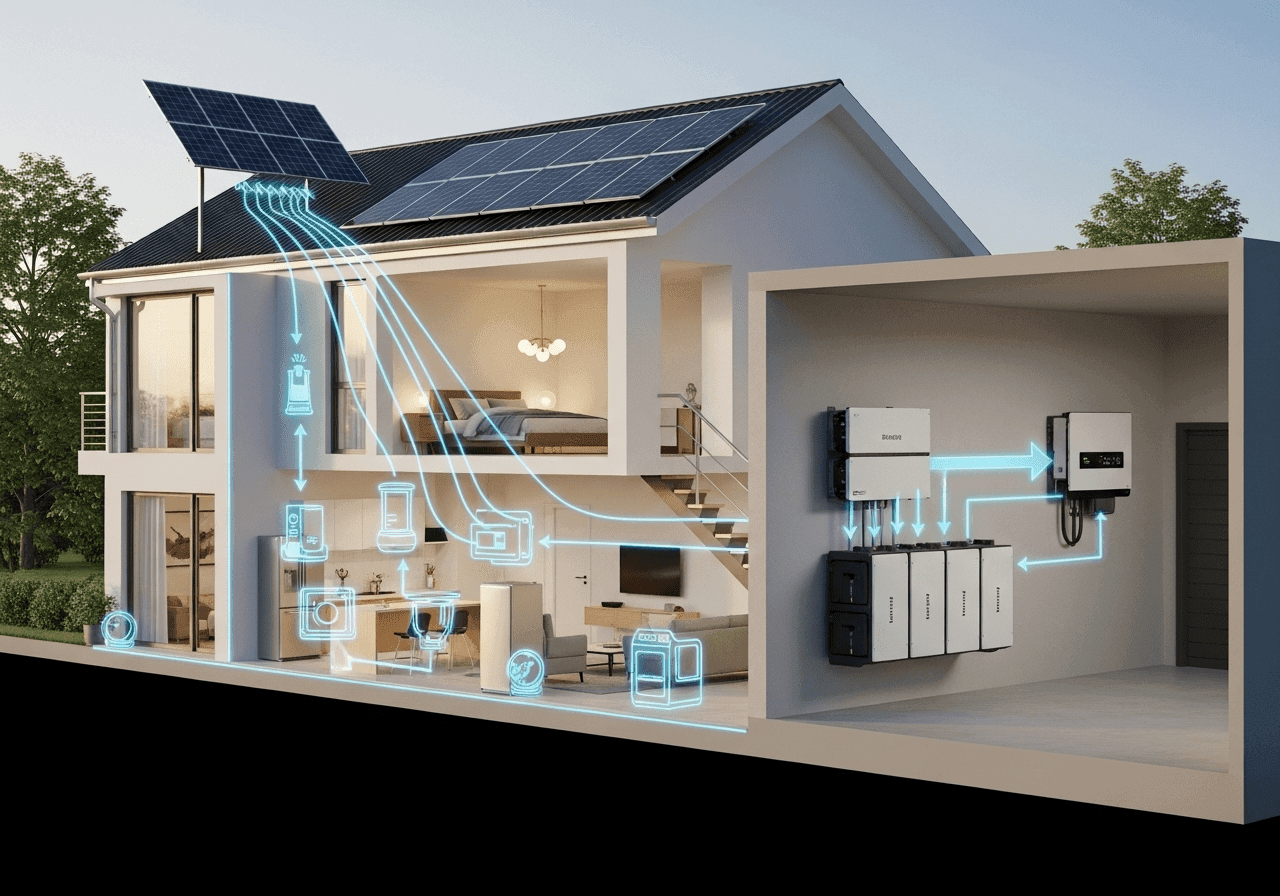
Three things decide how well that chain performs:
- Charge controller type: MPPT controllers recover 20 to 30% more energy than older PWM units, especially in cold or partly shaded conditions.
- Inverter efficiency: A cheap modified sine inverter can run 10 to 15% less efficient than a pure sine unit, and that loss compounds every single cycle.
- Days of autonomy: Grid-tied homes with a stable grid often only need 1 day of stored backup. Off-grid cabins in cloudy regions are better served by 2 to 3 days.
If you’re pairing a battery bank with solar for the first time, size the panels for your daily energy draw first, then size the battery to bridge the gap between sundown and sunrise, with margin for a string of overcast days.
For deeper dives on the panel side, see our solar watt-hour calculator and hybrid solar system planner, which both feed directly into the battery numbers above.
What Battery Sizing Mistakes Cost You the Most Money?
The costliest mistakes are ignoring depth of discharge, forgetting inverter and wiring losses, picking the wrong system voltage for the load, and skipping a safety margin entirely. Each one either shortens battery life or forces an expensive mid-life upgrade.
| Mistake | What Happens | Fix |
|---|---|---|
| Ignoring DOD | A 200 Ah lead-acid battery at 50% DOD only gives 100 Ah usable, so runtime is cut in half | Divide required Ah by your chemistry’s DOD before buying |
| Skipping efficiency losses | Real AC output falls 8–15% short of the DC energy stored | Divide by your combined system efficiency, not just the battery’s |
| Wrong system voltage | A 5,000W load on 12V pulls over 400A, needing bulky 4/0 AWG cable | Match voltage to load: 12V under 1kW, 24V to 2.5kW, 48V above that |
| No safety margin | Aging, temperature swings, and surprise loads leave zero buffer | Add 10–20% margin as standard, 25%+ in extreme climates |
| Mixing chemistries or ages | Weakest cell drags the entire bank down, causing early failure | Replace batteries as a matched set, same brand and capacity |
Cold and heat both eat into capacity, and it’s easy to forget until winter or summer proves it the hard way. Lead-acid can lose up to 20% of its rated capacity near freezing, while lithium loses closer to 10%. Add regional temperature derating on top of your safety margin if you live somewhere with real seasonal swings.
Keep parallel strings to 4 or fewer where possible. More strings means more cell balancing work and a higher chance one weak string quietly drags the rest down.
Check your local code before you finalize anything. In the US, NEC Article 706 sets the minimum wire gauge, disconnect, and fire safety requirements for energy storage systems, and most local jurisdictions inspect against it before they’ll sign off on a permit.
Want the exact runtime a given bank will deliver before you commit? Our battery backup duration calculator works from the same Ah formula in reverse, and the hybrid inverter sizing calculator helps you match the inverter to whatever bank you land on.
Run Your Own Numbers
Use the battery sizing calculator above with your real load, voltage, and chemistry to get an exact Ah figure and configuration for your setup.
Scroll Up to the CalculatorFrequently Asked Questions
A battery sizing calculator works out the amp-hour (Ah) capacity and battery configuration you need to run a given load for a set number of hours. It factors in system voltage, depth of discharge, and round-trip efficiency so you don’t guess your way into an undersized or oversized bank.
It takes your load in watts, your backup hours, your system voltage, your battery’s depth of discharge, and your round-trip efficiency, then runs them through the formula Ah = (Watts × Hours) ÷ (Volts × Efficiency × DOD). The result is the usable amp-hours you need before adding a safety margin.
Guessing usually means multiplying watts by hours and stopping there, which ignores DOD and efficiency losses. That gap alone can leave you 30 to 60 percent short on real-world runtime, which is why a proper calculator that accounts for every variable protects both your budget and your battery’s lifespan.
Use it any time you’re specifying a battery bank for solar backup, a UPS, an off-grid cabin, or an RV, before you buy anything. It’s most useful at the design stage, when swapping one input like voltage or chemistry can change your final battery count and total cost significantly.
Cost depends heavily on chemistry and capacity. LiFePO4 typically runs $400 to $700 per kWh installed, while flooded lead-acid starts around $150 to $250 per kWh but needs replacing far more often, so the lifetime cost often ends up higher than lithium.
LiFePO4 wins on cycle life (4,000 to 6,000 cycles vs 500 to 1,000) and usable capacity (80 to 90 percent DOD vs 50 to 60 percent), so you need a smaller, lighter bank for the same job. Lead-acid still makes sense for low-cycle, budget-first backup where upfront cost matters more than longevity.
A modest 10 to 20 percent oversize is worth it, since it keeps your daily DOD shallower and stretches cycle life. Going far beyond that just ties up cash in capacity you’ll rarely touch, so it stops paying for itself.
The most common mistake is calculating capacity from nameplate wattage and skipping depth of discharge entirely. A 200 Ah lead-acid battery run to 50 percent DOD only gives you 100 Ah of real, safe capacity, and missing that step is how systems end up dying hours earlier than planned.
Sizing Your Battery Bank the Right Way, From Here
The formula never changes: Ah = (Watts × Hours) ÷ (Volts × Efficiency × DOD). What changes is how carefully you measure the inputs going into it.
Run your real, measured load through a battery sizing calculator, pick the chemistry that fits your budget and cycle needs, and add a safety margin sized to your climate. That’s the whole method, and it’s the same one installers charge for.
Start with your load. Grab a watt meter, measure what you actually run, and plug real numbers into the calculator above rather than nameplate ratings. Every decision after that gets easier once that first number is accurate.
Sources & Further Reading
Last Updated: | Next Review:
- Battery University (Cadex Electronics) — battery chemistry specs and DOD/cycle-life data.
- National Fire Protection Association — NEC Article 706, Energy Storage Systems.
- U.S. Department of Energy, Solar Energy Technologies Office — residential and off-grid energy storage guidance.
- National Renewable Energy Laboratory (NREL), U.S. Department of Energy — energy storage system performance research.
Recommended Solvebility Tools
Written by Nouman Ahmed
Civil Engineer • Solar Energy Consultant • Software Developer
Nouman is the founder of Solvebility, with practical experience in solar PV system design, engineering calculations, and calculator development since 2011. This tool was built by Nouman and reviewed by the Solvebility engineering team to verify formulas, assumptions, and calculation accuracy before publication — and is updated whenever industry standards change.