

Hybrid Inverter Sizing: The Engineering Guide Behind the Calculator
Run the numbers below and you’ll get a kVA figure in seconds. This guide explains what’s happening behind that number, why a hybrid inverter sizing calculator has to weigh continuous load, surge current, battery voltage, and PV array capacity together rather than one at a time, and where most self-designed systems go wrong before a single panel is bolted down.
§1Common Hybrid Inverter Sizing Mistakes
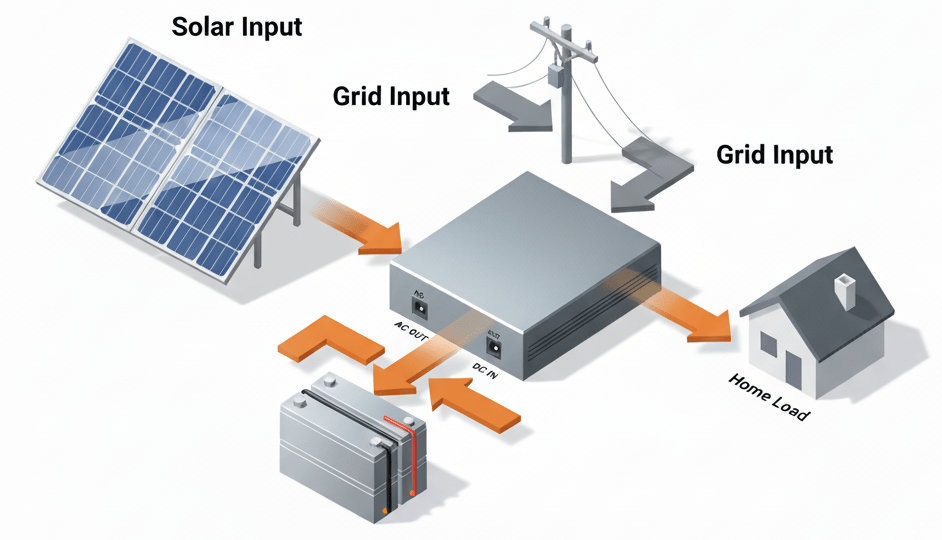
The three sizing mistakes that cause the most callbacks are ignoring surge current from motors and compressors, choosing battery voltage without checking cable cost at higher current, and treating the inverter, battery, and PV array as separate purchases instead of one matched system. Any one of these can turn a working design into a nuisance-tripping, undersized, or overpriced installation.
I’ve walked into more than a few homes where the homeowner proudly shows off a brand-new hybrid inverter that trips every time the fridge compressor kicks in. The continuous wattage math was fine. Nobody accounted for the 3x starting surge a compressor pulls for half a second. That’s the gap between a spec sheet number and a system that actually holds up under real household behavior.
Undersizing shows up fast: nuisance trips, an inverter that shuts down mid-cycle, or a battery bank that hits zero three hours before dawn. Oversizing is quieter but just as costly. A 10 kVA inverter running a 2 kW average load spends most of its life at 15-20% capacity, well below the efficiency curve’s sweet spot, and the extra $2,000-$4,000 spent on unused headroom rarely comes back as value.
The pattern I see most often with DIY designs is components purchased in isolation: a big inverter, a mismatched battery voltage, and a PV array sized off a rule of thumb rather than the actual daily load. Balanced sizing means the inverter’s continuous rating, the battery’s usable capacity, and the array’s daily output all point at the same load profile. Get one wrong and the other two are wasted money.
Before sizing anything, write down every appliance you actually want backed up during an outage, not every appliance in the house. Full-home backup costs 2-3x more than a targeted essential-circuits design, and most outages don’t require running the electric oven off battery power.
Hybrid Inverter Quick System Assessment Tool
Check off the loads you want backed up and this tool gives you a directional read on inverter range, battery voltage, PV array size, and backup duration in real time. For exact kVA, Ah, and kWp figures with regional derating built in, use the full sizing calculator at the top of this page.
Appliance Load Builder
| IncludeOn | Appliance | Qty | Hrs/day |
|---|
Live Assessment
Directional estimates only, based on the same formulas used above (surge factor, PF 0.9, inverter efficiency 92%). Not a substitute for the full calculator or a licensed engineer’s sign-off.
§2Hybrid Inverter Sizing Methodology
Every credible hybrid inverter sizing calculator runs the same core sequence: total the continuous load, account for surge, size the battery around backup duration, match the PV array to daily consumption, and apply safety margins at each stage. Skipping a step doesn’t save time, it just moves the failure point from the design phase to the first summer heatwave.
Continuous Load Calculation
Continuous load is the sum of everything running at once during normal operation, not peak-of-peak demand. List every circuit you want backed up, note its rated wattage, and add. A typical 3-bedroom home running fridge, lights, fans, a modem, and a TV lands around 1,800-2,500W continuous. This number alone tells you almost nothing about surge behavior, which is why it’s only the first input, not the final answer.
Surge Load Considerations
Motors, compressors, and pumps draw 1.5-3x their running wattage for a fraction of a second at startup. A 750W well pump can surge to 2,250W momentarily. The inverter’s surge rating, not its continuous rating, has to cover the largest single starting load layered on top of everything else already running. Ignore this and the inverter’s overload protection will trip the moment two motor loads start close together.
Battery Bank Sizing Principles
Battery capacity is a function of continuous load, desired backup hours, system voltage, round-trip efficiency, and usable depth of discharge. Lithium LFP batteries tolerate 85% DOD without meaningfully shortening cycle life, while lead-acid should stay closer to 50% to hit its rated cycle count. That single variable can double or halve the battery bank size for the same backup duration.
Solar Array Sizing Relationship
The PV array has to replace what the battery discharges each day, not just meet instantaneous load. Size it against daily energy consumption in watt-hours, divided by peak sun hours and system efficiency. Panel count then follows from wattage per module. Skip this step and you’ll own a battery bank that never fully recharges before the next outage.
Safety Margins
Add 10-20% to the raw inverter and PV figures for aging, future load growth, and measurement uncertainty. Battery sizing typically gets a similar 10% pad. Push much past 25% and you’re paying for capacity that sits idle for the system’s entire service life.
Worked Example
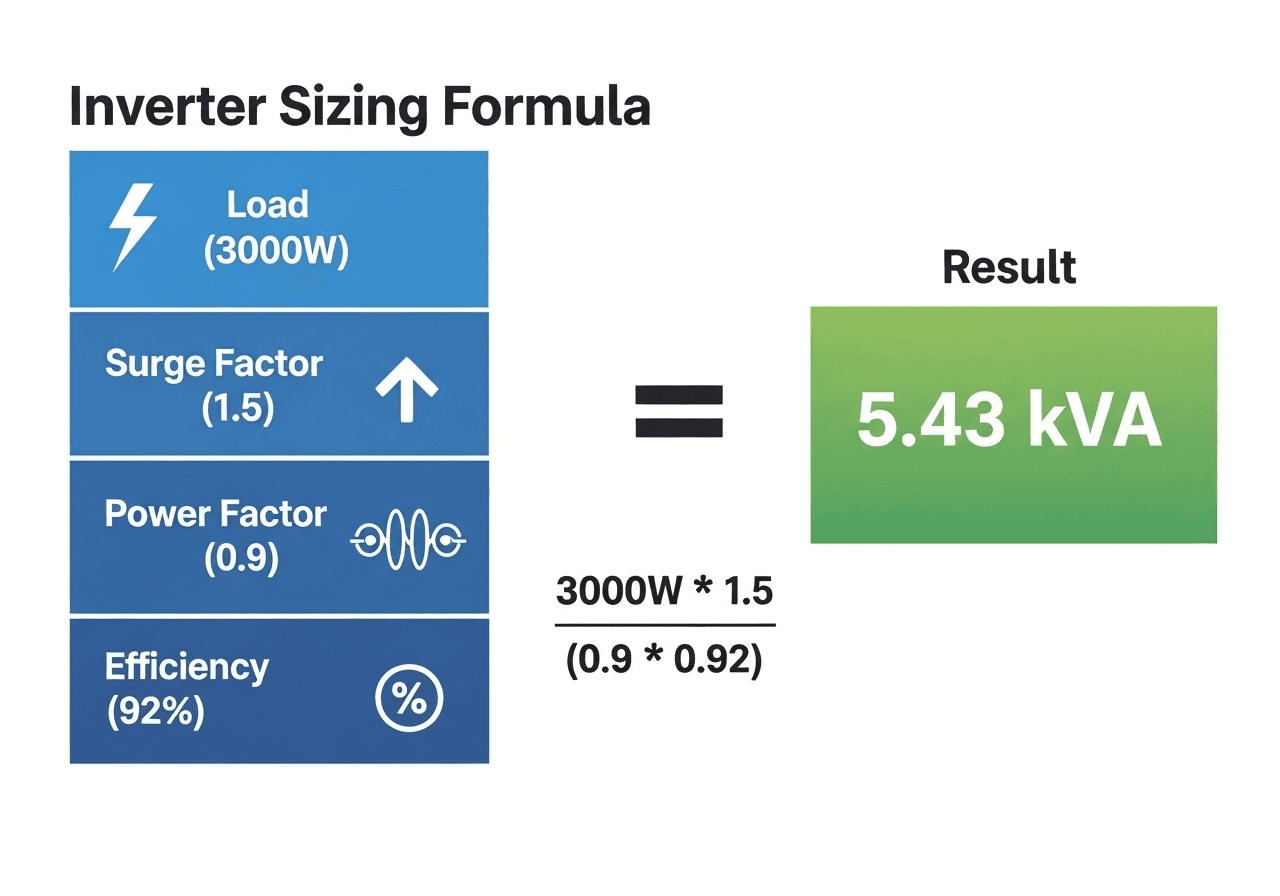
Continuous load: 3,000 W  |  Surge factor: 1.5  |  PF: 0.9  |  Inverter eff: 92%

Raw inverter kVA = (3,000 x 1.5) / (1,000 x 0.9 x 0.92)
                 = 4,500 / 828 = 5.43 kVA
Recommended inverter: 5.5-6.0 kVA (with 10-15% margin)

Raw battery Ah = (3,000 x 6) / (48 x 0.92 x 0.85)
               = 18,000 / 37.54 = 479 Ah  ->  527 Ah with 10% margin

Daily energy = 3,000 W x 6 h = 18,000 Wh = 18 kWh
Raw PV kWp   = 18,000 / (5.0 PSH x 0.85 eff x 1,000) = 4.24 kWp
Final PV     = 4.24 x 1.10 (margin) x 1.03 (regional derate) = 4.80 kWp
That single worked example is the backbone of the calculator above. Change the region, and the power factor, peak sun hours, and derating percentages shift with it, which is exactly why a hybrid inverter sizing calculator built for one country rarely gives an accurate answer in another.
§3Inverter Selection Reference Tables
These reference figures give you a sanity check against the calculator’s output. Real designs still need the appliance-by-appliance total, but if your result lands far outside these ranges for a comparable household, double-check your inputs before ordering equipment.
| Household Type | Continuous Load | Typical Backup | Recommended Inverter |
|---|---|---|---|
| Studio / small apartment | 800-1,200 W | 3-4 h | 1.5-2.0 kVA |
| Small home (lights, fans, TV) | 1,500-2,000 W | 3-6 h | 2.5-3.0 kVA |
| Medium home (+ fridge, AC) | 2,500-3,500 W | 6-8 h | 4.0-5.0 kVA |
| Large house (full backup) | 4,500-6,000 W | 8-12 h | 6.5-8.0 kVA |
| Home office / small business | 1,200-1,800 W | 8-10 h | 2.0-2.5 kVA |
| Shop / cafe | 3,500-4,500 W | 4-6 h | 5.5-6.5 kVA |
| Critical server / medical | 600-1,000 W | 24 h | 1.2-1.5 kVA |
| Small workshop | 1,000-1,500 W | 4-6 h | 2.0-2.5 kVA |
| System Voltage | Load Range | Current @ 5 kW | Typical Cable |
|---|---|---|---|
| 12V DC | Under 1 kW | ~480 A | 600+ MCM |
| 24V DC | 1-3 kW | ~240 A | 4/0 AWG |
| 48V DC | 3-10 kW | ~120 A | 1/0 AWG |
| 110V+ DC | 10 kW and up | ~52 A | 2 AWG |
| Daily Energy Need | Raw PV Requirement | With 10% Margin | Approx. Panel Count (450W) |
|---|---|---|---|
| 6 kWh | 1.41 kWp | 1.55 kWp | 4 panels |
| 12 kWh | 2.82 kWp | 3.10 kWp | 7 panels |
| 18 kWh | 4.24 kWp | 4.66 kWp | 11 panels |
| 24 kWh | 5.65 kWp | 6.21 kWp | 14 panels |
| 30 kWh | 7.06 kWp | 7.76 kWp | 18 panels |
| Load Point | Typical Efficiency | Notes |
|---|---|---|
| 10% of rated capacity | 78-85% | Below efficiency curve; avoid heavy oversizing |
| 25% of rated capacity | 88-91% | Common at night with only fridge/standby loads |
| 50% of rated capacity | 92-95% | Efficiency sweet spot for most hybrid units |
| 75-100% of rated capacity | 90-93% | Efficient but higher thermal stress over time |
§4Battery & Solar Integration
Battery Chemistry Comparison
Chemistry choice affects usable capacity, cycle life, and total cost per cycle more than any other single decision in the battery bank. Lead-acid looks cheaper on the sticker price and loses that advantage fast once you divide cost by usable cycles.
| Chemistry | Safe DOD | Round-Trip Eff. | Cycle Life | Cost/kWh |
|---|---|---|---|---|
| Lithium Iron Phosphate (LFP) | 85% | 92% | 6,000+ | $300-400 |
| Lithium NMC | 80% | 90% | 3,000+ | $350-450 |
| Lead-Acid AGM | 50% | 80% | 800-1,200 | $150-200 |
| Sodium-Ion | 80% | 88% | 4,000+ | $240-320 |
| Vanadium Flow | 80% | 75% | 12,000+ | $500-700 |
Divide cost per kWh by cycle life to get true cost per cycle. LFP usually beats lead-acid on lifetime cost despite roughly double the upfront price.
Depth of Discharge
DOD determines usable capacity, not nameplate capacity. A 10 kWh lithium bank at 85% DOD delivers 8.5 kWh of usable energy; the same nameplate capacity in lead-acid at 50% DOD only delivers 5 kWh. This is the single most common miscalculation I see in DIY designs that apply outdated lead-acid rules to lithium systems.
Charging Current
Charge current is generally kept at or below 0.5C for lithium LFP (half the battery’s Ah rating per hour) to control heat and preserve cycle life, though many LFP cells tolerate higher rates. Check the manufacturer’s charge current limit against your inverter’s maximum charging output before finalizing battery bank size, since an undersized charger stretches recovery time after a deep discharge.
Round-Trip Efficiency
Round-trip efficiency captures the energy lost converting AC to DC for charging and back to AC on discharge. Lithium systems typically run 90-92%; lead-acid drops to 75-85%. Over a year of daily cycling, that gap adds up to real kWh, which is why round-trip efficiency belongs in the PV sizing calculation, not just the battery spec sheet.
Solar Production Assumptions
Peak sun hours, not total daylight hours, drive PV output. A location with 12 hours of daylight might only have 5.0 peak sun hours, the equivalent full-intensity sun exposure used for sizing. Combined system losses from wiring, inverter conversion, temperature, and soiling typically total 10-15%, which is why the sizing formula divides by system efficiency rather than treating panel wattage as delivered output.
Seasonal Performance
Winter PSH can run 30-50% below summer figures depending on latitude. Germany, for example, swings from roughly 2.0 PSH in winter to 4.5 in summer. Systems designed only around annual averages tend to underperform exactly when backup power matters most, during storm season or winter outages, so size against your region’s worst realistic month if backup reliability is the priority.
§5Installation & Electrical Design Considerations
Single-Phase vs Three-Phase
Most residential hybrid inverters up to about 10 kW run single-phase, matching standard 120/240V or 230V residential service. Systems above that range, or commercial installations with three-phase motor loads, typically need a three-phase inverter to balance load across all three legs and avoid overloading a single phase.
Cable Sizing Overview
Cable size follows directly from system voltage and current, not just power rating. A 5 kW load at 12V draws roughly 480A, requiring cable in the 600+ MCM range; the same 5 kW at 48V draws about 120A on 1/0 AWG. That difference alone can move cable cost by several hundred dollars on a single run, which is why voltage selection happens early in the design, not after the battery bank is purchased.
Circuit Protection
DC disconnects, fuses, and breakers need ratings that account for the inverter’s surge current, not just continuous draw. Undersized DC protection nuisance-trips under motor starting loads; oversized protection fails to protect the wiring during an actual fault. Match breaker and fuse ratings to both the cable ampacity and the equipment manufacturer’s specifications.
Earthing
Proper earthing bonds the inverter chassis, battery rack, and PV array frames to a common grounding electrode system, protecting against shock hazards and stray current corrosion. Requirements vary by code jurisdiction, but the underlying principle, a low-impedance path back to the grounding electrode, is consistent across NEC, IEC, and AS/NZS frameworks.
Surge Protection
Surge protective devices (SPDs) on both the AC and DC sides guard against lightning-induced transients and utility switching surges. Rooftop PV arrays are especially exposed, and a single unprotected surge event can take out an inverter’s control board even without a direct lightning strike.
Ventilation
Hybrid inverters generate heat proportional to load and shed it through convection or fans. Cramped utility closets with no airflow push ambient temperature well above the 25°C rating point, triggering thermal derating exactly when the system is working hardest. Leave the manufacturer’s specified clearance on all sides, typically 200-300mm minimum.
Operating Temperature
Most hybrid inverters are rated for -20°C to 50-60°C ambient, but continuous output starts derating around 25-40°C depending on the model. Garage and outdoor enclosures in hot climates routinely exceed that threshold in summer, which is why the temperature input in the sizing calculator directly affects the recommended capacity.
§6What Affects Real-World Hybrid Inverter Performance?
Ambient temperature, altitude, partial loading, and battery aging are the four factors that most commonly separate a hybrid inverter’s spec-sheet output from its measured performance in the field. Temperature derating alone can cut usable capacity by 10-15% in a hot, poorly ventilated installation.
Inverter Efficiency
Efficiency isn’t a flat number; it varies by load point, as shown in the efficiency table above. Sizing an inverter so typical daily load sits near 40-70% of rated capacity keeps it operating near peak efficiency rather than at the low end of the curve.
Ambient Temperature
A common rule of thumb applies roughly 1% output derating per degree Celsius above 25°C ambient. At 40°C, that’s a 15% capacity reduction before any other factor is considered, which is why hot-climate installations should oversize the continuous rating rather than rely on the nameplate figure alone.
Altitude
Thinner air at elevation reduces convective cooling efficiency, and most manufacturers specify derating above 2,000m, often around 1% per additional 100m above that threshold. High-altitude installations should confirm the manufacturer’s altitude derating table before finalizing capacity.
Partial Loading
Running consistently below 20% of rated capacity drops efficiency into the high-70s to low-80s percent range for many units, wasting energy as heat rather than useful output. This is the direct cost of oversizing: not just upfront capital, but ongoing efficiency loss every single day.
Battery Aging
Lithium batteries lose roughly 2-3% usable capacity per year under normal cycling, meaning a system sized exactly to today’s backup requirement will fall short of that same target within 3-5 years. Building in the 10% safety margin discussed earlier gives the battery bank room to age without a mid-life capacity shortfall.
System Expansion Planning
Adding an EV charger, a heat pump, or a pool pump later is common enough that it’s worth sizing the inverter’s continuous rating with 15-20% headroom for future loads, even when the battery and PV array are sized tightly to current needs. Inverter capacity is far more expensive to upgrade after installation than to specify correctly the first time.

§7Safety, Codes & Standards
Sizing correctly is only half the job. The equipment also has to satisfy the electrical code in your jurisdiction before it can be permitted, inspected, and legally connected to the grid or occupied space. Standards vary by region, so treat this section as an orientation, not a substitute for checking your local adopted code cycle.
NEC Overview (USA)
In the United States, NFPA 70, the National Electrical Code, governs PV and battery installations primarily through Article 690 (Solar Photovoltaic Systems) and Article 705 (Interconnected Electric Power Production Sources). Rapid shutdown requirements under NEC 690.12 require DC conductors to drop to 30V within 30 seconds outside a 1-foot array boundary, and 80V within 30 seconds inside it, unless a listed PV Hazard Control System is used instead.
IEC References (International / Europe)
IEC 62109 covers safety requirements for power converters used in photovoltaic systems, while EN 50549 governs grid connection requirements for generating plants in parallel with distribution networks across much of Europe. These standards focus heavily on insulation, isolation, and anti-islanding protection for grid-interactive inverters.
AS/NZS Considerations (Australia)
Australian and New Zealand installations reference AS/NZS 5139 for battery system installation requirements and AS/NZS 4777 for grid connection of energy systems via inverters. These standards set specific requirements around battery enclosure ventilation, thermal runaway protection, and inverter anti-islanding response times.
Grid-Interactive Safety
Any hybrid inverter that can export to the grid needs anti-islanding protection, a function that detects a grid outage and disconnects the inverter within a code-mandated window, typically under 2 seconds, to protect utility line workers from backfeed. This function operates independently of the battery backup transfer switch and can’t be disabled for grid-tied operation.
Rapid Shutdown Concepts
Rapid shutdown exists to protect firefighters from energized DC conductors during a structure fire, not to serve as a routine maintenance disconnect. Module-level power electronics, like microinverters or power optimizers, are the most common compliance path, since they can de-energize each panel individually rather than relying on a single array-level shutdown point.
Electrical Inspection Guidance
Before scheduling an inspection, confirm equipment nameplate ratings match the submitted plan set, cable sizing matches calculated ampacity with derating applied, grounding and bonding are complete and visible, and all labeling required under the local code cycle is installed. A design that passes the sizing calculator’s math still needs to satisfy the AHJ’s specific documentation requirements.
§8Frequently Asked Questions
What size hybrid inverter do I need for my house?
Most 3-4 bedroom homes running a fridge, lights, fans, and a TV during an outage need a 5 kW to 8 kW hybrid inverter. Add the wattage of every appliance you want powered at once, multiply by 1.15 to 1.25 for safety margin, and check that figure against the inverter’s surge rating for motor-driven loads like pumps and compressors.
Can a hybrid inverter be oversized?
Yes. An oversized hybrid inverter runs at low partial load most of the time, which drops conversion efficiency by 5 to 10 percentage points and adds unnecessary upfront cost. A 10 kVA unit serving a 2 kW average load rarely operates near its efficiency peak, so match capacity to actual demand plus a reasonable margin rather than buying headroom you won’t use.
What battery voltage should I use for a hybrid inverter system?
Use 12V for systems under 1 kW, 24V for 1-3 kW residential setups, and 48V for anything from 3 kW to 10 kW, which covers most homes. Higher voltage cuts current draw for the same power, which means thinner, cheaper cables and lower resistive losses across the battery-to-inverter run.
How do I calculate PV array size for a hybrid inverter?
Divide your daily energy consumption in watt-hours by your location’s peak sun hours multiplied by system efficiency, typically 0.85. A home using 18 kWh per day in a location with 5 peak sun hours needs roughly 4.2 kWp of panels before adding a safety margin and regional derating, which usually pushes the final figure to about 4.8 kWp.
How much do hybrid inverter sizing mistakes cost?
Undersizing typically forces an inverter swap costing $800 to $2,500 once nuisance tripping shows up under motor loads, while undersized battery voltage can add $600 or more in oversized copper cabling alone. Oversizing wastes 20-40% of the equipment budget on capacity that never gets used.
Is a hybrid inverter worth it compared to a standard grid-tie inverter?
A hybrid inverter is worth the added cost, typically 20-30% more than a grid-tie-only unit, if you need backup power during outages or want to shift self-consumption with a battery. If your goal is purely offsetting a utility bill with no backup requirement, a standard grid-tie inverter is usually the more economical choice.
Hybrid inverter vs standard inverter: what’s the real difference?
A standard grid-tie inverter only exports solar power to the grid and shuts down during a blackout for safety. A hybrid inverter adds a battery charge controller and an automatic transfer switch, so it can charge a battery bank, island itself from the grid during an outage, and keep selected circuits running.
Do I need a professional engineer to size a hybrid inverter system?
A calculator gets you a solid planning-stage estimate, but a licensed electrician or PE should verify final equipment ratings, cable sizing, and code compliance before installation, especially for systems above 5 kW or any grid-interactive setup. Most jurisdictions require a stamped design for permitting on larger residential and all commercial systems.
§9Getting Hybrid Inverter Sizing Right the First Time
A hybrid inverter sizing calculator earns its keep when it treats the inverter, battery bank, and PV array as one interdependent system instead of three separate purchases. Continuous load sets the floor, surge load sets the ceiling, battery voltage and chemistry set the backup window, and the PV array closes the loop by replacing what the battery gives up each day.
Run your numbers through the calculator above for a region-specific figure, then cross-check the result against the reference tables in this guide. If the two disagree by a wide margin, revisit your load list before assuming either number is wrong.
No calculator, including this one, replaces a site survey and a professional review before purchase. Verify final equipment ratings, cable sizing, and code compliance with a qualified installer, particularly on any system feeding back into the grid. For deeper dives into the individual components covered here, see our battery sizing calculator, backup duration calculator, and hybrid solar system planner.
Long-term system planning pays for itself. Size the inverter with room for the loads you’ll add in five years, not just the ones you have today, and the battery bank you install now will still make sense after a few years of normal capacity fade. That’s the difference between a system you size twice and one you get right the first time.
Sources & Further Reading
Last Updated: | Next Review:
- NFPA. “NFPA 70, National Electrical Code.” Article 690 & Article 705.
- International Electrotechnical Commission. “IEC 62109 — Safety of Power Converters for PV Systems.”
- Standards Australia. “AS/NZS 4777 & AS/NZS 5139 — Grid Connection and Battery System Installation.”