

Solar Roof Area & Layout Estimator: How Many Panels Actually Fit?
Type your roof size in and this tool tells you the panel count, the system size in kW, and draws the layout so you’re not guessing.
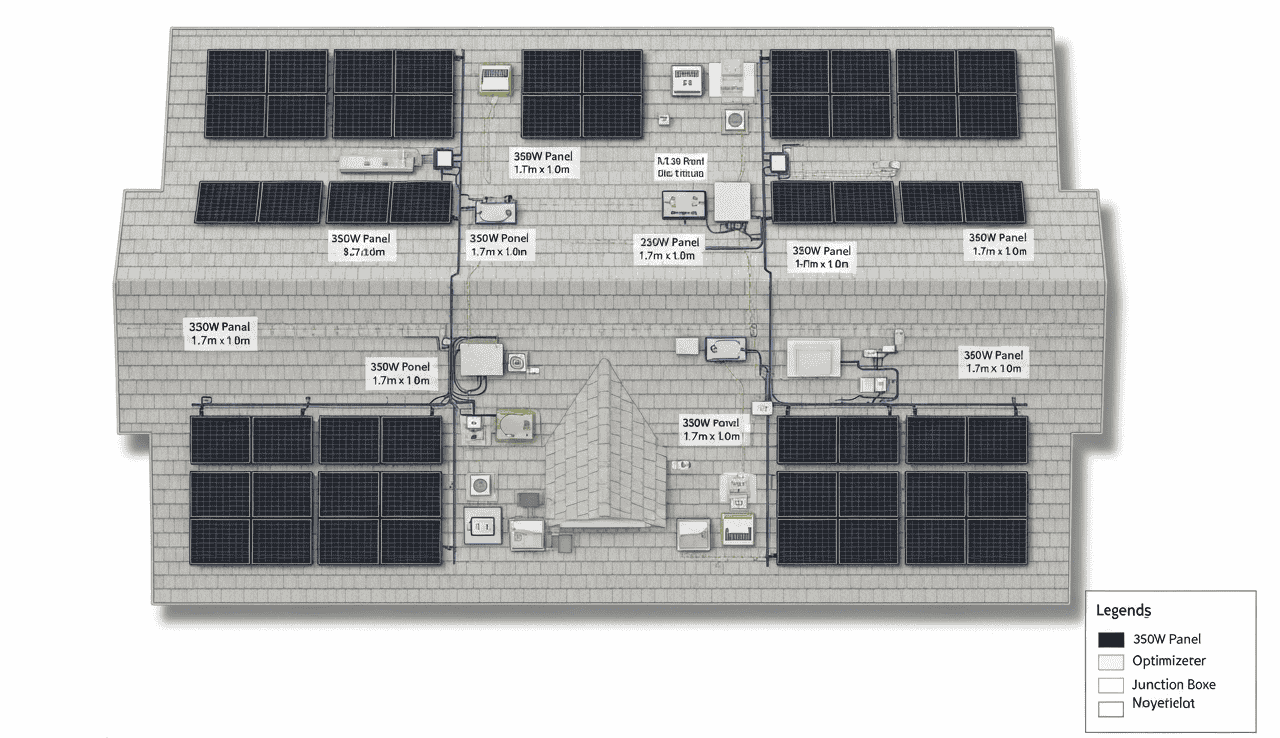
Most online solar calculators just ask for your electric bill and spit out a sales quote. That’s not what you searched for. You want to know if your actual roof, the one with the AC unit and the chimney and that weird jog in the wall, can physically hold enough panels to matter.
This estimator does the geometry. You put in roof dimensions, panel size, and any obstructions, and it fits a real grid, in real units, whether your roof is flat or pitched. Below the tool, we walk through the math so you know exactly what it’s doing and why.
Try the Solar Roof Area & Layout Estimator
Roof Units
Roof Type
Panel Specification
Results PORTRAIT
Layout Preview
How to Calculate Roof Area for Solar Panels
Here’s where most rough estimates go wrong. People measure the roof, multiply length by width, and assume that whole number is fair game for panels. It isn’t.
Fire codes and mounting hardware both eat into that number. Most jurisdictions want a clear setback path around the roof edge, usually somewhere between 0.3 and 0.5 meters (1 to 1.5 feet), so firefighters have somewhere to walk. Then there’s whatever is already sitting up there: a rooftop AC unit, a vent stack, a water tank, a skylight. Subtract all of that first.
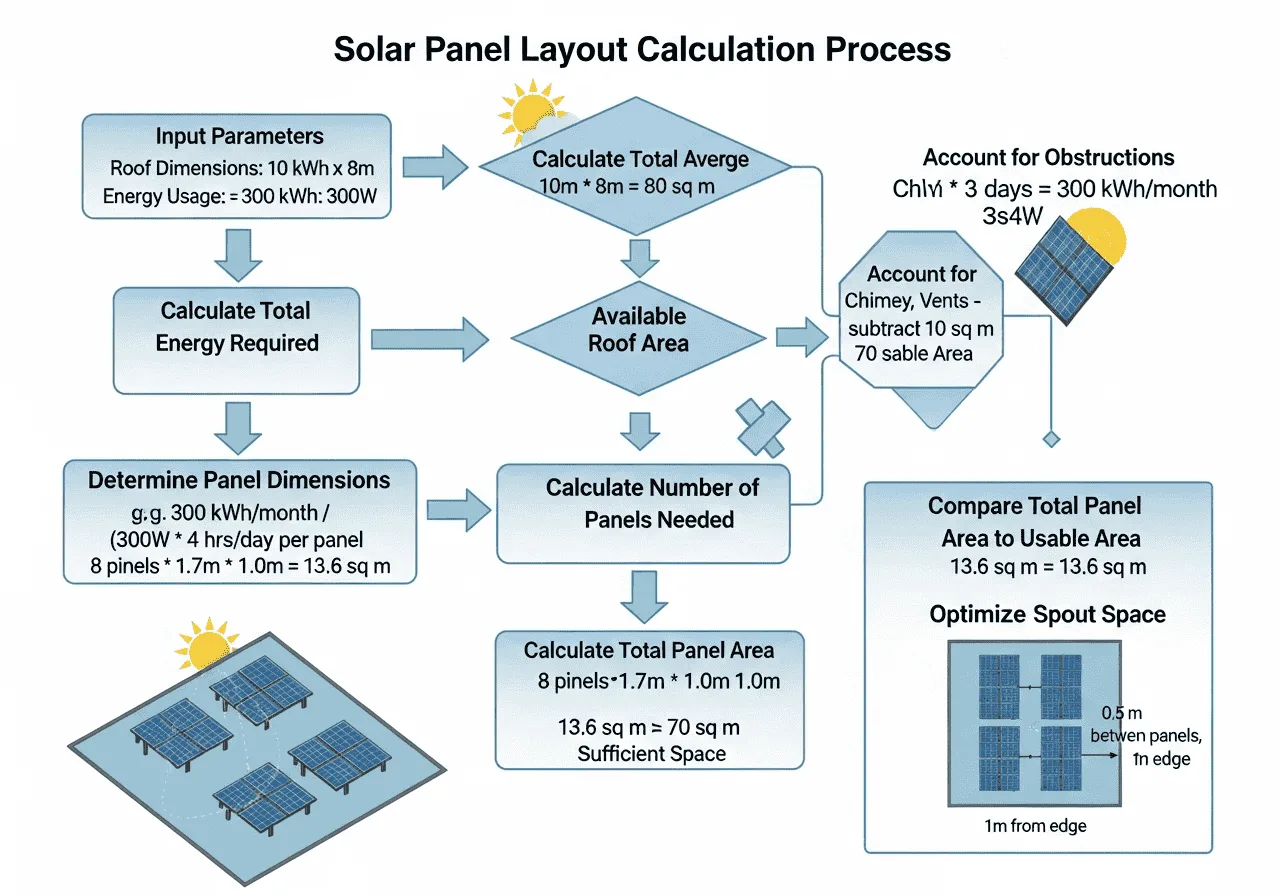
How setback margins and obstructions shrink your usable roof area before any panel gets placed.
What’s left is your usable area. That’s the number that goes into the estimator above.
How Many Solar Panels Fit on Your Roof?
Say your usable area is 14 m by 7.2 m, and you’re using a standard 1,900 mm × 1,000 mm panel with a 30 mm gap between panels.
| Orientation | Columns | Rows | Panels | System Size |
|---|---|---|---|---|
| Portrait (long side vertical) | 7 | 7 | 49 | 22.1 kW |
| Landscape (long side horizontal) | 13 | 3 | 39 | 17.6 kW |
In this example, portrait wins by 10 panels, about 4.5 kW more capacity, just from rotating the grid. That’s why the estimator tests both directions automatically instead of locking you into one.
Flat Roof vs Sloped Roof: What Changes
Flat roofs are common across a lot of the Gulf, North Africa, and parts of South Asia. Sloped, pitched roofs dominate in much of North America, Europe, and Australia. The physics of fitting panels differs between the two, which is why this tool has a separate mode for each.
Flat roofs need row spacing
Panels on a flat roof sit on angled racks, usually 10–20°, to shed rain and catch more sun. Tilt one row up and it throws a shadow on the row behind it during low winter sun. The fix is a row spacing factor, extra distance between rows so the shadow clears. That’s the “Row Spacing Factor” input above; a value around 1.6–2.0 is a reasonable starting point for most latitudes.
Sloped roofs pack tighter
On a pitched roof, the roof itself is already tilted toward the sun, so panels mount flush, rail-to-roof, with almost no gap needed between rows beyond basic clearance. You lose less usable area to spacing, which is part of why sloped roofs often carry more capacity per square meter than flat ones of the same size.
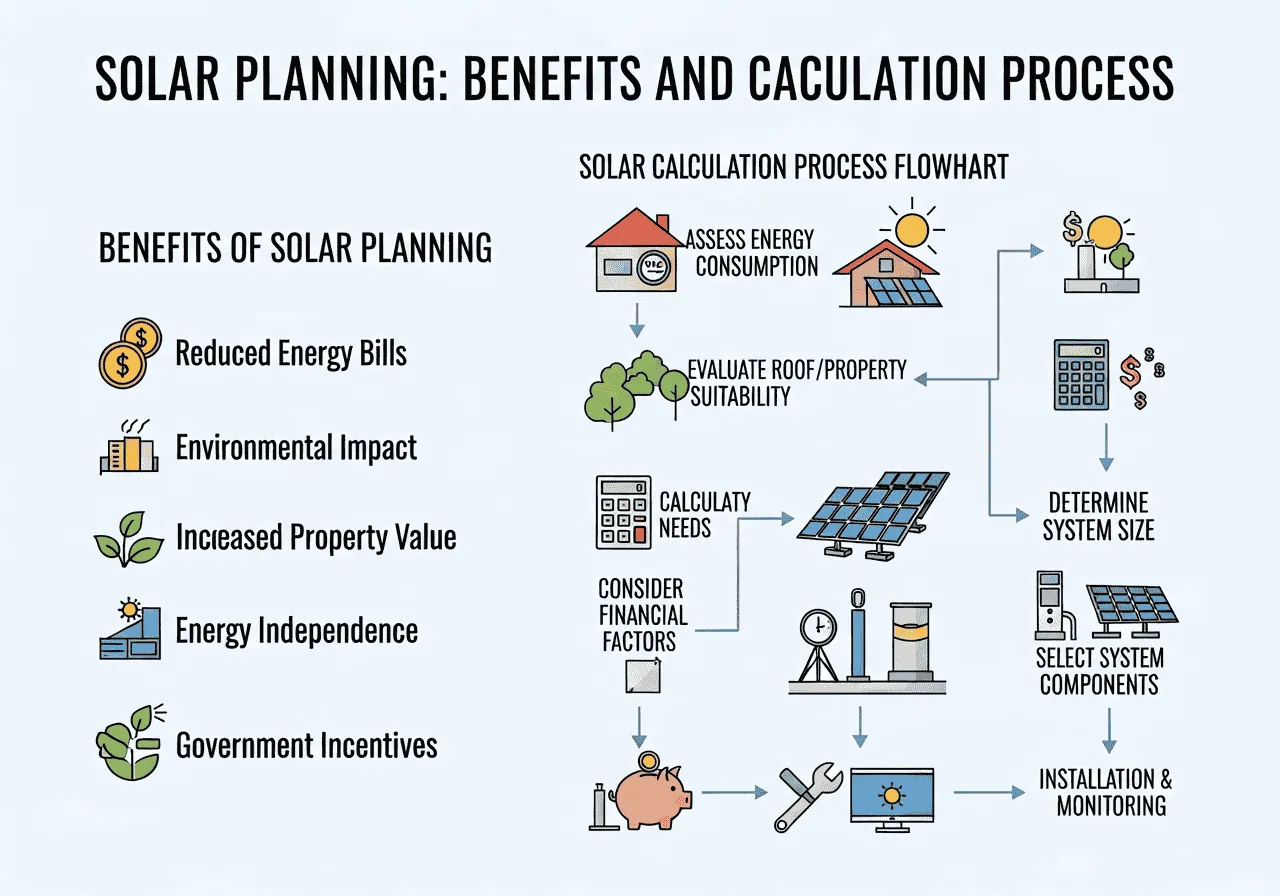
Row spacing on a flat roof versus flush mounting on a sloped roof, and how each changes your panel count.
How Much Roof Area Does 1 MW of Rooftop Solar Need?
If you searched anything with “1 MW” and “square meters” in it, this is your answer, and yes, it’s a range on purpose. Panel efficiency, row spacing, and roof shape all push the number around.
| System Size | Power Density (rule of thumb) | Estimated Roof Area Needed |
|---|---|---|
| 10 kW | ~170 W/m² | 50–70 m² |
| 100 kW | ~170 W/m² | 500–700 m² |
| 500 kW | ~170 W/m² | 2,500–3,500 m² |
| 1 MW | ~150–200 W/m² | 5,000–6,000 m² |
A tighter number always needs your actual panel wattage and layout, which is exactly what the estimator above is for. Feed it your real roof and panel specs instead of a generic 170 W/m² assumption, and you’ll get a figure specific to your building, not the industry average. If you’d rather start from your electric bill instead of your roof, the solar sizing calculator works backward from your usage to a target system size.
Common Mistakes When Measuring a Roof for Solar
- Skipping the setback. A 0.4 m margin around a 10 m × 8 m roof removes almost 15 m² before a single panel goes down.
- Ignoring shading objects. Chimneys, vents, and satellite dishes cast shadows that move through the day. Measure their footprint, not just their base.
- Assuming one orientation. As shown above, rotating the panel grid 90° can change your count by 10 panels or more on the same roof.
- Using someone else’s row spacing factor. A flat roof at a high latitude needs more row spacing than one near the equator. Don’t copy a number from a forum post written for a different climate.
- Confusing footprint with roof-plan area. On a sloped roof, the actual mounting surface is longer than its flat footprint. Measure along the slope, not the shadow it casts on the ground.
- Locking in a panel count before checking string voltage. A layout that fits on paper can still fail if the string voltage falls outside your inverter’s window. Run the count from this page through the PV array string configuration calculator before you order hardware.
Frequently Asked Questions
What is a solar roof area & layout estimator?
It’s a calculator that takes your roof dimensions and panel size and works out how many solar panels physically fit, in a real grid layout, after accounting for setbacks, obstructions, and mounting spacing.
How do I calculate roof area for solar panels?
Measure roof length and width, subtract a setback margin (about 0.3–0.5 m per side) and the footprint of any obstructions, then multiply what’s left. That usable area is what you divide panel dimensions into.
How many solar panels can I fit on my roof?
It depends on your usable roof area divided by panel size plus spacing, tested in both orientations. A typical home roof around 100 m² usable area often fits 25–40 standard panels, but the only accurate number comes from your specific dimensions.
Does a flat roof or sloped roof fit more panels?
Sloped roofs usually fit more panels per square meter because panels mount flush with almost no row spacing. Flat roofs need extra row-to-row gap for tilted racking, which reduces usable density.
How much roof area does 1 MW of solar need?
Roughly 5,000 to 6,000 square meters, based on a rule-of-thumb rooftop power density of about 150–200 watts per square meter. Your exact number shifts with panel efficiency and layout.
Is this estimator free to use?
Yes. Enter your roof and panel details above and it runs entirely in your browser, no signup, no email required.
Can I use this for a commercial rooftop, not just a house?
Yes. The math works the same at any scale, from a garage roof to a warehouse. Just switch units and plug in your actual roof and panel dimensions.
Conclusion
A roof only holds so many panels, and guessing that number from a satellite photo gets you a rough quote at best. Run your actual length, width, setback, and panel size through the estimator above and you get a real count, a real kW figure, and a diagram you can hand to an installer.
The same logic scales up or down. It works for a 60 m² home roof and a 6,000 m² warehouse roof using the MW-scale numbers covered earlier. Change the roof type, the panel orientation, or the row spacing factor, and watch the layout redraw itself instantly.
Once you know how many panels fit, the next question is usually storage and inverter sizing, both covered in the related tools below.
Related Solvebility Calculators
- Solar Sizing Calculator — start from your electricity usage instead of your roof to find a target system size.
- Battery Sizing Calculator — size the storage bank once you know how much your roof can generate.
- Hybrid Inverter Sizing Calculator — match an inverter to the panel count and battery bank you’ve settled on.
- PV Array String Configuration Calculator — check string voltage before you wire the layout from this page.
- Solar Watt Hour Calculator — work out daily and monthly energy consumption to sanity-check your system size.
- Hybrid Solar System Planner Calculator — model panels, battery, and grid backup together for a full system design.
References
- Gagnon, P., Margolis, R., Melius, J., Phillips, C., and Elmore, R. (2018), “Rooftop solar photovoltaic technical potential in the United States: A detailed assessment,” Environmental Research Letters 13, 024027 — rooftop PV area and capacity methodology used for the MW-to-square-meter planning figures on this page.
- U.S. Department of Energy, “Solar Rooftop Potential” — national rooftop area and technical potential data referenced for context on rooftop solar scale.
- National Electrical Code (NEC), Article 690 — Solar Photovoltaic (PV) Systems, referenced for general setback and installation clearance conventions.
- IEC 62109 — Safety of power converters for use in photovoltaic power systems, referenced for general international installation standards.
Know your roof. Know your panel count. No sales call required.
Run the Estimator Again