


Semester GPA vs Cumulative GPA: Differences, Formula & Examples
Standing outside a professor’s office waiting for final grades creates a unique form of anxiety. You check your student portal, refresh the transcript page, and suddenly see two numbers side-by-side: a 3.80 and a 3.15. Which one determines whether you keep your merit scholarship? Which one goes on your resume when applying for software engineering internships? And why does one number drop sharply after a single tough class while the other barely moves?
Understanding the mathematical, structural, and practical differences between your semester GPA vs cumulative GPA is essential for navigating higher education successfully. Confusing these two numbers causes unnecessary panic during finals week or, worse, leads to unexpected academic probation warnings because you calculated your progress incorrectly.
Most college students realize their overall average dropped after a rough term, but few understand the exact credit-weight equations driving that shift. A bad semester feels like a catastrophic failure until you break down the mathematical pooling of quality points across your entire degree path.
This comprehensive guide breaks down everything you need to know about semester GPA vs cumulative GPA calculations, credit hour weighting dynamics, strategies for repairing a damaged academic record, and how corporate recruiters and graduate school admissions committees evaluate your official transcripts.
Semester GPA measures your weighted academic performance exclusively within a single academic term (such as Fall or Spring), while cumulative GPA calculates your aggregate average across every completed credit hour throughout your degree program. Semester GPA acts as a high-volatility short-term progress report, whereas cumulative GPA reflects long-term academic stability and determines degree completion, honors, and formal program standing.
Table of Contents
- 1. What is a Semester GPA? Deep Dive into Short-Term Tracking
- 2. What is a Cumulative GPA? Understanding Aggregate Performance
- 3. Semester GPA vs Cumulative GPA: Comprehensive Side-by-Side Comparison
- 4. Mathematical Mechanics: Step-by-Step Grade Weighting Calculations
- 5. Why Cumulative GPA Becomes Harder to Change Over Time
- 6. Does Semester GPA Affect Cumulative GPA?
- 7. How to Calculate the Semester GPA You Need to Reach a Target Cumulative GPA
- 8. How Much Can One Semester Change Your Cumulative GPA?
- 9. Employer and Graduate School Evaluation Strategies
- 10. Actionable Strategies to Recover from a Low Semester GPA
- 11. Major GPA, Institutional GPA, and Transfer Credit Variations
- 12. Frequently Asked Questions (FAQ)
1. What is a Semester GPA? Deep Dive into Short-Term Tracking
A semester GPA reflects the weighted grade average earned strictly within a single academic term (4 to 5 months). It isolates recent academic performance without factoring in previous grades or future credit registrations.
Your semester Grade Point Average (GPA) serves as a tactical, short-term measure of academic performance. It looks exclusively at the classes you completed within a designated term—typically a 15-week or 16-week traditional semester, a 10-week quarter, or an intensive summer session. Once that term closes and grades are finalized, your semester GPA locks in place and does not change.
Academic institutions use the semester GPA as a real-time health check. Because it isolates recent performance, it shows academic advisors how well you adapted to a specific course load, managed personal challenges during those months, or handled advanced coursework compared to entry-level classes.
Key Purposes of a Semester GPA
Universities rely on term-specific grade point averages to manage immediate administrative policies, student recognition, and early intervention programs:
- Dean’s List and Term Honors: Academic honors for individual terms rely entirely on your semester performance. Dean’s List requirements vary by institution; many schools set a minimum term GPA and minimum number of credits.
- Academic Probation Warnings: If your semester GPA falls below an institution’s academic-standing threshold, you may be placed on academic warning or probation. The threshold and consequences vary by university.
- Athletic and Extracurricular Eligibility: Collegiate athletic associations (such as the NCAA) and campus leadership organizations often require students to maintain a minimum semester GPA to remain eligible for competition and active membership.
- Course Load Capacity Adjustments: Students seeking to register for overload credits (e.g., taking 18 to 21 credits in a single term) must demonstrate high semester GPAs in preceding terms to secure departmental approval.
If you experience severe personal, medical, or family difficulties during a term, your semester GPA will reflect that temporary dip. It acts as an isolated marker that you can explain to advisors without permanently ruining your entire transcript profile if managed quickly.
2. What is a Cumulative GPA? Understanding Aggregate Performance
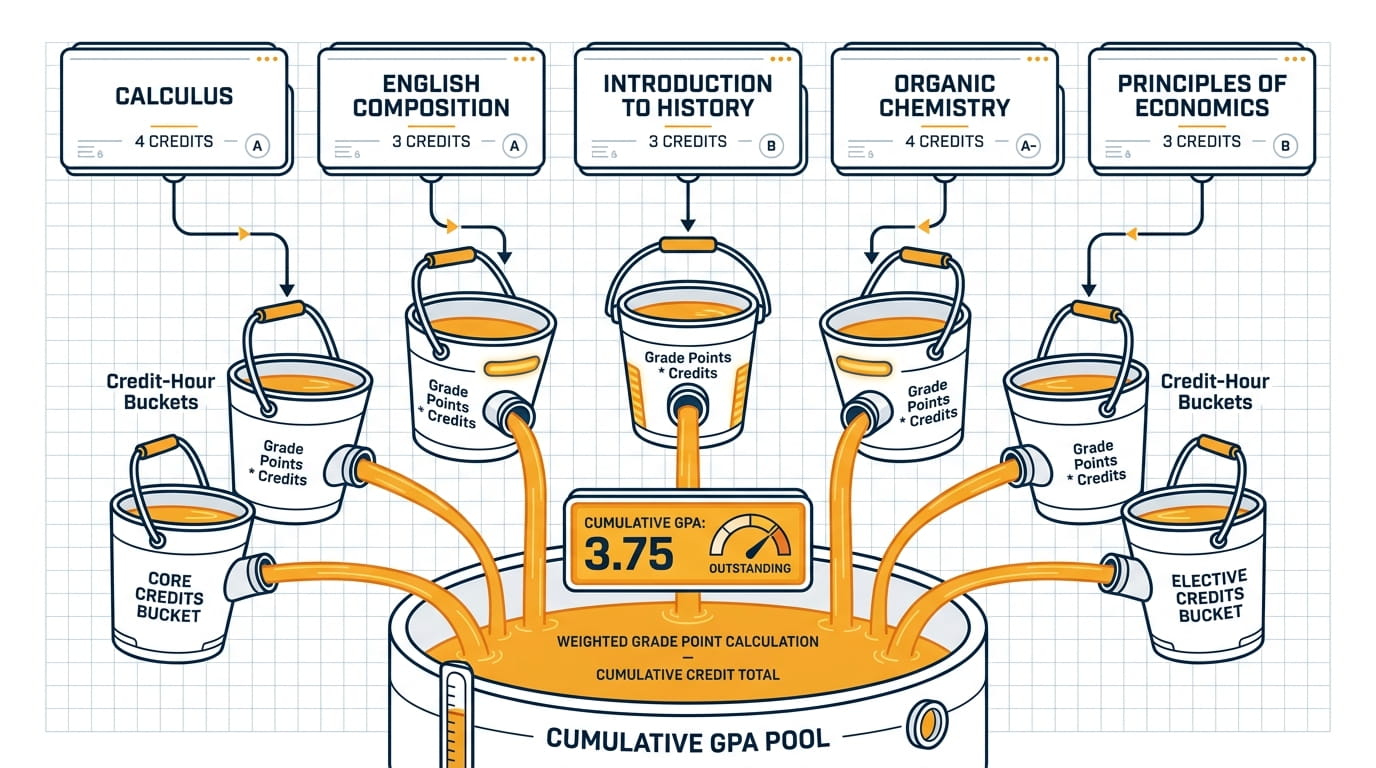
A cumulative GPA is the running, aggregate mathematical average of all quality points earned divided by all attempted credit hours across your entire college career. It serves as your permanent academic baseline.
While a semester GPA captures a single chapter of your academic journey, your cumulative GPA represents the entire book. It pools every letter grade, quality point, and attempted credit hour from your first day of freshman orientation to your final senior capstone exam into one unified metric.
Your cumulative GPA is the central figure printed at the bottom of official academic transcripts, recorded in institutional registrar databases, and checked by degree audit software prior to graduation. It reflects sustained performance across multiple years, showing whether you can consistently meet academic standards across diverse disciplines, varied professor expectations, and rising course difficulty levels.
Primary Applications of a Cumulative GPA
Because it offers an overarching summary of academic quality, external institutions and university authorities prioritize your cumulative average for high-stakes decisions:
- Graduation and Degree Conferral: Many institutions set minimum GPA requirements for graduation or degree completion, but the required GPA varies by institution, degree, and program.
- Latin Honors at Graduation: High-level graduation distinctions such as Cum Laude (typically top 16–30%), Magna Cum Laude (top 6–15%), and Summa Cum Laude (top 1–5%) are determined by cumulative GPA thresholds at degree completion.
- Financial Aid and Merit Scholarships: Scholarships and financial-aid programs may require students to meet academic-progress standards, but the exact GPA and credit requirements depend on the program and institution.
- Graduate School Applications: Some graduate programs publish minimum GPA requirements or use GPA during initial screening, while others evaluate applicants more holistically.
3. Semester GPA vs Cumulative GPA: Comprehensive Side-by-Side Comparison
The core difference lies in scope and volatility. Semester GPAs measure short-term performance over 12–18 credits and swing dramatically with individual grades. Cumulative GPAs aggregate 60–120+ credits, providing long-term stability that resists rapid shifts.
Understanding how semester GPA vs cumulative GPA metrics interact helps you allocate study hours, plan course loads, and avoid unnecessary panic over temporary grade drops. The table below outlines the core differences between these two metrics.
| Evaluation Criteria | Semester GPA | Cumulative GPA |
|---|---|---|
| Time Window | Single Academic Term (4–5 Months) | Entire Academic Career (2–4+ Years) |
| Credit Volume Base | 12 to 18 Credit Hours (Typical Full-Time Load) | 60 to 120+ Credit Hours (Degree Total) |
| Mathematical Volatility | High: A single grade shift heavily alters the average. | Low: Dampened by accumulated credit weight over time. |
| Reset Schedule | Resets to zero at the start of every new term. | Never resets; carries forward continuously until graduation. |
| Primary Internal Use | Dean’s List, Term Warning, Athletic Eligibility | Degree Audit, Graduation Approval, Financial Aid Renewal |
| Primary External Use | Demonstrating Academic Improvement Trends | Job Resume Screening, Graduate Admissions Cutoffs |
| Administrative Impact | Triggers single-semester probation or warnings. | Triggers academic suspension or degree withholding. |
4. Mathematical Mechanics: Step-by-Step Grade Weighting Calculations
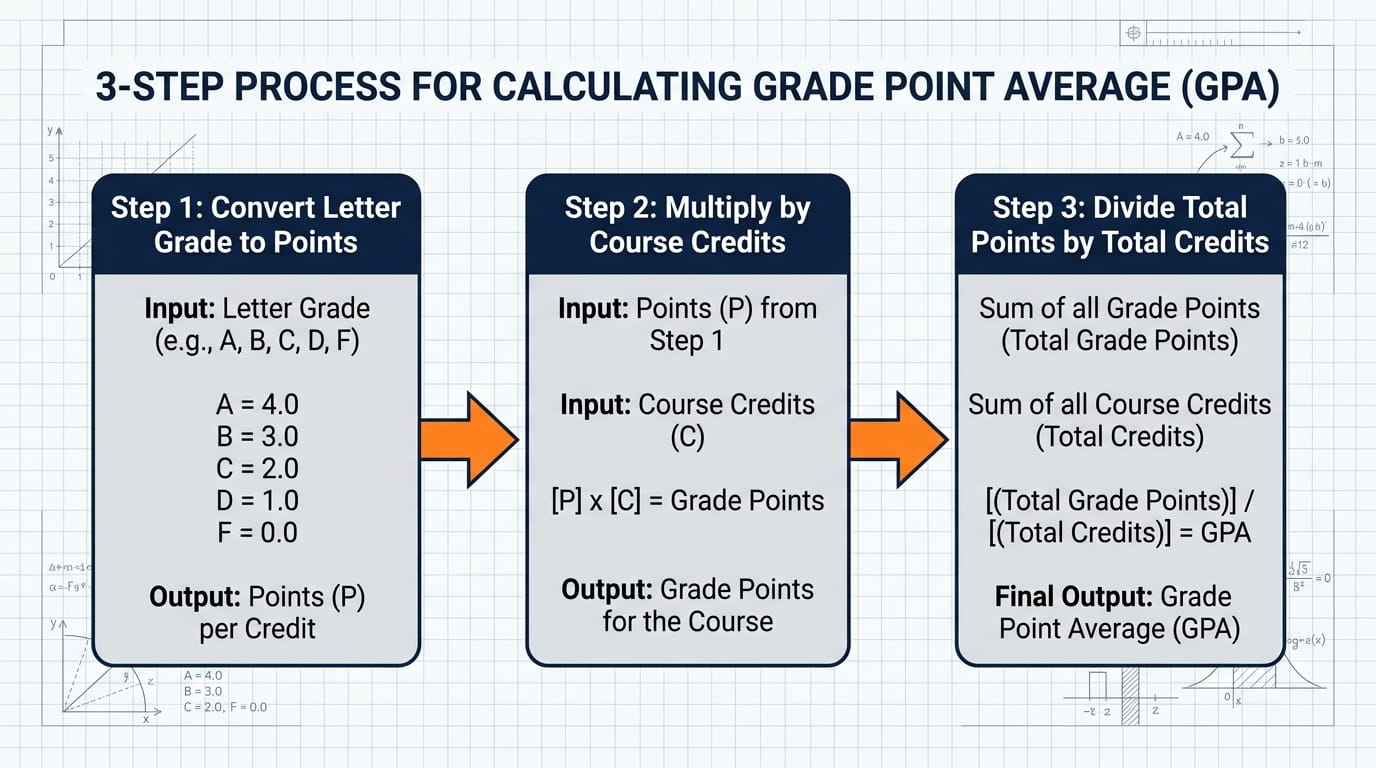
GPAs are weighted averages, not simple arithmetic means. You calculate both semester and cumulative GPAs by converting letter grades into standard numerical points, multiplying by course credit hours to find quality points, and dividing total quality points by total attempted credits.
A common error among college students is treating all classes as equal when calculating grade point averages. Getting an ‘A’ in a 1-credit physical education lab does not balance out an ‘F’ in a 4-credit Organic Chemistry lecture. Grade point averages rely entirely on credit-weighted math.
Standard Standardized 4.0 Scale Point Conversion
Most colleges and universities in the United States and Canada use a standard 4.0 grading scale to translate letter grades into numerical quality point values:
- Grade A (4.00 points): Outstanding Performance (93–100%)
- Grade A- (3.70 points): Excellent Performance (90–92%)
- Grade B+ (3.33 points): Above Average Performance (87–89%)
- Grade B (3.00 points): Good Performance (83–86%)
- Grade B- (2.70 points): Average-High Performance (80–82%)
- Grade C+ (2.33 points): Satisfactory-Plus Performance (77–79%)
- Grade C (2.00 points): Satisfactory Performance (73–76%)
- Grade C- (1.70 points): Minimum Passing Performance (70–72%)
- Grade D (1.00 point): Marginal Passing Performance (60–69%)
- Grade F (0.00 points): Failure / No Credit Earned (Below 60%)
Step 1: Calculating Your Semester GPA
To calculate your semester GPA, follow these three steps for the classes taken in that specific term:
- Multiply the course credit hours by the grade point value earned to get the Quality Points for each course.
- Add all individual course quality points together to calculate Total Term Quality Points.
- Divide Total Term Quality Points by Total Term Attempted Credits.
Let’s work through a practical example of a student taking 14 credit hours in a single Fall semester:
- Course 1: Calculus I (4 Credits) — Grade: B (3.00 Points)
4 Credits × 3.00 = 12.0 Quality Points - Course 2: General Chemistry + Lab (4 Credits) — Grade: A (4.00 Points)
4 Credits × 4.00 = 16.0 Quality Points - Course 3: World History (3 Credits) — Grade: C+ (2.33 Points)
3 Credits × 2.33 = 6.99 Quality Points - Course 4: Microeconomics (3 Credits) — Grade: A- (3.70 Points)
3 Credits × 3.70 = 11.1 Quality Points
Calculation Summary:
- Total Term Credits Attempted: 4 + 4 + 3 + 3 = 14 Credits
- Total Term Quality Points: 12.0 + 16.0 + 6.99 + 11.1 = 46.09 Quality Points
- Semester GPA Calculation: 46.09 Quality Points ÷ 14 Credits = 3.29 Semester GPA
Step 2: Calculating Your Cumulative GPA
To calculate your cumulative GPA, combine your new term quality points and credits with your existing academic history. Never average your semester GPAs together directly (e.g., adding 3.00 and 4.00 and dividing by 2), because terms with different credit loads will skew the math.
Assume the student from the previous example had already completed three semesters prior to this term:
- Prior Completed Credits: 45 Credit Hours
- Prior Accumulated Quality Points: 130.5 Quality Points
- Prior Cumulative GPA: 130.5 ÷ 45 = 2.90 Cumulative GPA
Now, combine the prior totals with the new Fall semester results:
- New Total Accumulated Credits: 45 (Prior) + 14 (Current) = 59 Total Credits
- New Total Accumulated Quality Points: 130.5 (Prior) + 46.09 (Current) = 176.59 Total Quality Points
- Updated Cumulative GPA: 176.59 ÷ 59 = 2.99 Cumulative GPA
Notice how earning a strong 3.29 semester GPA across 14 credits raised the student’s cumulative GPA from 2.90 to 2.99 across their 59 completed credits.
To run these credit-weighted calculations automatically without doing manual algebra, use our free GPA Calculator tool.
5. Why Cumulative GPA Becomes Harder to Change Over Time
As you accumulate completed credit hours, each new semester represents a smaller fraction of your total academic record. This builds mathematical inertia, making senior-year cumulative GPAs resistant to large changes.
One of the most important mathematical realities students face is that cumulative GPA becomes less responsive as more credits accumulate. There is no universal formal name for this effect; it follows directly from the weighted-average formula. Early in your college career, your cumulative GPA is highly responsive. By the time you reach your senior year, moving your cumulative average requires extraordinary performance shifts.
Freshman Year vs. Senior Year Volatility Shift
To understand why this happens, look at how a single perfect semester (15 credits of straight A’s / 4.00 GPA) affects a student’s cumulative average at different points in their academic path:
- Scenario A: Freshman Year (Starting with 15 prior credits at a 2.50 GPA)
- Prior Record: 15 Credits, 37.5 Quality Points.
- New Term: 15 Credits at 4.00 (60 Quality Points).
- New Calculation: (37.5 + 60) ÷ (15 + 15) = 97.5 ÷ 30 = 3.25 Cumulative GPA.
- Net Change: A massive jump of +0.75 points.
- Scenario B: Senior Year (Starting with 105 prior credits at a 2.50 GPA)
- Prior Record: 105 Credits, 262.5 Quality Points.
- New Term: 15 Credits at 4.00 (60 Quality Points).
- New Calculation: (262.5 + 60) ÷ (105 + 15) = 322.5 ÷ 120 = 2.68 Cumulative GPA.
- Net Change: A modest rise of only +0.18 points.
In both cases, the student achieved the exact same 4.00 semester GPA over 15 credits. However, because the senior already accumulated 105 credits, that term accounted for only 12.5% of their total record, whereas the freshman term accounted for 50%. Establishing a strong study foundation in your first two years is far easier than trying to repair a low cumulative GPA right before graduation.
If you enter your senior year with a low cumulative GPA, focus your energy on major-specific courses and upward trajectory metrics rather than expecting your overall cumulative average to jump significantly.
6. Does Semester GPA Affect Cumulative GPA?
Yes. Your semester GPA affects your cumulative GPA because the semester’s quality points and credits are added to your previous totals. The effect is larger when you have fewer completed credits and smaller after you have accumulated a large credit base.
The key is that cumulative GPA is not calculated by simply averaging your semester GPAs. Instead, combine total quality points and total GPA credits. For example, if you have 45 prior credits with 130.5 quality points and earn 46.09 quality points over 14 new credits, your cumulative GPA becomes 176.59 ÷ 59 = 2.99.
How to Calculate the Semester GPA You Need to Reach a Target Cumulative GPA
If you know your current cumulative GPA, completed credits, next-semester credit load, and target GPA, you can calculate the semester GPA you need:
Required Semester GPA = [(Target GPA × New Total Credits) − Current Quality Points] ÷ New Semester Credits
For example, a student with a 2.90 cumulative GPA across 59 credits has 171.1 current quality points. If the student takes 15 more credits and wants a 3.00 cumulative GPA, the required semester GPA is [(3.00 × 74) − 171.1] ÷ 15 = 3.39. This type of scenario is useful for planning realistic GPA goals before registration and final exams.
How Much Can One Semester Change Your Cumulative GPA?
| Prior GPA | Prior Credits | New Semester GPA | New Cumulative GPA |
|---|---|---|---|
| 2.50 | 15 | 4.00 | 3.25 |
| 2.50 | 30 | 4.00 | 3.00 |
| 2.50 | 60 | 4.00 | 2.80 |
| 2.50 | 90 | 4.00 | 2.71 |
These examples illustrate the mathematical effect of accumulated credits. The same 4.00 semester has a much larger impact when the student has fewer prior credits.
9. Employer and Graduate School Evaluation Strategies
Corporate recruiters use cumulative GPA thresholds for initial applicant filtering. Conversely, graduate school admissions committees evaluate trajectory, looking past a rough freshman year if your recent semester GPAs show consistent improvement.
Students often wonder: “When I submit an application, which number actually matters?” The answer depends on whether you are entering the job market or applying to advanced academic programs.
How Corporate Recruiters Evaluate Your Transcript
Large enterprise corporations, engineering firms, financial institutions, and management consultancies process thousands of entry-level applications annually. To manage this volume, human resources departments set up automated Applicant Tracking Systems (ATS).
- Screening Thresholds: Some employers use GPA as a screening criterion, but practices vary by employer and recruiting system. Recent NACE research shows that GPA screening remains common enough to matter, while skills-based hiring is increasingly used alongside or instead of GPA screening.
- First Job Priority: Your cumulative GPA matters primarily for your very first post-graduation job. Once you gain 2 to 3 years of full-time professional experience, employers care about work achievements, project portfolios, and industry certifications rather than college grades.
- Resume Display Rules: If your cumulative GPA is slightly below a candidate threshold but your major GPA or recent semester GPAs are significantly higher, list your Major GPA explicitly on your resume (e.g., “Major GPA: 3.70 / Cumulative GPA: 3.10”).
How Graduate Admissions Committees Review Transcripts
Graduate and professional programs can evaluate academic records differently. For example, AMCAS calculates standardized GPAs during application verification, which can differ from the GPA reported by a student’s institution:
- Trajectory and Momentum Analysis: Admissions committees may consider grade trends and the rigor of coursework, but how much weight they give to improvement varies by program.
- Upper-Division Course Performance: Graduate programs care most about performance in advanced 300-level and 400-level major classes. A low semester GPA during your freshman year caused by introductory electives carries far less weight than strong performance in senior capstone courses.
- Contextual Explanation Letters: Graduate applications include addendum sections where you can explain specific low semester GPAs. If a sudden drop was caused by documented illness, family emergencies, or working full-time jobs, admissions boards take those circumstances into account.
10. Actionable Strategies to Recover from a Low Semester GPA
To repair your academic record, use institutional grade forgiveness policies to retake failed classes, rebalance your course load difficulty, utilize campus tutoring, and audit transcript metrics early each term.
If a difficult term drops your semester GPA and threatens your cumulative standing, taking quick action prevents lasting academic damage. Implement these four transcript recovery strategies:
1. Leverage Course Repeat and Grade Forgiveness Policies
Some institutions offer grade replacement, forgiveness, or repeat policies, but the calculation rules, eligible courses, and repeat limits vary by school.
A repeated course may or may not replace the original grade in the GPA calculation, and the original attempt may remain visible on the transcript. Check your institution’s registrar policy before assuming a repeat will change your cumulative GPA.
2. Balance Course Load Weighting and Subject Difficulty
Avoid stacking four heavy, reading-intensive or mathematically dense courses in the same semester. If you need to recover from a low semester GPA, pair two rigorous core major requirements with two manageable general education electives. This structure gives you enough study time to secure high grade points in every class.
3. Use Pass/Fail Options Judiciously
If your university permits taking non-major elective courses on a Pass/Fail (P/F) or Satisfactory/Unsatisfactory (S/U) basis, use this option for subjects outside your primary strengths. Earned credits count toward graduation limits without adding low numerical quality points to your semester or cumulative averages.
4. Audit Your Standings with Digital Calculators
Do not wait until final grade posting week to learn where your averages stand. Midway through each term, calculate your target scores for remaining assignments, midterms, and finals. Use our free, interactive GPA Calculator to model exact grade scenarios and set achievable goals for the rest of the semester.
11. Major GPA, Institutional GPA, and Transfer Credit Variations
Beyond standard semester and cumulative averages, universities track major GPAs (departmental requirements only), institutional GPAs (courses taken in residence), and transfer GPAs (external credit evaluations).
When reviewing academic records, you may encounter secondary GPA categories on degree audit reports. Understanding how these variations operate prevents unexpected transcript complications:
- Major GPA: Calculates quality points earned strictly within courses required for your primary degree program (e.g., all Electrical Engineering or Business Administration requirements). It excludes general education distribution electives like introductory art or physical education.
- Institutional GPA: Reflects only the coursework completed directly at your current university campus. If you attend multiple colleges, your institutional GPA isolates your performance at your degree-granting home campus.
- Transfer GPA: When transferring credits from a community college or secondary university, standard academic policy converts accredited hours as completed units while leaving the letter grades behind. Many institutions award transfer credit without incorporating the original institution’s grade points into the home institution’s GPA, but transfer-GPA policies vary by school and program.
12. Frequently Asked Questions (FAQ)
Can a high semester GPA quickly fix a low cumulative GPA?
A high semester GPA improves a low cumulative GPA rapidly during your freshman year, but its impact diminishes as you earn more credit hours. During early semesters, your credit base is small, so a 4.0 term lifts your overall score quickly. By senior year, when you have completed 90 or more credits, a single high semester GPA produces only a minor increase in your total cumulative average.
Does cumulative GPA include transfer credits from other colleges?
Many institutions accept transfer credits toward degree requirements without incorporating the original institution’s grade points into the home-institution GPA. However, transfer-credit and GPA treatment varies by school, program, and application system.
What happens if my semester GPA drops below a 2.00 threshold?
A semester GPA below an institution’s academic-standing threshold may lead to academic warning or probation. The threshold, required interventions, and conditions for returning to good standing vary by university.
Is major GPA different from cumulative and semester GPA?
Yes. Major GPA isolates courses required directly for your academic major program, ignoring general education requirement classes. Semester GPA looks at all courses taken in a single term, while cumulative GPA tracks all courses taken across your entire academic program.
Do failed classes stay on your cumulative GPA after retaking them?
Policies vary by university, but many higher education institutions offer grade forgiveness programs. Under these policies, retaking a failed course replaces the original failing grade point (0.00) with the new grade in your cumulative GPA math. However, the original attempt and grade usually remain visible on your official transcript log.
Which GPA should I put on my entry-level resume?
If a job posting requests a GPA, use the GPA that best matches the employer’s stated requirement and label it clearly. If no GPA is requested, students can decide whether including a strong cumulative or major GPA adds useful context to an entry-level resume.
Does semester GPA affect cumulative GPA?
Yes. The semester’s quality points and credits are added to your existing totals, so the semester GPA changes your cumulative GPA. The size of the change depends on how many credits you have already completed.
Is cumulative GPA the average of all semester GPAs?
No. Cumulative GPA is normally calculated from total quality points divided by total GPA credits. Simply averaging semester GPAs can be wrong when semesters contain different numbers of credits.
Which GPA matters more: semester GPA or cumulative GPA?
It depends on the decision. Semester GPA shows recent performance and can reveal improvement or decline, while cumulative GPA summarizes the full record. Schools, scholarship programs, and employers may use different GPA measures and thresholds.
Summary
Your semester GPA measures short-term academic performance over a single term, while your cumulative GPA represents your long-term standing across your entire degree program. Both metrics play distinct roles in monitoring academic standing, securing financial aid, applying to graduate schools, and qualifying for initial employment opportunities.
Understanding how credit hours weight your grades allows you to set clear academic goals each term. Start tracking your academic progress today by auditing your transcript data using our free GPA Calculator to plan your optimal pathway to graduation.
Sources & Academic References
Last Updated: | Next Scheduled Review:
- NACE Job Outlook 2025 — employer use of GPA screening and skills-based hiring.
- NACE Job Outlook 2026 update — current evidence on skills-based hiring and GPA screening.
- AAMC/AMCAS Grades and GPA Calculations — standardized AMCAS GPA methodology.
- AAMC/AMCAS Grades Factored Into GPA Calculations — repeated courses, plus/minus grades, and special cases.
- AACRAO 2026 Academic Record and Transcript Benchmark — evidence that transcript and academic-record practices vary by institution.
Recommended Interactive Tools

Nouman Ahmed, a Civil Engineer with practical experience in solar energy system design, engineering calculations, electrical systems, and engineering software development. Since 2011, he has been involved in residential and commercial solar energy projects, helping design practical PV solutions and technical calculation tools.
Nouman is the founder of Solvebility, an engineering resource dedicated to publishing accurate, transparent, and easy-to-use online calculators covering renewable energy, electrical engineering, construction, mathematics, finance, health, and other technical disciplines.