
Lithium vs Lead Acid Batteries for Solar: Cost, Capacity, Lifespan & Efficiency
A practical comparison of lithium (LiFePO4) and lead-acid batteries for solar storage, with real usable-capacity math and a 10-year ownership perspective.
A lead-acid bank and a lithium bank can have the same nameplate capacity while delivering different amounts of usable energy. That difference matters when you size a solar battery bank.
If you are comparing lithium vs lead-acid batteries for solar, the key questions are not just purchase price and amp-hours. You also need to consider depth of discharge (DoD), cycle life, efficiency, charging behavior, temperature, maintenance and replacement cost.
This guide compares those factors and works through a 24 kWh example so you can see how the battery-bank sizing changes between the two chemistries.
What’s Actually Different Between Lithium and Lead-Acid Batteries?
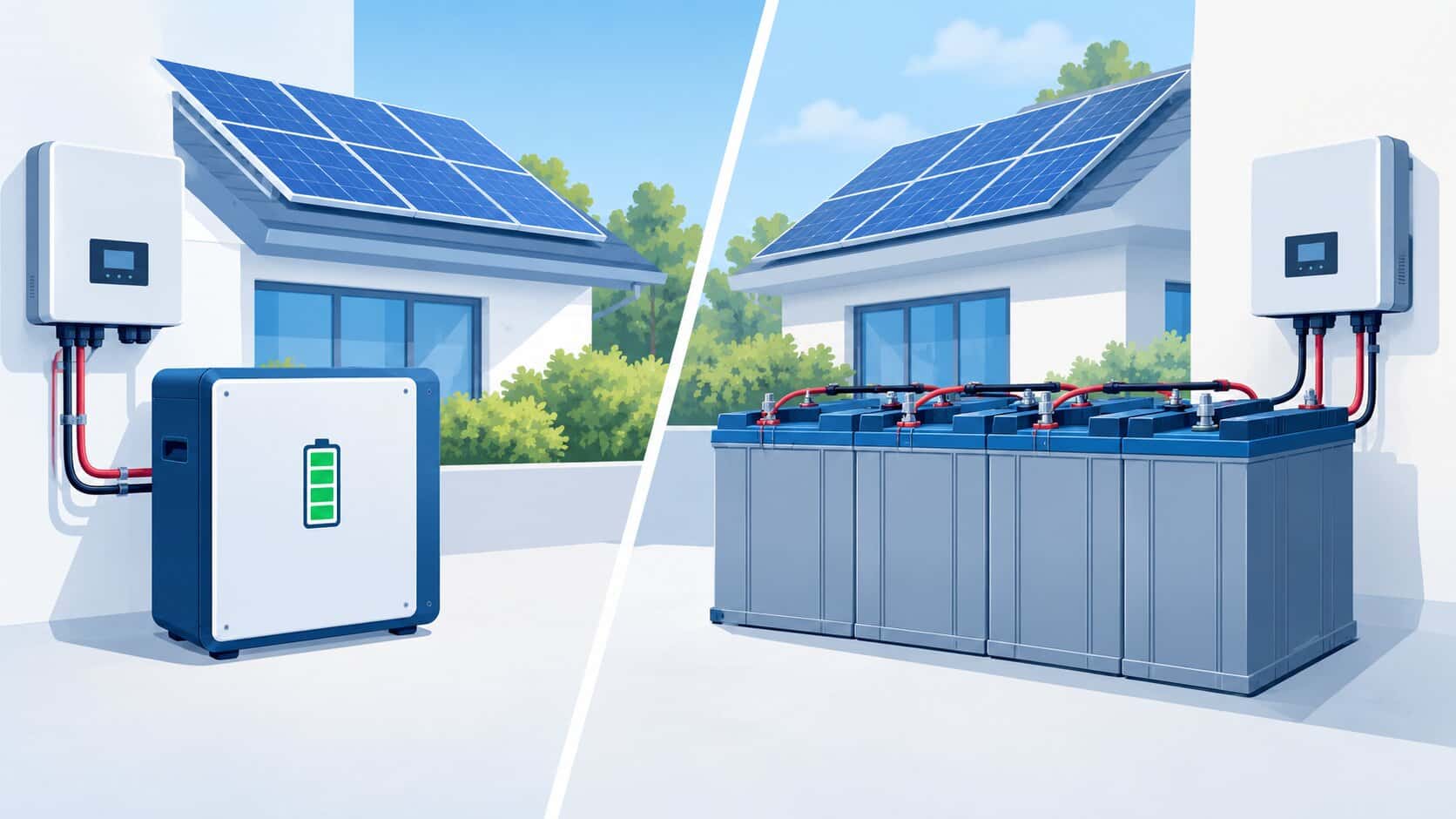
Both battery types store solar energy for later use. The chemistry, construction and battery-management requirements are what create the practical differences.
Lead-acid remains useful where low upfront cost, simple technology or occasional backup is the priority. LiFePO4 has become popular for frequent solar cycling because it combines high cycle life with a high usable-energy fraction and relatively low maintenance.
Exact specifications vary by manufacturer and model, so the figures below should be treated as typical comparison ranges rather than universal specifications.
| Characteristic | Lithium (LiFePO4) | Lead-Acid (Flooded/AGM) |
|---|---|---|
| Typical cycle-life range | Often about 2,000–6,000 cycles | Often about 300–1,000 cycles |
| Common daily DoD range | Often around 80–95% | Often around 50% for conservative daily use |
| Typical round-trip efficiency | About 90–95% | About 75–85% |
| Energy density | Higher; usually a smaller and lighter bank for the same usable energy | Lower; usually a larger and heavier bank |
| Maintenance | Low; BMS handles cell protection | Flooded types require watering and terminal care; AGM generally needs less routine maintenance |
| Cold-weather behavior | Capacity falls in cold; charging below 0°C commonly requires manufacturer-approved protection/heating | Available capacity also falls in cold and charging performance changes with temperature |
How Long Does Each Battery Last in a Solar System?
Cycle life is the number of specified charge/discharge cycles a battery can complete before its capacity falls to the manufacturer’s stated end-of-life threshold. It is not the same thing as a guaranteed calendar lifespan.
For example, 3,650 equivalent full cycles represents one equivalent full cycle per day for 10 years. A lead-acid battery with a 500-cycle rating would reach that cycle count in about 1.37 years if it really completed one equivalent full cycle every day. Actual field life can be shorter or longer because manufacturers use different test conditions and end-of-life criteria.
Temperature also matters. Elevated temperatures generally accelerate degradation in both chemistries. Use the battery manufacturer’s temperature limits and installation guidance instead of applying one universal temperature-to-life rule.
How Much Usable Capacity Do You Really Get?
A 400Ah lead-acid battery is not normally treated as 400Ah of daily usable capacity if you want to protect service life. At a 50% DoD assumption, about 200Ah is available before reaching the planned discharge limit. The correct DoD depends on the battery model and the manufacturer’s recommendations.
Consider a 24 kWh usable-energy requirement on a 48V system:
- Required usable capacity: 24,000 Wh ÷ 48 V = 500 Ah.
- Lithium at 85% DoD: 500 Ah ÷ 0.85 = about 588 Ah. A 600 Ah bank provides a small sizing margin.
- Lead-acid at 50% DoD: 500 Ah ÷ 0.50 = 1,000 Ah of nominal bank capacity.
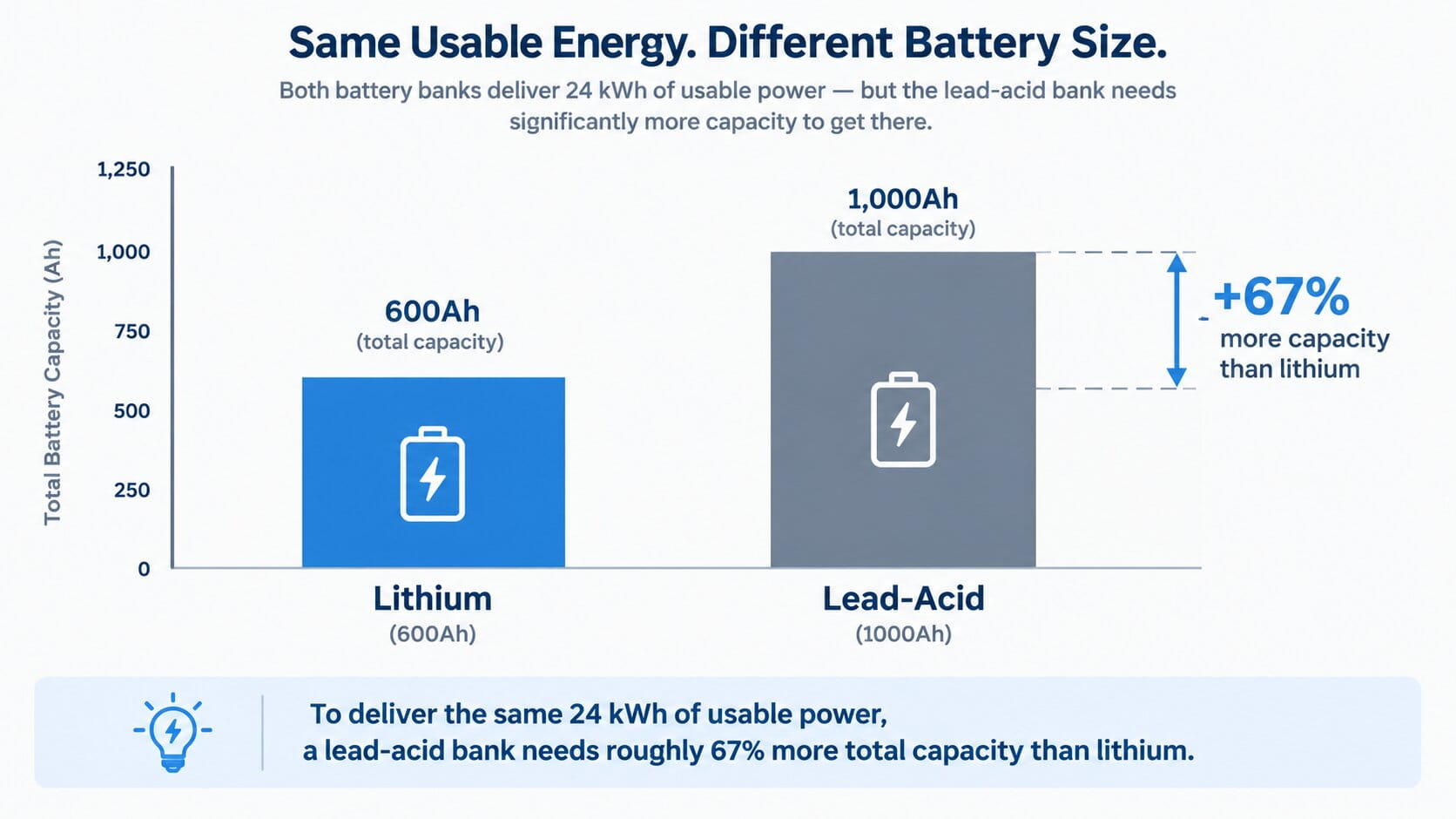
In this simplified example, the 1,000Ah lead-acid bank has about 67% more nominal capacity than the 600Ah lithium bank. The actual bank you need should also account for inverter efficiency, cable losses, temperature, battery age, peak load and the manufacturer’s operating limits.
Use Solvebility’s Battery Sizing Calculator to calculate battery-bank requirements from your load, backup hours, system voltage and selected battery chemistry.
Which Battery Charges Faster and Wastes Less Energy?
Round-trip efficiency describes how much energy you get back compared with the energy stored. A battery with 80% round-trip efficiency returns roughly 80 units for every 100 units stored, before considering other system losses.
| Metric | Lithium (LiFePO4) | Lead-Acid |
|---|---|---|
| Typical round-trip efficiency | About 90–95% | About 75–85% |
| Charging profile | Generally accepts higher current through much of the charge | Charge current typically tapers as the battery approaches full charge |
| Full-charge time | Can be relatively short with an appropriately sized charger | Often longer, especially because the final stage tapers |
| Solar-system impact | Less stored energy is lost during a charge/discharge cycle | More energy can be lost as charging and conversion losses |
Do not select a charger solely from a generic chemistry label. Match charge voltage, current, temperature limits and battery-management requirements to the exact battery model and inverter/charger.
What Does Each Battery Cost Over 10 Years?
Battery cost comparisons are highly market-dependent. Brand, chemistry, usable capacity, BMS, enclosure, installation, inverter compatibility, shipping and local labor can materially change the final price. For that reason, avoid treating one dollar-per-kWh figure as a universal market price.
| Cost factor | Lithium (LiFePO4) | Lead-Acid |
|---|---|---|
| Upfront battery cost | Usually higher | Usually lower |
| Replacement risk under daily cycling | Generally lower when correctly sized and operated | Generally higher |
| Maintenance | Low | Higher for flooded batteries |
| Energy lost in cycling | Generally lower | Generally higher |
| Long-term cost | Can be favorable for frequent cycling | Can be favorable for low-cycle/occasional backup |
For occasional backup, the economics can change substantially because the battery may complete far fewer cycles. For daily off-grid cycling, replacement frequency and usable capacity become much more important than the initial purchase price alone.
Which Battery Should You Pick for Your Solar System?
- Off-grid, daily cycling: LiFePO4 is often the stronger fit because of its cycle-life and usable-capacity advantages.
- Weekend cabin or occasional backup: Lead-acid can be reasonable when cycles are infrequent and the battery is operated within its recommended DoD.
- Limited installation space: Lithium’s higher energy density can reduce the physical footprint.
- Cold climate: Compare the exact temperature specifications of both battery models. LiFePO4 batteries commonly need charging protection or heating below freezing.
- Strict upfront budget: Lead-acid may offer the lower initial purchase price, but budget for future replacement and maintenance.
Frequently Asked Questions
What is a lithium solar battery?
A lithium solar battery used in many home energy systems is commonly based on LiFePO4 chemistry. It generally offers longer cycle life, deeper usable discharge and higher round-trip efficiency than lead-acid, at a higher upfront price.
How does depth of discharge affect battery life?
Using a battery deeper than its recommended depth of discharge can accelerate degradation. Lead-acid systems are commonly designed around shallower daily discharge than LiFePO4 systems, but the exact limits depend on the battery manufacturer and operating conditions.
Why are lithium batteries popular for off-grid solar systems?
Off-grid systems often cycle their batteries daily. LiFePO4 batteries generally provide high cycle life, deeper usable capacity and high efficiency, making them well suited to frequent cycling when their higher initial cost fits the project.
When is lead-acid still a good choice?
Lead-acid can still make sense for occasional backup, low-cycle applications or projects where the lowest upfront battery cost is the main priority.
How much does a lithium solar battery cost?
Pricing varies substantially by chemistry, brand, usable capacity, BMS, inverter compatibility, installation and market. A per-kWh figure should therefore be treated as an illustrative estimate rather than a universal price.
How do lithium and lead-acid batteries perform in cold weather?
Both chemistries lose available capacity as temperature falls. LiFePO4 batteries also commonly restrict charging below 0°C unless they include suitable low-temperature heating or charging protection. Always follow the manufacturer’s temperature limits.
Is lithium worth the extra upfront cost?
For frequent daily cycling, lithium is often attractive because its cycle life, usable capacity and efficiency can reduce replacement and energy losses. For occasional backup, lead-acid may remain economically reasonable.
Can I mix lithium and lead-acid batteries in one bank?
Do not combine lithium and lead-acid batteries in the same bank unless the equipment manufacturer explicitly supports that configuration. Their charging requirements and battery-management behavior differ.
The Bottom Line
Lithium usually wins on cycle life, usable capacity, efficiency, size and maintenance. Lead-acid usually wins on upfront price and remains useful for low-cycle or occasional-backup applications. For a battery bank that will be cycled frequently for years, compare total ownership cost rather than purchase price alone.
Before buying, run your load and backup hours through the Battery Sizing Calculator to compare the required Ah and kWh for each chemistry.

Nouman Ahmed, a Civil Engineer with practical experience in solar energy system design, engineering calculations, electrical systems, and engineering software development. Since 2011, he has been involved in residential and commercial solar energy projects, helping design practical PV solutions and technical calculation tools.
Nouman is the founder of Solvebility, an engineering resource dedicated to publishing accurate, transparent, and easy-to-use online calculators covering renewable energy, electrical engineering, construction, mathematics, finance, health, and other technical disciplines.