

Generator Sizing Calculator: A Field-Tested Load, Fuel and Derating Guide
A wrongly sized standby generator shows up the first time you actually need it, not at the showroom. Here’s the load math, fuel logic, and derating rules that keep it from happening to you.
1. Site & Region
2. Mode A — Quick Total Load
3. Mode B — Detailed Appliance Entry
| Category | Appliance | Qty | Watts (per unit) | Voltage | Surge × | Total (W) |
|---|
Charts
Results
Warnings & Suggestions
Fuel Consumption & Cost Estimator
An undersized generator doesn’t fail quietly. It fails the moment the air conditioner compressor kicks on, dragging the whole panel into a brownout while the unit strains against a surge it was never built to carry. That’s the scenario field electricians get called out for more than any other backup power complaint, and it’s almost always traceable to one thing: someone picked a kW or kVA number off a shelf tag instead of running the load math.
This guide walks through the same methodology a licensed electrician would use to size standby or portable power for a home, a jobsite, or a small facility. You’ll get the load calculation sequence, real appliance wattage and surge data, fuel runtime math by fuel type, the single-phase versus three-phase decision, and the altitude and temperature derating factors that manufacturers rate their units without. There’s also a load-assessment checklist built into this page so you can run rough numbers as you read. If you’re weighing generator power against a solar-plus-battery setup instead, Solvebility’s full energy calculator library covers that comparison too.
Why Most Generator Sizing Estimates Fail Before Installation
Nameplate wattage tells you what a device draws once it’s running steady. It says nothing about the 2 to 6 times spike that motors, compressors, and pumps pull for the first half-second to few seconds of startup. A homeowner who adds up nameplate numbers for a refrigerator, a well pump, and a central air unit will consistently land 25 to 45 percent below what the panel actually demands the instant two of those motors overlap.
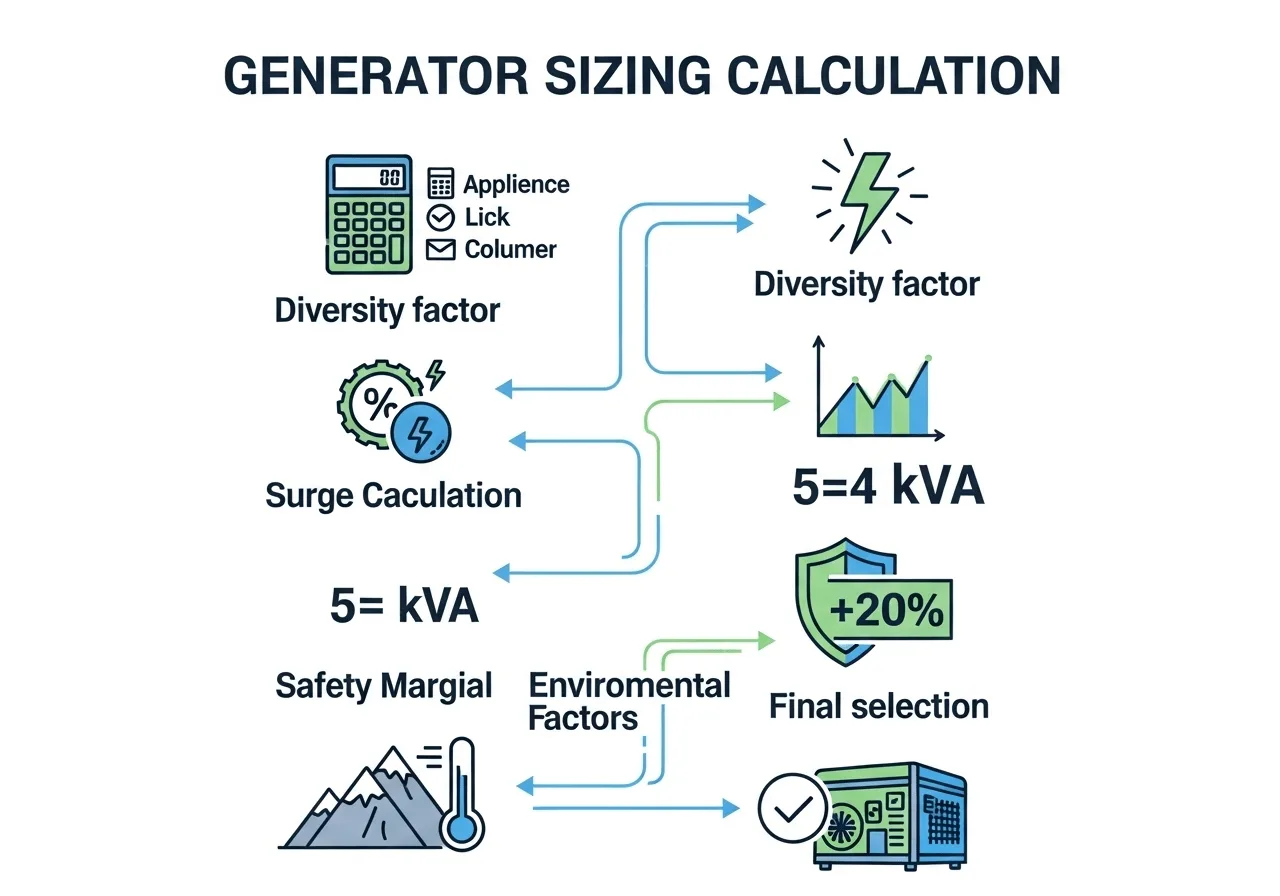
The second habit is treating diversity factor as an afterthought instead of a deliberate design input. Not every circuit runs at once, and a generator sized for 100 percent simultaneous use is typically oversized by 15 to 30 percent for a residential property, which wastes fuel and money without buying any real protection.
The third habit, skipping a capacity buffer, shows up two years later when a homeowner adds a hot tub, a second freezer, or an EV charger and finds the existing generator has zero headroom. A 20 percent margin above calculated peak demand is the industry-standard fix, and it costs far less to build in upfront than to re-size after installation.
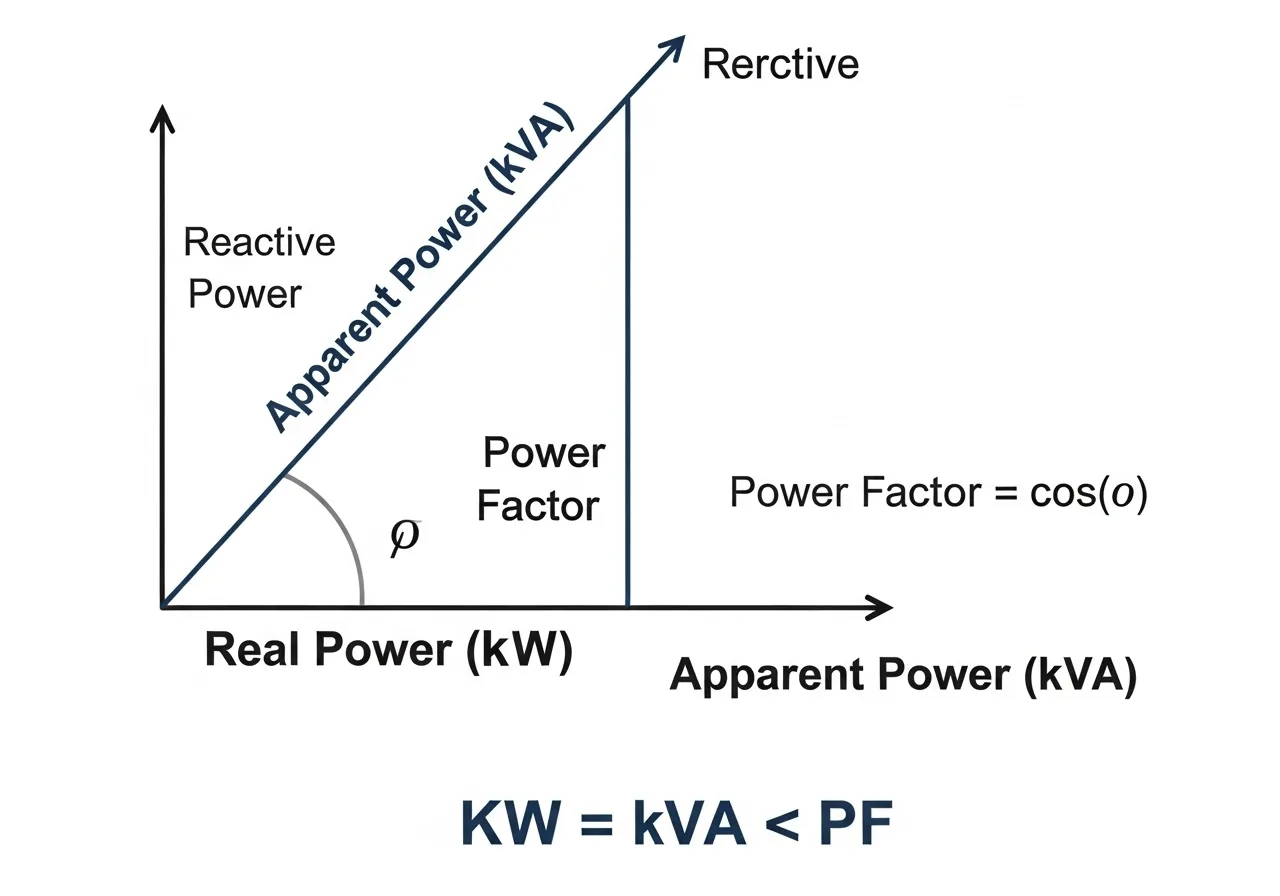
kW and kVA Are Not Interchangeable
A generator’s nameplate rating is almost always in kVA, apparent power, while your appliances draw kW, real power. The two connect through power factor (PF): kW = kVA × PF. A 20 kVA generator at a 0.85 power factor delivers 17 kW of usable output, not 20. Confusing the two ratings is the single most common paperwork error in generator specification, and it typically understates real capacity by 10 to 15 percent.
| Region | Typical PF | Standard Voltage | Frequency |
|---|---|---|---|
| United States | 0.80–0.85 | 120/240V | 60 Hz |
| Canada | 0.80–0.85 | 120/240V | 60 Hz |
| Australia | 0.85–0.90 | 230/400V | 50 Hz |
| United Kingdom | 0.85–0.90 | 230/400V | 50 Hz |
| European Union | 0.88–0.92 | 230/400V | 50 Hz |
How Do You Calculate the Load a Generator Needs to Carry?
Field sizing follows a fixed sequence. Skipping a step, or doing them out of order, is where most DIY calculations go wrong.
Step 1: Total Connected Load
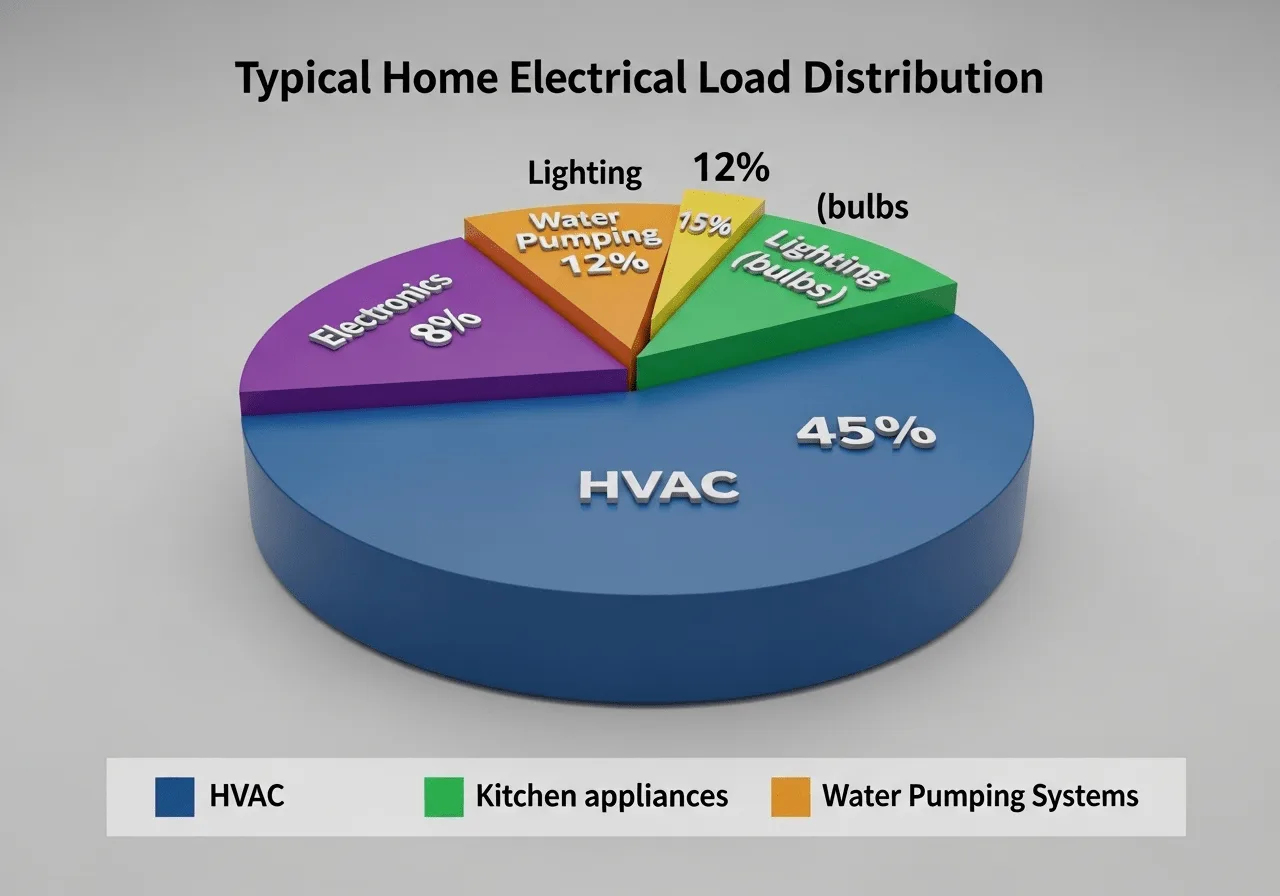
List every appliance you want the generator to carry and record its running wattage from the nameplate. For a mid-size home this typically totals 6,000 to 11,000 watts before any adjustment.
| Appliance | Running Watts | Typical Qty (home) |
|---|---|---|
| LED lighting circuit | 8–15 W each | 15–25 |
| Refrigerator/freezer | 150–400 W | 1–2 |
| Central AC (3-ton) | 3,200–4,500 W | 1 |
| Well pump (1 HP) | 750–1,500 W | 1 |
| Microwave oven | 1,000–1,300 W | 1 |
| Washing machine | 500–1,200 W | 1 |
| Sump pump | 800–1,050 W | 1 |
| Furnace blower fan | 500–800 W | 1 |
| Desktop workstation | 250–400 W | 1–3 |
Step 2: Apply a Diversity Factor
Diversity factor accounts for the fact that a household never runs every circuit at full draw simultaneously. Residential properties typically run 65 to 80 percent diversity, small commercial sites run 75 to 90 percent, and industrial facilities with continuous processes run 85 to 95 percent because so little of their load is discretionary.
Step 3: Add the Largest Starting Surge, Not All of Them
This is the step most DIY calculations get backward. You do not sum every motor’s starting surge, because in normal operation only one large motor starts at a time while everything else is already running steady. Identify the single largest surge in your load list and add that figure, and only that figure, to your diversity-adjusted continuous load.
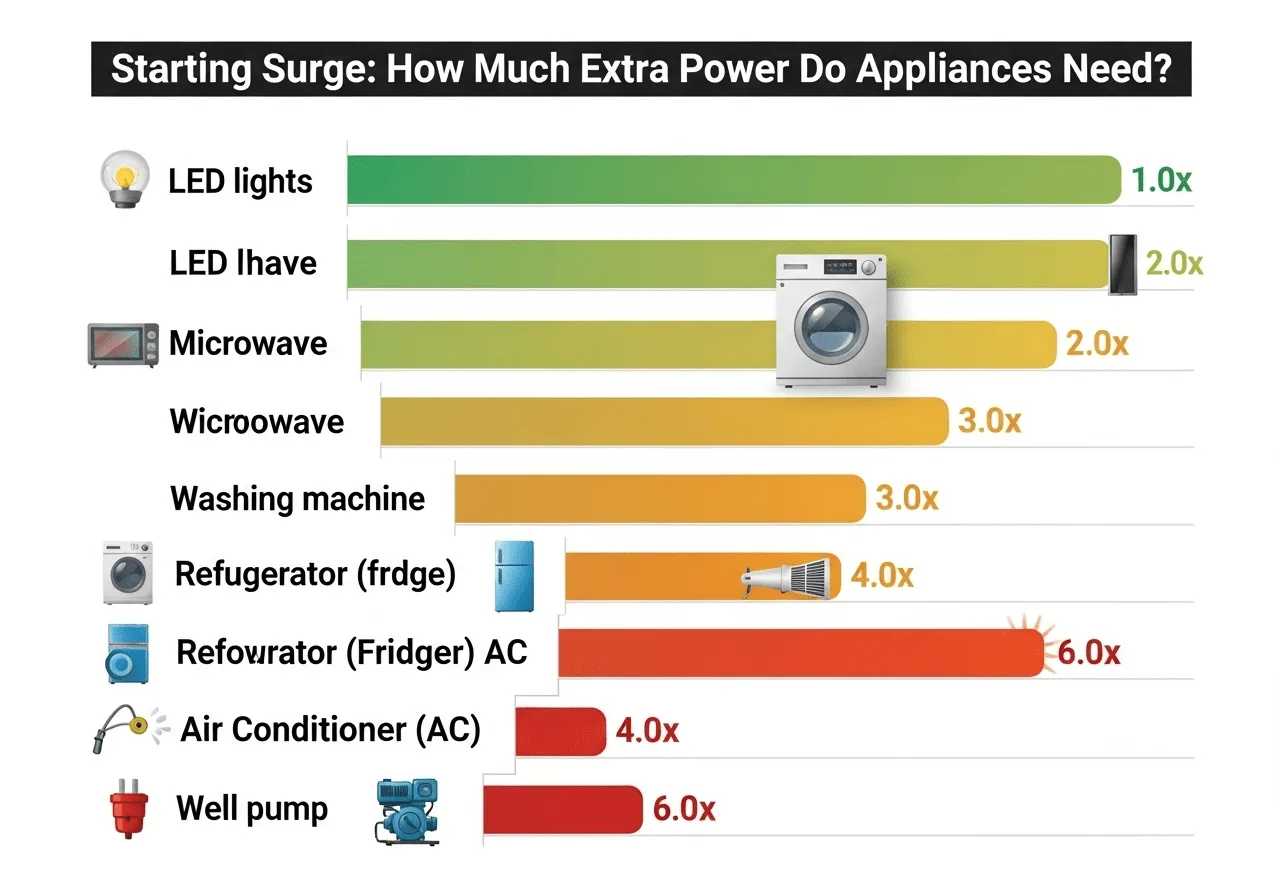
| Appliance Type | Surge Multiplier |
|---|---|
| LED / incandescent lighting | 1.0× |
| Microwave oven | 1.0–1.3× |
| Refrigerator / freezer | 2.5–3.0× |
| Washing machine | 2.0–3.0× |
| Central air conditioner | 3.0–5.0× |
| Sump / submersible pump | 3.0–5.0× |
| Well pump (1 HP) | 4.0–6.0× |
| Single-phase motor (1 HP, general) | 5.0–7.0× |
Step 4: Convert to kVA and Add the Safety Margin
Divide your combined peak demand (diversity-adjusted continuous load plus largest surge) by the assumed power factor to get required kVA, then multiply by 1.20 for the standard 20 percent buffer. A property with a 16,200 W combined peak at a 0.85 power factor needs roughly 19.1 kVA before the buffer, and about 22.9 kVA after it. That rounds up to the next standard rating, commonly 25 kVA in North America.
Pro tip
Standard generator sizes are not continuous. North American residential and commercial units typically step through 6, 8, 10, 12.5, 15, 20, 25, 30, 45, 60, 80, and 100 kVA. Calculating a precise 22.9 kVA requirement doesn’t mean a custom unit exists at that number; it means the next size up, 25 kVA, is your answer.
Which Fuel Type Delivers the Best Runtime for Your Duty Cycle?
Sizing and fuel selection are separate decisions, but they interact directly through runtime cost. A correctly sized generator running at 50 to 80 percent load burns fuel efficiently; the same unit running at 20 percent load, because it’s oversized, wastes 30 percent or more of its fuel budget on inefficient partial-load combustion.
| Fuel | Consumption Rate | Typical Engine Life | Best Fit |
|---|---|---|---|
| Diesel | 0.24–0.28 L/kWh | 12,000–30,000 hrs | Commercial, industrial, long-term off-grid |
| Gasoline | 0.35–0.40 L/kWh | 5,000–10,000 hrs | Portable, occasional residential backup |
| Natural gas | 0.28–0.34 m³/kWh | 15,000–25,000 hrs | Permanent standby with gas utility service |
| LPG / propane | 0.30–0.35 kg/kWh | 10,000–20,000 hrs | Rural sites, long-term fuel storage |
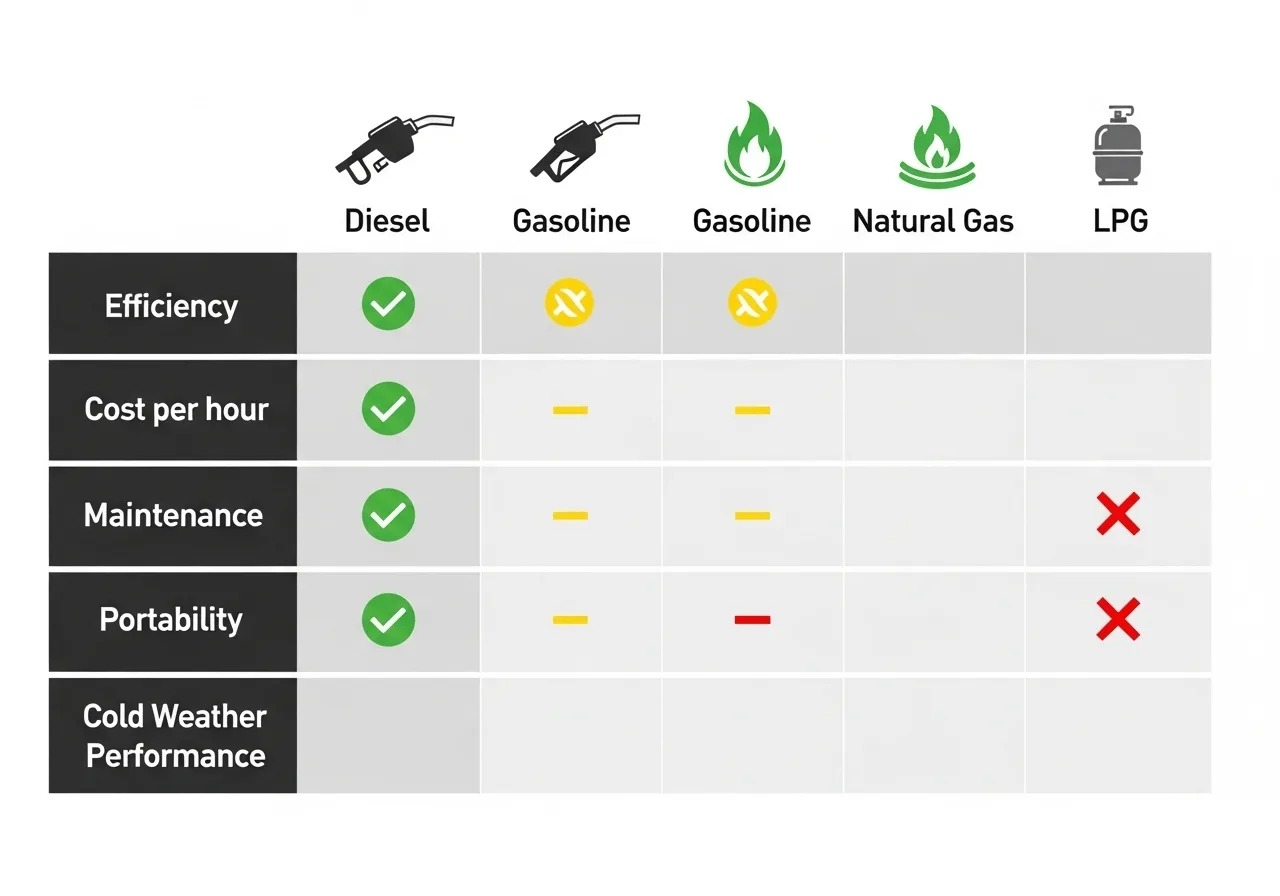
Runtime math follows a simple relationship: Fuel Use (per hour) = Generator Output (kW) × Fuel Rate × Load Factor. A 25 kVA diesel unit running a 15 kW load, roughly 60 percent utilization, at 0.26 L/kWh burns close to 3.9 liters per hour. Over a 72-hour outage, a common design target for residential standby, that’s approximately 281 liters, worth budgeting for before you finalize a fuel tank size. For a full hour-by-hour breakdown at your specific load and price, run the numbers through Solvebility’s generator fuel cost calculator.
Sizing the Fuel Tank to the Generator, Not the Other Way Around
Once you know your target runtime, typically 24, 48, or 72 hours for residential standby, and your expected load factor, tank sizing becomes straightforward multiplication. Undersized tanks force refueling during the outage they’re meant to cover, which is the second most common installation complaint after undersized generators themselves. The generator runtime calculator handles this step directly, including elevation and ambient temperature adjustments and support for auxiliary tanks.
Single-Phase or Three-Phase: Which One Matches Your Panel?
Phase configuration changes the sizing formula entirely, so getting this wrong upstream invalidates every calculation that follows. Single-phase kVA is simply voltage times current divided by 1,000. Three-phase kVA brings in the square root of 3: kVA = (√3 × V × I) ÷ 1,000. For a 400V three-phase system pulling 80 amps, that works out to roughly 55.4 kVA, not the 32 kVA a single-phase formula would incorrectly suggest. If your panel is wye or delta three-phase, verify line versus phase voltage first with Solvebility’s 3-phase power calculator before finalizing a generator spec.
Where Three-Phase Becomes Necessary
Three-phase power delivers smoother torque for large motors and reduces conductor sizing for a given load, which is why it dominates commercial and industrial installations. Homes rarely need it unless they run equipment like large workshop machinery, agricultural pumps, or a sizeable heat pump system originally specified for three-phase service. Verify your incoming utility service type before sizing; retrofitting three-phase service to a single-phase property is a utility-level project, not a generator swap.
Common error
Applying a single-phase formula to a three-phase load understates required capacity by roughly 42 percent (the difference introduced by the √3 factor). That gap is large enough to leave a “correctly calculated” generator unable to start a single large motor.
How Much Capacity Does Altitude and Heat Really Take Away?
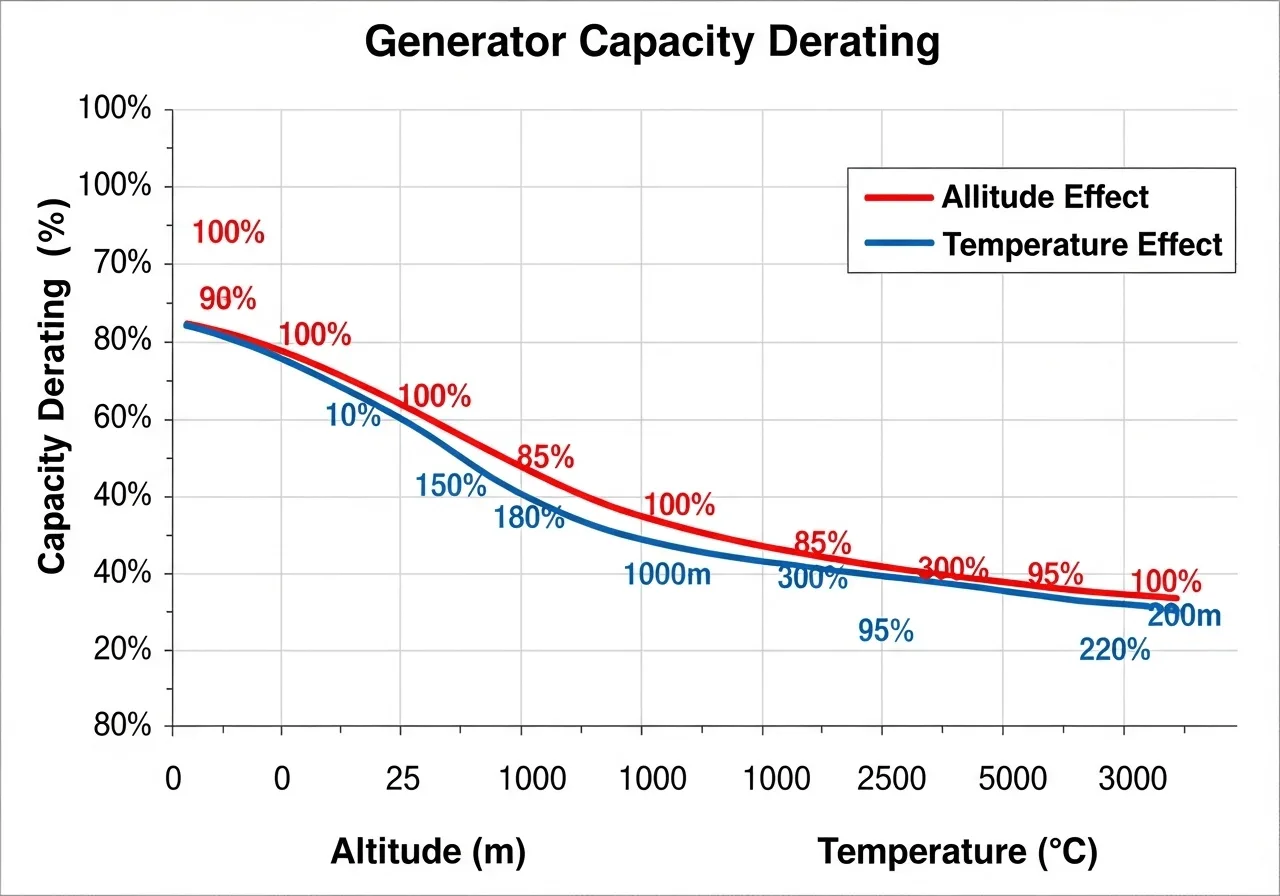
Manufacturer nameplate ratings are almost always measured at sea level and 25°C. Thinner air at elevation means less oxygen per combustion cycle, and hot intake air is less dense, so both reduce the engine’s real power output even though the generator’s electrical rating hasn’t physically changed.
Worked Example
Take a generator sized at 26.4 kVA before environmental adjustment, installed at 900 meters elevation with a 35°C summer design temperature.
- Altitude derate: roughly 2.5% × (900−150)/300 ≈ 6.3% loss, leaving a 0.937 factor
- Temperature derate: roughly 1% × (35−25)/5.5 ≈ 1.8% loss, leaving a 0.982 factor
- Combined factor: 0.937 × 0.982 ≈ 0.920
Effective capacity: 26.4 kVA × 0.920 ≈ 24.3 kVA, which is roughly 8 percent below the nameplate figure. If 24.3 kVA no longer clears your calculated requirement with margin, you need to step up to the next standard size rather than accept the shortfall on a hot afternoon.
Cold-Weather Considerations
Cold climates create a different problem: diesel units can struggle to start below roughly −15°C without a block heater, and battery cranking capacity drops noticeably in freezing conditions. A 5 to 10 percent capacity buffer is a reasonable allowance for sites with regular sub-zero starts, on top of the standard 20 percent margin.
Quick Load Assessment Checklist
This isn’t a replacement for a full engineering calculation. It’s a fast, editable reference to sanity-check a rough generator class before you commit to a detailed spec. Check the categories that apply, adjust wattage and quantity to match your actual equipment, and the tool sums your load and flags a class band in real time.
Load Assessment & Generator Class Checklist
Toggle categories, edit watts and quantity, set your diversity factor, and read the recommended class instantly.
Live Results
Related tools
Running a generator alongside solar and storage instead of as the sole backup source changes the sizing math. Check expected runtime with the battery backup duration calculator, or model a full hybrid setup with the hybrid solar system planner before committing to a generator-only design.
Final Sizing Checklist and Certification Standards to Verify
A calculated kVA number is only half the job. Before an installation is complete, confirm it against the standards your jurisdiction actually enforces, since a correctly sized generator installed against the wrong code is still a failed inspection.
- North America: Verify UL 2200 listing for the generator set and NFPA 70 (NEC) Article 702 compliance for standby system installation. Canadian installations reference CSA C22.1.
- Australia / New Zealand: Confirm compliance with AS/NZS 3000 wiring rules and, for standby performance ratings, ISO 8528.
- United Kingdom: Confirm compliance with BS 7671 (IET Wiring Regulations) for the connection and transfer switch installation.
- European Union: Confirm compliance with IEC 60364 and, where applicable, national standards such as VDE in Germany.
Before you sign off
Confirm five things: total connected load with nameplate data, diversity factor appropriate to occupancy type, largest single starting surge (not summed), environmental derating for your site’s elevation and design temperature, and a minimum 20 percent capacity buffer. Every one of those inputs should be documented, not estimated on-site.
Generator sizing rewards precision more than it rewards a bigger number. An oversized unit running at 15 to 25 percent load for most of an outage suffers from incomplete combustion, carbon buildup, and, in diesel units, wet stacking, all of which shorten service life and raise maintenance cost. The goal is a unit that spends most of its runtime in the 50 to 80 percent load band, sized with enough headroom to survive the single worst-case motor start on your panel.
Run your numbers through the load calculation methodology above, sanity-check them against the checklist tool on this page, and verify the result against your regional wiring code before ordering equipment. That sequence, in that order, is what separates a generator that performs on the worst night of the year from one that trips a breaker the first time the compressor kicks on.
Frequently Asked Questions
What size generator do I need for a typical home?
Most single-family homes in the 1,800 to 2,800 square foot range land between 12 kVA and 26 kVA once starting surge and a 20 percent safety margin are included. Homes with a 3-ton or larger central air conditioner or a submersible well pump usually sit at the upper end of that range.
How do you convert kW to kVA for a generator?
Divide the real power in kW by the power factor to get kVA. A load of 18 kW at a 0.85 power factor requires a generator rated at roughly 21.2 kVA, since kVA equals kW divided by power factor.
Is it bad to oversize a backup generator?
Yes. Running a generator below 30 percent of its rated capacity for extended periods causes wet stacking in diesel units and incomplete combustion in gasoline units, which shortens engine life. The efficient operating band for most units sits between 50 and 80 percent of rated load.
What happens if a generator is undersized?
An undersized generator overloads under starting surge, which causes voltage sag, frequency drop, nuisance breaker trips, and in repeated cases, winding damage. A 20 percent capacity buffer above your calculated peak demand prevents most of these failures.
Do I need a three-phase generator for my property?
Three-phase generators are needed when the connected equipment, such as large HVAC compressors, industrial motors above roughly 10 HP, or certain well pumps, is wired for three-phase service. Nearly all single-family residential panels in North America run on single-phase 120/240V service.
How much does altitude reduce generator output?
Naturally aspirated generators lose approximately 2.5 to 3 percent of rated capacity for every 300 meters (1,000 feet) of elevation above roughly 150 meters (500 feet). A generator rated at 30 kVA at sea level may deliver closer to 27 kVA at 1,500 meters elevation.
Which fuel type gives the longest generator runtime?
Diesel generators typically deliver the best fuel efficiency, consuming roughly 0.24 to 0.28 liters per kWh at 75 percent load, compared with 0.35 to 0.40 liters per kWh for gasoline units. Natural gas units trade some efficiency for unlimited runtime when connected to a utility line.
What certifications should a sized generator meet?
In North America, look for UL 2200 listing and compliance with NFPA 70 Article 702 for standby systems. In the UK and EU, confirm compliance with BS 7671 or the relevant national wiring regulation alongside ISO 8528 performance ratings.
For a full interactive calculation with region-specific presets, appliance database entry, and PDF export, use the detailed Generator Sizing Calculator on this page. The methodology above is the same logic that tool automates.
References and Related Standards
- NFPA 70 — National Electrical Code, Article 702 (Optional Standby Systems)
- IEC 60364 — Low-Voltage Electrical Installations
- CSA C22.1 — Canadian Electrical Code
- AS/NZS 3000:2018 — Australian/New Zealand Wiring Rules
- BS 7671 — IET Wiring Regulations (UK)
- IEEE Std 446 — Recommended Practice for Emergency and Standby Power Systems
- Solvebility — Generator Sizing Calculator methodology reference