

Backup Power Planning
Generator Runtime Calculator: How Long Will It Actually Run?
The tank rating on the box is a best-case number. Here’s the real math behind how long a generator runs, and how to get a number you can actually plan around.
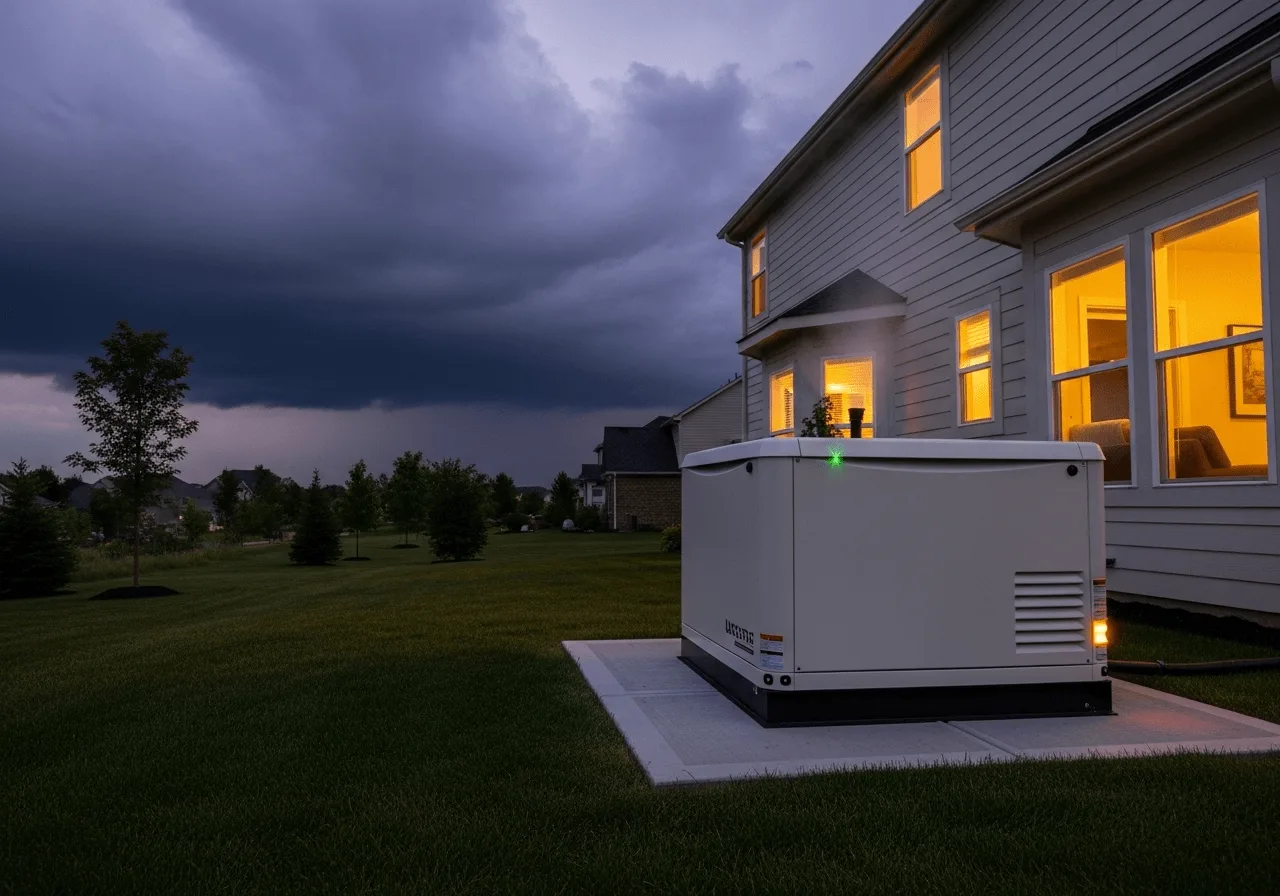
Picture this. The power’s out, the fridge is humming on backup, and the generator’s tank gauge says you’re good for eight hours. Four hours later, it sputters out.
That gap between the number on the spec sheet and the number in real life is the whole reason a runtime calculator exists. Manufacturers test fuel burn under one set of lab conditions. Your basement, your load, your weather, and your altitude are never those conditions.
This guide walks through the exact math the calculator above uses: load factor, fuel type, temperature, altitude, and tank size, all in one formula. By the end, you’ll be able to run these numbers yourself, on paper, for any generator you own or are shopping for.
What Is a Generator Runtime Calculator?
Quick answer: A generator runtime calculator estimates how many hours a generator will run on a given amount of fuel, based on your specific load, fuel type, tank size, and environmental conditions. It’s more accurate than the runtime printed on the box, because that number assumes a fixed 50% load in ideal weather at sea level.
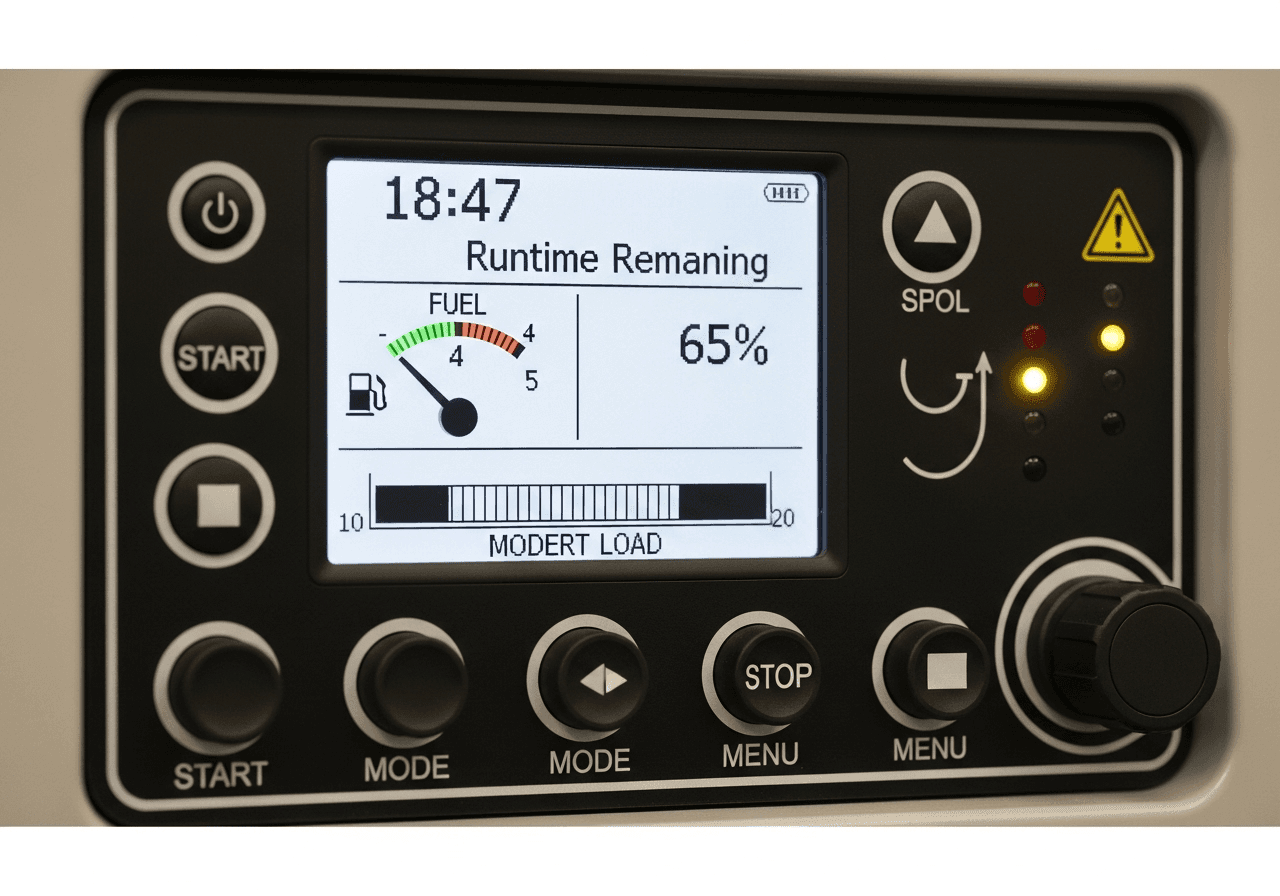
Think of the box rating as an EPA fuel economy sticker on a car. It’s produced under controlled test conditions so buyers can compare models fairly. It’s not a promise about your commute.
A generator’s true runtime depends on how hard it’s working (load), what it burns (fuel type), how cold or high up it is (environment), and how much fuel it’s holding right now (tank state). Change any one of those and the hours change with it.
That’s the gap this tool closes. Instead of one static number, you get a runtime built from your actual setup. If you’re comparing a generator against other backup options, our full set of energy calculators covers everything from solar sizing to inverter capacity.
How Does a Generator Runtime Calculator Actually Work?
Quick answer: The calculator multiplies your generator’s rated fuel consumption by a load factor, then adjusts for fuel type, temperature, and altitude. The result is divided into your usable tank capacity to give you a runtime in hours.
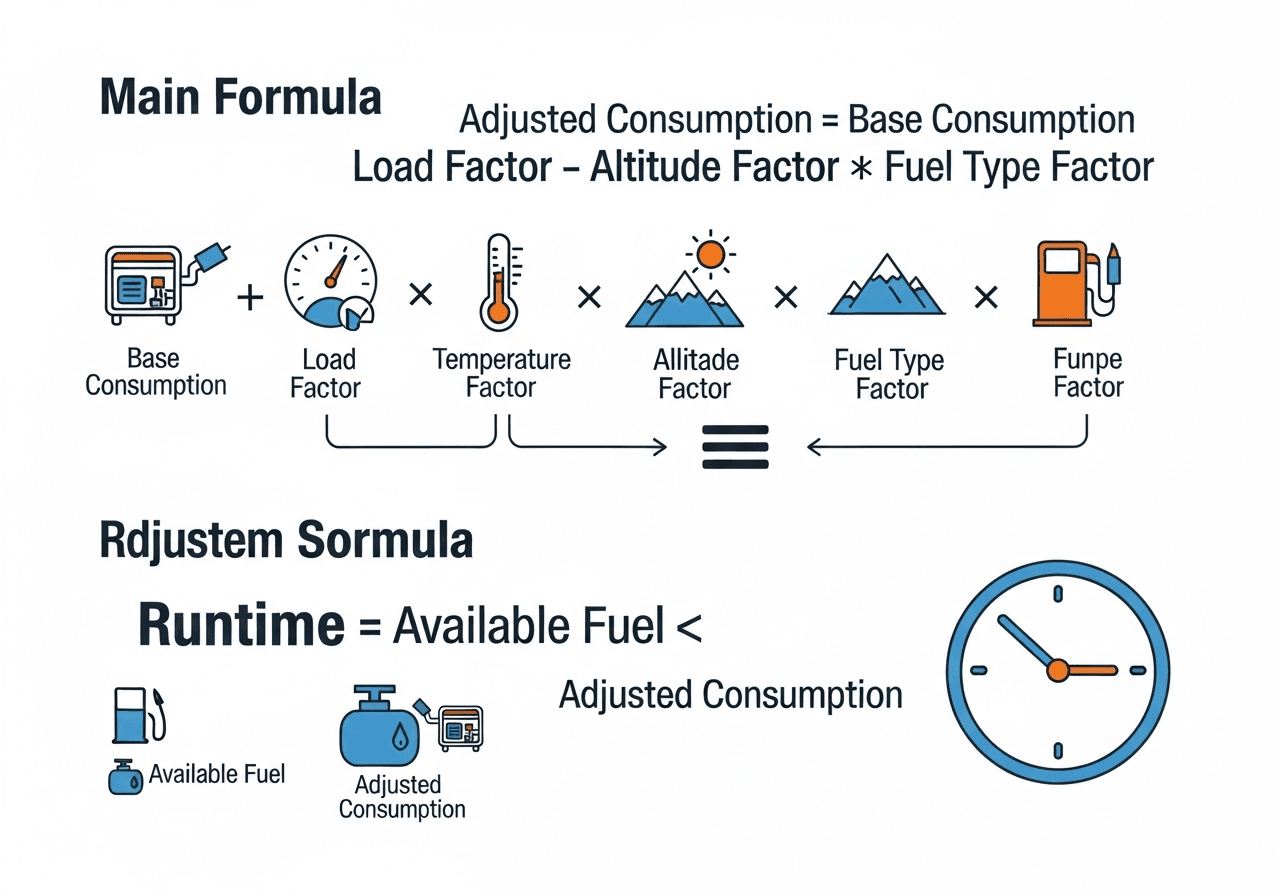
Here’s the core formula, stripped down:
Runtime (hours) = Usable Fuel (L or gal) ÷ Adjusted Consumption Rate (L/hr or gal/hr)
The work happens in that “adjusted consumption rate.” It’s built in four steps:
- Start with the rated burn rate. Every generator has a documented fuel consumption figure at 50%, 75%, and 100% load, usually in the owner’s manual.
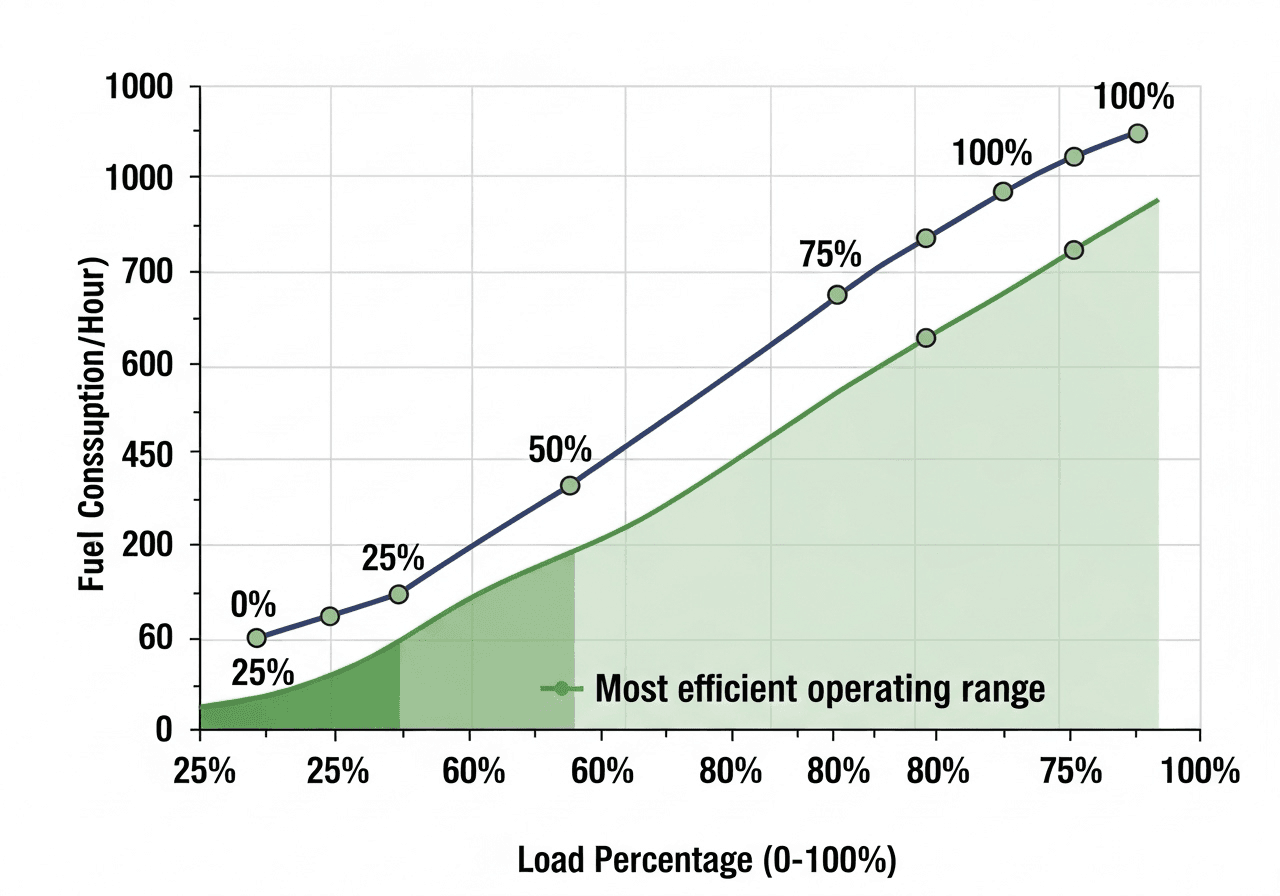
- Apply your real load factor. Fuel burn doesn’t scale in a straight line with load. A generator at 25% load doesn’t burn a quarter of its full-load rate; it burns closer to 35-40%, because the engine still has to overcome friction and idle losses regardless of output.
- Adjust for fuel type. Diesel packs roughly 15% more energy per liter than gasoline, so a diesel unit sipping the same volume runs measurably longer.
- Correct for temperature and altitude. Cold air is denser, so combustion needs more fuel to hit the same output. Thin air at altitude does the opposite: less oxygen means less power per stroke, so the engine works harder for the same load.
Once you’ve got the adjusted rate, divide it into how much fuel is actually usable, not the full tank size. Most manufacturers recommend keeping 5-10% in reserve so the fuel pickup never runs dry and pulls in sediment or air.
Generator Fuel Consumption by Load: The Real Numbers
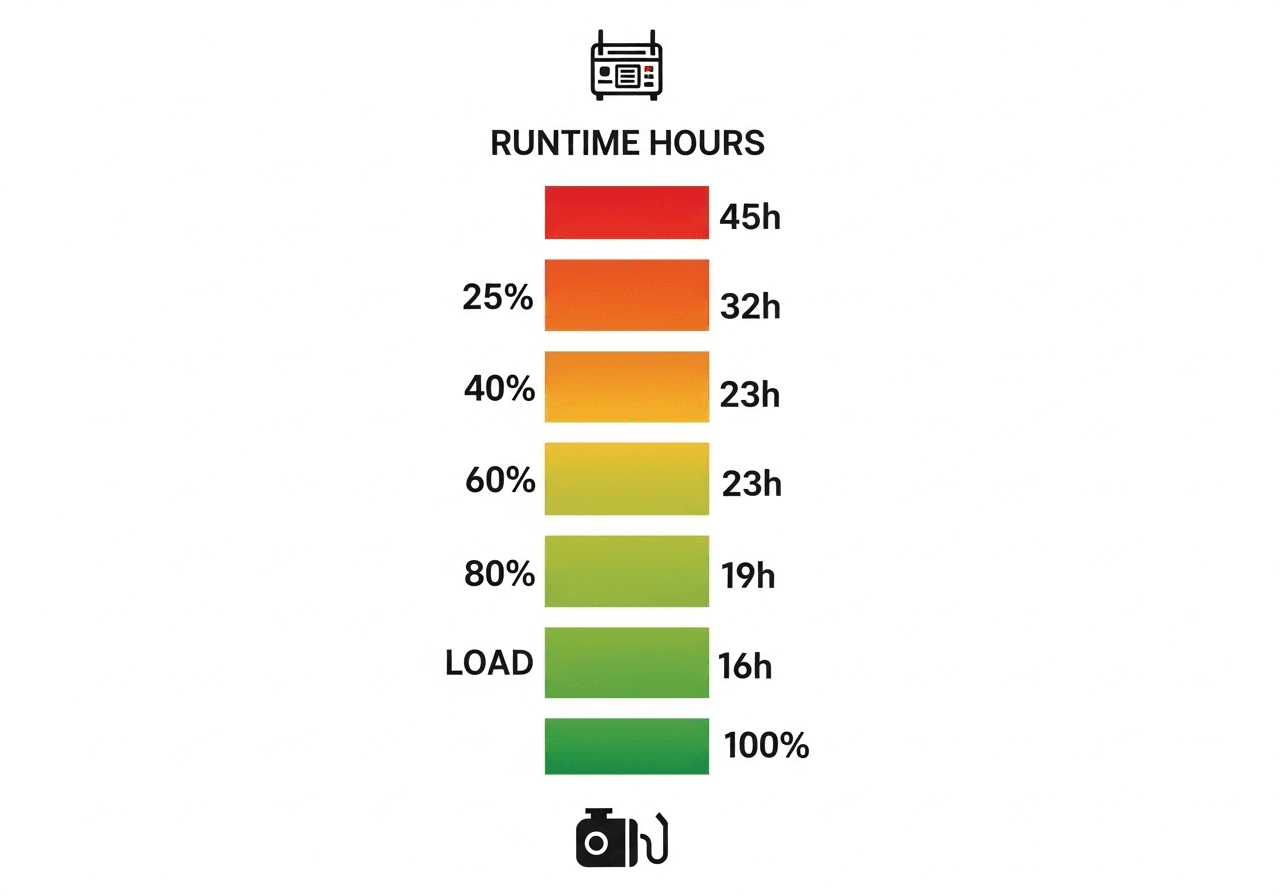
Load is the single biggest lever on runtime, and it’s the one most people get wrong. Running a generator at a light load feels efficient. It usually isn’t.
| Load level | Fuel burn rate | Estimated runtime |
|---|---|---|
| 25% load (light) | ~0.6 gal/hr (2.3 L/hr) | ~33 hours |
| 50% load (typical) | ~0.9 gal/hr (3.4 L/hr) | ~22 hours |
| 75% load (heavy) | ~1.3 gal/hr (4.9 L/hr) | ~15 hours |
| 100% load (rated max) | ~1.7 gal/hr (6.4 L/hr) | ~12 hours |
Pro tip: The sweet spot for most generators sits around 60-80% load. Below that, you’re burning disproportionate fuel per kWh delivered. Above it, you’re pushing the engine toward its thermal limit and shortening its service life.
Diesel vs. Gasoline vs. Propane vs. Natural Gas: Which Runs Longer?
Quick answer: Diesel generators run longest per gallon because diesel has the highest energy density of common generator fuels. Propane and natural gas burn cleaner but deliver less energy per unit, so runtime drops even though the equipment often lasts longer with less maintenance.
| Fuel type | Energy density | Runtime vs. gasoline baseline |
|---|---|---|
| Diesel | ~38.6 MJ/L | +15% to +20% longer |
| Gasoline | ~33.7 MJ/L | Baseline |
| Propane (LPG) | ~25.5 MJ/L | -25% to -30% shorter |
| Natural gas | Varies by supply pressure | Effectively unlimited if piped to the grid |
A diesel generator running a home through a storm will typically outlast a same-size gasoline unit on the same tank volume. That’s why standby diesel units dominate hospitals, data centers, and construction sites where a runtime calculator isn’t optional, it’s part of the emergency plan.
Propane and natural gas trade some runtime for stability. Propane doesn’t degrade in storage the way gasoline does, and a natural-gas unit tied into a home’s gas line effectively removes the “how much fuel is left” question entirely, since it draws straight from the utility supply.
If constant refueling isn’t appealing at all, it’s worth running the numbers on a battery bank instead of, or alongside, a fuel-burning generator. Our battery sizing calculator shows what a comparable Ah or kWh capacity looks like for the same load.
How Temperature and Altitude Change Your Runtime
These two variables get ignored constantly, and they shouldn’t be. Together they can swing a runtime estimate by 15-20% in either direction.
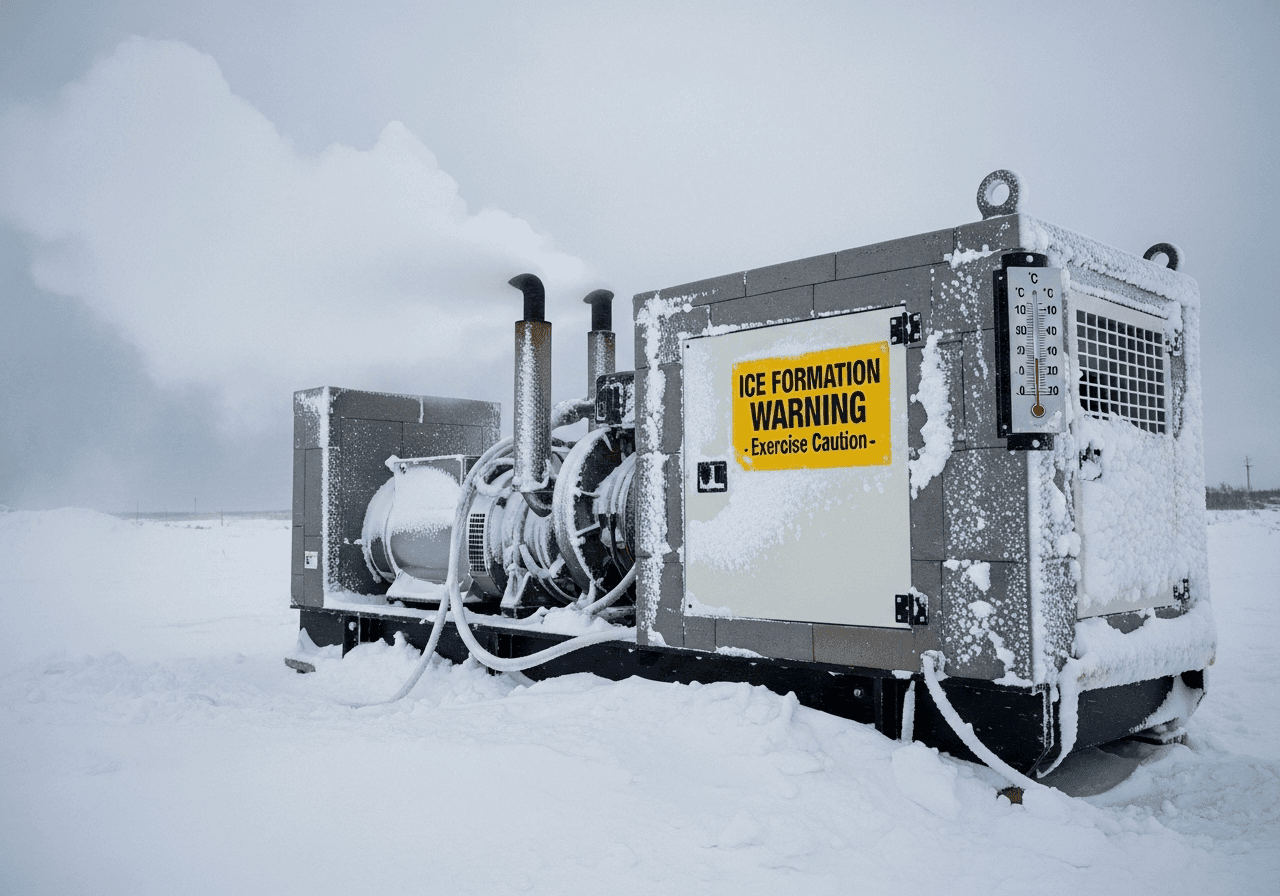
Cold weather thickens engine oil, forces richer fuel mixtures for reliable ignition, and increases the energy needed to heat the engine block before it reaches efficient operating temperature. Below freezing, expect fuel burn to run 10-15% above the rated figure.
Altitude works differently. Thinner air at elevation means less oxygen per combustion cycle, so a naturally aspirated engine loses roughly 3-4% of its power output for every 1,000 feet (300 m) above sea level. To hold the same load, the engine has to work harder, which increases fuel burn per kWh delivered even though total output stays the same.
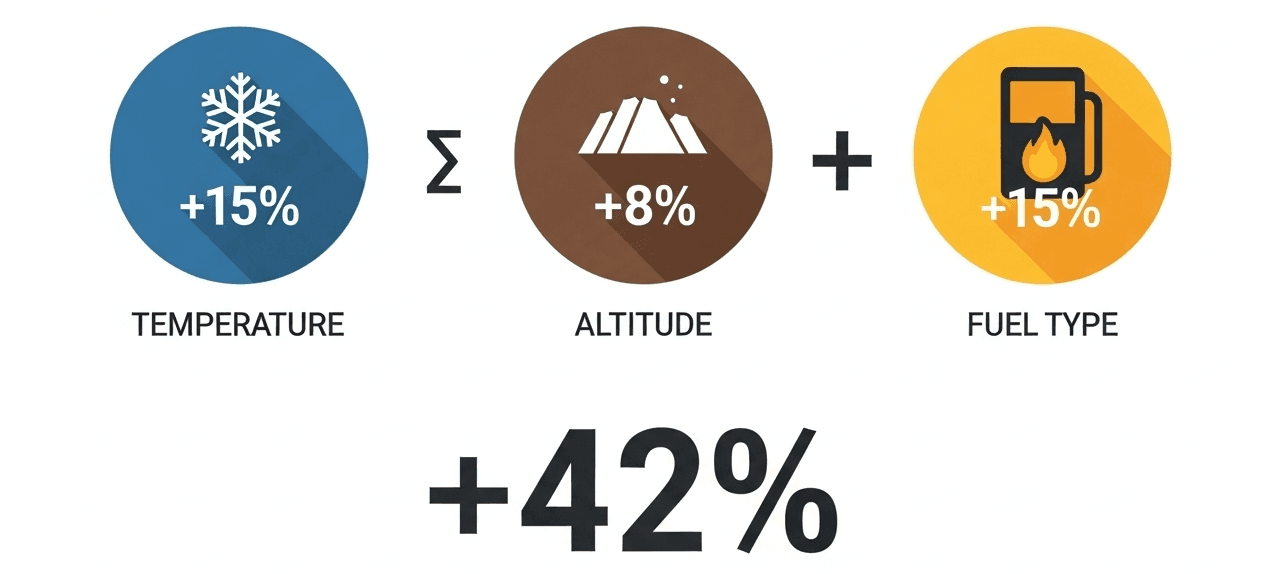
Pro tip: If you’re running a generator at a mountain cabin in winter, don’t just apply one correction. Stack both the cold-weather and altitude adjustments, then add a 10% safety margin on top before you trust the runtime number.
How to Calculate Generator Running Time by Hand
Here’s a worked example using a mid-size portable generator, so you can see every step before you ever touch the calculator above.
Scenario: A 7,500-watt gasoline generator, running a home at 60% load, in 5°C weather, at 500 m elevation, with a 6-gallon tank.
- Rated consumption at 50% load (from the manual): 0.6 gal/hr. At 60% load, apply the non-linear adjustment: roughly 0.68 gal/hr.
- Temperature correction for 5°C: add 5%. 0.68 × 1.05 = 0.71 gal/hr.
- Altitude correction for 500 m (about 1,640 ft): subtract roughly 1.6% power, which pushes fuel burn up about 2% to hold the same load. 0.71 × 1.02 = 0.72 gal/hr.
- Usable fuel: keep a 10% reserve on a 6-gallon tank, leaving 5.4 gallons usable.
- Runtime = 5.4 ÷ 0.72 = 7.5 hours.
Compare that to the “8-10 hours at 50% load” figure often printed on the box, and you can see how quickly real conditions eat into the advertised number. That 7.5-hour figure is the one worth planning a fuel schedule around.
What Does a Generator Actually Cost to Run?
Quick answer: At current fuel prices, a mid-size portable generator running at 50% load typically costs $3-6 USD per hour in gasoline or diesel, or roughly $1.50-3 per hour on propane. Multiply your hourly burn rate by local fuel price to get a running cost, then multiply by expected outage hours for a total.
| Generator size | Fuel type | Approx. cost per hour |
|---|---|---|
| 3,000-5,000 W | Gasoline | $2-3.50 |
| 7,000-10,000 W | Gasoline | $3.50-6 |
| 10,000+ W | Diesel | $4-7 |
| 7,000-10,000 W | Propane | $2-4 |
Fuel is only part of the running cost. Oil changes every 100-200 hours, air filters, and spark plugs add up over a season of regular use. For most homeowners running a generator occasionally during outages, fuel dominates the bill. For a construction site running one daily, maintenance intervals start to matter just as much as gallons burned.
Running Generators in the US, Canada, Europe and Australia
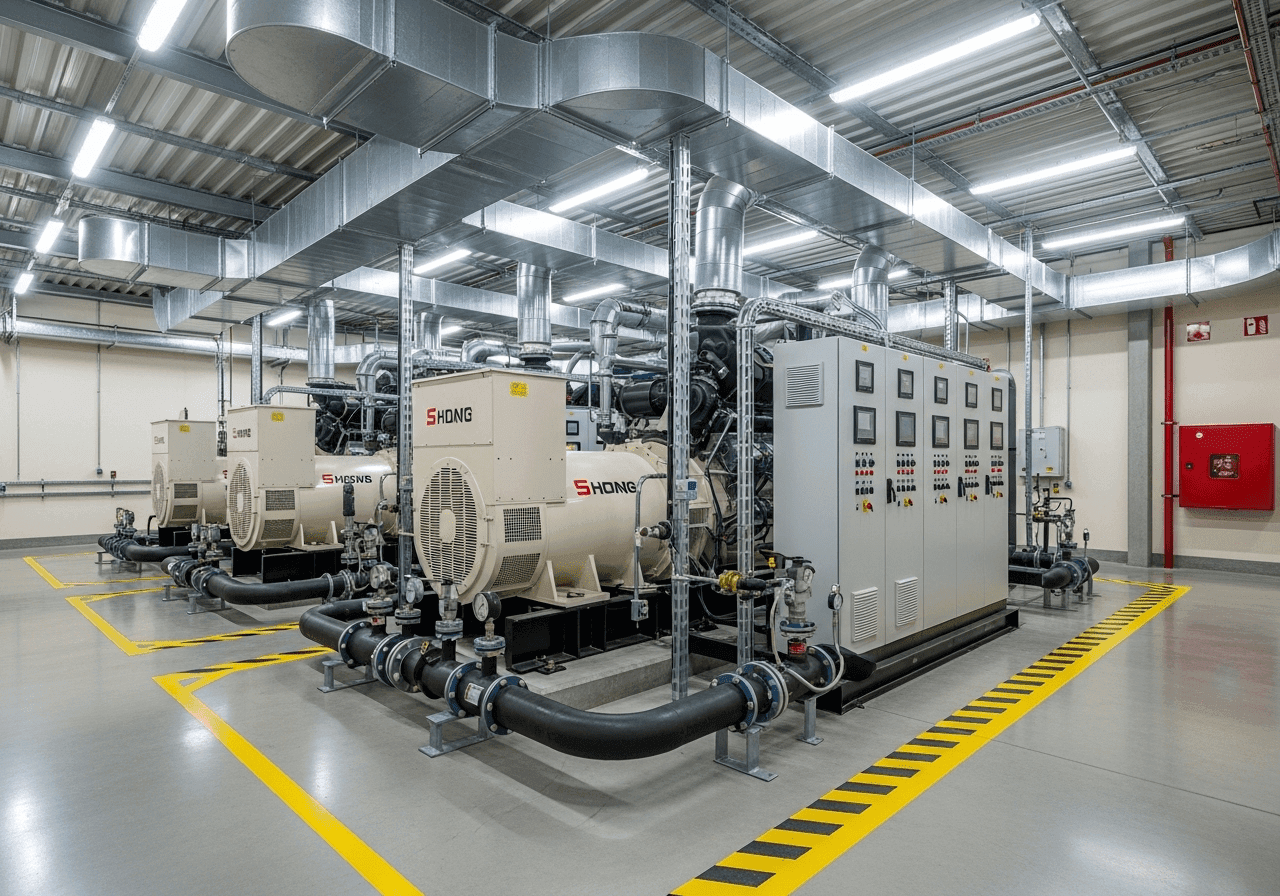
Runtime math is universal, but the rules around how generators get installed and rated are not. A few regional notes worth knowing before you plan around a number:
United States and Canada: Standby generators for critical facilities generally follow NFPA 110, which sets performance requirements for emergency and standby power systems. Diesel units sold for stationary and portable use are also subject to EPA nonroad diesel emission standards, which affects fuel system design and, indirectly, real-world consumption figures. Cold-climate provinces in Canada see the temperature correction discussed above applied more aggressively for a larger share of the year. If you’re wiring a standby unit into a panel, our cable size calculator covers NEC-compliant ampacity and voltage drop for that run.
Europe: Generating sets are commonly tested and rated against ISO 8528-1, the international standard covering application, ratings, and performance of engine-driven generating sets. Diesel and gasoline units placed on the EU market must also meet Stage V non-road emissions rules under Regulation (EU) 2016/1628, which has pushed many manufacturers toward cleaner-burning, more fuel-efficient engine designs over the past several years.
Australia: Generating sets connected to a home or site’s electrical installation fall under AS/NZS 3010, which governs safe connection rather than fuel performance. Australia’s mix of extreme summer heat and remote, higher-altitude mining and regional sites means both ends of the temperature-altitude correction can come into play depending on where the generator sits.
None of these standards change the underlying fuel-burn math. What they change is how a generator is installed, tested, and documented, which is worth knowing if you’re comparing spec sheets across regions.
Common Generator Runtime Calculation Mistakes
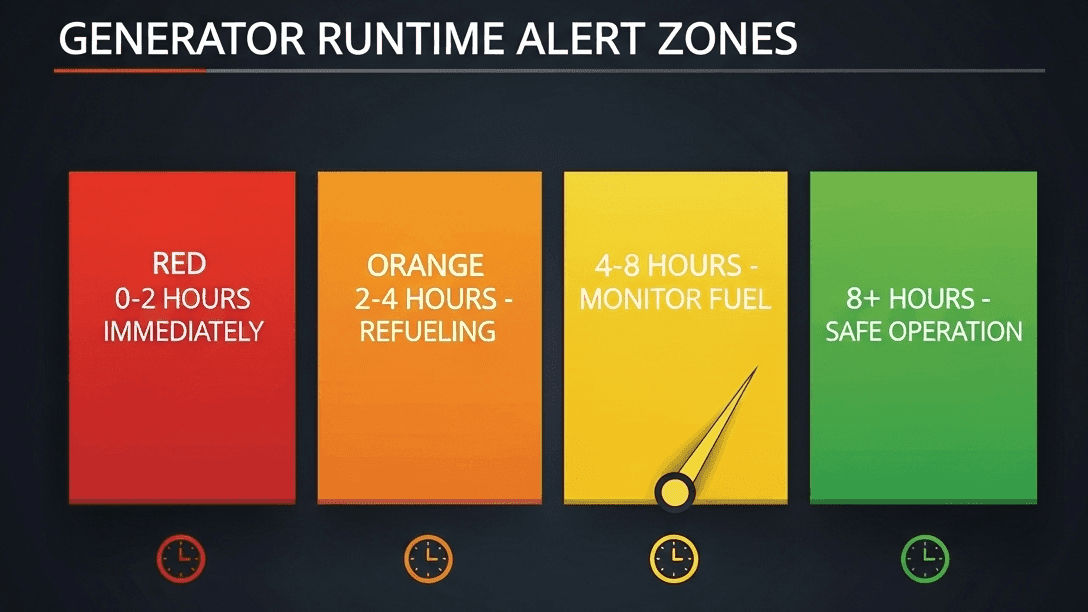
- Using the box rating as a real-world number. That figure comes from a fixed 50% load in lab conditions. Your load almost never matches it exactly.
- Assuming fuel burn scales linearly with load. It doesn’t. Idle losses mean a lightly loaded generator burns more fuel per kWh than one running near its efficient band.
- Ignoring the fuel reserve. Running a tank to literal empty risks drawing sediment or air into the fuel line. Budget 5-10% as unusable.
- Skipping temperature and altitude corrections. Both can move real runtime by double digits, and they stack rather than cancel out.
- Forgetting inrush load from appliances that cycle on and off. A refrigerator or well pump kicking on can spike demand well above your average load, briefly pushing the generator into a heavier burn rate.
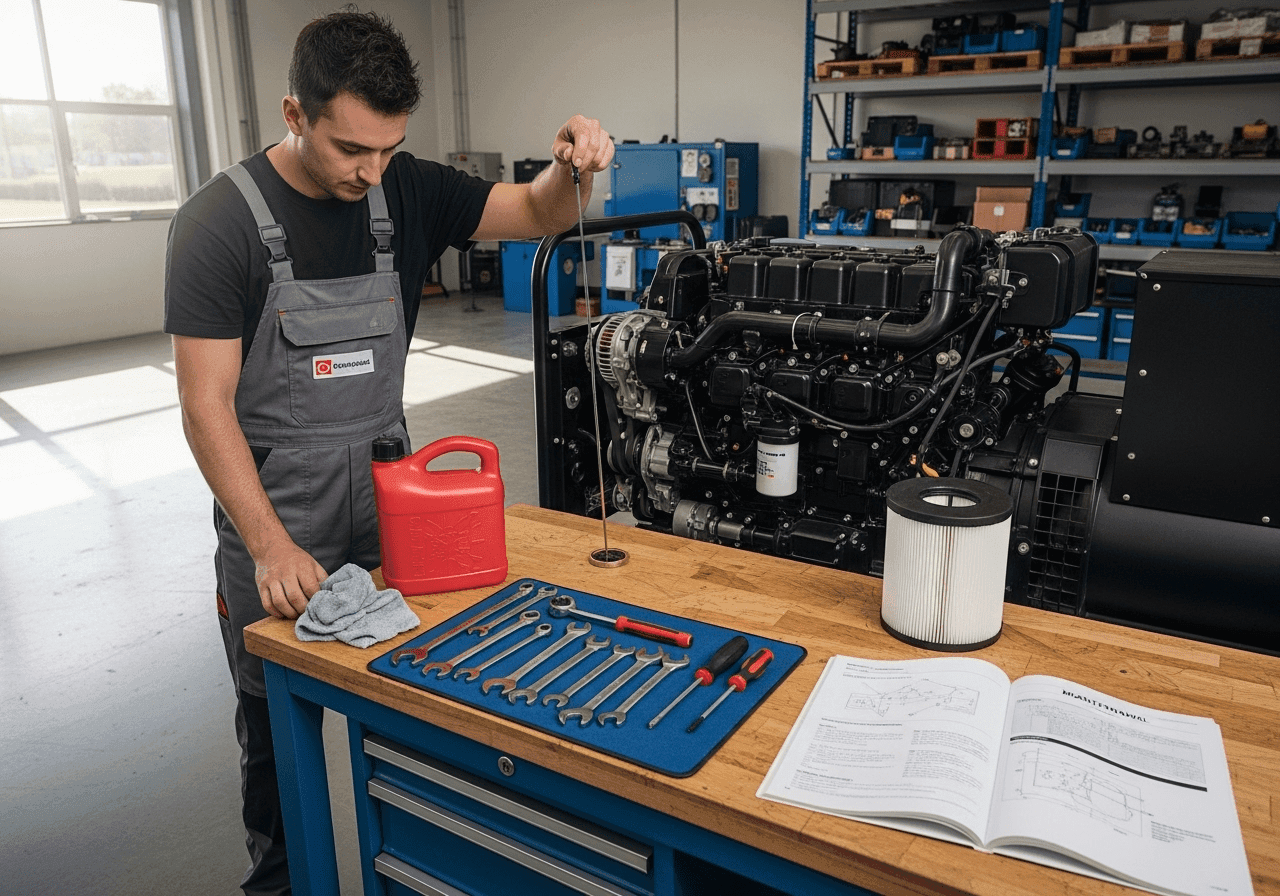
Worth adding: a poorly maintained generator won’t hit its rated consumption figures at all. Dirty air filters, old oil, and worn spark plugs all push real fuel burn above the spec sheet, regardless of how carefully you’ve corrected for load, weather, and altitude.
Frequently Asked Questions
How long can a generator run continuously?
Most portable generators are rated for continuous operation as long as fuel and oil are maintained, but manufacturers generally recommend a cool-down break every 8-12 hours to check oil level and let components rest. Standby units built for continuous duty can run for days without stopping, provided fuel supply and maintenance intervals are kept up.
What is the 80% rule for generators?
The 80% rule is a sizing guideline that says a generator should be loaded to no more than about 80% of its rated capacity during normal operation. It leaves headroom for the inrush current of appliances starting up and keeps the engine out of the stress zone near its maximum rating, which extends both service life and fuel efficiency.
How do I calculate how long my generator will run?
Divide your usable fuel volume by the adjusted consumption rate. Start with the manufacturer’s rated burn at your load level, then adjust for fuel type, temperature, and altitude. The calculator above automates this, or you can follow the worked example in this guide to do it by hand.
Does a generator use more fuel at higher altitude?
Yes. Thinner air at altitude reduces the oxygen available for combustion, so a naturally aspirated engine loses power output, roughly 3-4% for every 1,000 feet of elevation. To maintain the same load, the engine burns more fuel per kWh delivered.
Is a propane generator’s runtime shorter than a gasoline one?
Generally, yes, on an equal volume basis. Propane carries less energy per liter than gasoline, so a propane generator burns through fuel faster to produce the same output. Many owners accept the shorter runtime in exchange for propane’s longer shelf life and cleaner combustion.
How much fuel reserve should I leave in the tank?
Most manufacturers recommend treating the bottom 5-10% of tank capacity as unusable. Running a tank to complete empty risks drawing sediment or air into the fuel pickup, which can damage the fuel pump or cause the engine to stall under load.
Why does my generator run shorter than the advertised runtime?
Advertised runtime is almost always based on a fixed 50% load in mild, sea-level conditions. Real households and job sites rarely match that exactly, and cold weather, altitude, or a heavier load will all shorten the actual runtime below the number on the box.
Plan Around Real Numbers, Not Box Numbers
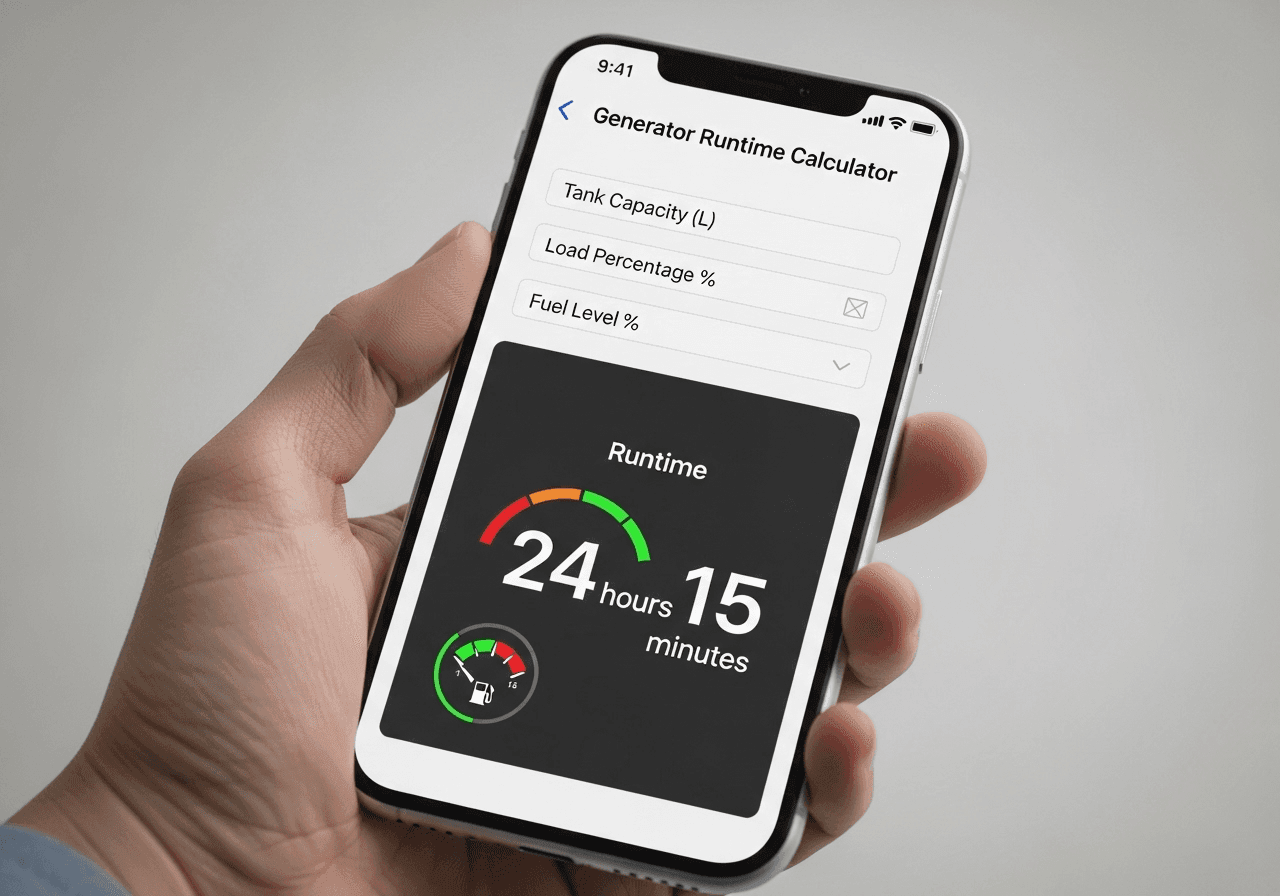
A generator’s true runtime is a moving target, shaped by load, fuel, temperature, and altitude all at once. The manufacturer’s number is a starting point, not a plan.
Now that you’ve seen the math behind it, run your own numbers in the calculator above. Plug in your generator’s rated consumption, your expected load, and your local conditions, and you’ll walk away with a runtime figure you can actually build a fuel schedule around.
Pairing a generator with solar and battery storage for a hybrid setup? Our hybrid inverter sizing calculator is the natural next step.


