

IELTS Band Score Calculator
Calculate, compare and plan IELTS band scores with a transparent, accuracy-first scoring engine.
Enter your four IELTS section bands
Use 0.5-band increments. Your overall band updates automatically.
Skill profile
Your four section bands shown against Band 9.
Score balance
Calculated from the highest minus lowest section score.
Transparent calculation
Enter all four section scores to see the calculation.
Listening raw score
Select correct answers out of 40.
Reading raw score
Academic and General Training use separate conversion tables.
Target Band Planner
Use your current four section scores from the Overall tab.
Minimum improvement needed
The engine tests valid 0.5-band possibilities instead of guessing.
Smart score combinations
Mathematically generated options, sorted by fewer changes and smaller total improvement.
What do I need?
What-if score simulator
Change one skill and see the projected overall band instantly.
Multi-skill simulator
Adjust several section scores together.
Profile A
Profile B
Comparison
| Metric | Profile A | Profile B | Difference |
|---|
IELTS Score Summary
A clean summary of the current four-section profile.
IELTS Band Score Calculator: Find Your Overall Band Score
Important: Solvebility calculates the Overall Band using IELTS scoring rules. Listening and Reading raw-score conversions are estimates for practice and planning because the exact conversion can vary by test version. This tool does not issue official IELTS results.
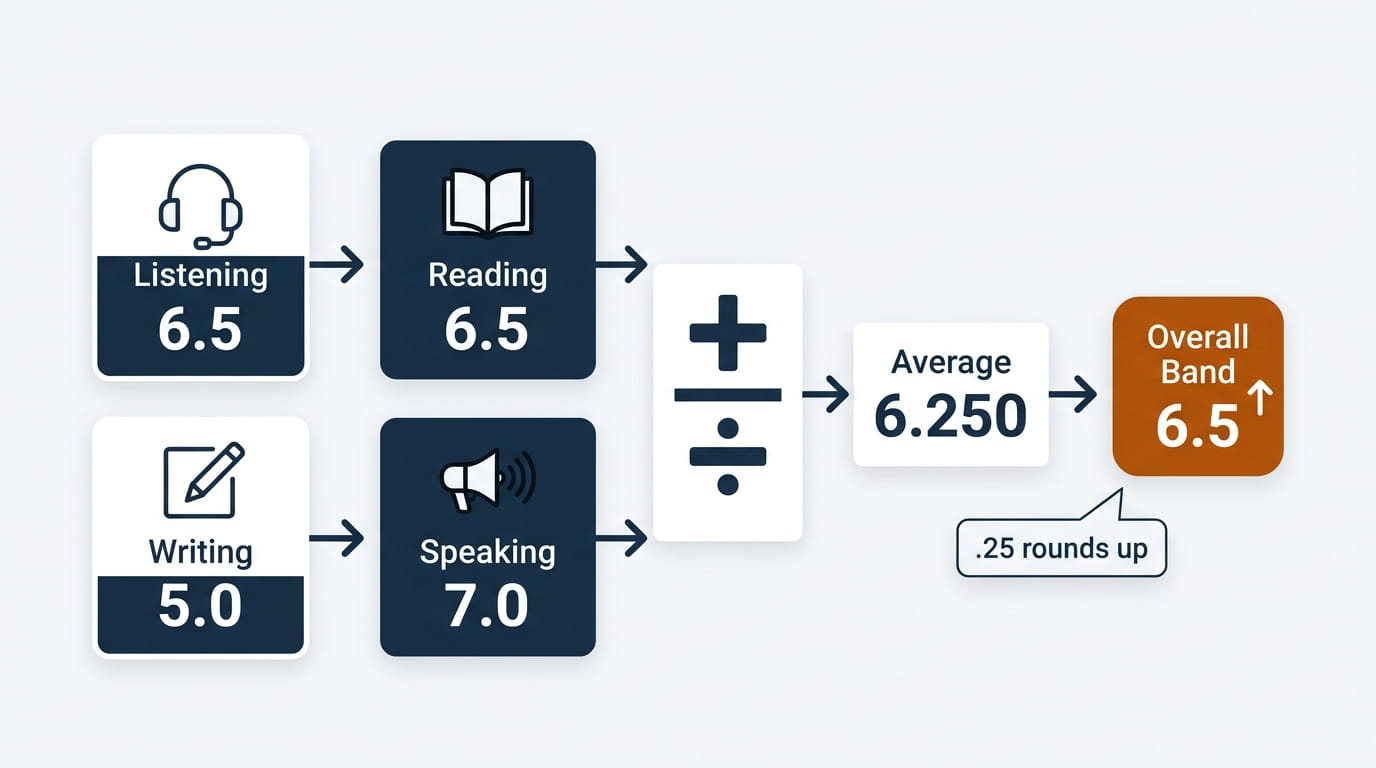
A 6.25 average becomes an Overall Band of 6.5 under the IELTS rounding rule. The Overall Band is calculated from the four section scores and then rounded to the nearest whole or half band, with .25 and .75 averages rounded upward to the next half or whole band.
You’ve probably added up your four section scores by hand, divided by four, and second-guessed the result. Maybe a university portal wants your Overall Band and you’re not sure if a 6.875 becomes a 7.0 or stays at 6.5. One wrong guess and you either apply somewhere you don’t qualify for, or skip a program you actually meet the bar for.
This guide explains how the Overall Band Score is calculated, shows typical Listening and Reading raw-score conversion ranges, and explains how to use Solvebility’s IELTS Band Score Calculator to check your score, convert practice-test marks, and plan a target band.
The Overall Band calculation and scoring rules are checked against official IELTS guidance. Raw-score conversions are presented as estimates because IELTS notes that the precise marks required can vary slightly between test versions.
How Is the IELTS Overall Band Score Calculated?
Add your Listening, Reading, Writing, and Speaking band scores and divide by four. IELTS rounds the average to the nearest whole or half band. If the average ends in .25, it rounds up to the next half band; if it ends in .75, it rounds up to the next whole band.
All four sections carry equal weight. There’s no bonus for a strong Speaking score offsetting a weak Writing one beyond simple averaging, and there’s no minimum you have to clear in any single section unless the institution you’re applying to sets one itself.
The formula looks like this:
Overall Band = (Listening + Reading + Writing + Speaking) ÷ 4, rounded to the nearest half band.
The key point is that IELTS does not simply apply a generic rounding rule. An average ending in .25 rounds up to the next half band, and an average ending in .75 rounds up to the next whole band. Other averages are rounded to the nearest whole or half band. For example, 6.125 becomes 6.0, 6.25 becomes 6.5, 6.625 becomes 6.5, and 6.75 becomes 7.0.
Official IELTS guidance provides worked examples of this rounding method. The examples below are paraphrased from that guidance:
| Test Taker | Listening | Reading | Writing | Speaking | Average | Overall Band |
|---|---|---|---|---|---|---|
| Test Taker A | 6.5 | 6.5 | 5.0 | 7.0 | 6.250 | 6.5 |
| Test Taker B | 4.0 | 3.5 | 4.0 | 4.0 | 3.875 | 4.0 |
| Test Taker C | 6.5 | 6.5 | 5.5 | 6.0 | 6.125 | 6.0 |
Test Taker A has an average of 6.25 and therefore receives 6.5. Test Taker C has an average of 6.125 and receives 6.0. The result comes from applying the IELTS rounding rule after the four section scores have been averaged.
On the Overall Band tab of the calculator, enter your scores with the plus and minus buttons instead of typing them. It keeps every value locked to a valid half band, so you can’t accidentally enter something like 6.3, which IELTS never actually reports.
How Do Raw Scores Convert to a Listening or Reading Band?
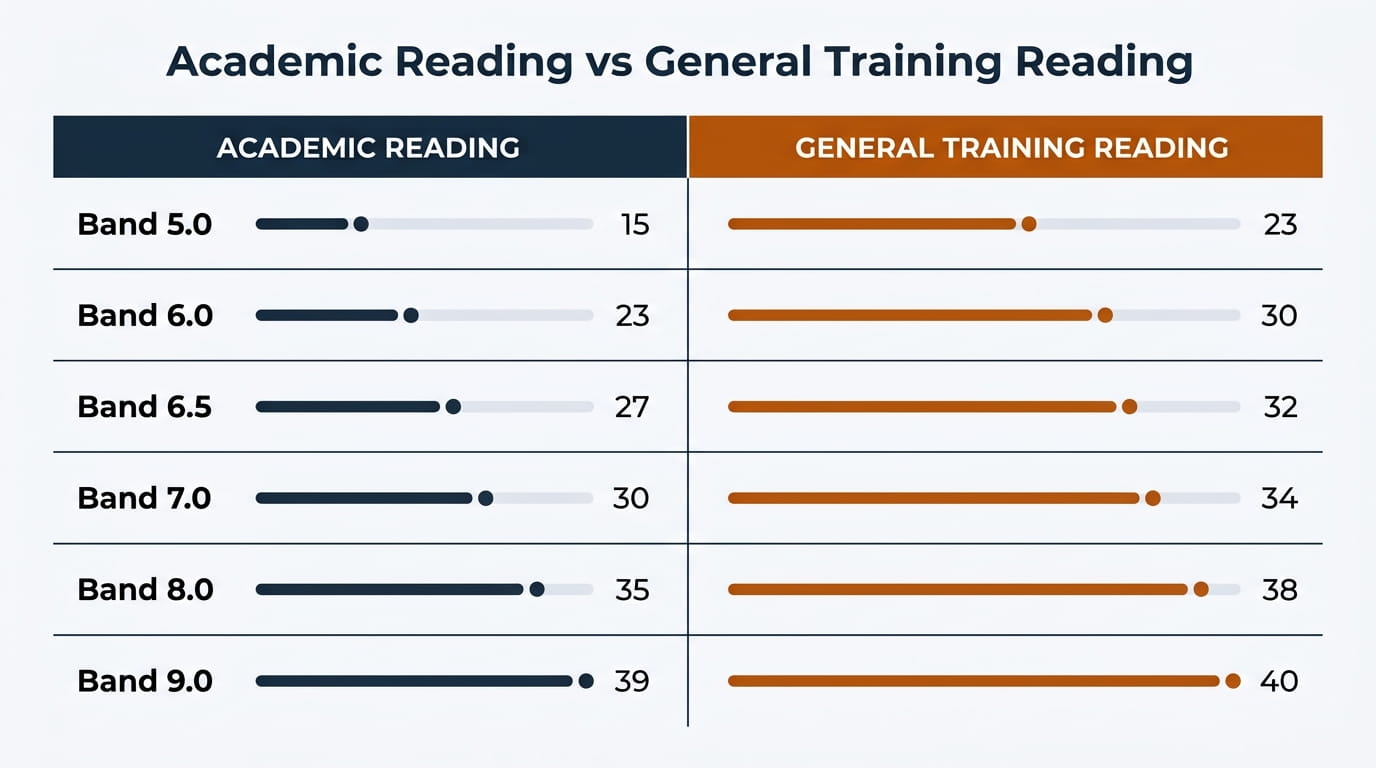
Listening and Reading contain 40 questions, with one mark for each correct answer, and the raw result is converted to a band. Academic Reading and General Training Reading use different conversion guidance. The exact raw score needed for a band can vary slightly between test versions.
Writing and Speaking don’t work this way. A trained examiner scores those against four assessment criteria each (Task Achievement or Task Response, Coherence and Cohesion, Lexical Resource, and Grammatical Range and Accuracy for Writing; Fluency and Coherence, Lexical Resource, Grammatical Range and Accuracy, and Pronunciation for Speaking), and reports a band directly. There’s no raw-to-band table for either.
Listening and Reading are objectively marked, so IELTS publishes typical raw-score guidance. The exact raw score needed for a particular band can vary slightly between test versions, so the ranges below should be treated as estimates rather than guarantees.
| Band | Listening | Academic Reading | General Training Reading |
|---|---|---|---|
| 9.0 | 39–40 | 39–40 | 40 |
| 8.5 | 37–38 | 37–38 | 39 |
| 8.0 | 35–36 | 35–36 | 37–38 |
| 7.5 | 32–34 | 33–34 | 36 |
| 7.0 | 30–31 | 30–32 | 34–35 |
| 6.5 | 26–29 | 27–29 | 32–33 |
| 6.0 | 23–25 | 23–26 | 30–31 |
| 5.5 | 18–22 | 19–22 | 27–29 |
| 5.0 | 16–17 | 15–18 | 23–26 |
| 4.5 | 13–15 | 13–14 | 19–22 |
| 4.0 | 10–12 | 10–12 | 15–18 |
Important: These are estimates for practice and planning, not an official IELTS result. Exact raw-score conversion can vary by test version.
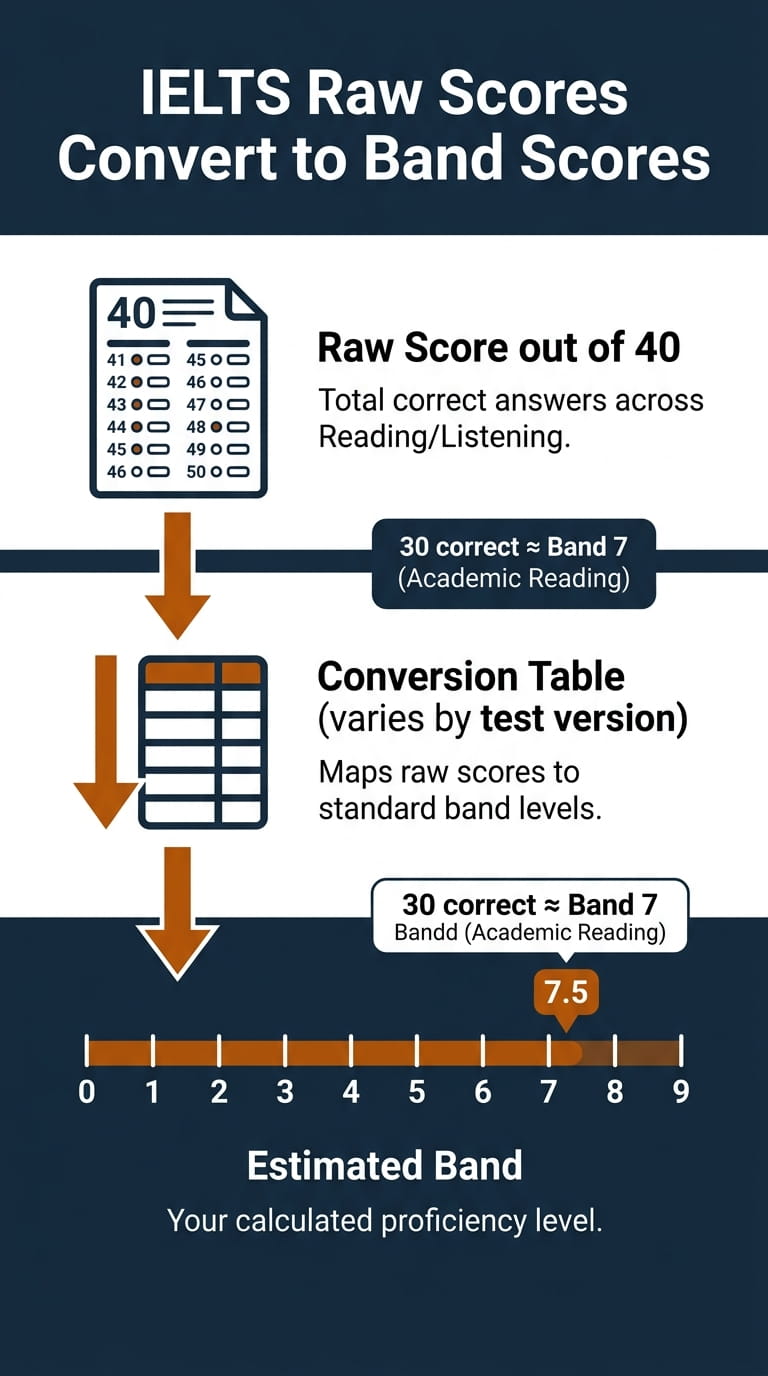
Look at Band 7 in the table above. Academic Reading needs around 30 correct answers. General Training needs around 34 or 35. Same band, same 40-question format, four or five more correct answers required. That gap holds at almost every band level, which is why a General Training candidate who “read like a Band 7” on an Academic-style practice test can come in lower on test day.
How Do I Use the Solvebility IELTS Band Score Calculator?
The calculator has six tabs: Overall Band, Raw Converter, Target Planner, Score Simulator, Compare, and Summary. Start on Overall Band to get your rounded score, then use Raw Converter if you only have raw marks, and Target Planner if you’re aiming for a specific score.
The calculator is designed to perform calculations in your browser without requiring an account or uploading your scores.
1. Enter your four section scores on the Overall Band tab
Set Listening, Reading, Writing, and Speaking with the dropdowns or the plus and minus steppers. As soon as all four are filled in, the tab shows your rounded Overall Band, the exact average behind it (like “6.250”), which skill is strongest and weakest, and how balanced your profile is across the four skills.
2. Convert raw marks on the Raw Converter tab
If you’ve only got a raw score from a practice test (say, 32 out of 40 in Listening), switch to this tab. Enter the raw mark and it returns the estimated band. For Reading, pick Academic or General Training first, since they use different conversion tables.
3. Set a goal on the Target Planner tab
Choose the Overall Band you need, from 5.0 up to 9.0. The tool compares it to your current score and, if you’re short, generates up to five ranked ways to close the gap, sorted to show the option that requires changing the fewest sections first. There’s also a single-skill mode: pick one section and see the minimum score you’d need there alone, assuming the other three stay exactly where they are.
4. Test scenarios on the Score Simulator tab
Drag one skill’s value up or down and watch your projected Overall Band update immediately, alongside the net change from your current score. It’s the fastest way to see whether raising Writing from 6.0 to 6.5 is actually worth more than raising Speaking by the same half band.
5. Compare two profiles on the Compare tab
Enter two complete sets of four scores, Profile A and Profile B, side by side. Useful for comparing two practice tests, or your last real result against the score you’re aiming for. The table shows the overall and per-skill difference in one place.
6. Review and save on the Summary tab
This tab recaps everything: Overall Band, exact average, all four section scores, your strongest and weakest skill, and your band profile (for example, “Good User”). Copy the summary as text, generate a share link, or save it to your local history so you can track how your practice scores change over time.
What Do IELTS Band Scores Actually Mean?
Each whole IELTS band, from 0 to 9, has an official skill-level label. Band 9 is “Expert,” Band 7 is “Good,” Band 5 is “Modest,” and so on down to Band 0, “Did not attempt the test.” These labels come directly from IELTS’s own scoring guidance.
Half bands such as 6.5 and 7.5 sit between the whole-band descriptors. Use the official band descriptors for the individual skill or overall score when interpreting what a result means.
| Band | Skill Level | What It Means |
|---|---|---|
| 9 | Expert | Fully operational command of English, appropriate, accurate, and fluent |
| 8 | Very Good | Fully operational, with only occasional unsystematic inaccuracies |
| 7 | Good | Operational command, occasional inaccuracies in some situations |
| 6 | Competent | Generally effective command despite some inaccuracies |
| 5 | Modest | Partial command, copes with overall meaning in most situations |
| 4 | Limited | Basic competence limited to familiar situations |
| 3 | Extremely Limited | Conveys only general meaning in very familiar situations |
| 2 | Intermittent | Great difficulty understanding spoken and written English |
| 1 | Non-user | No real ability to use the language beyond isolated words |
| 0 | Did Not Attempt | No assessable information provided |
Solvebility uses the official whole-band descriptors as the reference for its result labels. Any simplified grouping shown by the calculator is a presentation aid and does not replace the official IELTS descriptor.
How Does My IELTS Band Score Compare to CEFR Levels?
IELTS bands can be compared approximately with CEFR levels, but the two scales are not exact equivalents. IELTS states that 8.5 and above is recognised as C2, Band 8.0 is borderline, and the C1 threshold falls between 6.5 and 7.0.
The CEFR is a general language-proficiency framework rather than an IELTS scoring scale. IELTS guidance recommends treating the relationship as approximate: the C1 threshold falls between 6.5 and 7.0, while 8.5 and above is recognised as C2 and 8.0 is borderline.
| CEFR Level | Approximate IELTS Band | General Description |
|---|---|---|
| C2 | 8.5 – 9.0 | Approximate C2 range |
| C1 | 7.0 – 8.0* | Advanced, effective operational command |
| B2 | 5.5 – 6.5* | Upper-intermediate, independent user |
| B1 | 4.0 – 5.0 | Intermediate, independent user |
| A2 | 3.0 – 3.5 | Elementary, basic user |
These are approximate comparisons, not exact equivalences. IELTS states that the C1 threshold falls between 6.5 and 7.0, and that 8.0 is borderline while 8.5 and above is recognised as C2. Check the score requirement set by the institution or organisation you are applying to.
How Do I Reach My Target IELTS Band Score?
Find the gap between your current Overall Band and your target, then check which single section, if raised, closes that gap with the smallest change. Because all four sections are averaged equally, your weakest section usually offers the cheapest path to a higher overall score.
Say you’re sitting at Listening 7.0, Reading 7.0, Writing 6.0, and Speaking 7.0. That averages to 6.75, which rounds up to Overall Band 7.0. You’re already there. Now say Writing comes in at 5.5 instead. The average drops to 6.625, rounding to 6.5, a full half band lower, from one section alone.
A lower score in one skill can move the final average across a rounding boundary. Because all four sections contribute equally to the average, improving a weaker section can sometimes be an efficient way to reach a target Overall Band.
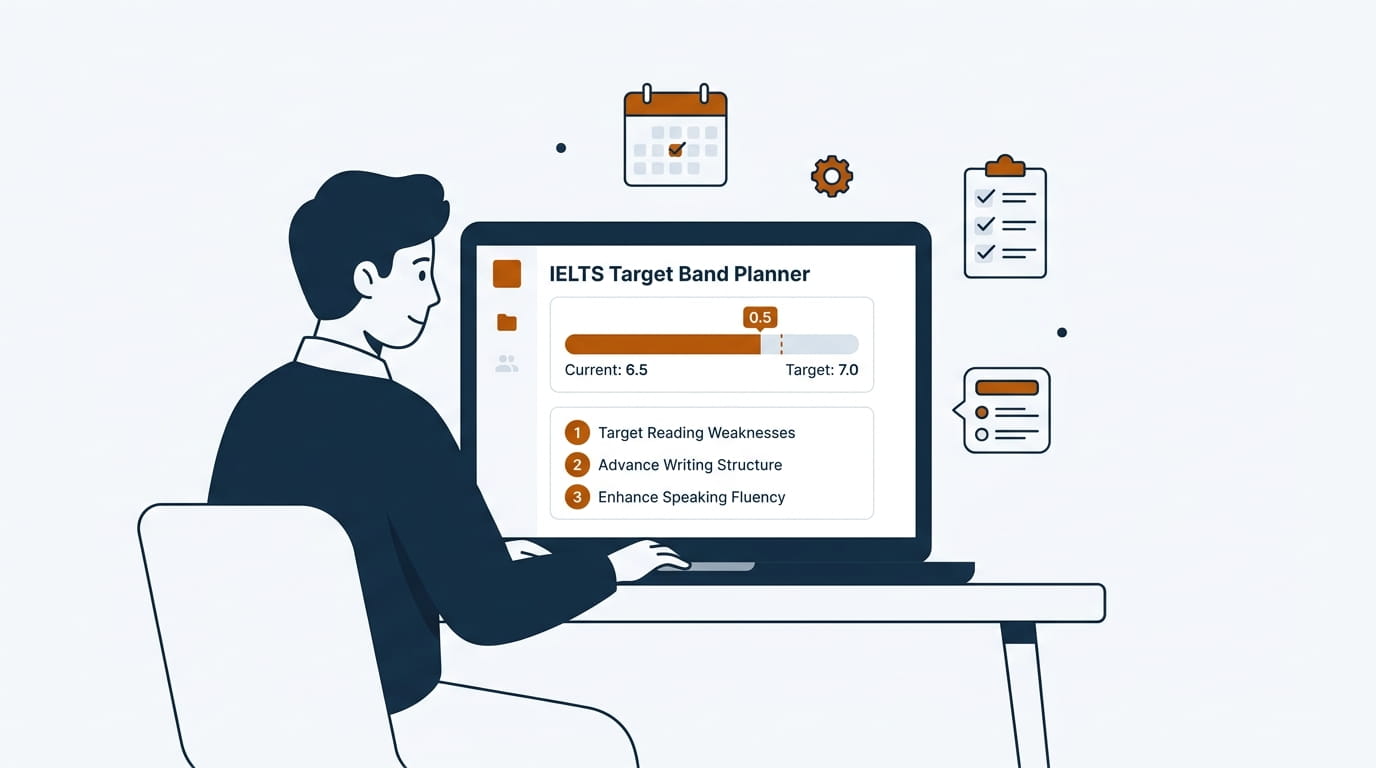
Run this kind of scenario on the Target Planner tab before you register for a retake. Enter your last real or practice scores, set your target, and the calculator lists the smallest realistic combination of section improvements, so you’re not guessing whether to spend the next month drilling Writing or Speaking.
Check the single-skill “what do I need” result on the Target Planner tab first. If it shows your weakest section needs to jump more than a full band, it’s often more realistic to plan for smaller gains across two sections instead of one large jump in your weakest area.
Mistakes That Skew Your Overall Band Score
A few habits quietly throw off self-calculated IELTS scores. None of them are complicated once you know to check for them.
Rounding each section before averaging
IELTS rounds once, at the very end, after averaging all four raw section bands. If you round each section first and then average the rounded numbers, you can land on a different, usually lower, Overall Band than the real one.
Applying standard rounding instead of the IELTS rule
A 6.25 average looks like it should round down under normal rounding conventions. IELTS rounds it up. This single difference is behind most of the “why is my score higher than I calculated” questions test takers post online.
Using an Academic Reading table for a General Training test
The two Reading tests share a band scale but not a conversion table. Running a General Training raw score through an Academic Reading chart can overstate your band by a full half point or more at certain scores.
Treating the raw-to-band table as exact
The published Listening and Reading conversion figures are averages across test versions. Your specific test administration might need one mark more or fewer for the same band. Use the raw converter as a close estimate, not a guaranteed outcome.
Ready to check your own score?
Enter your four section scores in the calculator above and see your real Overall Band Score, plus a full target-band plan.
Open the IELTS Band Score CalculatorFrequently Asked Questions
What is an IELTS Band Score Calculator?
An IELTS Band Score Calculator is a free tool that averages your four section scores (Listening, Reading, Writing, Speaking) and rounds the result using IELTS’s official rounding rule to show your Overall Band Score. It also converts raw Listening and Reading marks out of 40 into an estimated band.
How is the IELTS Overall Band Score calculated?
Add your four section band scores and divide by four. IELTS then rounds that average to the nearest half band using its official rounding rule. For example, scores of 6.5, 6.5, 5.0, and 7.0 average to 6.25, which rounds up to an Overall Band of 6.5.
How does IELTS round the overall band score?
If your four-skill average ends in .25, IELTS rounds it up to the next half band. If it ends in .75, IELTS rounds it up to the next whole band. Any other decimal rounds to the nearest 0.5, so 6.125 becomes 6.0 and 6.625 becomes 6.5.
What raw score do I need for Band 7 in Listening?
You typically need around 30 correct answers out of 40 to reach Band 7 in Listening, based on figures published by IELTS. This number shifts by a mark or two between test versions, so treat it as a close estimate rather than a guarantee.
Is Academic Reading scored the same as General Training Reading?
No. Both use the same 40-question format and 0 to 9 band scale, but General Training Reading requires more correct answers than Academic Reading for the same band. Band 7 needs around 30 correct answers in Academic Reading but around 34 to 35 in General Training.
What does a Band 6.5 mean in real terms?
Band 6.5 sits between IELTS’s Competent User (Band 6) and Good User (Band 7) descriptors. It generally means you communicate effectively in familiar situations with some inaccuracies, and it meets the minimum requirement for many university and skilled-migration applications.
How long is an IELTS score valid?
IELTS recommends that test results be treated as valid for two years after the test date, based on research into how second-language skills fade over time. Some organizations set their own, longer window, so check directly with the institution you’re applying to.
What’s the difference between IELTS and CEFR levels?
CEFR describes six broad proficiency levels from A1 to C2, while IELTS reports a finer 0 to 9 band scale. Cambridge Assessment English has aligned the two, though IELTS itself notes that bands like 6.5 and 8.0 sit near the border between two CEFR levels.
Can I use this calculator to predict my real IELTS Writing or Speaking score?
Not directly. Writing and Speaking are marked by trained examiners against four assessment criteria each, not a raw score formula. Use the calculator to see how a Writing or Speaking band you’ve already been given affects your Overall Band Score.
Is the Solvebility IELTS Band Score Calculator free to use?
Yes, it’s completely free with no sign-up. Every calculation, including the raw score converter, target band planner, and score simulator, runs in your browser, and Solvebility doesn’t store your scores on a server.
Get Your Real IELTS Overall Band Score in Seconds
The math behind your Overall Band Score isn’t complicated once you know the rounding rule, but it’s easy to get wrong by hand, especially near a .25 or .75 average. You now have the key calculation rules, the main differences between Academic and General Training Reading conversions, and a practical way to check whether your target Overall Band is achievable.
Start by entering your last practice or real test scores into the Solvebility IELTS Band Score Calculator above. If you’re short of your target, the Target Planner tab will show you the fastest realistic way to close the gap.
Calculation Methodology
The Overall Band is the arithmetic average of Listening, Reading, Writing, and Speaking, rounded according to IELTS guidance. Listening and Reading raw-score conversions shown by Solvebility are estimates for practice use; they are not a substitute for an official IELTS result.
Sources & Further Reading
Last Updated: | Next Review: | Reviewed by the Solvebility Education Tools Team
- IELTS.org. “IELTS Scoring in Detail: Band Scores Explained.” 2026.
- IELTS.org. “IELTS and the CEFR.” 2026.
- British Council. “Take IELTS.” Official test partner site.
- IDP IELTS. Official test partner site.
- Cambridge Assessment English. Official test partner site.
Recommended Resources
Written by Nouman Ahmed
Civil Engineer • Solar Energy Consultant • Software Developer
Nouman is the founder of Solvebility, with practical experience in solar PV system design, engineering calculations, and calculator development since 2011. This tool was built by Nouman and reviewed by the Solvebility engineering team to verify formulas, assumptions, and calculation accuracy before publication — and is updated whenever industry standards change.