Excavator vs Manual Excavation: Cost & Time Comparison
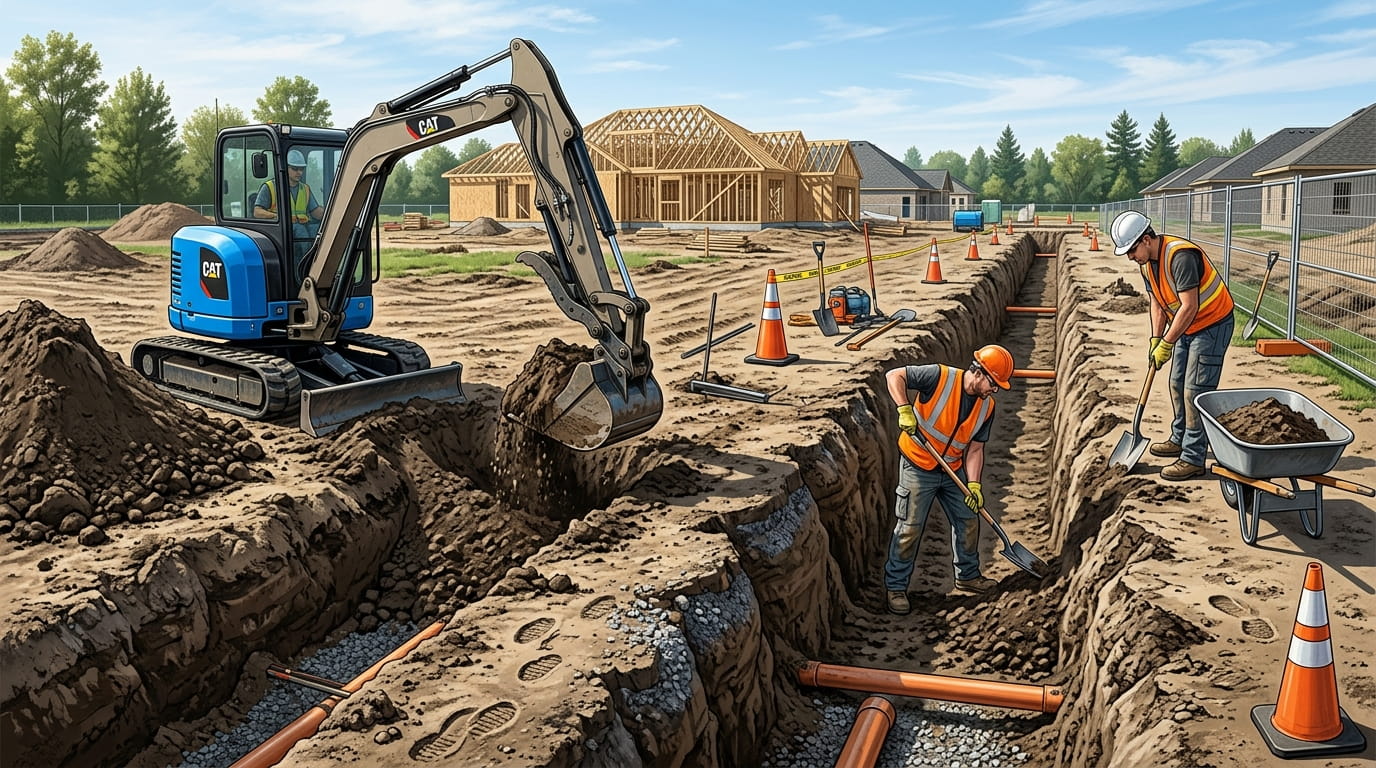
A mini excavator can dig a 20-bank-cubic-yard trench in roughly two hours of digging time. A 3-person crew with shovels needs closer to 11 crew-hours, about a day and a half, for the same hole. That gap is key to every excavator vs. manual excavation decision. If you guess wrong, it can get expensive fast.
Cost isn’t as simple as “machines cost more.” Labor hours add. Rental fees and delivery charges add too. And soil type changes both numbers in ways a lot of estimates skip.
This guide walks through production rates, wage data, and a worked cost comparison, sourced from OSHA, the Bureau of Labor Statistics, and published construction cost-estimating references. Key figures are linked directly to their source as they come up, with a full reference list at the end.
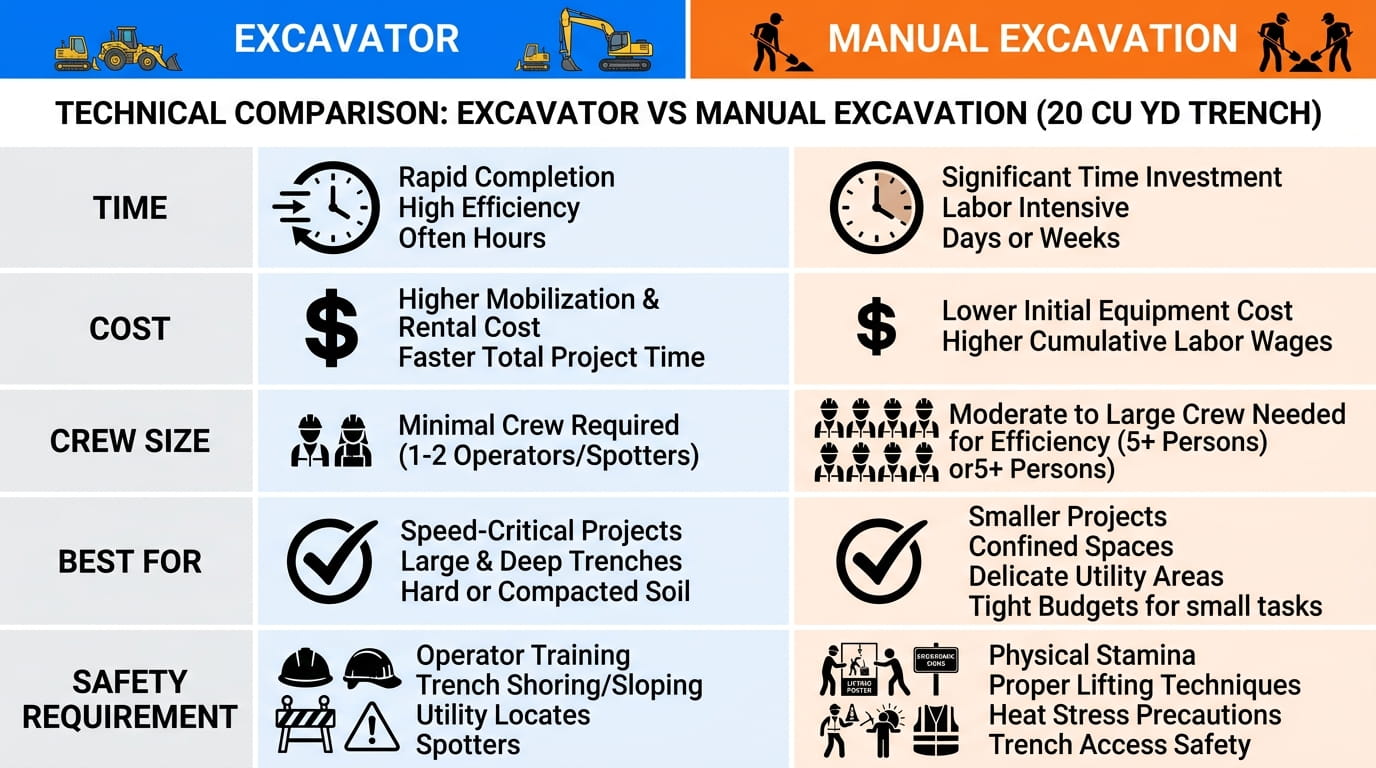
| Factor | Manual Excavation | Mini Excavator |
|---|---|---|
| Production rate | ~0.4–0.9 BCY per worker per hour (see Table 1) | ~8–12 CY per hour (see Table 2) |
| Labor requirement | Higher — output scales only with crew size | Lower — one operator covers the job |
| Equipment cost | Low — hand tools only | Rental + delivery + fuel (see cost section) |
| Small jobs | Often cost-competitive, no rental minimum to cover | Rental day-minimums can outweigh the time saved |
| Tight access | Advantage — fits anywhere a person fits | Machine may not fit through gates or tight spaces |
| Large volumes | Slow — labor hours scale linearly | Usually faster and cheaper per cubic yard |
Where the “small job” advantage actually flips to “large job” depends on your local labor rate, rental pricing, and site access, not a fixed number. The worked example further down walks through one real scenario so you can see how the tradeoff plays out in dollars and hours.
- How to calculate excavation time for both methods
- How many cubic yards a person can dig by hand per day
- How many cubic yards an excavator digs per hour
- Excavator vs manual excavation: which costs less
- How much faster an excavator is than hand digging
- Is manual excavation safe for deep trenches
- When manual excavation is the right call
- FAQ
How Do You Calculate Excavation Time for Excavators vs Manual Labor?
So each rate below clearly states which one it uses.
Every excavation estimate starts with volume. The basic formula has not changed in a century.
length times width times average depth gives you cubic yards, in BCY, since that’s the undisturbed ground you’re measuring. Solvebility’s own excavation and earthwork volume calculator handles this automatically, plus polygon shapes and soil-specific swell and shrink factors.
Once you have volume, time depends entirely on your production rate.
Manual crews: Time (crew-hours) = Bank Volume (BCY) ÷ (Crew Size × BCY per worker per hour).
Excavators: production rate follows the formula used across the industry for cost estimating: Q = (Vbucket × FF × Eff × 3600) ÷ tcycle, where Q is loose cubic yards per hour (LCY/hr), Vbucket is heaped bucket capacity, FF is the fill factor (decimal), Eff is job efficiency (decimal), and tcycle is cycle time in seconds. Since Q comes out in LCY, divide by (1 + swell%) to convert back to BCY/hr, the number you actually need to compare against a bank-volume takeoff (formula source: ToolGrit excavator production guide).
Fill factor and job efficiency do most of the damage to “spec sheet” numbers. A bucket rated for 1 cubic yard rarely loads a full yard on every pass (fill factor under 100%), and no operator digs productively for a full 60 minutes out of every hour. ToolGrit’s production guide puts job efficiency at roughly 40–55% for typical operations, rising to about 83% for a highly efficient 50-minute-productive hour, meaning 24 to 50 productive minutes per hour, not 60.
That efficiency range is a widely used estimating convention, not a fixed law, so treat it as a planning assumption and adjust for your own crew and site. The same goes for swell factors generally: they’re illustrative estimating assumptions, not universal values, and actual swell should be based on project-specific soil data when it’s available.
- Calculate bank volume (length × width × depth, or the polygon tool for irregular plots).
- Apply a swell assumption for your soil type.
- Estimate manual crew-hours using the production rates in Table 1.
- Estimate excavator digging time using the production rates in Table 2, converting LCY ↔ BCY as needed.
- Compare labor cost against rental, delivery, fuel, and disposal costs for the equipment option.
How Many Cubic Yards Can One Person Dig by Hand per Day?
Two real data points bracket this range. A widely used construction cost-estimating training problem has a 4-laborer crew (plus a half-time foreman) hand-excavating 40 bank cubic yards of heavy soil in 24 crew-hours, that is, 3 shift-days of 8 hours each, during which all 4 laborers work simultaneously. That’s 96 total labor-hours (24 crew-hours × 4 laborers), so productivity works out to 40 ÷ 96 ≈ 0.42 BCY per worker-hour, roughly 3.3 cubic yards over an 8-hour day per worker, for dense, difficult ground (source: construction cost-estimating training example).
On the lighter end, an experienced general contractor bidding a hand-dig job in sandy soil (a working estimator’s field figure, shared in a Contractor Talk forum discussion) planned for 7 bank cubic yards per digger per day, about 0.875 BCY per hour, with a separate crew handling stockpiling and hauling.
| Condition | BCY per Worker per Hour | BCY per Worker per 8-Hr Day | Source |
|---|---|---|---|
| Heavy/dense soil, hand tools only | 0.42 | ~3.3 | Cost-estimating training example (96 total labor-hours for 40 BCY) |
| Moderate/sandy soil, digging only (hauling separate crew) | 0.875 | ~7.0 | Contractor field estimate |
| Illustrative blended estimate, loose soil / shallow / easy access | ~1.0–1.2 (not a published benchmark, shown for planning only) | ~8–9.5 | Interpolated from the two rows above, not independently sourced |
Depth and confined space cut into these numbers fast. A trench 4 feet wide is a different job than a pile cap 30 feet square. Add stockpiling, hauling, and dewatering, and real output on a hand-dig job often lands well below the digging-only rate.
How Many Cubic Yards Can an Excavator Dig per Hour?
Size class drives this number more than any other factor. A 1 to 2 ton mini excavator squeezes through a backyard gate but moves less material per cycle. A full-size machine with a 1-cubic-yard bucket clears far more ground, provided there’s room to swing and a truck to load.
| Machine Class | Bucket Capacity | Rate | Basis |
|---|---|---|---|
| Mini excavator (1.5–4 ton) | ~0.15–0.4 yd³ | 8–12 CY/hr | Illustrative planning assumption; original figure does not specify BCY or LCY, so do not treat it as a published benchmark |
| Standard excavator (1 yd³ bucket) — theoretical max | 1 yd³ | ~120 LCY/hr | 1 CY bucket × 2 cycles/min (30-sec cycle time) × 60 min, ~100% fill factor, continuous digging, no breaks |
| Standard excavator (1 yd³ bucket) — illustrative planning range | 1 yd³ | ~48–100 LCY/hr | Illustrative result: 120 LCY/hr theoretical maximum × 40–83% job-efficiency assumption (ToolGrit: 40–55% typical, up to 83% for a 50-min-productive hour) |
| Standard excavator (1 yd³ bucket) — illustrative daily planning range | 1 yd³ | ~384–800 LCY/day | 48–100 LCY/hr illustrative range × 8-hour workday; not adjusted separately for swell |
The 120 LCY/hr figure is a spec-sheet ceiling, not a number to plan a schedule around: it assumes a full bucket on every single pass and zero downtime for repositioning, truck changes, or operator fatigue. Applying ToolGrit’s stated 40–83% job-efficiency range brings that down to a realistic 48 to 100 LCY/hour, and across an 8-hour day, that’s roughly 400 to 800 LCY, a range built directly from the hourly figures above so it stays internally consistent.
The 384–800 LCY/day range above is the planning range used throughout this article because it is derived directly from the stated 48–100 LCY/hour assumptions. Do not combine it with unrelated dealer-guide ranges that use different bucket sizes, productive-hour assumptions, or volume bases.
Excavator vs Manual Excavation: Which Costs Less?
Here’s the math behind that answer, using a 20-bank-cubic-yard trench in mixed soil (illustrative 10% swell assumption, the same default Solvebility’s excavation calculator uses for mixed conditions; actual swell should be based on project-specific soil data when available).
| Item | Manual (3-person crew) | Mini Excavator |
|---|---|---|
| Bank volume | 20 BCY | 20 BCY |
| Production assumption | 3 workers × 0.6 BCY/worker/hr (illustrative blend of Table 1’s two sourced rates) | 10 BCY/hr assumed (midpoint of the unsourced 8–12 CY/hr mini-excavator rule of thumb, explicitly treated as bank-volume for this calculation; see note below) |
| Time formula | 20 ÷ (3 × 0.6) = 11.1 crew-hours (elapsed working time, not total labor-hours) | 20 ÷ 10 = ~2.0 hours of digging |
| Total labor/machine-hours | 11.1 crew-hours × 3 workers = 33.3 total labor-hours | ~2.0 machine-hours, though rental is typically billed as a full day regardless |
| Labor/equipment cost | 33.3 labor-hours × $22.47/hr (BLS May 2024 median pay for Construction Laborers, $46,730/year) ≈ $748 in wages alone, before tools, hauling, or disposal | Assumption: ~$250 mid-range 1-day mini excavator rental + ~$150 assumed delivery (both day-based) ≈ $400–$500, not directly sourced market averages, shown for illustration |
The excavator wins here mostly because rental day-minimums exist: even a 2-hour job usually gets billed a full day (per HomeGuide and Bob Vila’s cost guidance), so you’re paying for time you don’t use. But 33.3 total labor-hours at even a modest crew wage still outpaces a single day’s rental once you add up three paychecks. Change the crew size, local wage, or rental rate and the answer can shift, this is a worked illustration, not a universal rule.
Real-world excavation pricing backs up the general shape of this tradeoff. HomeGuide’s 2026 cost data puts basic soil excavation at roughly $2.50 to $15 per cubic yard depending on soil and access, while rock excavation runs far higher, often $50 to $200+ per cubic yard, because it needs specialized breaking equipment. DOZR’s 2026 marketplace data puts mini excavator rentals at $150 to $400 per day, and HomeGuide lists a full excavation crew with equipment at roughly $100 to $300 per hour. All of these vary by soil, access, depth, disposal needs, region, equipment class, and project scope, treat them as ranges to sanity-check a local quote against, not fixed prices.
How Much Faster Is an Excavator Than Digging by Hand?
Line up the production rates from Tables 1 and 2 and the gap is clear. A 3-person crew at the blended manual rate used in the worked example (0.6 BCY/worker/hr) produces 3 × 0.6 = 1.8 BCY/hour as a crew. A mini excavator at 8–12 CY/hour (treated as BCY/hour, per the worked example’s explicit assumption) is roughly 4.4× to 6.7× that crew rate, call it 4 to 7 times faster, which lines up with the worked example above. This comparison only holds if the excavator rate is read as BCY/hour; if it’s actually a loose-volume rate, convert with a swell factor first.
For a full-size, standard excavator, the comparison points to a much bigger gap, though it mixes sources with different units and should be read as illustrative of scale rather than a precise figure. Because the manual benchmark is in BCY/day while the excavator planning range is in LCY/day, a precise speed multiplier would require a stated swell conversion and comparable operating assumptions. The full-size machine therefore should be described only as substantially faster, not assigned a precise multiplier in this article.
That’s why timeline, not just cost, often decides the call. A foundation dig that needs to happen before a concrete pour is scheduled doesn’t have room for a hand crew to take two extra days.
Is Manual Excavation Safe for Deep Trenches?
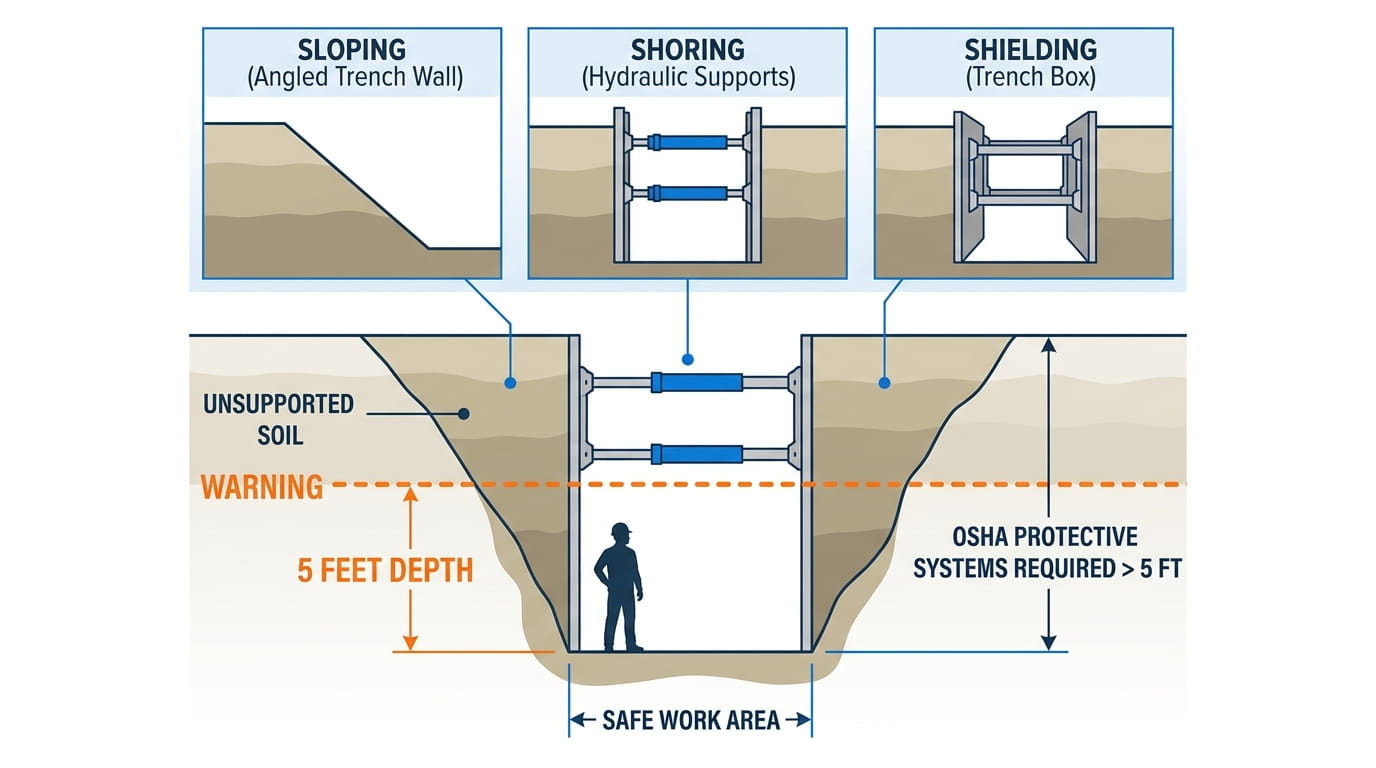
Soil is heavier than it looks. OSHA notes that one cubic yard can weigh as much as a car, and after heavy rain, that weight climbs further while the soil gets less stable. That combination is why cave-ins remain one of construction’s deadliest hazards.
The trend is improving, but slowly, and the figures below are point-in-time counts from specific OSHA releases, not final full-year totals. Trench collapses were tied to 39 deaths in 2022, a record year, falling to 15 in 2023. OSHA’s November 4, 2024 release put the calendar-year 2024 figure at 12, explicitly labeled “to date” at the time of that release. OSHA’s release dated June 28, 2025 states 11 trench-related fatalities had been reported in 2025 as of that date, a partial-year figure, not a full-year total. Separately, OSHA’s FY 2024 top-10 most-cited standards list shows 629 citations issued for excavation requirements that fiscal year, with $4.5 million in associated penalties.
Federal rules require a protective system, benching, sloping, shoring, or a shielding system like a trench box, on any excavation 5 feet deep or greater. A competent person has to inspect that system before anyone climbs in.
When Should You Choose Manual Excavation Over an Excavator?
Machines don’t win every job. A few situations still call for hand tools:
- Small volumes. For many small U.S. residential jobs, the break-even point can fall somewhere around 5 to 10 BCY, but the actual threshold depends heavily on rental minimums, delivery fees, local labor rates, access, soil conditions, disposal, and whether an operator is included.
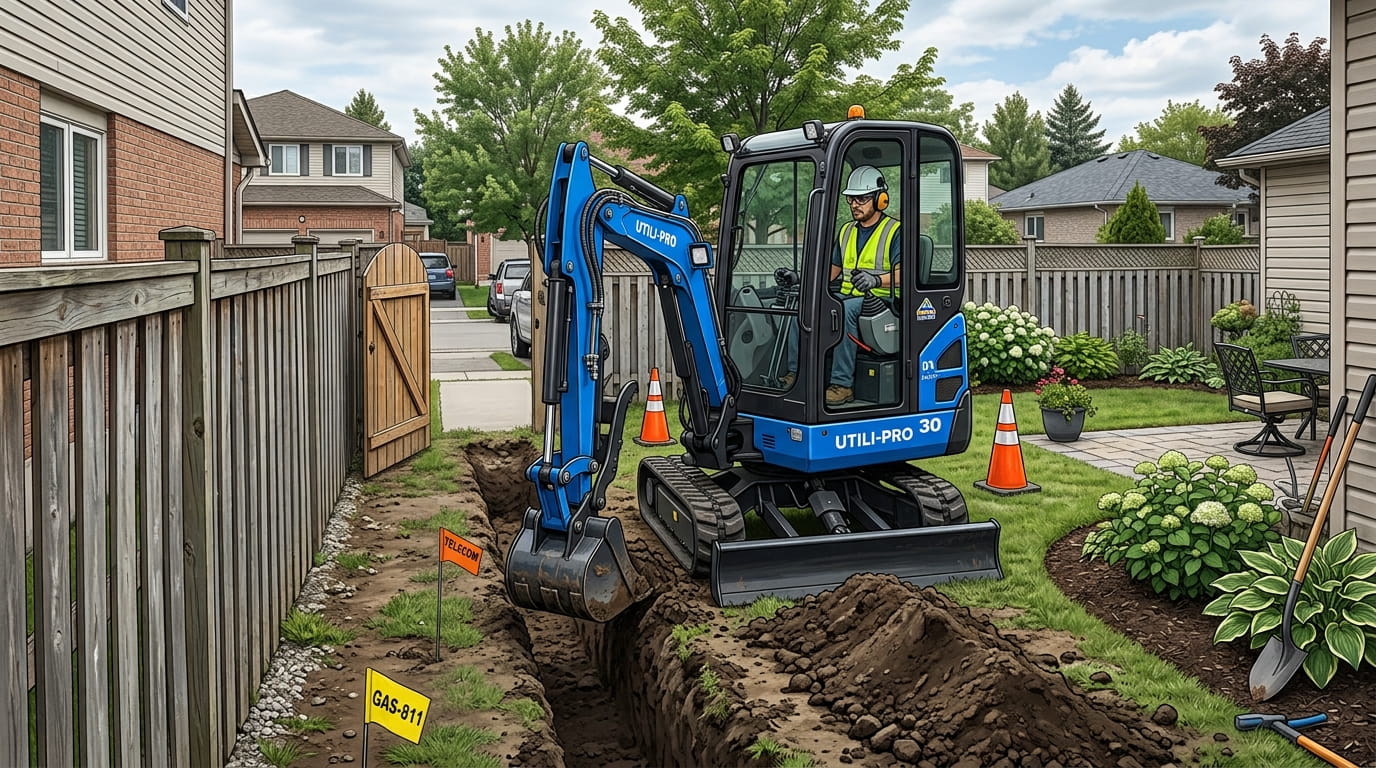
- Tight access. Some backyards, basements, and interior spaces don’t have a gate wide enough for even a mini excavator.
- Utility proximity. When excavation approaches marked underground utilities, follow the utility owner’s requirements and applicable local or state rules, and use the required hand-exposure or other approved method rather than relying on a fixed distance.
- Root and foundation work. Precision digging around tree roots or near an existing foundation favors control over speed.
- One-off small repairs. A single footing patch or a short utility repair trench rarely justifies mobilizing equipment at all.
Frequently Asked Questions
What’s the real difference between excavator and manual excavation?
An excavator moves soil with a hydraulic bucket. The mini-excavator figure of 8–12 CY/hour is an illustrative planning assumption with no specified BCY/LCY basis, while the full-size figure of 48–100 LCY/hour is derived from the stated theoretical cycle and efficiency assumptions. A person with hand tools moves about 0.4 to 0.9 bank cubic yards per hour. The excavator wins on speed for anything past a small volume. Manual work wins on precision near buried utilities, roots, or foundations.
How much does excavator rental cost per day?
A mini excavator (1.5 to 4 ton) rents for about $150 to $400 per day, based on 2026 marketplace data from DOZR and SkidSteersDirect. Mid-size machines run $700 to $1,500 per day. Weekly rentals cut the effective daily rate by roughly 60%.
Why is manual excavation more expensive per cubic yard than it looks?
Total labor-hours stack up fast, not just elapsed time. In one worked example, a 3-person crew took 11.1 crew-hours (33.3 total labor-hours) to hand-dig a 20-BCY trench. At $22.47 per hour, based on BLS May 2024 median pay for Construction Laborers ($46,730/year), that’s about $748 in wages alone, before tools, hauling, or disposal, versus roughly $400–$500 for a mini excavator’s day rental and delivery on the same job.
When is manual excavation the right choice?
Manual excavation tends to make sense for small volumes (often under roughly 5 to 10 BCY, though the real break-even depends on local rates and rental minimums), tight access a machine can’t fit through, work near utilities where the utility owner’s rules require hand exposure, or precision work close to root systems and foundations where a bucket strike would cause real damage.
How much does excavation cost per cubic yard?
Basic soil excavation runs roughly $2.50 to $15 per cubic yard depending on soil type, access, and region, according to HomeGuide’s 2026 cost data. Rock excavation runs far higher, often $50 to $200 or more per cubic yard, because it needs specialized breaking equipment.
Excavator vs manual excavation: which is faster?
A mini excavator runs roughly 4 to 7 times faster than a 3-person hand crew on the same volume, based on the production-rate estimates in this article. A full-size excavator’s reconciled daily-output range points to a much bigger gap on larger jobs, roughly an order of magnitude or more by one illustrative comparison, though soil, machine size, volume basis, and access all affect the exact multiple.
Is manual excavation safe for deep trenches?
OSHA requires a protective system, sloping, benching, shoring, or a trench box, for any excavation 5 feet deep or more. OSHA’s preliminary count put trench-related fatalities at 12 for calendar year 2024 (as of a November 2024 release) and 11 reported so far in 2025 (as of a June 2025 release), both point-in-time counts, not final totals. One cubic yard of soil can weigh as much as a car.
Do I need a permit or a professional for trench excavation?
Permit requirements vary by state, city, project type, depth, location, and proximity to utilities. Check with your local permitting authority before excavation. For trenches at or beyond 5 feet, OSHA rules call for a competent person on site to inspect the protective system before anyone enters.
Getting Your Numbers Right Before You Dig
Excavator vs manual excavation isn’t really a fixed threshold. It’s a tradeoff between labor-hours, rental minimums, and access, and the numbers above show how each pulls in a different direction depending on job size. Small, tight, or utility-sensitive jobs still belong to a crew with shovels. Larger volumes usually tip toward a rented machine, once you count total labor-hours honestly rather than just elapsed time.
Run your own project through Solvebility’s excavation and earthwork volume calculator first. It handles cut-and-fill volume, soil-specific swell and shrink factors, and truck load counts, so the production-rate math in this guide starts from a number you can trust. From there, you can price out labor hours against a rental quote and see which method actually wins your job.
Ready to run your own numbers?
Get instant cut, fill, and cost estimates with Solvebility’s free Excavation & Earthwork Volume Calculator, or browse the full civil engineering calculator suite.
References
- OSHA — Department of Labor encouraged by decline in worker death investigations (Nov. 4, 2024 release; 2024 trench fatality count “to date”)
- OSHA — US Department of Labor urges safe practices during trench and excavation work (June 28, 2025 release; 2025 trench fatality count)
- OSHA — Trenching and Excavation safety topic page (5-foot protective-system requirement)
- Equipment World — OSHA’s top 10 construction violations in 2024 (629 excavation citations, FY 2024)
- U.S. Bureau of Labor Statistics — Occupational Outlook Handbook, Construction Laborers and Helpers, Pay (May 2024 OEWS data)
- DOZR — 2026 excavator rental pricing guide
- HomeGuide — Excavation cost data, 2026
- Solvebility — Excavation & Earthwork Volume Calculator (swell/shrink factors and unit conversions)

Nouman Ahmed, a Civil Engineer with practical experience in solar energy system design, engineering calculations, electrical systems, and engineering software development. Since 2011, he has been involved in residential and commercial solar energy projects, helping design practical PV solutions and technical calculation tools.
Nouman is the founder of Solvebility, an engineering resource dedicated to publishing accurate, transparent, and easy-to-use online calculators covering renewable energy, electrical engineering, construction, mathematics, finance, health, and other technical disciplines.