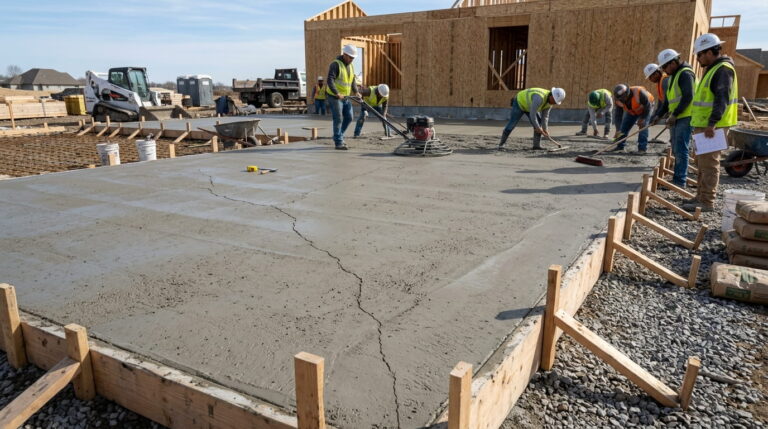


Reducing Construction Waste Through Accurate Volume Calculation
Last Updated: August 20, 2026 | Next Review: February 2027 | Reviewed against U.S. EPA C&D debris data and the assumptions stated in this guide.
Most contractors don't waste material because they're careless. They waste it because the math was off before the truck ever showed up.
A slab poured 2 inches thicker than planned. A load of block ordered off a rough guess instead of a real takeoff. An excavation that moved 15% more soil than the drawings said it would. None of that shows up as a mistake until the dumpster's full and the invoice lands.
This guide walks through how accurate volume calculation cuts material waste at the source, where the waste actually comes from on a typical job, and which numbers matter most when you're pricing concrete, aggregate, excavation, or masonry. The national C&D figures are drawn from U.S. EPA data. Material waste allowances in this guide are explicitly presented as illustrative planning ranges, with sources and assumptions explained at the end.
- Why Construction Waste Starts With Bad Math
- How Do You Calculate Material Volume Accurately?
- Where Does the Waste Actually Come From?
- Getting Excavation and Earthwork Numbers Right
- Concrete, Block, and Aggregate: Where Over-Ordering Gets Expensive
- What Tools Actually Cut Waste on a Job Site?
- Other Ways to Reduce Construction Material Waste
- How Much Does Better Volume Calculation Actually Save?
- How We Estimate Construction Material Waste
- FAQ
- Sources & References
Why Construction Waste Starts With Bad Math
The U.S. EPA estimated that about 600.3 million tons of construction and demolition (C&D) debris were generated in the United States in 2018, the most recent year with published national data.[1] That figure covers both demolition and construction activity, and the split matters: demolition accounted for roughly 567.3 million tons of the total, more than 90%, while construction-related debris made up a much smaller share, around 33.0 million tons.[1] The 600-million-ton figure describes national C&D debris generation, not the volume of material wasted specifically on new-construction projects, and it shouldn't be read as one.
On an individual job site, the waste that matters to your budget looks different. A quantity gets eyeballed instead of calculated, a flat "just in case" buffer gets added on top, and the order gets rounded up because that's what the supplier stocks in bulk. Multiply that across every material on a job and you end up paying for concrete, block, and framing that never needed to be bought.
Volume calculation touches nearly every one of those decisions at once. Get the cubic yards right on your excavation, the square footage right on your slab, and the linear footage right on your framing, and the allowance you add can be replaced by a calculated, material-specific factor based on project conditions and historical performance.
Construction material waste vs. C&D debris: these terms get used interchangeably, but they're not the same thing. Construction material waste is material purchased or produced for a project that never gets installed or used, whether that's excess concrete, off-cuts, damaged product, or simple over-ordering. C&D debris is the broader EPA-tracked waste stream that also includes renovation and demolition material, most of which is generated by tearing structures down rather than building them. This article focuses on the first category, since that's the one a contractor can control at the ordering stage.
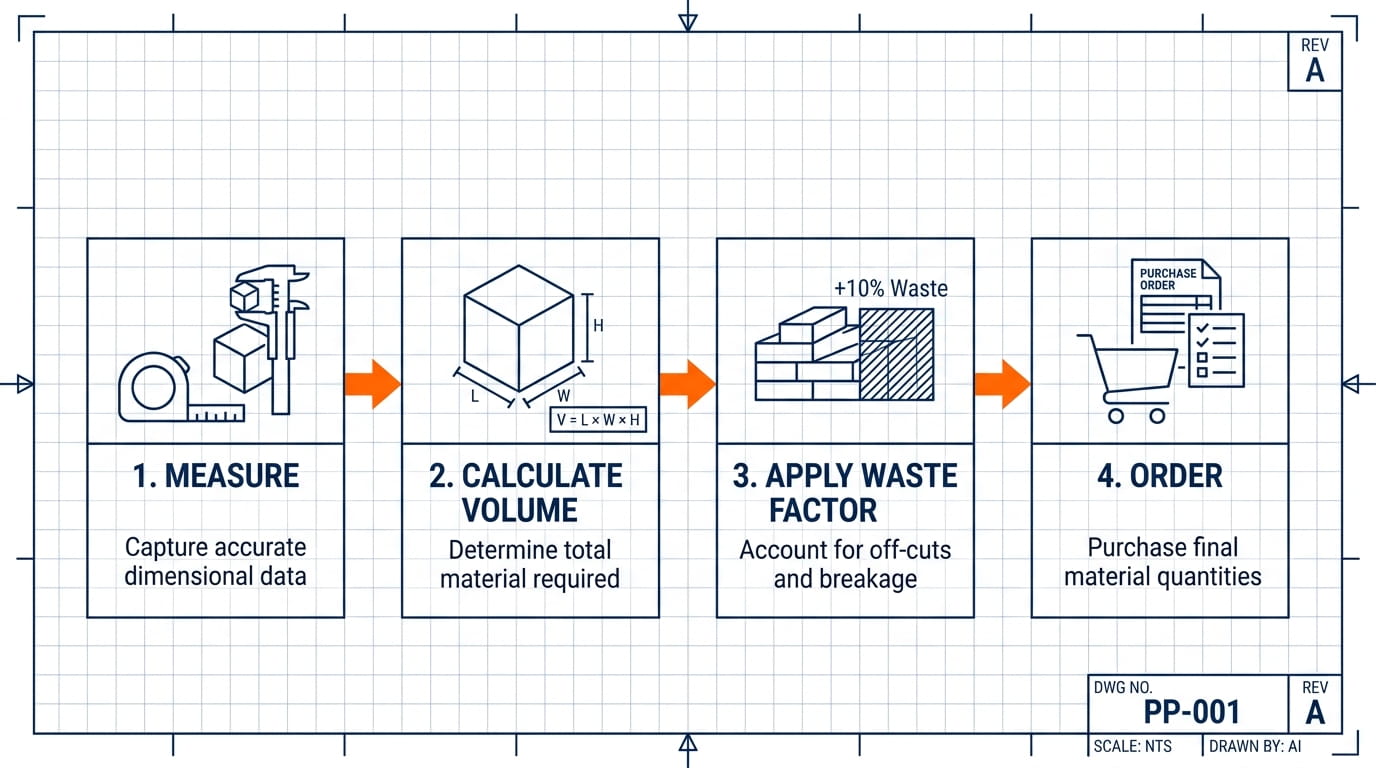
A four-step takeoff process: measure, calculate volume, apply the right waste factor, then order.
How Do You Calculate Material Volume Accurately?
Quick answer: Measure the actual dimensions on site or from current drawings, apply the correct geometric formula for the shape (length × width × depth for slabs, cross-sectional area × length for trenches), then add a material-specific waste factor before you order. Skipping the field measurement step is where most estimating errors start.
Accurate volume calculation comes down to five steps, and skipping any one of them is usually where the error creeps in.
- Measure the real dimensions. Use current drawings, but verify against the actual site or framed structure when you can. Plans change. Sites shift.
- Pick the right formula for the shape. A rectangular slab is length × width × depth. An irregular footing needs to be broken into simpler shapes and summed. A trench needs cross-sectional area × length.
- Convert to the unit you're buying in. In the U.S. ready-mix market, concrete is commonly ordered and priced by the cubic yard. Divide cubic feet by 27 before you call the batch plant.
- Apply a waste factor specific to the material. Concrete needs less padding than tile laid on a diagonal. A flat 10% across every material is a guess, not a calculation.
- Cross-check against your budget. If the volume comes back wildly different from what you priced the job at, recheck the measurement before you order.
A calculator built for the specific material saves time here and catches unit-conversion mistakes that spreadsheets miss. Solvebility's Excavation & Earthwork Volume Calculator handles cut-and-fill volumes directly in cubic yards, which is usually where the biggest numbers (and the biggest errors) show up.
Where Does the Waste Actually Come From?
Quick answer: Most construction material waste comes from cutting losses, over-ordering to avoid running short, and site handling damage rather than defective material. How much waste each material generates depends heavily on project geometry, layout complexity, and how carefully quantities were calculated before ordering.
Waste percentages aren't consistent across materials, and treating them as if they were is how estimators overspend on some items and run short on others. The ranges below are planning figures, useful as a starting point for building your own waste factor, not a guarantee for any specific job.
| Material | Planning Range | Main Cause |
|---|---|---|
| Concrete (ready-mix, formed pour) | 2% – 5% | Over-batching, spillage, formwork gaps |
| Brick & block masonry | 5% – 15% | Breakage, corner and course cutting |
| Framing lumber | 10% – 20% | Off-cuts, custom-length sizing |
| Drywall / gypsum board | 10% – 15% | Cutting around openings and corners |
| Tile (straight lay) | 10% – 15% | Edge cuts, breakage |
| Tile (diagonal or pattern lay) | 15% – 25% | Complex cut geometry |
| Excavated soil / fill | 5% – 15% | Soil swell (bulking) and cut/fill imbalance |
These are illustrative planning ranges used in this guide, not universal industry standards or project guarantees. Actual waste on any given project depends on geometry, material specification, workmanship, cutting requirements, ordering practices, site conditions, and supplier minimums, and should be adjusted based on your own project history where possible.
Concrete tends to sit toward the lower end of that range on a straightforward, well-formed pour, largely because it's almost always calculated as a real volume before it's ordered; nobody wants to guess and come up short mid-pour. Materials that get eyeballed instead of calculated, like tile layout or framing off-cuts, tend to run higher. The actual number for any pour still depends on formwork accuracy, placement losses, and site conditions, so treat the 2–5% figure as an illustrative planning allowance to verify against your own results, not a fixed industry requirement.
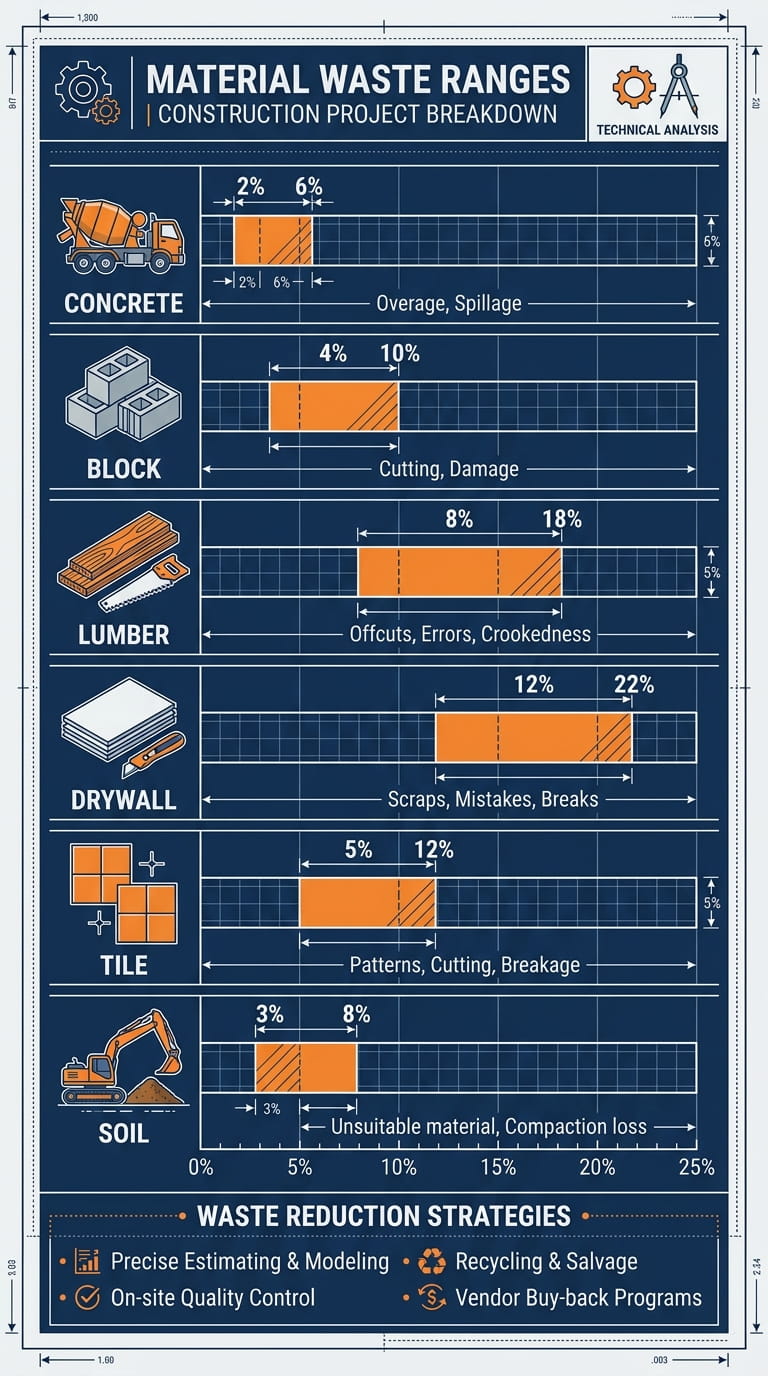
Waste sources break down into cutting loss, over-ordering, and handling damage, in that order of impact.
Getting Excavation and Earthwork Numbers Right
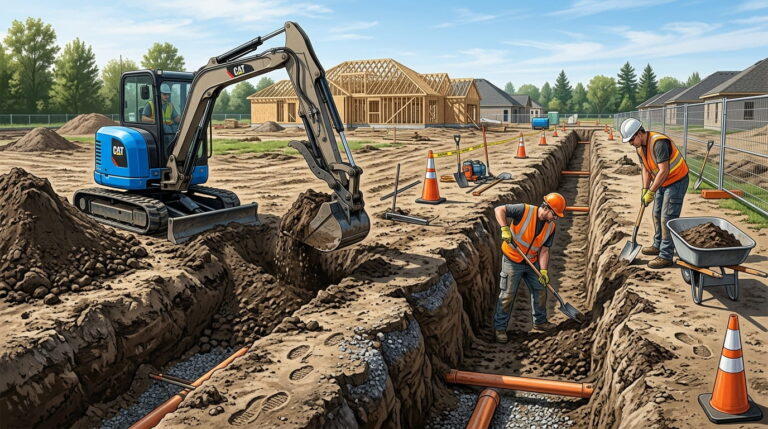
Excavation is where volume errors get expensive fast, because you're moving cubic yards by the hundreds or thousands, not by the bag. Getting this right starts with understanding that "volume" isn't one number here. It's three:
- Bank volume — the volume of soil as it sits undisturbed in the ground, before anything is dug.
- Loose volume — the volume that same soil occupies once it's excavated and sitting in a pile or truck bed. Disturbed soil generally occupies more loose volume than its bank volume, a property commonly called "swell" or "bulking," though the actual swell factor varies significantly by soil type, moisture content, and how the material is handled, so it's worth confirming with a geotechnical reference or your supplier rather than assuming a fixed percentage.
- Compacted volume — the volume that same material occupies once it's placed as fill and compacted, which is usually less than its loose volume and can be close to, at, or below its original bank volume depending on compaction effort.
A common estimating mistake is calculating haul-off volume or disposal cost using the bank (in-ground) measurement instead of the loose measurement the truck will actually carry, which under-orders trucks and under-budgets disposal. Fill orders run into the opposite issue: the loose volume you buy needs to cover the compacted volume you actually need once it's placed and rolled. Mixing up these three volumes in either direction either leaves you short mid-project or paying to haul away material you didn't need.
Run cut-and-fill numbers through a dedicated tool rather than a flat rule of thumb. The Excavation & Earthwork Volume Calculator factors in bank and loose volume separately, which is the step most manual takeoffs skip. If you're still deciding between renting equipment or hand-digging a smaller area, our breakdown on excavator vs. manual excavation cost and time covers when the machine actually pays for itself.
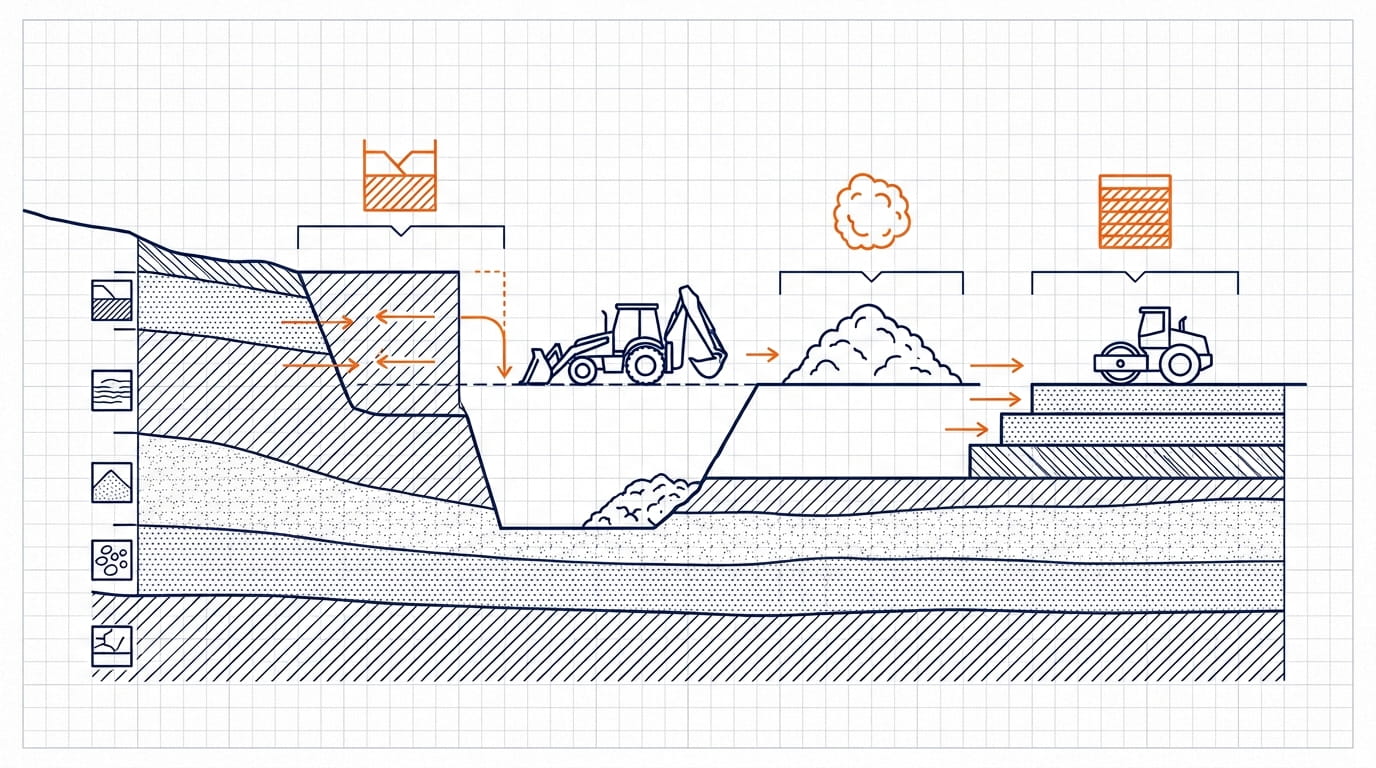
Bank volume, loose volume, and compacted volume are three different numbers. Mixing them up is the most common excavation estimating error.
Concrete, Block, and Aggregate: Where Over-Ordering Gets Expensive
Concrete is unforgiving in both directions. Order short and you're paying for a second truck, a short-load fee, and a cold joint you didn't want. Order long and you're paying to dispose of wet concrete that hardens in the chute before anyone can use it.
Illustrative example: take a 1,800 square foot slab poured at 4 inches thick. The calculated geometric volume is 1,800 × (4 ÷ 12) ÷ 27 = 22.22 cubic yards. Add a 5% planning allowance for spillage and formwork variance and the order comes to about 23.33 cubic yards. If the order instead gets rounded up to a flat 30 cubic yards, that's roughly 7.78 cubic yards more than the calculated-plus-allowance figure. Using an assumed delivered ready-mix price of $150 to $180 per cubic yard, that excess works out to approximately $1,167 to $1,400 on a single pour, before any disposal or short-load fees. This is a worked example to show the arithmetic, not a documented case from a specific project.
A real volume calculation before every order catches this: length × width × depth ÷ 27 for cubic yards, then an illustrative planning allowance such as 2% to 5% for a straightforward slab pour, subject to project-specific verification. Our Concrete Mix Design Calculator handles the mix ratios once you've got the volume locked in.
Block and brick masonry behave differently. Waste climbs with the number of cuts, so a wall full of corners, openings, and course adjustments wastes more than a long straight run. The Bricks and Block Masonry Calculator accounts for standard coursing and mortar joint width, which keeps the count closer to what you'll actually lay.
| Order Method | 1,800 sq ft Slab (4") | Result |
|---|---|---|
| Rounded estimate ("call it 30 yards") | 30 cu yd | ~7.78 cu yd above the calculated figure, ~$1,167–$1,400 in excess material |
| Calculated volume + 5% allowance | 23.33 cu yd | Aligns with the calculated geometric volume plus a planning margin |
What Tools Actually Cut Waste on a Job Site?
Spreadsheets and rules of thumb get you close. Purpose-built calculators get you accurate, because they apply the right formula and the right waste factor for each material instead of one blanket number for everything.
- Volume and quantity calculators. Excavation, concrete, and masonry calculators handle unit conversions and geometry automatically, which removes the most common source of manual error.
- Material-specific takeoff tools. Tile and plaster waste vary enormously by layout pattern, so a generic 10% factor is often wrong in both directions. The Smart Tile Calculator and Wall Plaster Quantity Calculator adjust for pattern and coat thickness.
- Post-job comparison. After every project, compare what you ordered to what you actually used. This is the step most crews skip, and it's the one that improves your waste factor over time instead of guessing forever.
- On-site verification. A quick field measurement before ordering catches the drawings-vs-reality gap before it becomes a wasted truckload.
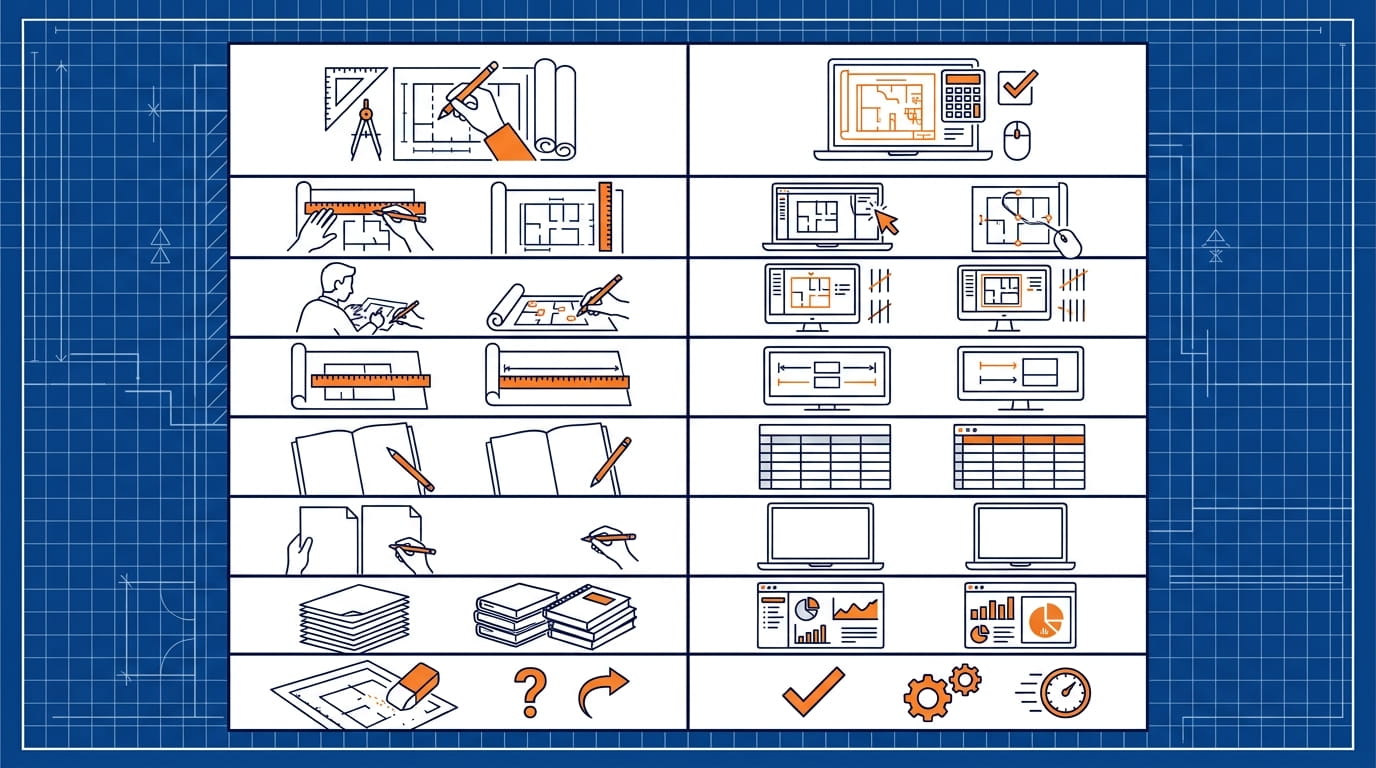
Manual takeoffs depend on the estimator's experience. Calculators apply the same formula and waste factor every time.
Other Ways to Reduce Construction Material Waste
Accurate volume calculation prevents waste before it happens, but it isn't the only lever. These practices work alongside it:
- Quantity takeoff discipline. Run a formal takeoff for every material category rather than estimating some by feel, especially on materials with high cut waste like tile and masonry.
- Material-specific waste factors. Apply a different allowance per material instead of one flat number across the whole job, since a straight concrete pour and a diagonal tile layout don't waste at the same rate.
- Field verification before ordering. Check drawings against actual site conditions right before you place a large order. Plans and sites drift apart over the course of a project.
- Procurement and delivery planning. Order in phases where practical instead of all at once, so mid-project design changes don't leave you holding material you no longer need.
- Supplier coordination. Talk to suppliers about return policies, minimum order quantities, and delivery scheduling. Some waste comes from being locked into a supplier's bulk unit rather than the exact quantity needed.
- Proper material storage. Weather exposure, poor stacking, and unsecured storage damage materials that were correctly ordered in the first place. Storage failure is waste too, even when the takeoff was right.
- Cutting and layout optimization. Plan cut layouts for sheet goods, tile, and lumber to minimize off-cuts, and reuse larger off-cuts on smaller sections of the job where they fit.
- Reuse of suitable material. Usable off-cuts, excess block, and surplus fill can often go to a smaller area of the same project or a future job instead of the dumpster.
- Recycling what can't be reused. Concrete, masonry, and metal are commonly recyclable through C&D recycling facilities, which reduces landfill volume even when the material itself couldn't be avoided.
- Post-project waste tracking. Compare what you ordered against what you used on every project. That comparison, done consistently, is what turns a generic waste factor into one calibrated to your own crews and conditions.
How Much Does Better Volume Calculation Actually Save?
Quick answer: The savings depend entirely on your current waste allowance, the affected material budget, and how much of that allowance is actually reducible. The scenario below shows the arithmetic for one set of assumptions; it is not a benchmark for what every project will save.
Illustrative scenario: if a project reduces its waste allowance from 10% to 4% on the portion of the material budget affected by that allowance, the direct difference is 6 percentage points. On $150,000 of affected material spend, that difference equals $9,000. The table below applies the same 6-point difference across a few project sizes purely to show how the math scales; actual results vary by material mix, project conditions, ordering practices, and how much of the total budget the allowance actually touches.
| Affected Material Spend | At a 10% Allowance | At a 4% Allowance | Difference (Illustrative) |
|---|---|---|---|
| $20,000 | $2,000 | $800 | ~$1,200 |
| $150,000 | $15,000 | $6,000 | ~$9,000 |
| $1,000,000 | $100,000 | $40,000 | ~$60,000 |
The underlying arithmetic is simple: a smaller, better-calculated allowance costs less than a larger, rounded-up one, and the gap compounds as material prices rise, which they have most years. Whether your project actually captures a difference this size depends on how much of your budget is currently padded with a flat allowance versus a calculated one.
How We Estimate Construction Material Waste
The figures and examples in this guide follow a consistent method, and it's worth stating plainly so you can judge how much to rely on them:
- Quantity takeoff. Volumes and areas are calculated from stated dimensions using standard geometric formulas, not scaled off drawings by eye.
- Unit conversion. Cubic feet are converted to cubic yards (÷ 27) before pricing, matching how ready-mix and bulk aggregate are actually sold.
- Material-specific allowances. Waste allowances are applied per material rather than as one flat percentage, using the planning ranges in the table above.
- Field verification. Wherever possible, calculated quantities should be checked against an actual site or framed measurement before ordering, since drawings and site conditions can diverge over the course of a project.
- Bank, loose, and compacted volume. Earthwork calculations distinguish between these three states explicitly, since treating them as interchangeable is a common source of over- or under-ordering.
- Assumptions and variability. Dollar figures in this guide use a stated price range (for example, $150–$180 per cubic yard for ready-mix) as an assumption, not a quote. Actual prices vary by region, supplier, and market conditions, and readers should substitute current local pricing for any real budgeting decision.
Waste allowances published here are planning figures drawn from common estimating practice, not a single peer-reviewed study, and they should be adjusted against your own project history wherever you have it.
FAQ
What is construction material waste?
Construction material waste is any material purchased or produced for a project that isn't installed or used, including over-ordered concrete, off-cuts from framing and tile, and damaged or discarded product. It's a narrower category than construction and demolition (C&D) debris, which also includes renovation and demolition material and is tracked separately by the EPA.
How do you calculate material volume for a construction project?
Measure the actual dimensions, apply the correct geometric formula for the shape, convert to your purchasing unit (usually cubic yards for concrete and fill), then add a material-specific waste allowance. A dedicated calculator handles the formula and conversion automatically and reduces the chance of a unit-conversion error.
Why does reducing construction waste through volume calculation matter?
Waste isn't just an environmental cost. Every cubic yard or square foot you over-order is money spent on material you'll likely pay again to haul away. Getting the volume right the first time reduces both the purchase cost and the disposal cost.
When should you recalculate material volumes during a project?
Recalculate any time the drawings change, before every major material order, and once more against a field measurement right before you place the order. Plans and site conditions can drift apart over a project's timeline, and a calculation done closer to order day tends to be more accurate.
How much does inaccurate estimating cost a construction project?
It varies significantly by project, material mix, and estimating practice, so there's no single industry-wide figure. A 10% to 15% flat overage may be used as a conservative project-specific buffer in some estimating workflows, but it is not a universal industry standard. Replacing a blanket allowance with a calculated, material-specific factor is the approach this guide recommends, with the actual dollar impact depending on the project and material mix.
Volume calculators vs. manual takeoffs: which is more accurate?
Calculators tend to be more consistent because they apply the same formula and allowance every time, regardless of how rushed the estimator is. A skilled estimator doing a manual takeoff can be just as accurate, but manual work is more vulnerable to rounding, unit-conversion mistakes, and fatigue on long bids.
Is a 10% waste factor always the right number?
No. A flat 10% is a shortcut, not a calculation, and it isn't backed by a single standard that applies to every material. A well-formed concrete pour often needs a smaller allowance, while a diagonal tile layout or a heavily-cut masonry wall can reasonably need more. Using one number across every material tends to overspend on the easier items and underspend on the harder ones.
What's the easiest way to start reducing construction material waste this week?
Pick your next big-ticket order, whether that's concrete, excavation, or masonry, and run it through a proper volume calculator instead of a rounded estimate. Compare the result to what you would have ordered by habit. That single comparison usually shows where your current allowance has been padding costs unnecessarily.
The Bottom Line
Waste reduction on a job site rarely comes down to one big fix. It comes down to running the real numbers before every order, instead of defaulting to a round figure that feels safe.
Start with whichever material carries the biggest line item on your next bid, usually concrete or excavation, and calculate the actual volume before you call it in. The Excavation & Earthwork Volume Calculator is a good place to start if earthwork is part of the scope, and the rest of Solvebility's civil engineering calculators cover concrete, masonry, tile, and plaster from there.
Sources & References
- U.S. Environmental Protection Agency. Construction and Demolition Debris: Material-Specific Data. Advancing Sustainable Materials Management, 2018 data.
- U.S. Environmental Protection Agency. Sustainable Management of Construction and Demolition Materials.
Waste allowance ranges cited in this guide reflect common construction estimating practice rather than a single published dataset, and are labeled as planning ranges throughout for that reason. Cost figures use assumed pricing stated in context and should be substituted with current local pricing for actual budgeting.

Nouman Ahmed, a Civil Engineer with practical experience in solar energy system design, engineering calculations, electrical systems, and engineering software development. Since 2011, he has been involved in residential and commercial solar energy projects, helping design practical PV solutions and technical calculation tools.
Nouman is the founder of Solvebility, an engineering resource dedicated to publishing accurate, transparent, and easy-to-use online calculators covering renewable energy, electrical engineering, construction, mathematics, finance, health, and other technical disciplines.