
Concrete Slab Cracking: Causes and How to Prevent It
Reviewed by a licensed civil engineer on the Solvebility Review Board. See our Editorial Policy.
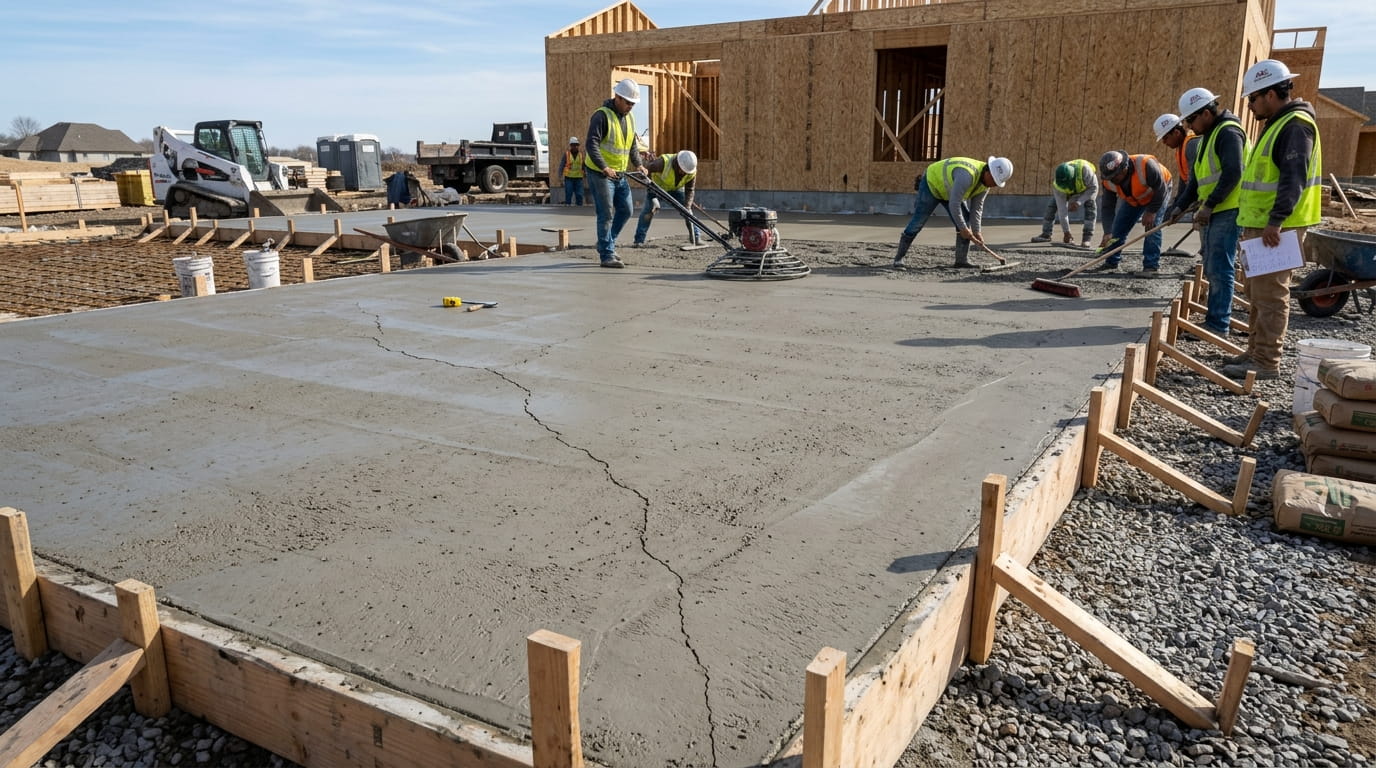
A cracked concrete slab in the first year isn’t rare. Most driveways, garage floors, and patios develop at least a hairline crack, and in most cases that’s just concrete doing what concrete does.
The hard part is telling a normal shrinkage crack apart from one that means your subgrade is failing or the slab is heaving. Guess wrong and you either panic over nothing or ignore a crack that gets worse every winter.
This guide covers what actually causes concrete slab cracks, how to prevent them before you pour, and how to tell which ones need a professional. It follows standard practice from the American Concrete Institute (ACI 302.1R, ACI 360R) and the Portland Cement Association (PCA), the two references most US contractors work from.
Key Terms, Defined
- Plastic shrinkage cracking
- Thin, random cracks that form while concrete is still soft, usually within 6 hours of the pour, from surface water evaporating too fast.
- Drying shrinkage
- Straight, thin cracks that form over the following weeks as the cured slab loses its remaining internal moisture and contracts.
- Differential settlement
- Uneven sinking of the ground under a slab, where one section compacts or erodes more than the rest.
- Water-cement ratio
- The proportion of water to cement in the mix by weight; a lower ratio means less shrinkage but a stiffer, harder-to-place mix.
What Causes Concrete Slab Cracking?
Concrete slabs crack mainly from shrinkage during curing, poor soil compaction, missing or badly spaced control joints, and rapid moisture loss in hot or windy weather. Nearly all of it is preventable with proper prep before the pour.
Concrete is a mix of cement, water, sand, and aggregate. As it cures, water either reacts with the cement or evaporates, and the slab physically shrinks. That shrinkage has to go somewhere. If the slab can’t move freely, or dries unevenly, it cracks.
Five factors show up again and again in cracked concrete driveways, garage floors, and patio slabs:
- Poor soil compaction or expansive soil — the ground settles or swells unevenly under the slab
- Missing control joints — no planned weak point for the crack to follow
- Fast drying — wind, heat, or low humidity pull water out before the concrete gains strength
- High water-cement ratio — a wetter mix shrinks more as it dries
- Loading too soon — driving or parking on a slab before it cures fully
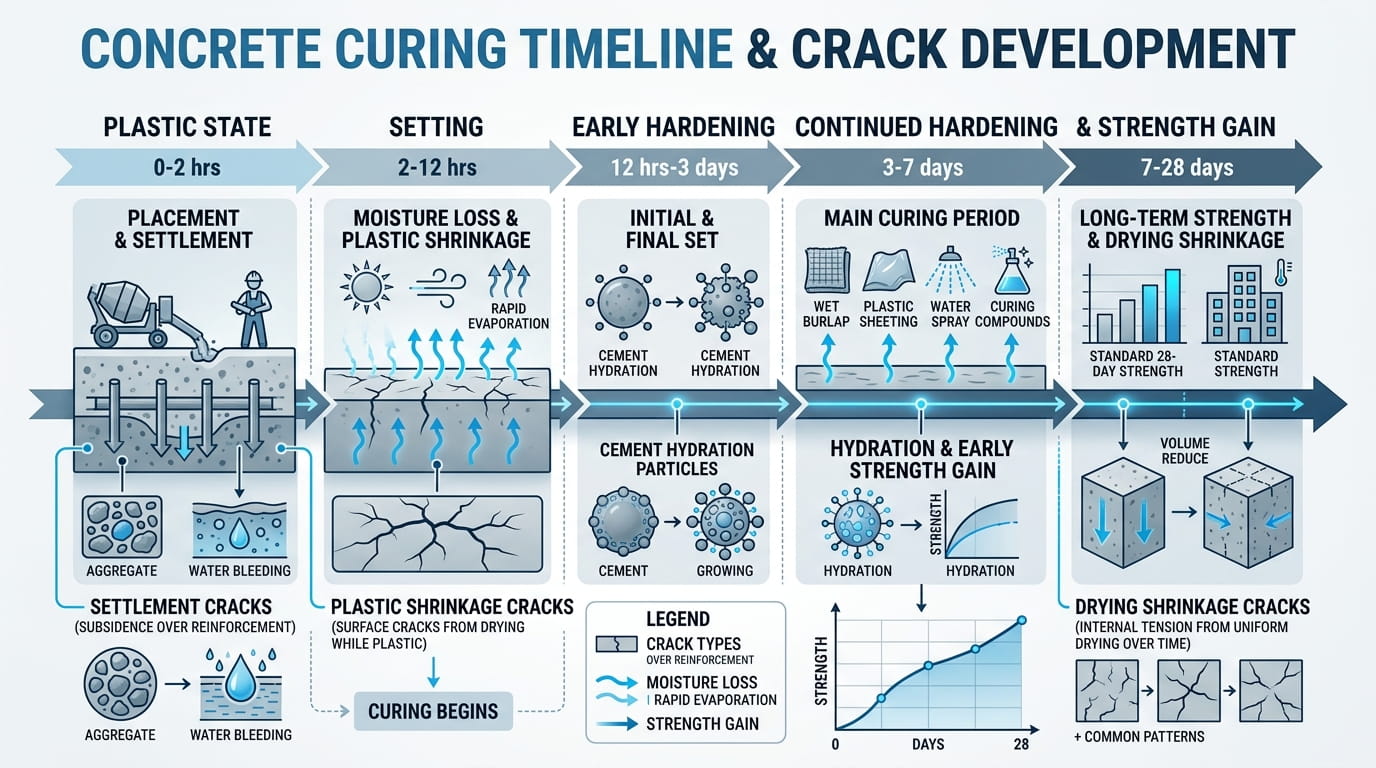
Why Do Concrete Slabs Crack During the Curing Process?
Plastic shrinkage cracking happens when surface water evaporates faster than bleed water can replace it, most often on hot, dry, or windy days. It shows up within the first few hours, before the slab has any real strength to resist it.
Two curing-related cracks are worth telling apart. Plastic shrinkage cracks form while the concrete is still soft, within about six hours, as thin, irregular, sometimes map-like lines. Thermal cracking is related but caused by heat instead of moisture: thick slabs generate heat as cement hydrates, and if the surface cools faster than the core, that temperature gap stresses the concrete.
Drying shrinkage cracks form later, over the first few weeks, as the slab’s remaining moisture leaves and it contracts. These are the straight, thin lines running from a corner or edge.
Pour early morning or late afternoon in hot months. A curing compound or wet burlap applied within the first hour slows evaporation and gives the concrete time to build strength before shrinkage stress kicks in.
How Does Poor Soil Compaction Lead to Differential Settlement Cracks?
A compacted, uniform subgrade gives the slab even support, so it can’t settle unevenly. Skipping compaction, or pouring over expansive soil that swells and shrinks with moisture, is one of the most common causes of differential settlement cracking.
Concrete is strong in compression but weak in tension. When part of a slab loses support underneath, even slightly, that section bends under its own weight. Concrete doesn’t bend well, so it cracks instead.
Good subgrade prep, per PCA guidance, means:
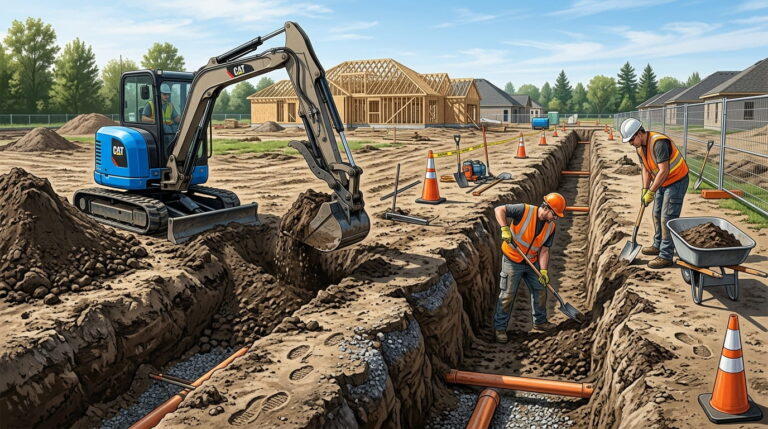
- Removing topsoil and organic material down to stable soil
- Filling low spots with compactible gravel, not loose dirt
- Compacting in 4–6 inch lifts with a plate compactor
- Grading for drainage so water doesn’t pool and soften the base
- Testing for expansive clay soil in regions where it’s common, and adding extra sub-base if present
Weak spots settle first, and that settlement is what turns a hairline crack into a slab visibly dipping on one side. You can rough out cut-and-fill volumes for base material with Solvebility’s Excavation & Earthwork Volume Calculator before ordering gravel.
What Role Do Control Joints and Expansion Joints Play?
A control joint gives a slab a planned, weakened line to crack along instead of splitting randomly. An expansion joint is different: it’s a full-depth gap that lets adjoining slabs move without pushing against each other.
A control joint is a groove cut into the slab, either tooled while the concrete is still green or sawed within 6–18 hours after finishing. It reduces the slab’s thickness at that line by about 25%, enough to guide the shrinkage crack down the joint instead of across the visible surface.
| Slab Thickness | Max Joint Spacing | Typical Use |
|---|---|---|
| 4 in | 8–10 ft | Patios, walkways |
| 5 in | 10–12 ft | Standard driveways |
| 6 in | 12–15 ft | Heavy-use driveways, light commercial |
| 8 in | 15–18 ft | Commercial slabs, equipment pads |
Rule of thumb: joint spacing in feet should be about 2 to 3 times the slab thickness in inches. Expansion joints, by contrast, go where a slab meets a wall, another slab, or a fixed structure, using a compressible filler so nothing cracks from thermal movement.
How Does Water-Cement Ratio and Mix Design Affect Cracking?
A higher water-cement ratio makes concrete easier to place, but more water has to leave the slab as it cures, which means more shrinkage stress. Most residential slabs should target a ratio of 0.45–0.50.
Other mix-design choices that reduce concrete slab cracks:
- Fiber reinforced concrete — synthetic fibers mixed throughout help control plastic shrinkage cracking
- Rebar or wire mesh reinforcement — doesn’t stop cracks from forming, but holds them tight once they do
- Curing compound — sprayed on right after finishing, it seals in moisture during the critical first days
- Proper concrete finishing — overworking the surface pulls excess water and fines upward, weakening the top layer
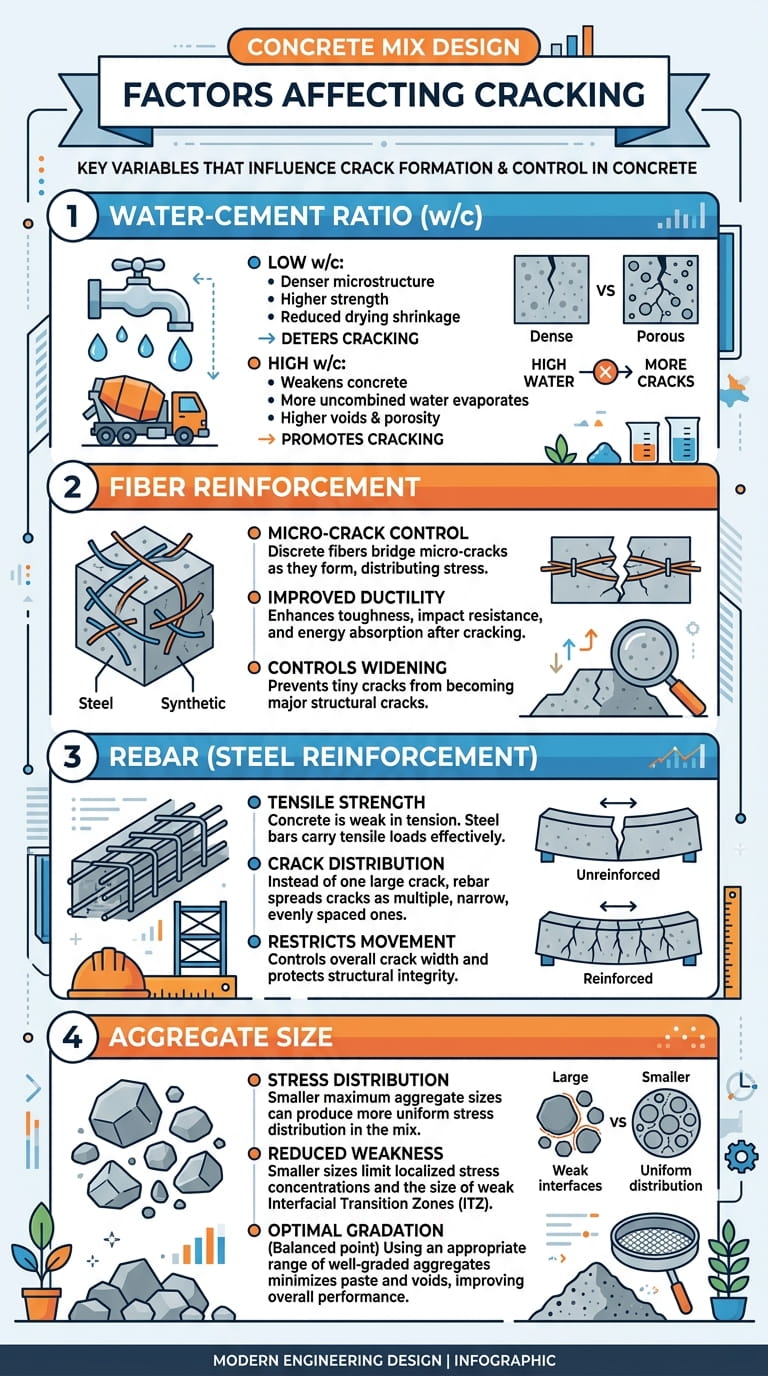
Run your target compressive strength and water-cement ratio through Solvebility’s Concrete Mix Design Calculator (ACI 211) before you order ready-mix, so the batch plant quotes the right ratio from the start.
Concrete Slab Crack Prevention Checklist
- Compact subgrade in 4–6 inch lifts; test for expansive soil first
- Grade for drainage so water can’t pool under the slab
- Keep water-cement ratio at 0.45–0.50
- Add fiber reinforcement or rebar per span and load requirements
- Cut or saw control joints at 2–3x slab thickness (in feet)
- Apply curing compound or wet burlap within the first hour
- Avoid pouring in direct sun, high wind, or below 40°F without precautions
- Keep vehicles off a new slab for at least 7 days, full load for 28 days
Shrinkage Cracks vs. Settlement Cracks: What’s the Difference?
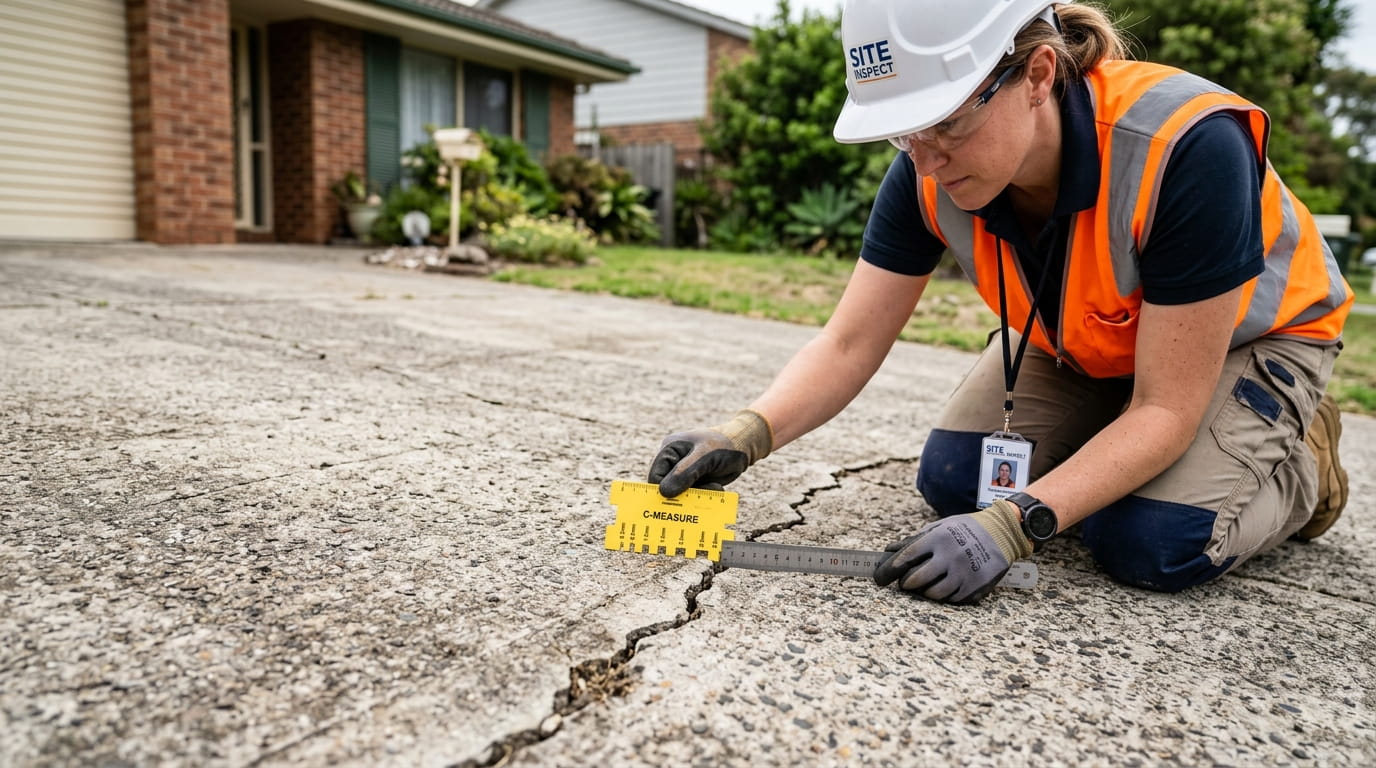
Shrinkage cracks are thin, straight, and appear within days of the pour. Settlement cracks are wider, uneven, and show up later because the soil under part of the slab compacted or eroded more than the rest.
| Feature | Shrinkage Crack | Settlement Crack |
|---|---|---|
| When it appears | Hours to weeks after pour | Months to years after pour |
| Crack width | Usually under 1/8 in | Often 1/8 in or wider |
| Shape | Straight, thin lines | Jagged, uneven, may step |
| Cause | Water loss during curing | Differential settlement of soil |
| Elevation change | None | One side often sits lower |
| Typical fix | Cosmetic sealant | Mudjacking, slab leveling, or replacement |
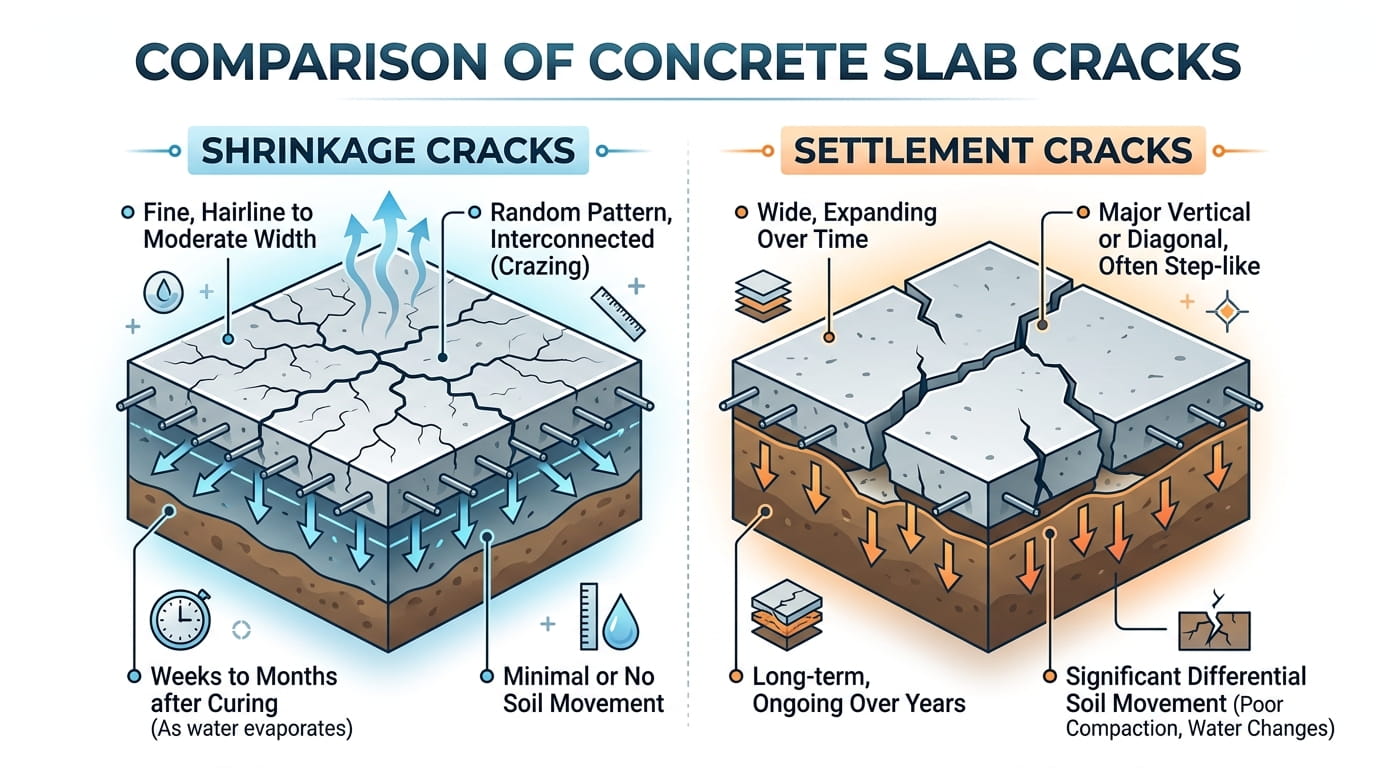
The elevation test is the fastest way to tell them apart. If both sides are level, it’s almost certainly shrinkage. If one side sits higher, that’s settlement, and it’s worth a foundation crack inspection before it spreads.
How Do You Repair a Cracked Concrete Slab?
Hairline cracks under 1/8 inch usually just need a flexible concrete sealant or crack filler to keep water out. Wider cracks in a garage or driveway do better with an epoxy crack injection or polyurethane crack injection that bonds both sides back together structurally.
For settlement cracks, sealing the surface doesn’t fix the ground underneath. Mudjacking (pumping a grout mix under the slab) or polyurethane foam lifting can raise a sunken section back to level. If settlement is severe, slab replacement is sometimes the more cost-effective option long term.
| Method | Best For | Typical Cost |
|---|---|---|
| Concrete sealant / crack filler | Hairline shrinkage cracks | $50–$150 per crack (DIY) |
| Epoxy crack injection | Structural hairline-to-moderate cracks | $250–$800 per crack |
| Polyurethane crack injection | Cracks with active water infiltration | $300–$800 per crack |
| Mudjacking | Moderate settlement, budget option | $500–$1,300 per area |
| Polyurethane foam lifting | Precise leveling, less invasive | $700–$1,500 per area |
| Slab replacement | Severe or repeated settlement | $8–$15 per sq ft |
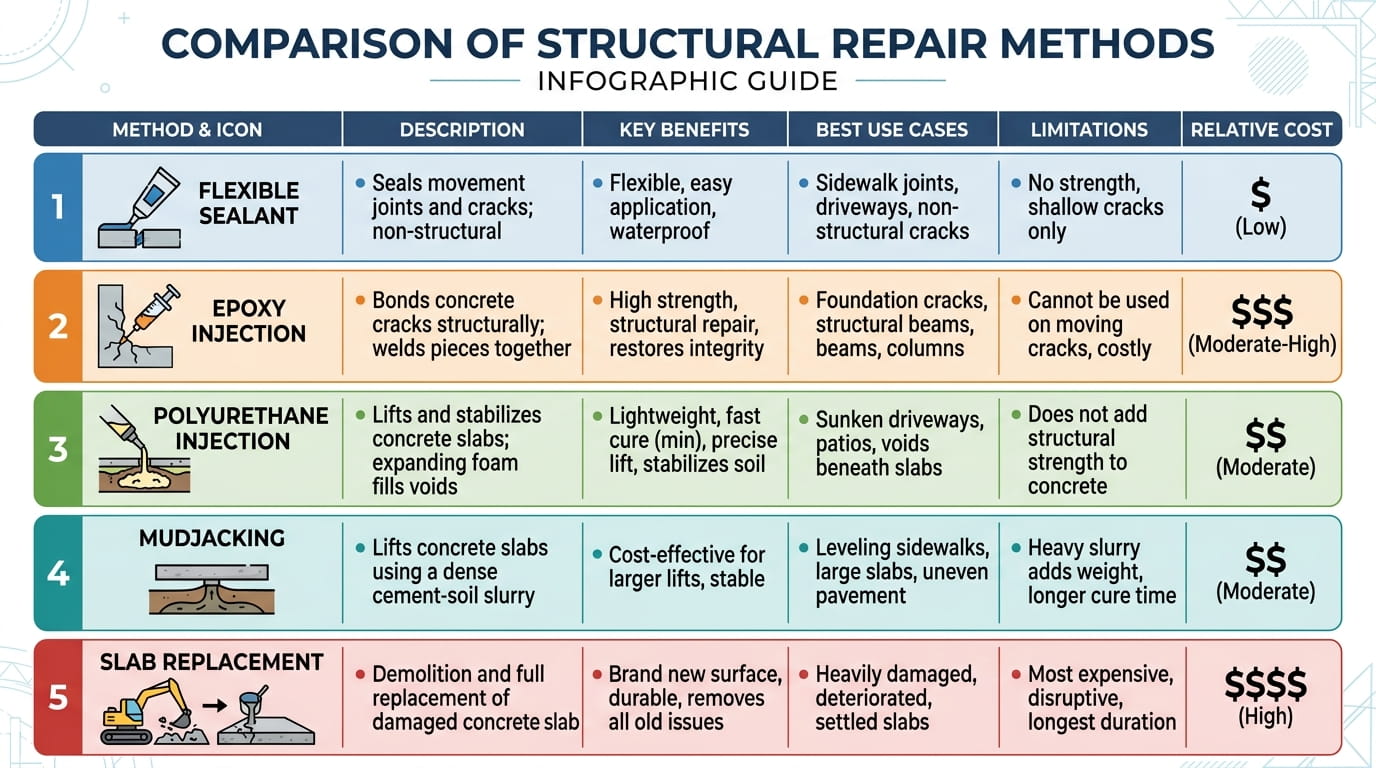
Don’t fill a crack that’s still moving. Watch it for a season. If it’s stable, a sealant or injection holds. If it keeps growing, fix the subgrade first, or you’ll repair the same crack every year.
Decision Tree: When to Call a Professional
Quick Self-Check
- Is the crack wider than 1/4 inch?
Yes → Get a foundation crack inspection from a structural engineer.
No → Continue to step 2. - Does one side of the crack sit noticeably higher than the other?
Yes → Likely differential settlement; call a foundation contractor.
No → Continue to step 3. - Has the crack visibly grown over the last few months, or is it paired with sticking doors/windows or stair-step cracks in masonry?
Yes → Get a professional inspection; these signs point to ongoing movement.
No → Likely a stable shrinkage crack; a DIY sealant or crack filler is fine.
Frequently Asked Questions
What is concrete slab cracking?
It’s the general term for any fracture in a poured slab, from a barely visible shrinkage line to a wide structural split. Engineers group them by cause: plastic shrinkage, drying shrinkage, differential settlement, or thermal cracking, and the cause determines whether it’s cosmetic or serious.
How does soil compaction affect slab cracking?
Uncompacted or expansive soil moves as moisture levels change, and a slab poured on top of it moves with it, unevenly. That uneven movement is called differential settlement, and it’s the leading cause of wide, jagged cracks that show up months after the pour, not days.
Do control joints actually stop cracking?
Not entirely, and that’s not really their job. A control joint cuts the slab about 25% thinner along a line, so shrinkage stress concentrates there instead of tearing across the open surface. The slab still cracks; the joint just decides where.
What does concrete crack repair typically cost?
For a residential driveway or garage floor, expect $250–$800 per crack for epoxy or polyurethane injection. Mudjacking or polyurethane foam lifting for a settled section runs $500–$1,500 per area, and full slab replacement is usually priced per square foot, generally $8–$15 depending on region and thickness.
What’s the real difference between shrinkage and settlement cracks?
Timing and elevation. A shrinkage crack shows up within days to weeks, stays thin, and both sides of the crack stay level with each other. A settlement crack can take months or years to appear, tends to be wider, and one side is usually visibly lower than the other.
Should I worry about a hairline crack in a new slab?
Generally no. Some shrinkage is built into how concrete cures, and most residential slabs show a hairline crack somewhere within the first year. Start paying attention once a crack exceeds 1/8 inch, lets water through, or grows season over season.
How do I know if a crack needs a structural engineer?
Use width and pattern as your filter. Anything over 1/4 inch, any stair-step pattern through masonry, or any crack paired with sticking doors and windows is worth a foundation crack inspection rather than a DIY sealant job.
Getting the Pour Right the First Time
Most cracked concrete slabs trace back to something decided before the concrete showed up: a rushed subgrade, joints spaced too far apart, or a mix with too much water. Fix those three and you avoid most preventable cracking.
Before you order, check your excavation volumes with the Excavation & Earthwork Volume Calculator, confirm your mix design with the Concrete Mix Design Calculator, and lay out the slab footprint with the Plot Area & Perimeter Calculator. If the crack you’re dealing with runs through a block foundation wall rather than a slab, the Brick & Block Masonry Calculator and a Structural Load Calculator check are the next steps before calling an engineer. Browse the full set on the Civil Engineering Calculators hub.
Sources & Further Reading
Last Updated: | Next Review:
- American Concrete Institute (ACI). “ACI 302.1R: Guide for Concrete Floor and Slab Construction.”
- American Concrete Institute (ACI). “ACI 360R: Design of Slabs-on-Ground.”
- Portland Cement Association (PCA). “Concrete Slab Cracking: Causes and Control.”
- National Ready Mixed Concrete Association (NRMCA). “Subgrade and Subbase for Concrete Slabs.”
- ASTM International. Standards for concrete testing and materials.
See our full Citation Policy for how we source and verify technical claims.
Related Solvebility Tools

Nouman Ahmed, a Civil Engineer with practical experience in solar energy system design, engineering calculations, electrical systems, and engineering software development. Since 2011, he has been involved in residential and commercial solar energy projects, helping design practical PV solutions and technical calculation tools.
Nouman is the founder of Solvebility, an engineering resource dedicated to publishing accurate, transparent, and easy-to-use online calculators covering renewable energy, electrical engineering, construction, mathematics, finance, health, and other technical disciplines.