
How Many Bags of Cement Are Needed Per Cubic Meter?
Last Updated: August 29, 2026 | Next Review: February 2027
Order too few bags and the pour stops halfway through. Order too many and you’re paying to store or dump what’s left. Both come down to the same fix: know the exact bag count before you call the supplier.
This guide walks through the formula, a worked example, and how the count shifts depending on your mix ratio, your region, and the bag size printed on the label. The numbers here are checked against standard nominal-mix practice and real regional bag-weight data, not a rule of thumb passed down from job to job.
- Why the Number Changes With Your Mix Ratio
- The Formula: How to Calculate Cement Bags Per Cubic Meter
- Worked Example: 1:2:4 Mix
- Cement Bags Needed by Mix Ratio
- Cement Bags Per Cubic Meter by Region: USA, Canada, Europe
- Cement Bags vs. Bagged Premixed Concrete
- How Much Does This Much Cement Cost?
- A Typical Wastage Allowance to Budget For
- Related Tools
- FAQ
Why the Number Changes With Your Mix Ratio
Cement demand per cubic meter tracks the mix ratio, not the volume alone. A leaner mix uses less cement per part of sand and aggregate. A richer mix built for higher strength uses more.
Check your drawing or site engineer’s spec before you order. Footings, slabs, and columns on the same project often call for different mixes, so one bag count rarely covers the whole job.
The Formula: How to Calculate Cement Bags Per Cubic Meter
Quick answer: Multiply the wet concrete volume by a dry-volume factor (commonly taken as 1.54) to account for voids in loose material, multiply that by the cement’s share of the mix ratio, then divide by the volume of one bag (0.0347 m³ for a 50 kg bag). This is a widely used nominal-mix approximation, not a single universal code value — always confirm the factor your project spec calls for.
Concrete gets batched dry, then mixed with water. Dry materials take up more space than the final compacted concrete, because there’s air between the particles. A commonly used approximation is to multiply the wet, finished volume by around 1.54 to estimate the dry volume you need to batch — this factor is a widely cited rule of thumb for nominal mixes, not a fixed physical constant, and can vary somewhat with material gradation and moisture.
- Dry volume = Wet concrete volume × 1.54
- Cement volume = Dry volume × (cement parts ÷ total parts in the ratio)
- Cement bags = Cement volume ÷ volume of one bag (0.0347 m³ for a 50 kg bag)
Worked Example: Cement Bags Per Cubic Meter for a 1:2:4 Mix
Take a common nominal mix of 1:2:4 (cement:sand:aggregate), used for footings and general mass concrete.
- Dry volume = 1 m³ × 1.54 = 1.54 m³
- Cement volume = 1.54 × (1 ÷ 7) = 0.22 m³
- Cement bags = 0.22 ÷ 0.0347 ≈ 6.3 to 6.5 bags of 50 kg cement (about 315-325 kg total)
In US customary terms, that’s roughly 695-715 lb of cement per cubic meter, or about 530-545 lb per cubic yard for the same ratio.
Cement Bags Needed by Mix Ratio
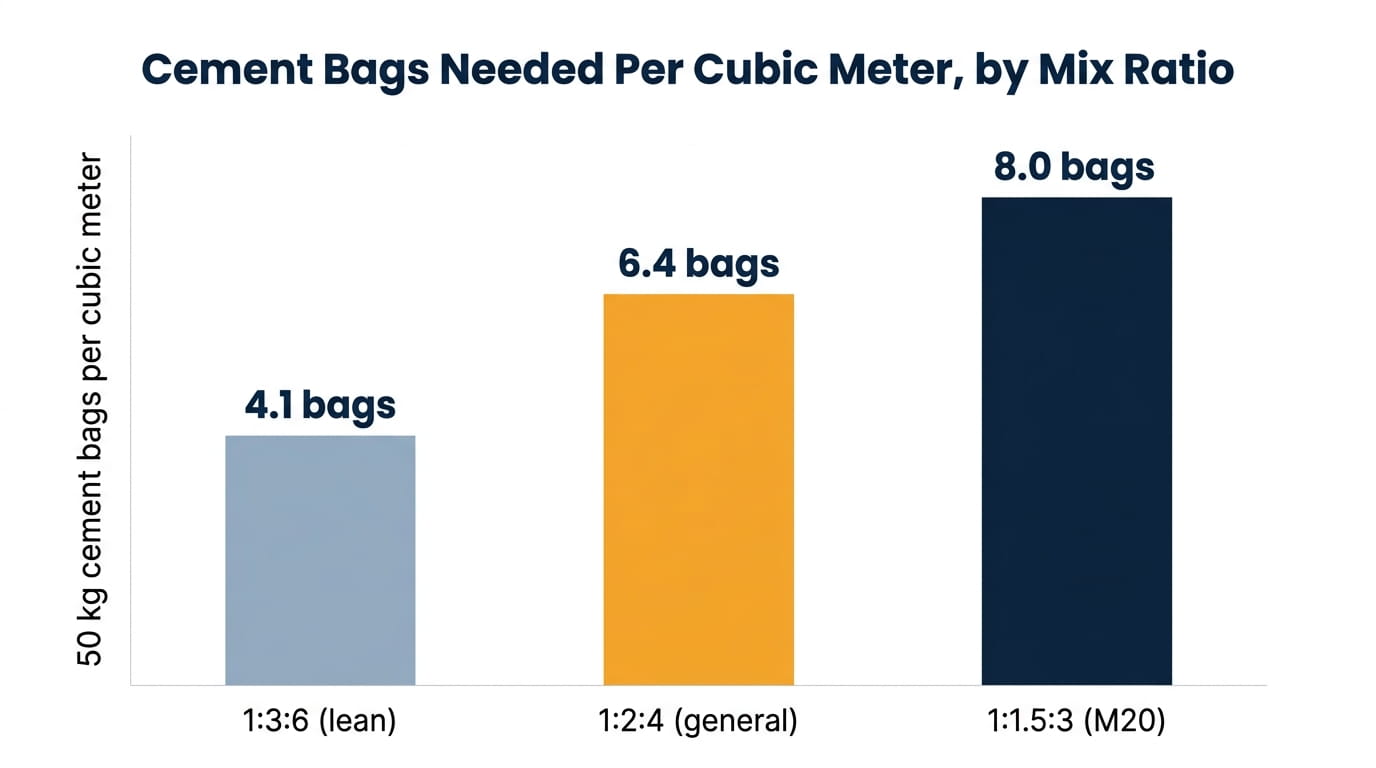
Cement demand nearly doubles between a lean mix and a structural mix.
Quick answer: A 1:2:4 mix needs about 6.3 to 6.5 bags of 50 kg cement per cubic meter. A leaner 1:3:6 mix needs about 4.1 bags. A richer 1:1.5:3 (M20) mix needs about 8 bags.
| Mix Ratio | Typical Use | 50 kg Bags per m³ | Approx. kg per m³ |
|---|---|---|---|
| 1:1.5:3 (M20) | Slabs, beams, columns | ~8 bags | ~400 kg |
| 1:2:4 (M15/general) | Footings, mass concrete | ~6.3-6.5 bags | ~315-325 kg |
| 1:3:6 (lean mix) | PCC, blinding layers | ~4.1 bags | ~205 kg |
These are quick nominal-mix estimates. Got a specified strength target instead, like 3,000-4,000 psi? Run your exact mix through the Concrete Mix Design Calculator — it covers ACI 211, IS 10262, EN 206, and CSA A23.1 and gives cement, sand, aggregate, and water quantities for your target strength directly.
Cement Bags Per Cubic Meter by Region: USA, Canada, Europe
Bag size isn’t universal. Order the wrong bag weight for your region and your count will be off by a lot, sometimes double.
| Region | Common Bag Size | Bags per m³ (1:2:4 mix) |
|---|---|---|
| USA | 94 lb (42.6 kg) is common | ~7.4-7.6 bags |
| Canada | 40 kg is common | ~7.9-8.1 bags |
| Europe (varies by country) | 25 kg is common (also 20 kg, 30 kg) | ~12.6-13 bags |
Bag sizes vary by supplier and country, so always check the weight printed on the bag before you convert — don’t assume the figures above match your specific supplier.
Cement Bags vs. Bagged Premixed Concrete
Here’s where a lot of guides get sloppy. A “cement bag,” pure cement you batch on site with your own sand and aggregate, is not the same product as a “bagged concrete mix,” a premixed blend of cement, sand, and aggregate you just add water to.
Premixed bags run 40-80 lb in the US or 20-30 kg elsewhere, and you’ll need far more of them per cubic meter, because you’re buying the whole mix, not just the binder. If you’re site-batching with separate materials, use the cement-only figures on this page, not a premixed-bag count pulled from a different product’s page.
How Much Does This Much Cement Cost?
Cement pricing varies a lot by region, supplier, and how much you’re buying at once, and it moves with the market, so any figure printed here would go stale fast and the sources available for a firm 2026 number weren’t reliable enough to stand behind. For a realistic budget, get a current quote from a local supplier or big-box retailer for the specific bag size and quantity you need — that will be far more accurate than any national average.
A Typical Wastage Allowance to Budget For
Spillage, mixer residue, uneven site conditions. The theoretical number is rarely what you actually use. Many contractors budget an extra 5-10% on top of the calculated bag count, though the right margin for your job depends on site conditions, crew experience, and how the concrete is being placed — treat 5-10% as a starting point to check against your own project, not a fixed rule.
A spare bag is a small, manageable cost. Running short mid-pour means a cold joint where the concrete stops and restarts, and that’s a real weak point you didn’t plan for.
Related Tools
- Estimating a plaster job instead of a pour? Try the Wall Plaster Quantity Calculator for cement and sand by coat thickness.
- Need excavation volumes before you order concrete? Use the Excavation & Earthwork Volume Calculator.
- Building a wall on top of the footing? The Brick & Block Masonry Calculator handles brick count and mortar.
FAQ
How many bags of cement do I need for 1 cubic meter of concrete?
About 6.3 to 6.5 bags of 50 kg cement for a standard 1:2:4 mix. A richer 1:1.5:3 (M20) mix needs closer to 8 bags. Confirm your mix ratio before ordering, since it’s the biggest variable.
How many 94 lb (US) cement bags are needed per cubic meter?
Around 7.4 to 7.6 bags of 94 lb cement per cubic meter for a 1:2:4 mix. A 94 lb bag works out to about 42.6 kg, a common bag size in the US, so it takes more bags than a 50 kg bag to hit the same total weight.
Why is the dry volume factor around 1.54?
Dry cement, sand, and aggregate have air gaps between the particles. Water and compaction close those gaps up, so a commonly used approximation multiplies the final wet volume by around 1.54 to estimate the dry material needed. It’s a widely used nominal-mix rule of thumb, not a fixed constant, so treat it as a planning figure rather than an exact value.
Should I add extra cement for wastage?
Many contractors add 5-10% on top of the calculated count to cover spillage and mixer residue, but the right margin depends on your site and crew — treat it as a typical planning allowance rather than a fixed rule, and adjust based on your own project’s conditions.
Does this calculation work for both metric and imperial projects?
Yes. The formula itself works in any unit system. This guide gives results in 50 kg bags, kilograms, and US pounds, so it holds whether you’re ordering in the US, Canada, or Europe.
What’s the difference between cement bags and bagged concrete mix?
A cement bag is pure binder, meant to be combined with your own sand and aggregate. A bagged concrete mix already contains all three, ready for water. They’re different products with different bag counts per cubic meter, so don’t mix up their figures.
The Bottom Line
The bag count isn’t a lookup, it’s a calculation, and the mix ratio drives it more than anything else on this page.
Confirm your mix ratio, run the formula above or the Concrete Mix Design Calculator, and add your wastage margin before you place the order. The rest of Solvebility’s civil engineering calculators cover excavation, masonry, and plaster from there.

Nouman Ahmed, a Civil Engineer with practical experience in solar energy system design, engineering calculations, electrical systems, and engineering software development. Since 2011, he has been involved in residential and commercial solar energy projects, helping design practical PV solutions and technical calculation tools.
Nouman is the founder of Solvebility, an engineering resource dedicated to publishing accurate, transparent, and easy-to-use online calculators covering renewable energy, electrical engineering, construction, mathematics, finance, health, and other technical disciplines.